Image source: wikiart.org
Introduction
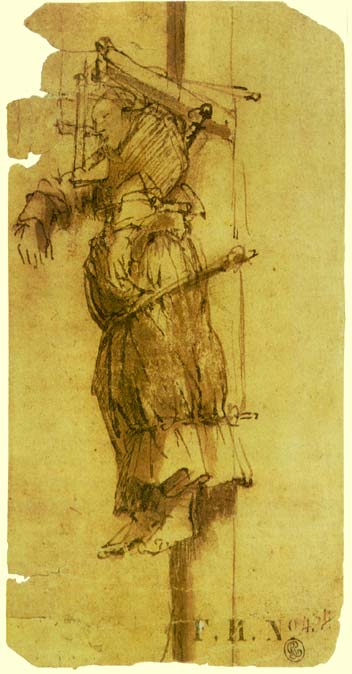
Rembrandt’s 1664 drawing of Elsje Christiaens—shown here in stark profile, bound to the execution post with the murder weapon fixed above—confronts the viewer with one of the most candid documents of civic punishment in seventeenth-century Amsterdam. Executed in brown ink with swift, searching strokes and small pockets of wash, the sheet condenses a sensational public event into a single, shattering image. Where many artists might have embellished the scene with legal officials or crowds, Rembrandt reduces it to the essentials: wood, rope, a young woman’s lifeless body, and the axe that explains why she hangs there. The result is not a lurid spectacle but an unsparing meditation on law, fate, and the fragile dignity of the condemned.
The Case And The City
Elsje Christiaens, a young woman from Denmark, reached Amsterdam seeking work and became entangled in a dispute over rent with her landlady near the Dam. The quarrel turned violent; in the heat of anger Elsje struck the landlady with an axe. The court condemned her to strangulation and posthumous display at the Volewijck gallows field north of the city, a peninsula specifically reserved for such civic admonitions. Executions were not only punishments but also performances of order, staged in open air to be seen and remembered. Rembrandt crossed the IJ by boat to witness the display. He made at least two studies of the body from different angles; the present sheet shows the side view against the relentless vertical of the post. The choice to record the scene links the artist to the city as citizen and observer, and it reveals a late-career commitment to truth that is both documentary and moral.
Format, Medium, And The Intelligence Of Economy
The narrow, vertical sheet all but compels the eye to move from the axe down through the bindings to the dangling feet. Brown ink furnishes the primary articulation of the forms; lean washes gather where gravity would deepen shadow—beneath the skirt’s tiers, along the post, under the chin and sleeve. The marks are few but decisive. Rembrandt’s line fattens where tension accumulates, such as at the rope knots and the cinched waist, and it thins where weight empties out, as in the drooping hand and the downward curve of the toe. This economy of means creates astonishing descriptive richness. Without fussy detail he evokes the roughness of the carpentry, the pressure of the yoke against the neck, and the soft collapse of cloth around an unresisting body.
Composition As Moral Architecture
The profile view transforms the scaffold into a diagram of justice. The post is a straight, implacable line; the body is all curves. Between them lies a chain of crossbars and clamps—devices that translate verdict into physical constraint. Rembrandt positions the head high relative to the sheet’s top edge, forcing the axe and the collar brace to enter the viewer’s space. Below, the skirt’s hem stops well above the paper’s lower edge, so a slim tail of post continues beyond the figure, emphasizing that Elsje is not supported by ground but by the very apparatus of punishment. The balance of empty paper around the figure is crucial. The blankness does not depict landscape or crowd; it functions as a moral silence enclosing the scene, a space in which the viewer’s response must take shape.
Anatomy Of A Body At Rest
The body’s storytelling is quiet but devastating. The head, wrapped in a kerchief, tips slightly forward over the yoke that fixes it to the post. The shoulders slump. One arm slides across the cinched waist; the other droops, palm open in a gesture of emptied agency. The knees bend softly, not from motion but from the weight of the body relieved of life’s internal resistance. The skirt, drawn in tiered volumes, flares at the hem and then narrows as if gravity had smoothed it. Nothing is made theatrical; the posture is the posture of ending. Rembrandt’s refusal of melodrama gives the drawing its force. We read the figure not as a symbol but as a person whose particular weight and proportions the artist dutifully recorded.
The Axe And The Sentence
Above the head, braced by a wedge and tied with rope, stands the axe, blade pointing outward. In the culture of early modern punishment, such emblems clarified the crime: the display made the logic of consequence legible to passersby. Rembrandt includes the axe without inflating it. The outline is crisp but not picturesque; it possesses none of the sheen that would turn it into a fetish. Instead, its significance derives from its relation to the bound figure below. The weapon explains but does not justify. The image’s center of gravity remains the person, whose life has ended and whose body answers to the inexorable vertical of the post.
Light, Paper, And The Ethics Of Clarity
On a monochrome drawing, light is a function of restraint. Rembrandt keeps large portions of the paper untouched, allowing the body to emerge from the ground by contrast rather than by contour alone. Wash accents under the breast, at the waist’s cinch, and along the skirt’s folds provide the sensation of dimensionality without drowning the figure in shadow. The illumination is even, almost clinical. There is no spotlight that would dramatize the scene; there is instead a quiet legibility that refuses both sensationalism and sentimentality. The viewer is given exactly enough to see, and thus to know.
The Scaffold As Drawing Lesson
Carpentry becomes composition. The long post, the collar brace, the transverse pins, and the angled supports articulate a geometry of diagonals and right angles that hold the figure like a theorem. Rembrandt captures the slight twist of the yoke and the way a lateral pin bites into the waist, details that convince the eye of physical truth while also functioning as linear counterpoints to the body’s curves. The interplay of straight and bent, hard and soft, is the grammar through which the drawing speaks. It is also an argument about the world: law is hard, the person is tender; apparatus is simple, life complex.
From Crowd Spectacle To Private Witness
Contemporary prints often framed executions with crowds, officials, banners, and inscriptions, converting punishment into panoramic theater. Rembrandt subtracts all of that. The crowd is implied in the very need for civic example, but viewers are denied the comfort of obscuring themselves within it. Instead, the sheet stages a one-to-one encounter: you, the onlooker, and she, the displayed. That conversion from public spectacle to private witness is the drawing’s ethical core. It forces a question: what does it mean to behold the cost of justice without either averting your eyes or taking pleasure in the sight? The drawing models an answer—look carefully, say only what is needed, grant the condemned the dignity of exactness.
Gender And The Refusal Of Voyeurism
The subject’s gender inevitably shaped seventeenth-century reactions; the transgressive woman was a stock figure of moral literature and street gossip. Rembrandt gives his viewer no license for prurience. Clothing is rendered as volume, not ornament; the faint glimpse of a bare foot under the hem is a consequence of posture, not an invitation. The kerchiefed head, the covered chest, and the modest construction of the skirt all counter the period’s tendency to eroticize female bodies in distress. The result is a drawing almost stubbornly chaste in the face of a society that enjoyed mixing cruelty and curiosity.
Relation To Rembrandt’s Other Elsje Studies
The side-view sheet differs tellingly from the frontal or three-quarter studies of the same subject. Turned to profile, Elsje becomes more object-like—a silhouette suspended along the beam of justice. Yet even here Rembrandt preserves individuality through the small kink of the wrist, the slightly protruding toe, and the distinctive layering of her dress. Comparing the sheets also reveals an artist testing how viewpoint changes meaning. The frontal view conveys exposure and pathos; the profile emphasizes mechanism and sentence. Together they form a diptych of the event: human presence and institutional structure.
Late Style And Moral Temperature
By 1664 Rembrandt had pared his art to a hard, lucid core. The late paintings and drawings withdraw from decorative flourish and press toward essence. In this drawing, essence means line that thinks and a composition that refuses rhetoric. The moral temperature is cool. It is not indifferent—Rembrandt’s empathy permeates the sheet—but it is controlled, suited to a subject that requires steadiness of hand and mind. The choice of brown ink, the sparing deployment of wash, and the calm cadence of strokes all reflect this discipline. Behind the economy lies a lifetime’s mastery: the ability to suggest air, weight, and silence with a handful of marks.
Looking At The Drawing Today
Standing before the sheet, the eye completes what the line implies. The viewer fills the blank paper with wind across the water at the Volewijck, with the murmur of a dispersed crowd, with the creak of timber. But the drawing also asks for a second kind of completion: a moral one. It asks the viewer to add to the scene neither outrage nor titillation but recognition. The young woman who committed a crime and paid for it with her life is made present here not for our judgment but for our memory. The paper has aged; the image’s claim has not.
The Image As Counter-Monument
Public displays of executed bodies intended to burn fear into civic memory. Rembrandt’s drawing, paradoxically, becomes a counter-monument. It preserves the condemned not as warning but as person. The thin inked lines outlast the wood and rope they describe, and by doing so they transmute a temporary spectacle into a durable remembrance. That transmutation is one of art’s quiet powers. Where the scaffold enforces forgetting through terror and repetition, the drawing enforces remembering through attention and singularity.
Conclusion
This 1664 profile drawing of Elsje Christiaens is a work of extreme restraint and profound consequence. With a narrow format, a disciplined palette of ink and wash, and a composition that binds the human figure to the stern geometry of the scaffold, Rembrandt turns a civic punishment into a meditation on justice, responsibility, and the ethics of seeing. The axe is there, the ropes are there, the post is there, but the drawing’s center is the person—her weight, her posture, her stopped breath. Few images in European art present a harsher subject with greater tenderness or achieve such narrative density with so little noise. Looking at it, one doesn’t feel lectured; one feels summoned to witness. That summons, sustained by a handful of strokes on a small sheet, is why this drawing remains among the most haunting and humane documents of Rembrandt’s late career.