Image source: wikiart.org
Introduction
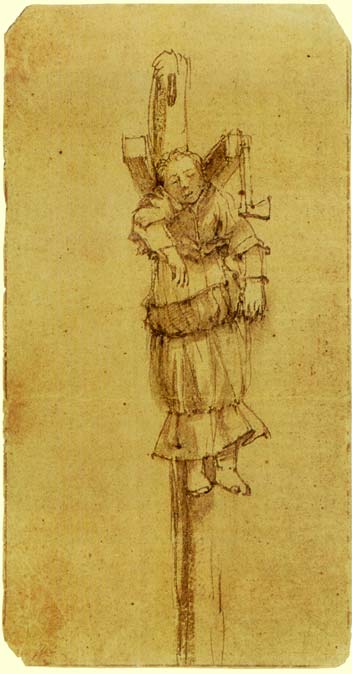
Rembrandt’s 1664 study of Elsje Christiaens is one of the most unsettling, humane, and incisive works of his late years. Unlike the grand biblical narratives and stately portraits that dominate his reputation, this sheet records a moment from the civic life of Amsterdam: a young Danish maidservant, executed for the murder of her landlady, hangs publicly with the fatal axe bound to the scaffold as warning and spectacle. Rembrandt approached the scene not as a court chronicler or a moralizing preacher but as a witness with a pen. The drawing compresses a city’s legal ritual, a life’s abrupt end, and an artist’s ethical attention into a deceptively simple vertical composition. In a few strokes of brown ink, reinforced by wash and heightened with traces of body color on some versions, he transforms a punitive display into a meditation on vulnerability, justice, and the duty of looking.
The Historical Incident and Why Rembrandt Looked
Elsje Christiaens arrived in Amsterdam from Jutland in search of work, lodged with a landlady near the Dam, and soon fell into a quarrel over unpaid rent. The conflict escalated; Christiaens seized an axe and struck her landlady, who died. In May 1664 a court condemned the young woman to be strangled and her body displayed at the Volewijck gallows field, with the axe affixed above as emblem of the crime. Public executions were civic rituals in the seventeenth-century Dutch Republic, mnemonic spectacles meant to deter through terror and to reassure the citizenry that law prevailed. Rembrandt, then living on the Rozengracht and already a veteran of personal and financial storms, crossed the IJ to the site and drew the body at least twice. The decision to go was not voyeuristic curiosity alone. He was a painter intensely concerned with the human face and body in states of extremity: aging, grief, revelation. The sheet of Elsje continues that concern and adds the weight of documentary immediacy.
Medium, Scale, and the Intelligence of the Line
The drawing’s power arises from its spareness. Executed in brown ink and wash, it reads as quick notation; yet the economy is calculated. Rembrandt lets the vertical of the post set the entire rhythm. The tied arms, sagging torso, and tilted head descend in soft arcs that answer the post’s rigidity. He thickens the line where weight gathers, especially around the bundled waist and the crook of the elbow, and allows it to taper where gravity thins the form—the dangling foot, the relaxed hand. Wash passages pool under sleeves and skirt to suggest cast shadow and the swell of cloth. The line is descriptive without being pedantic. It catches the knotted rope, the wedge of the supporting spar, the trapezoid shadow cast by the axe handle, and the awkward geometry of the platform hardware with brisk assurance. As in his best etchings, Rembrandt trusts broken, searching strokes to do the work of modeling and atmosphere simultaneously.
Composition as Moral Syntax
The sheet is a master class in how placement can think. Rembrandt pushes the figure high on the page so that the post and body occupy a single, uninterrupted descent from top to near bottom, with only a slim tail of post extending below the dress’s hem. This decision makes the body feel suspended in the viewer’s space, not comfortably grounded. The balance of blank paper to drawn form matters profoundly. The empty margins do not simply indicate sky or air; they register the terrifying availability of space around the executed. She is exposed to all gazes, with no enclosing architecture to shelter dignity. At the same time, the slight rightward lean of the head and the gentle S-curve of the torso soften the cruelty of the device. The composition thereby holds a contradiction: implacable vertical power versus human pliancy. It is that contradiction—the state’s rigid judgment against a body’s exhausted surrender—that the sheet keeps before our eyes.
The Body as Narrative
Rembrandt declines to dramatize with theatrical contortions. Elsje’s head droops to one side, the mouth slightly parted, the eyelids lowered; the neck is braced against a board that fastens to the post like a crude yoke. One arm is slung forward across the belly, the other hangs with opened fingers. The skirt’s tiered hem widens at the bottom, like a bell that has just stopped ringing. Every element suggests cessation rather than struggle. The artist does not show the moment of strangulation but the stillness that follows, when time elongates and the display begins. Through this calm, descriptive posture he asks the viewer to consider the whole story compressed into a single image—the quarrel, the blow, the sentence, the civic pageant, the lonely end. He does so without inscribing words, without allegorical emblems beyond the axe itself.
The Axe as Emblem and Problem
The axe above the head is both minimal prop and moral hinge. Tied upright at the top of the post, with a small wedge stiffening the handle, it asserts the legal logic of early modern punishment: the crime made visible so that the consequence appears proportionate, almost mathematical. Yet nothing in Rembrandt’s line allows that equation to feel complete. The spare mark that defines the axe iron, barely heavier than the marks defining the eyelids, refuses to grant the instrument dominance over the person. The weapon’s outline looks precariously balanced, an object given its meaning only by the body beneath it. In the tension between emblem and individual, the drawing quietly shifts sympathy.
The Ethics of Looking
Drawings from life at an execution site raise ethical questions that Rembrandt seems to anticipate. He neither sensationalizes nor averts his eyes. The sheet’s smallness and speed imply standing nearby, drawing with discreet focus rather than sweeping gestures that would turn the scene into performance. He records details necessary to truth—a strap here, the brace there, the knots at the waist—but never lingers on gore or invites grim fascination. The pathos is in the overall droop of posture and the tenderly indicated face. Rembrandt’s concern is not to condemn or exculpate; it is to witness fully. In a city where the crowd came to look, the artist models another way of looking: precise, quiet, responsible.
Relation to Rembrandt’s Late Practice
The Elsje sheets belong to a cluster of late works in which Rembrandt engages the threshold between documentary record and spiritual meditation. Like the drawings of beggars, the studies of his own aging features, and the deeply felt biblical scenes from the 1650s and 1660s, they replace theatrical flourish with presence. Technical decisions echo those elsewhere: the abbreviated contour that leaves a viewer to complete the form, the rich intelligence of wash flicked across the page to conjure mass out of emptiness, the willingness to tolerate awkwardness when truth demands it. Even the choice of a long, narrow sheet aligns with his love of formats that force composition to invent new solutions. Nothing feels habitual or mannered; the sheet breathes with the urgency of a specific encounter.
Amsterdam’s Punishment Theater and Its Visual Culture
The Volewijck gallows field was part of the city’s visual culture, a liminal zone where law performed itself for the public. Painters and printmakers had long depicted executions and punishments, often as moralizing series or sensational broadsheets. Rembrandt’s drawing stands apart from those traditions. It does not arrange multiple criminals in a panoramic scaffold scene or decorate the margins with texts. It boils the event down to one figure on one post in uninterrupted space. By refusing the bustle of spectators and officials, he relocates meaning from the spectacle’s social mechanics to the interior dignity of the punished. This shift is crucial. It marks the sheet not as journalism or propaganda but as a profoundly human document.
Light Without Illumination
On a monochrome sheet, light emerges as the proportion between ink and paper. Rembrandt allows large areas of untouched paper to act as ambient light, while dark accents under the arms, beneath the bust, and along the skirt declare weight and recession. The soft wash around the head works like a halo inverted, not sanctifying but isolating. This is not Caravaggesque spotlighting; it is a measured clarity that enables every part to be read at a glance. Such lucidity denies the viewer the protection of obscurity. Nothing is hidden, and yet nothing is screamed. Light becomes ethical clarity—just enough to see what one must see.
The Gendered Body and Seventeenth-Century Sensibilities
That the condemned is a young woman matters. Early modern audiences often regarded female criminality through a mixture of fascination and alarm, reading it as a breach not only of law but of gendered order. Rembrandt neither eroticizes nor shames. The dress is described matter-of-factly, tiers and waistband indicated without relish; the bare foot peeking from the hem is not invitation but aftermath. In the relaxed hand and slack mouth he offers a tenderness that insists on her personhood, even as the apparatus reduces her to example. The sheet thereby gently resists the era’s appetite for lurid female transgression.
Comparisons with Other Versions and with the Etched Corpus
Rembrandt appears to have made more than one study of Elsje’s body. Some sheets introduce additional wash or shift the angle slightly, testing how posture and light alter the tenor of the image. The variations reveal an artist not content with a single note but searching for the right visual sentence to hold the event. Compared with his etched scenes of the crucifixion or depictions of the raising of Lazarus, the Elsje sheets reverse the spiritual vector: rather than a movement from death toward life, they present life arrested and displayed. Yet the same belief in the expressive capacity of the human figure persists. In both etched and drawn media, he trusts that a turn of the head or sag of the shoulder can bear more truth than any ornamental flourish.
The Vertical Line as Theology
The implacable post running through the composition suggests more than scaffold architecture. As a form it proposes fate, the stern axis along which human acts meet consequence. Around this line the body is gathered and tied, unable to escape alignment with judgment. Yet the delicate s-curves of the figure negotiate with that axis, as if to say that even within judgment, the human remains supple, complex, and particular. The drawing’s theology resides there: the world’s law is straight; the person’s life is curved. Rembrandt lets both stand, neither canceling the other.
Memory, Empathy, and Civic Conscience
Why does this small sheet linger in the mind when grander canvases fade? Partly because it feels like a town’s conscience caught on paper. A citizen-artist went where the city displayed its justice and recorded the cost without comment. The image does not exonerate Elsje Christiaens, whose act was real and lethal. But it refuses to let her vanish into the category of example. The sympathetic specificity of her face, the slight turn of her foot, the unheroic droop of her arm—these make forgetting difficult. In that sense the drawing functions as a counter-ritual to the official spectacle. The gallows says remember the law; Rembrandt’s pen says remember the person.
Seeing the Drawing Today
Encountered in a museum or reproduction, the sheet still asks for the viewer’s ethical attention. It is easy to glide past drawings, especially ones with minimal detail, but the Elsje image rewards slow looking. Notice how the line lightens where fabric thins, and darkens where gravity pulls. Follow the contour from the turban-like headgear and the collar brace down to the layered skirt hem; feel the rhythm slow and then pause at the tiny wedge of shoe extending past the garment. Observe how little is needed to suggest the platform’s carpentry—a slanted brace, a notch of shadow—and how that little persuades the eye to believe the entire structure. Then return to the face, which is neither idealized nor grotesque. The drawing’s moral power begins where line and feeling meet.
Legacy and Modern Resonance
For later artists and viewers, the Elsje drawings have become emblematic of Rembrandt’s late humanism. They demonstrate a way to engage violence in art without exploiting it, to document without congealing into propaganda, to register civic reality without surrendering to its harshest terms. In an age saturated with images of punishment and spectacle, the sheet offers an alternative practice of witness: minimal, exact, compassionate. It reminds us that the distance between a city’s order and an individual’s life can be only a few inches of rope, and that art can narrow or widen that distance by how it chooses to look.
Conclusion
Rembrandt’s 1664 “Elsje Christiaens” is a small drawing with the gravity of a monument. It strips narrative to a single suspended body and, in that reduction, opens a vast field of meaning: the workings of law, the fragility of the person, the responsibilities of spectatorship, the intelligence of line. The sheet’s vertical thrust and delicate curves hold judgment and empathy in equilibrium. Its light, made from the untouched page, offers clarity without glare. Its few marks suggest a lifetime of looking condensed into minutes of drawing. To study it is to feel the tremor of a real event transmitted across centuries by a hand that refused to turn away. In this refusal lies the drawing’s enduring power and its quiet instruction for anyone who would use images to think about justice and the human condition.