Image source: wikiart.org
Introduction
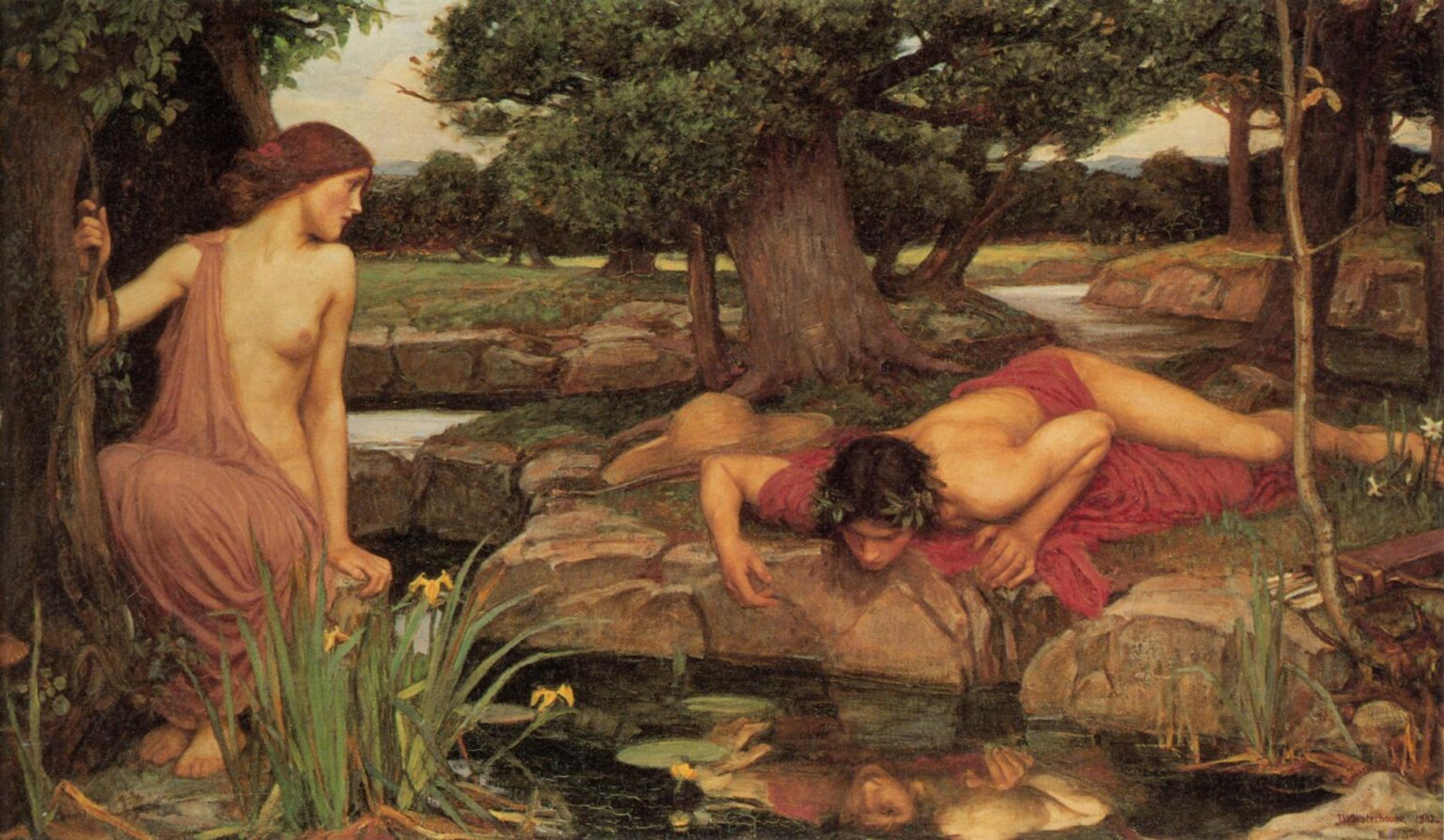
John William Waterhouse’s Echo and Narcissus from 1903 returns to a myth that is as much about seeing as it is about desire. The story is familiar: Narcissus becomes captivated by his own reflection, while Echo, reduced to repeating the words of others, watches helplessly from the margins. Waterhouse chooses not to stage the myth as spectacle but as a quiet, suspended moment in nature, where the smallest gestures carry the weight of fate. The painting feels almost hushed, as if the air around the pool has thickened, holding back sound and time alike. That hush is not only narrative, it is emotional. The scene is built to make you look longer than you expected, and to realize that looking, for Narcissus and for the viewer, is both the pleasure and the trap.
Waterhouse’s late works often show a deep confidence in combining literary subject matter with sensuous, carefully arranged landscapes. Here, he strips the myth down to its essential psychological triangle: the self, the other, and the image. The pool is not simply water, it is a mirror that divides the world into what is real and what is desired. Echo is not simply a figure, she is a presence that cannot reach, and the painting makes that distance feel physical.
The Myth Reimagined as a Still Moment
In many retellings, Narcissus is punished for cruelty, while Echo is punished for talkativeness. Yet Waterhouse’s version is less moralizing than it is compassionate. Narcissus is not shown as triumphant or vain in the usual theatrical sense. Instead, he appears vulnerable, folded over the water, absorbed by something he cannot grasp. Echo, similarly, is not depicted as a ghostly aftereffect but as a living person who still has the capacity to hope. That hope is what makes her position so painful.
The drama unfolds without overt action. No gods appear. No loud gestures announce the myth’s conclusion. Waterhouse paints the scene at the threshold, when Echo is near enough to see Narcissus clearly, but not near enough to matter to him. This choice makes the painting feel modern in its psychology. The tragedy is not an explosion, it is a slow closing of possibilities. Narcissus is already lost, not because anyone forces him, but because attention itself has become a prison.
Composition and the Geometry of Distance
The composition is organized as a quiet diagonal tension. Echo occupies the left side, upright and alert, her body turned toward Narcissus and her gaze fixed on him. Narcissus lies to the right, stretched along the bank, angled toward the pool. Between them runs the central obstacle: the water, edged by stones, a narrow channel that functions like a boundary line. The pool is small but decisive. It is the painting’s hinge, the point where every gaze converges.
Echo’s posture creates a sense of contained movement. She is braced, one hand against a tree trunk, as if she has paused mid step. Narcissus, by contrast, is collapsed into the act of looking. His bent neck and lowered face make him seem pulled downward, as if the reflection has weight. Waterhouse designs the scene so that Echo looks across to Narcissus, while Narcissus looks down and away. The viewer is placed in a position to see both perspectives at once, which intensifies the emotional imbalance. One figure is focused on another person. The other is focused on an image.
The landscape reinforces this structure. Trees frame the scene and create a sheltered, almost secret enclosure, like a natural stage. The bank and stones guide the eye toward the reflective surface. Even the curved forms of the rocks feel arranged to cradle the pool, turning it into a focal point that appears inevitable.
Color, Light, and the Mood of Late Summer
Waterhouse’s palette here is warm but restrained. Greens and browns dominate the setting, with a softness that suggests late summer or early autumn, when foliage is still lush but the light has mellowed. The warmth is not celebratory. It feels like the warmth of a memory, a glow that makes the present moment feel already past. This is important, because the myth itself is about the instant when experience turns into obsession and life begins to withdraw.
The strongest color accents are the draperies. Echo’s muted, earthy rose cloth echoes the tones of bark and soil, as though she belongs to the living landscape. Narcissus’s deeper red drapery is richer and more saturated. It brings physicality and sensuality to his figure, but it also reads as a warning note, a signal of appetite and peril. The red pulls attention toward him, just as his reflection pulls his attention away from the world.
Light is diffused rather than dramatic. There is no sharp spotlight, no harsh contrast. The soft light encourages lingering observation, which is fitting for a painting about looking. The reflective water, however, becomes a subtle source of luminosity. It holds pale highlights and mirrored tones, a kind of liquid brightness that is both beautiful and unsettling because it is not solid. Waterhouse makes the pool visually appealing and conceptually dangerous.
The Pool as Mirror and Threshold
The pool is the painting’s psychological engine. Waterhouse paints it with enough clarity to register reflection, but not so much clarity that it becomes a crisp portrait. The reflection is present, yet it trembles with the natural instability of water. This matters because Narcissus’s desire depends on misunderstanding. He is not simply admiring himself. He is falling in love with a surface that cannot reciprocate, an image that gives the illusion of presence without offering touch or speech.
The stones around the pool feel like a boundary marking a sacred or cursed site. Their solidity contrasts with the fluid reflection, setting up a tension between what can be held and what cannot. Narcissus’s body bridges this contrast. He is flesh pressed against rock, leaning toward water. The more he leans, the less he belongs to the world behind him.
The pool also separates Echo from Narcissus in a way that feels almost cruelly minimal. The distance is short enough to make her longing immediate, yet the barrier is absolute because the true obstacle is not water, it is Narcissus’s attention. Waterhouse turns a mythic punishment into a human experience: the pain of being near someone whose focus is elsewhere.
Echo as Presence, Not Just a Victim
Echo’s depiction is crucial to Waterhouse’s interpretation. She is not hidden in the foliage like a spying nymph. She is clearly visible, a full participant in the scene, and her visibility intensifies the tragedy. There is nothing vague about her desire. Her face is turned, her body angled, her attention unwavering. Yet she remains silent in the painting’s world, not because the viewer cannot imagine her speaking, but because the myth has already taken her voice.
Waterhouse suggests her emotional state through restraint. Her pose is tense but not melodramatic. She does not collapse or reach out desperately. Instead, she holds herself, as though hoping that patience might change the outcome. That hope makes her feel dignified, and the dignity makes her suffering sharper. She is not reduced to an emblem. She is a person in a moment of realization.
The tree she touches becomes a silent ally. It supports her physically, but it also symbolizes rootedness, a living presence that stands in contrast to Narcissus’s relationship with a nonliving image. Echo is aligned with the world that grows, breathes, and changes. Narcissus is aligned with the world that repeats, mirrors, and traps.
Narcissus and the Body Pulled into Obsession
Narcissus’s figure is painted with a mixture of softness and tension. His limbs are relaxed enough to suggest surrender, yet his posture is also strained, because looking downward for too long is physically uncomfortable. This creates a subtle sense of compulsion. He is not simply choosing to gaze. He is compelled, drawn toward the reflection as if it holds a promise stronger than any human connection.
The laurel wreath on his head complicates the narrative. It can suggest beauty, victory, and classical association, but here it reads like irony. Narcissus is crowned, yet the crown does not bring honor. It frames him as a figure of aesthetic fascination, someone whose appearance becomes a kind of fate. The wreath also connects him to themes of art and imitation. A wreath is a crafted circle, a decorative echo of natural growth, which parallels the reflection as a decorative echo of reality.
Waterhouse avoids turning Narcissus into a villain. He is not glaring with arrogance. His absorption is almost childlike, a fragile amazement at the image in the water. That tenderness makes the myth’s cruelty more poignant, because it suggests that obsession can feel like wonder at first, and wonder can become a dead end.
Nature as Emotional Atmosphere
The landscape in Echo and Narcissus is not background. It is emotional atmosphere. Waterhouse’s trees form a protective canopy that makes the scene feel secluded, like a private world where ordinary social rules do not apply. This seclusion helps explain why Narcissus’s fixation can intensify unchecked. There is no crowd, no interruption, no voice calling him back to community.
The natural details also carry symbolic weight. The stillness of the water implies a pause in time. The stones imply permanence. The grass and foliage imply life continuing. Waterhouse uses these elements to set up a contrast between life’s movement and Narcissus’s stasis. Echo, positioned upright and watchful, is closer to movement. Narcissus, collapsed into reflection, is closer to stillness.
Even the small plants at the water’s edge matter. They locate the scene in a liminal zone where land becomes water, where boundaries soften. That liminality mirrors the psychological boundary Narcissus crosses, when the image stops being simply an image and becomes the object of devotion.
Waterhouse’s Style and the Late Pre-Raphaelite Inheritance
Although Waterhouse is often associated with the Pre-Raphaelite tradition, his relationship to it is both reverent and independent. In this painting, you can feel the Pre-Raphaelite love of myth and the careful attention to natural forms, but you can also feel a later softness. The paint handling is not hyper crisp everywhere. Instead, Waterhouse uses a gentle blending that suits the mood of dreamlike melancholy.
The figures remain central, yet they are integrated into the environment. Echo’s drapery takes on the tones of earth. Narcissus’s body rests along the stones as though he is becoming part of them. This integration supports the myth’s transformation, the way human emotion spills into nature and nature seems to respond.
Waterhouse’s approach also shows the influence of academic tradition, particularly in the idealized bodies and classical subject matter. But he steers academic idealization toward narrative psychology. Beauty is not displayed for its own sake. Beauty becomes the cause of the tragedy, the hook that draws Narcissus inward and keeps Echo waiting.
Themes: Desire, Selfhood, and Unanswered Speech
At its core, Echo and Narcissus is about the structure of desire. Echo desires Narcissus. Narcissus desires an image that is both himself and not himself. The tragedy is not simply that love is unreturned. It is that the forms of attention are incompatible. Echo’s love is directed outward. Narcissus’s love collapses inward.
The myth also raises questions about voice and identity. Echo is defined by repetition, by the inability to originate speech. Narcissus is defined by self encounter, by the inability to recognize another as equally real. Waterhouse visualizes this by giving Echo an active gaze and giving Narcissus a closed loop of attention. The painting becomes a meditation on communication failure. One figure cannot speak fully. The other figure does not listen at all.
There is also a subtle commentary on art itself. Painting is a kind of reflection, a crafted image that imitates life while remaining unreachable. Narcissus’s fatal fascination with an image can be read as a warning about mistaking representation for reality. Yet Waterhouse, as an artist, is also inviting the viewer to experience a controlled version of that fascination. We are meant to look, to admire, to linger. The painting becomes a safe mirror that lets us feel the myth’s allure without falling into it.
Emotional Impact and Lasting Appeal
The enduring power of this work lies in its emotional clarity. Even without knowing the myth, a viewer can read the relationships. One person watches with longing. Another is absorbed elsewhere. The landscape holds them in a quiet trap. That scenario remains timeless because it speaks to experiences beyond mythology: unreciprocated love, obsession, the way attention can become an act of abandonment.
Waterhouse also succeeds by refusing to rush the story. He does not show Narcissus transformed into a flower or Echo fading into air. He shows the moment when those outcomes become inevitable. That inevitability is what makes the scene haunting. It feels like a memory of a decision that was never consciously made.
The painting’s beauty contributes to its melancholy rather than softening it. The warm colors, the serene setting, the graceful bodies all create a sense of harmony, yet the narrative is disharmony. Waterhouse uses that contradiction to deepen the tragedy. The world is lovely, and that loveliness makes the loss more painful.
Conclusion
Echo and Narcissus is a painting about the cruelty of misdirected attention. Waterhouse turns myth into psychology, placing two figures in the same quiet world yet separating them through the invisible wall of obsession. Echo stands for the longing that seeks connection and cannot reach it. Narcissus stands for the self that becomes its own horizon. Between them lies the pool, a mirror that offers beauty without reciprocity.
In Waterhouse’s hands, the myth becomes less a punishment delivered from above and more a sorrow that grows from within. The painting invites the viewer to look closely, to feel the pull of the reflection, and to recognize the cost of loving what cannot answer. It is a scene of silence, but it speaks loudly about what happens when the heart’s focus narrows until the world disappears.