Image source: wikiart.org
Introduction to “Ecce Homo”
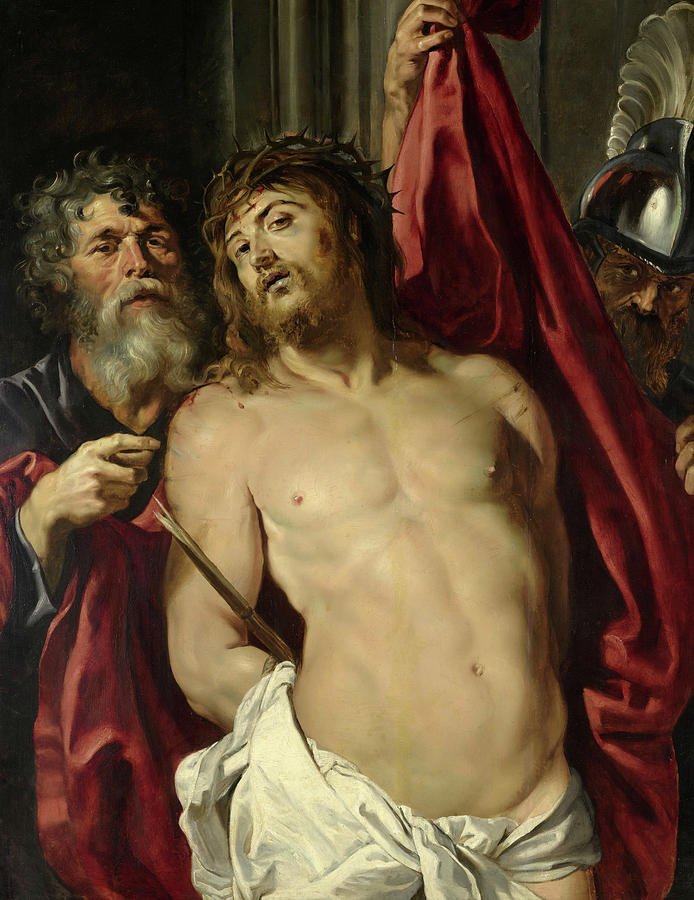
Peter Paul Rubens’s “Ecce Homo” is an intensely focused meditation on the suffering and dignity of Christ at one of the most charged moments in the Passion story. The title comes from the words of Pontius Pilate in the Gospel of John, “Ecce homo” – “Behold the man” – spoken as he presents the scourged and humiliated Jesus to the crowd. Rubens concentrates the entire drama of that scene into a tight, vertical composition: Christ, half-naked and bound, crowned with thorns, stands in the center, surrounded by figures who display him to the viewer.
This painting is not a distant narrative. It is a confrontation. Christ’s body leans slightly forward, his head tilted, eyes half open and directed outward. The viewer is in the position of the crowd, and the challenge of the image is to decide how to respond to the man who is shown.
Biblical Theme and the Meaning of “Ecce Homo”
The “Ecce Homo” moment occurs after Jesus has been arrested, interrogated, and brutally scourged. The soldiers mock him by dressing him in a purple or red cloak, placing a crown of thorns on his head, and hailing him as “King of the Jews.” Pilate then brings him out before the people, hoping that his battered appearance will evoke pity and that the crowd will be satisfied with this punishment. Instead, they demand crucifixion.
By choosing this subject, Rubens explores the paradox at the heart of Christian belief: the divine Son of God shown as a mocked, wounded, seemingly powerless man. “Behold the man” becomes an invitation to contemplate both his humanity and his hidden majesty. In Rubens’s hands, the scene becomes less about the historical Pilate and mob and more about each viewer’s encounter with Christ’s suffering.
Composition and Spatial Drama
The composition is remarkably concentrated. The figures are packed tightly into the frame, pressing forward toward the viewer. There is almost no visible background, only a hint of architectural columns. This lack of spatial depth forces all attention onto the bodies and faces.
Christ occupies the central vertical axis of the painting. His torso is exposed, illuminated, and slightly twisted, with one shoulder pushed back and the other forward. This torsion creates a sense of movement and vulnerability at once. To his left stands an older man, often interpreted as Pilate or a high official, clutching the red robe and gesturing toward Christ as he presents him. On the right, partially obscured, is a soldier with a shining helmet, gripping the cloak from behind.
The red garment frames Christ’s body like a curtain being opened. The hands that pull it aside reinforce the theatrical nature of the moment, as if the world’s stage is revealing its central actor. Christ’s bound hands are held behind his back, further emphasizing his helplessness and the fact that he is being displayed rather than acting.
The Figure of Christ: Vulnerability and Majesty
Rubens balances physical weakness and spiritual strength in his portrayal of Christ. The body is muscular but slack, bearing the marks of whipping and torture. A crown of thorns encircles his head; drops of blood appear on his brow and in his hair. His lips are slightly parted, his beard disheveled, his eyes heavy with pain and exhaustion.
Yet the overall impression is not of degradation alone. The curves of the torso, the subtle modelling of light on the flesh, and the serene, almost resigned expression convey a quiet majesty. Christ’s head tilts to one side in a gesture that hints at both suffering and compassion, as if he is already forgiving those who have harmed him.
The bound arms are crucial to the emotional impact. They deny him any chance to defend himself and present his body as an offering. The tension in the shoulders as the rope pulls his hands back suggests both physical strain and moral determination. Rubens’s Christ is not broken; he is choosing to endure.
The Surrounding Figures: Mockery and Ambiguity
The older man on the left, with grey hair and beard, grips the cloak and appears to speak. His face is animated, his mouth slightly open, eyes turned toward Christ or perhaps toward an unseen crowd. He may be Pilate, pronouncing the words “Ecce homo,” or one of the officials participating in the mockery. His expression is complex: there is a hint of irony, perhaps even a conflicted awareness of the injustice being carried out, but no true empathy.
Behind Christ on the right, the soldier in the polished helmet is largely hidden. The metallic sheen of the helmet catches the light sharply, contrasting with the softness of Christ’s skin. The soldier’s downturned gaze and firm grip on the cloak emphasize his role as enforcer. He is the impersonal face of power, anonymous and unreflective, defined more by armor than by individuality.
These figures create a frame of worldly authority around Christ. They handle him like an object, yet they also unintentionally reveal his importance. By turning their gestures and gazes toward him, they make him the focal point not only compositionally but symbolically.
Color, Light, and Baroque Chiaroscuro
Rubens’s use of color in “Ecce Homo” is both restrained and intense. The dominant hues are the warm flesh tones of Christ’s body, the deep red of the cloak, and the dark, almost black background. The red garment is especially significant. It symbolizes royalty, mockingly bestowed by the soldiers, but in Christian iconography it also evokes martyrdom and sacrificial love. Draped behind Christ like a mantle, it suggests both the robe of a king and the blood that will soon be shed.
Light plays across the painting in a focused beam, illuminating Christ’s torso and face while leaving much of the surrounding space in shadow. This dramatic chiaroscuro heightens the emotional intensity and gives the figures a sculptural presence. The highlights on the chest, shoulders, and abdomen make the flesh appear almost tangible, while the deep shadows around the ribs and under the arms add depth and somber gravity.
The older man’s face and hands are also strongly lit, revealing wrinkles, rough skin, and expressive features. In contrast, the soldier’s face is half hidden, with the brightest light falling on the reflective helmet. This difference underscores the moral and narrative roles of each character: one is engaged in speech and presentation, the other in silent force.
Emotional Impact and Psychological Depth
The emotional power of the painting arises from its psychological complexity. Christ’s expression is not a simple grimace of pain. There is weariness, but also a kind of inward focus, as if he is more aware of the spiritual significance of what is happening than of the immediate humiliation. The slight opening of the mouth and the tilt of the head give him a vulnerable, almost questioning look that invites the viewer’s empathy.
The older man’s proximity to Christ creates a tension between intimacy and exploitation. He stands close enough to touch, yet his gesture is one of exhibition, not comfort. Rubens captures a moment in which Christ is physically supported by his tormentors; they hold the cloak, manage his position, and thus keep him from collapsing, even as they continue the mockery. This coexistence of cruelty and inadvertent care encapsulates the paradox of the Passion story, where the very acts of rejection and violence become the means of redemption.
The painting therefore operates on several levels at once. It depicts historical cruelty, invites personal compassion, and hints at a larger theological drama in which Christ’s suffering is purposeful and salvific.
Symbolism and Theological Meaning
Several symbolic elements deepen the meaning of “Ecce Homo.” The crown of thorns, of course, signals both physical torment and the inversion of earthly kingship. Christ is mocked as “King of the Jews,” yet for Christians this moment reveals his true royal identity, concealed under suffering.
The red cloak has a double function. Within the narrative it is a prop for ridicule, but in religious art red often signifies divine love and the blood of martyrdom. Draped around Christ, it becomes a visual link between this moment and the impending crucifixion. It also echoes the liturgical vestments of priests, suggesting Christ as both victim and high priest offering himself.
The column behind Christ may allude to the pillar of the flagellation, rooting this scene in the sequence of Passion events. Its vertical lines contrast with the soft curves of Christ’s body, reinforcing his humanity against the cold rigidity of institutional power.
Christ’s partial nudity recalls the vulnerability of Adam and the shame of fallen humanity. In Christian theology, Christ is often described as the “new Adam” who bears human shame in order to restore dignity. Rubens emphasizes this connection by rendering the body with classical beauty yet exposing it to humiliation.
Rubens’s Style and Artistic Context
“Ecce Homo” showcases Rubens’s mature Baroque style, characterized by robust figures, rich color, and dynamic compositions that thrust the viewer into the scene. His training in Italy and his study of artists such as Titian and Caravaggio are evident in the sensuous modelling of flesh and the dramatic interplay of light and shadow.
At the same time, the painting reflects the Counter-Reformation emphasis on emotionally engaging religious imagery. The Catholic Church in Rubens’s time encouraged art that would move the faithful to deeper devotion by making sacred events feel immediate and real. Rubens responds by eliminating distracting details and focusing on a few large figures pressed close to the picture plane.
The sensual realism of Christ’s body may surprise some modern viewers, but for Rubens and his contemporaries, physical beauty was a way to honor the Incarnation, the belief that God truly took on human flesh. The painting insists that Christ’s suffering is not abstract; it is endured in a body as real and vulnerable as any human body.
Devotional Function and Viewer Engagement
In its original context, “Ecce Homo” would likely have served as an object of devotion and meditation, perhaps in a chapel or private collection. Viewers were invited to linger on the details of Christ’s suffering and to respond with repentance, gratitude, and love.
Rubens’s framing of Christ directly facing the viewer enhances this devotional function. The older man’s gesture saying “Behold the man” is essentially directed at us. The painting collapses the distance between the historical crowd and the present spectator, asking: what is your verdict? Will you respond with rejection, indifference, or compassion?
This engagement remains powerful today. Regardless of religious belief, viewers confront a striking portrayal of human vulnerability under public humiliation. The questions the painting raises about power, cruelty, and empathy are still contemporary. Rubens’s artistry ensures that the scene is not merely observed but felt.
Modern Resonance and Lasting Legacy
“Ecce Homo” continues to captivate because it compresses immense narrative and spiritual weight into a single, concentrated image. The combination of physical realism, emotional nuance, and symbolic richness allows it to speak across cultures and centuries.
For art historians, the painting is an exemplary study in Baroque technique. The subtle transitions of light, the control of color, and the handling of anatomy reveal Rubens at the height of his powers. For theologians and believers, it remains a profound visual commentary on the Passion. For general viewers, it is a haunting portrayal of an innocent figure subjected to institutional violence and public scorn, yet retaining an inner dignity that cannot be extinguished.
In inviting us to behold “the man,” Rubens also invites us to reflect on our own humanity: how we treat the vulnerable, how we use power, and how suffering can sometimes reveal, rather than destroy, the deepest truths about a person.