Image source: wikiart.org
Introduction
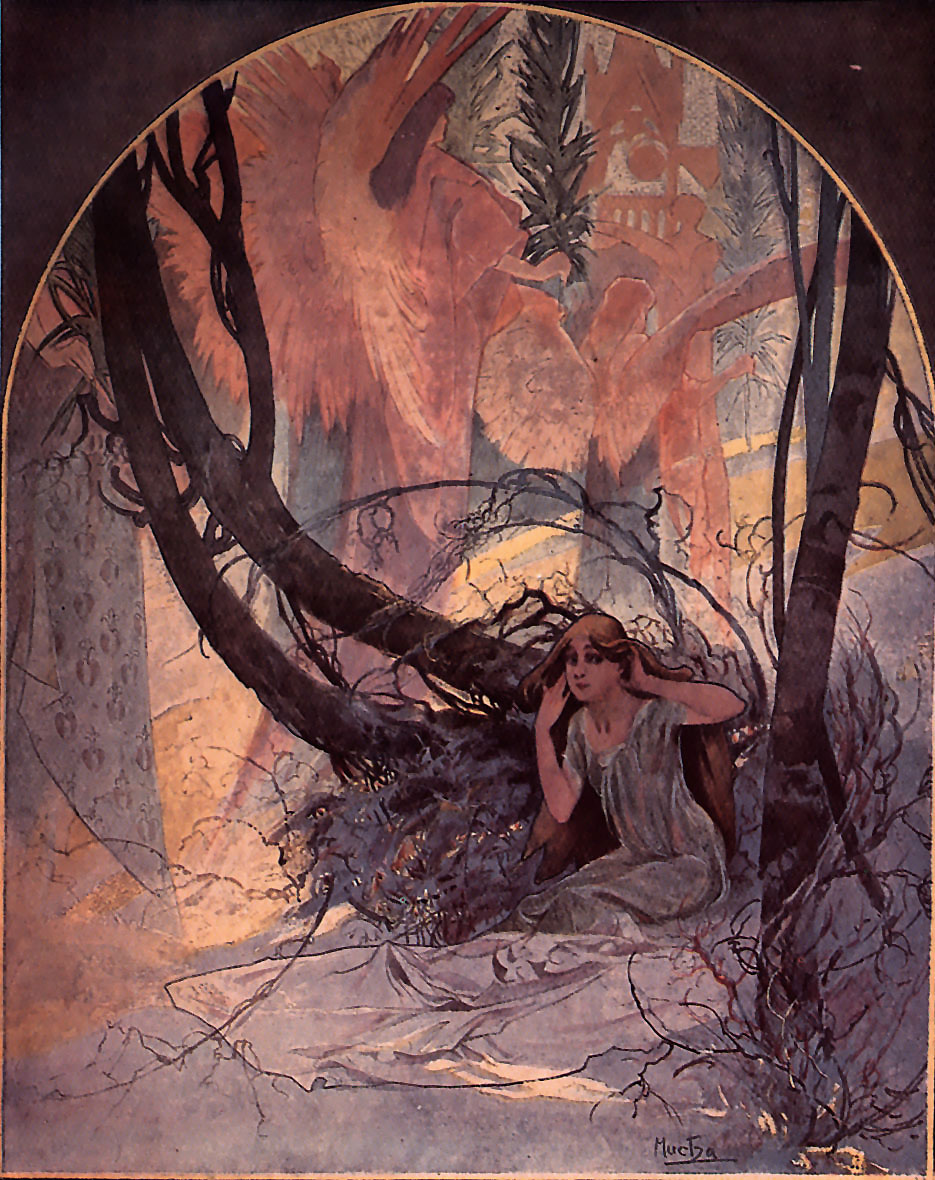
Alphonse Mucha’s “Easter Chimes Awaken Nature” (1896) is a vision of sound turned into light. Within a curved, chapel-like frame, a young woman kneels at the edge of a winter wood and cups her hands to her ears. The world around her is still cold—branches knotted, snow lying in soft drifts—yet the air quivers with the first peal of bells. Vast, wing-like forms rise in the background, glowing orange and rose as if the vibration itself had become visible. Mucha seizes the instant between dormancy and renewal and renders it not with theatrics but with listening, letting attention itself become the catalyst for spring.
Historical Context
The image belongs to a moment when Mucha had become the most recognizable designer in Paris yet remained deeply tethered to Moravian folklore and a private spirituality. In 1896 he was producing celebrated lithographs for theaters, luxury goods, and travel companies, but he was also probing subjects that could not be contained by product or celebrity. “Easter Chimes Awaken Nature” stands at this crossroad. It shares the ornamental clarity and rhythmic contour of his posters, while anticipating the visionary, liturgical strain that would culminate in “Le Pater” and the later Slav Epic. The work is an allegory of Easter in the language of Art Nouveau, where sacred time and seasonal time glide into one another.
Composition
The composition is organized as a lunette, a semicircle that suggests mural painting and ecclesiastical architecture. Inside that arc, a long diagonal of trunks leans from upper left to lower right, enclosing the seated figure in a protective cradle. An answering diagonal rises behind her in the form of radiant, sweeping planes, so that the lower half of the picture gathers inward while the upper half opens like breath. The maiden sits low, slightly off center, her smallness deliberate; she is a human measure set against a field of resonant forces. The ground is staged in bands—snow, thicket, path—each wider and calmer than the last, preparing the eye for the sudden expanse of sky where color swells and sound appears.
The Lunette as Meaning
Mucha’s arched frame is not a stylistic flourish. It confers liturgical space without the need for literal church interior. The arch feels like a threshold, a place where one steps from ordinary time into the duration marked by bells. It also concentrates the action. There is no escaping the curve; everything inside must harmonize. The maiden, trees, and radiant forms answer the arch with their own arcs, binding the image to the idea of a sanctuary made of air and light.
Palette and Light
The palette pivots on the meeting of cool and warm. Foreground snows and shadows are cast in lavenders, blue-grays, and softened greens, tones of late winter half-light. Behind and above, honeyed oranges and tender pinks begin to accumulate like sunrise. Mucha avoids harsh transitions; color veils one tone over another until the whole scene glows rather than shines. The maiden’s dress is neither stark white nor bright color; it absorbs surrounding hues, reading as a living neutral that belongs to both winter ground and spring air. Light in this world seems to diffuse from sound itself, bathing the grove in an almost musical atmosphere.
Making Sound Visible
There are no literal bells, yet the ringing is everywhere. The background is filled with vast, overlapping forms that read as angelic presences and as pressure waves fanning through space. Their edges are soft, their planes translucent, the repetitions regular enough to imply rhythm and free enough to feel like living breath. Trees bow slightly, grasses flutter, and even the tangle of undergrowth vibrates with short, nervous lines. Mucha thus invents a visual vocabulary for vibration: broad, warm fans for resonance and fine, dark filaments for the crackle of thaw. The listener’s hands are the hinge that converts these abstractions into sensation.
Nature’s Awakening
The title’s promise is honored in the picture’s textures. Closest to the viewer lies the winter garden of knots and briars, a microcosm of stasis. Beyond that thicket, the space begins to uncoil. Branches straighten; ornamental grasses trace long S-curves; the snow thins into lyrical stripes. Awakening is not illustrated with a sudden explosion of bloom but suggested as a change of line: from scratchy, intersecting strokes to continuous, swelling arcs. The eye experiences spring in the same way the ear experiences a chord resolving—through a shift in relations rather than a single event.
The Listener
The kneeling figure is neither saint nor heroine. Barefoot and simply dressed, she represents a person who has paused long enough to hear. Her face is attentive rather than ecstatic; her expression suggests recognition, as if memory were returning with the sound. The pose gathers body and landscape into one gesture: knees folded like hills, hair flowing like thawed streams, arms framing the ears like cupped leaves. She stands for nature newly aware of itself, and for the human being who understands spring not as spectacle but as the re-entry of meaning into the world.
Sacred and Seasonal Confluence
Easter joins the narrative of resurrection to the calendar of plants and weather. Mucha fuses those stories without choosing between them. The wing-like auras and the format’s echo of chapel architecture hint at liturgy; the forest edge, the unbound hair, and the primacy of weather announce a more pagan reverence for living cycles. The synthesis feels effortless because both ideas speak of an awakening after absence. The painting becomes a quiet theology: bells call souls to rejoice and, at the same time, set sap rising.
Art Nouveau Language
“Easter Chimes Awaken Nature” is a manifesto for the Art Nouveau belief that line is a living force. Everywhere curves run into curves, and even the most rigid elements—trunks, stones, frozen ground—are allowed to breathe. Ornament here is not afterthought; it is structure. The arabesque governs the flow of forms, translating physics into grace. In Mucha’s hands, continuous contour becomes a way to picture energy moving through matter, which is to say, life.
Space and Depth
Depth is created by stacked planes rather than by linear perspective. A screen of undergrowth separates the viewer from the figure; the figure sits in front of that screen; and the radiant background presses close, nearly flush with the picture plane. This tapestry-like space does two things at once. It keeps the viewer intimate with the scene—there is no long corridor to traverse—and it flattens the field just enough that patterns can do expressive work. The result is a world that feels near and ceremonial, like a modest chapel rather than a vast cathedral.
The Grammar of the Line
The line changes character according to what it describes. In the briars it becomes wiry and agitated, producing a sensation of cold prickliness. In the hair and drifting veil it lengthens into soft calligraphy. In the radiant auras it dissolves almost completely into color. This grammar allows the image to move between registers without losing unity. The signature at the lower right closes the sentence: a compact mark after a long, legato phrase.
Narrative Time
Mucha captures the threshold, not the aftermath. Snow still holds its pale ground; buds are barely suggested; the dominant hues of the sky are just beginning to gather warmth. The bells have only just begun to ring. Viewers feel the minutes to come: warmth will spread, branches will lift, the listener will rise. By fixing this earliest moment, the painting honors the kind of change that begins invisibly—in attitude, in attention, in the air—before it is tall enough to be named.
Technique and Surface
The surface reads like a sequence of transparent veils. Color is washed on in broad, translucent passes, the edges allowed to soften and interpenetrate. Mucha’s mastery of lithographic design is present in the clarity of shapes and in the way tones can be overprinted without turning muddy, yet the handling here leans toward watercolor or distemper, gentle and breathable. Nothing is over-defined; the viewer completes the edges in the mind, just as a listener completes a melody after the last note has sounded.
Visual Path
The eye responds to a choreography that mimics sound. We start with the listener’s pale face, circle her hands to feel the cupped ears, ride the leaning trunk up and left, and then open across the arc of glowing planes that sweep the sky. From there we drift down along the curves of light and return across the bands of snow to the figure. This circuit has the rhythm of a peal: attack, resonance, decay, and return to silence, ready for the next strike.
Dialogue with Mucha’s Oeuvre
Placed beside the seasonal panels of the mid-1890s, this work shares a devotion to the personification of nature but turns inward in mood and meaning. Compared with the theater posters, it sheds the singular star and gives the role of protagonist to atmosphere itself. Several elements forecast the large historical allegories to come: the visionary veils, the union of spiritual and national feeling, and the belief that clarity of contour can carry large themes without noise. It is a bridge between the marketplace and the chapel.
Contemporary Resonance
The work feels uncannily current because it privileges attention over spectacle. In a culture saturated with images, the act of listening becomes rare and, therefore, powerful. The painting also speaks to ecological consciousness: in its universe, human ritual and the more-than-human world are not estranged. A bell in town is felt in the woods; a shift in color at the horizon is audible to a kneeling person in the snow. Renewal registers as a change in relations across the whole field of life.
Conclusion
“Easter Chimes Awaken Nature” is a hymn to thresholds. With a modest subject—a woman listening at the forest’s edge—Mucha composes a liturgy of curves and color that lets viewers sense the precise second when cold minutes loosen and a warmer order begins to move through matter. The picture’s grace lies in its restraint: no blooming meadows, no processions, only sound becoming light and light becoming hope. It is Art Nouveau at its most contemplative and Alphonse Mucha at his most quietly assured.