Image source: wikiart.org
Introduction to Dolorosa
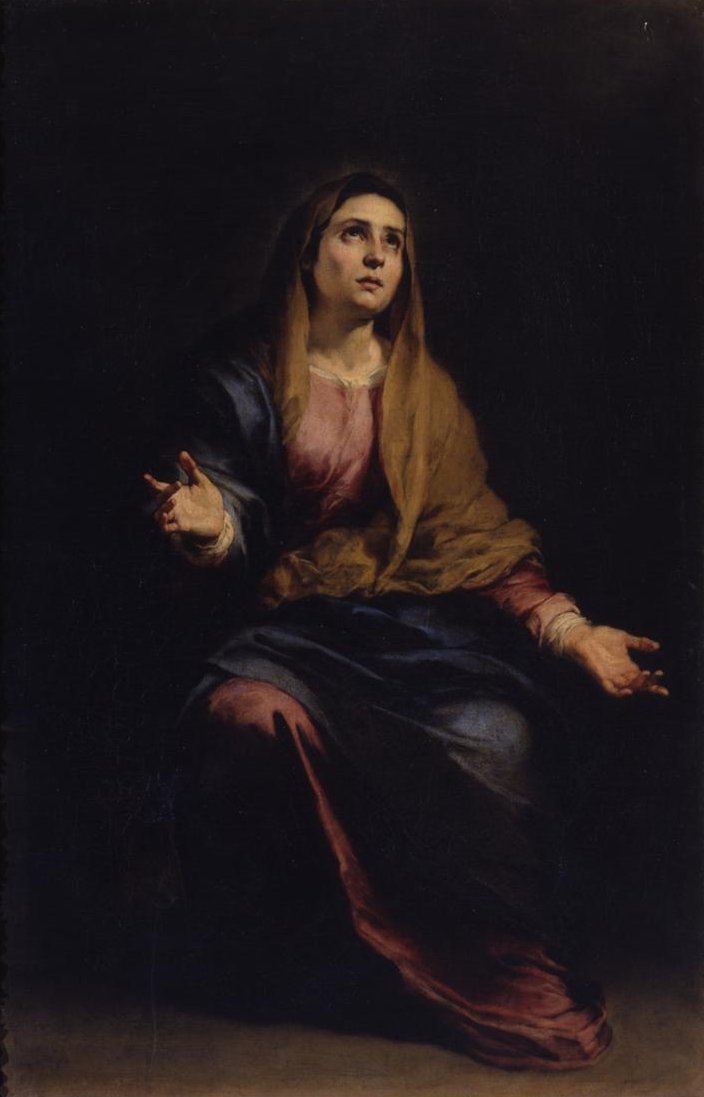
“Dolorosa,” painted around 1665 by Bartolome Esteban Murillo, is one of the most haunting images of the Virgin of Sorrows in Spanish Baroque art. The title refers to Mary in her condition of grief, traditionally associated with the Passion of Christ. Rather than surrounding her with narrative details of the Crucifixion, Murillo isolates the figure against a dark background and turns the entire painting into a concentrated study of silent anguish, prayer and surrender.
The Virgin kneels alone, her body softly illuminated against a nearly black void. Her hands are open in a gesture that combines pleading and acceptance, while her gaze lifts toward an unseen presence above. Wrapped in the familiar colors of blue and rose, with an ocher veil framing her face, she becomes a symbol of both human sorrow and unwavering faith. Murillo invites viewers not simply to admire a sacred icon but to enter into an intimate psychological and spiritual encounter with Mary at the moment of her greatest pain.
Historical and Devotional Context
Seventeenth century Seville, where Murillo worked, was a city marked by intense religious devotion, public processions, confraternities and a strong culture of penitence. Images of the Sorrowful Virgin played an important role in this devotional world. They accompanied Good Friday rituals, inspired personal meditation on the Passion and encouraged believers to unite their own sufferings to those of Christ and his mother.
Murillo was particularly adept at creating works that satisfied theological demands while also appealing emotionally to ordinary viewers. “Dolorosa” embodies this balance. The painting is both doctrinal and deeply human. Mary is presented as the compassionate intercessor who shares in Christ’s sacrifice, but she also appears as a mother overwhelmed by pain, caught in a moment of raw feeling.
The date around 1665 places the work in Murillo’s mature period, when his style had reached its fullest refinement. His brushwork had become increasingly soft and atmospheric, his colors warm and glowing, and his figures gentle yet psychologically nuanced. “Dolorosa” benefits from this maturity. It avoids early Baroque harshness and instead offers a tender but powerful depiction that would have resonated strongly with Sevillian viewers engaged in meditations on the Passion.
Composition and Spatial Simplicity
One of the striking aspects of “Dolorosa” is its compositional simplicity. Murillo places the Virgin slightly off center, kneeling toward the left edge of the canvas. The rest of the space is filled with deep, velvety darkness. There is no landscape, no architectural detail, no cross or spear. This radical reduction of setting focuses all attention on the figure herself.
Mary’s pose creates a gentle diagonal from the lower right corner, where her robes spread across the ground, up toward her uplifted face near the upper left. This diagonal movement suggests an inner rising, a spiritual reaching upward even as her physical posture remains low and humble. Her knees are on the ground, yet her eyes and thoughts are directed to heaven.
Her arms open outward, creating a horizontal line that stabilizes the composition. The left hand emerges from the shadow with the palm turned slightly upward, while the right hand extends further into the light, fingers relaxed yet tense with emotion. Together the diagonal of the body and the horizontal of the arms form a subtle cross shape, an echo of the very event that causes her sorrow.
The empty dark background acts almost like a stage curtain pulled away, leaving the viewer alone with Mary. This emptiness amplifies the sense that we are witnessing a private moment of prayer and grief, undistracted by external elements. It also universalizes the scene. Without specific narrative markers, the image can represent any moment of Mary’s sorrow, whether at the foot of the cross, after the deposition, or in solitary contemplation of what has happened.
Light and Color as Emotional Language
Murillo’s mastery of light is central to the impact of “Dolorosa.” A soft, golden illumination falls from the upper left, bathing the Virgin’s face, chest and hands while leaving much of the surrounding space in shadow. This light has both a natural and a spiritual quality. It suggests a real, directional source, but it also conveys the presence of divine consolation that surrounds Mary even in her anguish.
The contrast between light and dark is not brutally sharp, but rather carefully modulated. Shadows melt into mid tones, mid tones into highlights. This creates a velvety atmosphere and a sense of gentle mystery. The darkness is deep but not hostile. It resembles the night of faith through which Mary passes, trusting even when she does not fully see.
Color reinforces this emotional narrative. Murillo uses the traditional Marian palette of blue and rose, with a warm ocher veil. The deep blue mantle, which flows across her legs and down to the ground, suggests steadfastness and heavenly vocation. The rose tunic beneath introduces warmth and humanity, pointing to her beating heart and motherly love. The ocher veil, soft and earthy, unites these elements, anchoring the figure in the reality of human suffering.
Within this restrained palette, Murillo achieves luminous contrasts. The blue appears almost iridescent where the light touches it, while the rose fabric seems to glow from within, as if heated by grief and love. These chromatic effects ensure that the painting remains visually rich despite the minimal setting. They also encourage viewers to linger over the surface, discovering subtle variations that echo the complex layers of Mary’s inner experience.
Facial Expression and Psychological Depth
The emotional core of “Dolorosa” lies in the Virgin’s face. Murillo paints her with a remarkable balance of beauty and realism. She is not idealized into an unreachable celestial figure, nor is she weighed down with exaggerated theatrical grief. Instead, her features convey a contained but intense sorrow that feels true and immediate.
Her eyebrows lift slightly, creating gentle lines on her forehead that signal distress. Her eyes glisten and turn upward, as if seeking strength from God while also witnessing a scene of horror. The lips are parted, suggesting that she may be in the midst of silent words or a halted cry. The overall expression is one of being caught between shock, lament and surrender.
Murillo avoids tears running down her cheeks, which some artists used in similar images. By restraining this detail, he allows viewers to imagine the tears rather than simply see them, which can be even more powerful. The absence of overt weeping also reminds us of Mary’s inner strength. She feels deeply, yet she bears her grief with dignity and trust.
The modeling of the face is soft, with blended transitions of light and shadow. This softness suggests a living, breathing person rather than a carved statue. The play of light around her eyes and cheeks draws the viewer’s gaze repeatedly back to her expression, ensuring that the emotional connection remains central.
The Expressive Power of Gesture
The gestures of Mary’s hands and arms in “Dolorosa” are as eloquent as her face. Murillo pays careful attention to the position of each finger and the tension of the wrists. These details transform the pose into a complex language of prayer, lament and acceptance.
Her left arm extends outward and slightly downward, the hand open with the palm facing inward. This can be read as a gesture of offering. She presents her suffering and the suffering of her son to God, not clenching her hands in protest but opening them in surrender. The relaxed yet strained fingers show that this surrender is costly.
Her right arm opens more toward the viewer, as if inviting us into her grief. The palm is turned upward, an ancient sign of supplication. It is easy to imagine her speaking words such as “Why?” or “How long?” yet at the same time saying “Your will be done.” The dual orientation of her hands one toward God, one toward the viewer positions her as both supplicant and intercessor. She receives consolation from above and extends compassion outward.
The slight twist of her torso and the gathering of her robe around her knees intensify the sense of inward emotional pressure. She is not calmly seated but half rising, caught in a moment of spiritual upheaval. Murillo captures this tension without resorting to wild movement. The gestures remain controlled, mirroring her interior discipline, yet they convey powerful feeling.
Theological Symbolism and Marian Spirituality
Although “Dolorosa” looks like an intimate psychological portrait, it is also rich in theological meaning. In Catholic devotion, the Sorrowful Virgin stands as a model of perfect discipleship. She follows Christ even into the depths of suffering, uniting her own heart to his sacrifice.
Murillo expresses this theology visually. The dark background can be interpreted as the shadow of the cross and the eclipse of joy brought about by Christ’s Passion. Mary’s kneeling posture acknowledges that she is not equal to Christ but subordinate, a disciple who submits to the mystery she cannot fully understand.
At the same time, her closeness to the light and the traditional blue mantle signal her unique role in salvation history. She is not merely a witness to the Passion, she is the one who gave Christ his human flesh, which now suffers and dies. Her sorrow is therefore both maternal and redemptive. Devotional texts often speak of her as “co suffering” with Christ. Murillo visualizes this idea by letting the unseen drama of the Crucifixion echo through her body and expression rather than showing it directly.
For viewers engaged in personal prayer, the painting would have encouraged a spirituality of compassion and participation. Looking at Mary’s open hands and upward gaze, they were invited to place their own sorrows into her hands and through her to Christ. The image thus functions as a bridge connecting everyday suffering with the larger mystery of redemption.
Murillo’s Mature Style and Artistic Choices
“Dolorosa” showcases many hallmarks of Murillo’s mature style. The edges of forms are slightly softened, with transitions that blur gently into the surrounding darkness. This gives the figure a luminous, almost atmospheric presence. She seems to emerge from and sink back into the shadow, mirroring the way moments of intense emotion seem to rise up from the depths of the soul.
Murillo’s brushwork, though not visible in detail at a distance, creates a tactile sense of fabric and flesh. The folds of the blue mantle gather and spill with convincing weight, while the rose tunic clings more closely to the body. The ocher veil falls in simple, unpretentious lines, reinforcing Mary’s humility.
Unlike some Baroque artists who favored dramatic diagonals and theatrical lighting, Murillo opts for a quieter drama. The composition is spare, the gestures restrained, the light gentle. Yet the emotional impact is profound. This choice reflects his particular gift for combining Baroque intensity with a uniquely Sevillian tenderness.
In many of his works Murillo depicted children, beggars and humble saints with a warm, affectionate eye. That same humanism infuses “Dolorosa.” Mary’s sorrow is elevated and sacred, but it is also recognizably human. This ability to bring the divine close without trivializing it is one of the reasons Murillo became so beloved in Spain and beyond.
Emotional Resonance for Contemporary Viewers
Although “Dolorosa” was created in the context of seventeenth century Catholic devotion, its emotional resonance extends far beyond its original audience. Viewers today, regardless of their religious beliefs, can recognize in Mary’s posture and expression the universal experience of grief and pleading.
In a world marked by personal loss, social upheaval and uncertainty, the image of a figure who kneels in darkness yet looks upward with open hands can be deeply moving. It speaks to anyone who has felt overwhelmed and yet refused to give in to despair. The painting suggests that there is dignity in acknowledging pain and that inner strength can coexist with vulnerability.
At the same time, for those who share the Christian faith, “Dolorosa” continues to serve as an invitation to empathize with Mary’s sorrow and to contemplate the cost of love. Her willingness to remain present at the scene of suffering, rather than turning away, challenges viewers to accompany others in their pain with similar courage and compassion.
Murillo’s gentle palette and soft illumination keep the image from becoming oppressive. The darkness is real, but the light is also unmistakable. This balance offers a visual metaphor for hope in the midst of suffering, a theme as relevant today as it was in Murillo’s Seville.
Conclusion
“Dolorosa” by Bartolome Esteban Murillo is a masterpiece of Baroque devotional art that transcends its time through psychological depth and visual simplicity. By isolating the Virgin of Sorrows against a dark background, Murillo concentrates the viewer’s attention on her kneeling posture, open hands and upward gaze. These elements form a powerful language of grief, trust and intercession.
The painting’s warm yet subdued colors, gentle chiaroscuro and soft brushwork create an atmosphere of intimate contemplation rather than sensational drama. Mary appears as both a suffering mother and a steadfast believer, embodying the ideal of discipleship that remains faithful even in darkness.
Through this image Murillo offers a meditation on the mystery of sorrow transformed by love. “Dolorosa” invites viewers to stand beside Mary in her pain, to recognize their own struggles reflected in her eyes and to discover in her open hands a path toward surrender and hope. More than three centuries after its creation, the canvas continues to speak quietly but insistently about courage, compassion and the enduring strength of a heart that trusts even when it breaks.