Image source: wikiart.org
First impressions of “Diogenes” (1882)
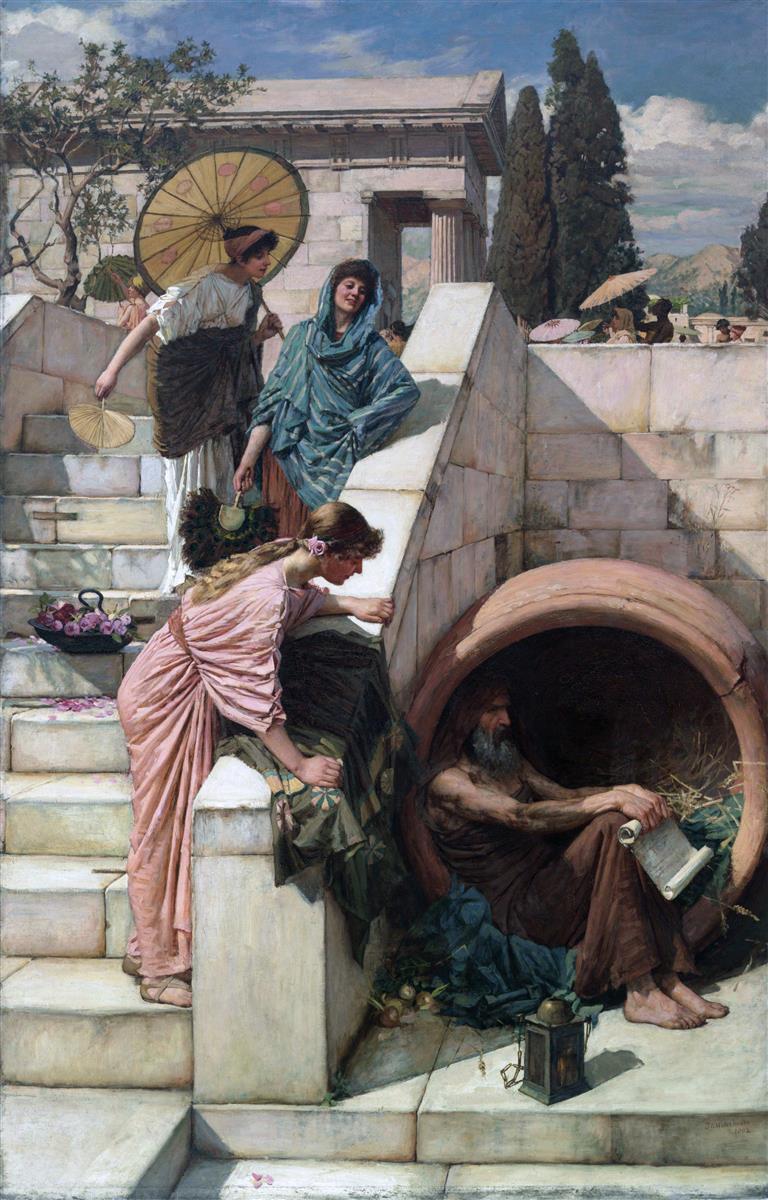
In “Diogenes” (1882) by John William Waterhouse, you feel the scene before you decode it. Sunlight hits pale stone in broad, clean planes, and the air looks warm enough to shimmer. Yet the emotional center is not the bright terrace or the distant hills, but the cool hollow of a huge earthen jar at the lower right. Inside that shadow sits the philosopher Diogenes, withdrawn, compact, and self contained, as if the world’s noise has been folded and put away.
Waterhouse builds an instant contrast: public space versus private conviction, polished marble versus rough clay, leisurely spectators versus a man who has chosen almost nothing. Three women occupy the stair and parapet above him, their fine drapery and parasols turning them into emblems of comfort and social belonging. One leans down, close enough to touch the boundary between their lives. The painting becomes a quiet drama about distance, not just physical distance measured in steps, but moral and psychological distance measured in values.
Diogenes of Sinope and the idea of chosen poverty
Diogenes, the famously abrasive Greek philosopher associated with Cynicism, is often remembered through anecdotes: rejecting luxury, mocking status, and insisting that virtue is enough. Even if you do not know the stories, Waterhouse gives you the core idea in visual terms. This is poverty presented not as collapse but as decision. The jar is not a punishment; it is a dwelling claimed with stubborn clarity.
The traditional Diogenes narrative is full of confrontations with polite society, because Cynic philosophy treats politeness as a veil that hides vanity. Waterhouse stages exactly that kind of encounter. The women represent a world of surfaces: clean stone, bright fabric, social ritual, shade held on a stick. Diogenes represents an opposing ideal: to strip life down until the remaining parts are true, and to accept the harshness that follows.
At the same time, the painting is careful not to make him purely heroic or purely pitiful. The jar’s darkness is real, the bedding looks improvised, and the ground is scattered with small objects like the leftovers of daily survival. Waterhouse holds the tension between admiration and discomfort, which is exactly where the subject lives.
John William Waterhouse and the Victorian classical imagination
Waterhouse is often grouped with Pre-Raphaelite taste, but he is also a painter of revivals, especially classical subjects filtered through Victorian sensibility. In the late nineteenth century, Greece and Rome were not just “the past.” They were a mirror in which modern viewers examined morality, desire, and social order. A philosopher like Diogenes offered a perfect device: ancient enough to feel universal, sharp enough to criticize the present without naming it.
Waterhouse’s classicism is not archaeological in a strict sense. It is theatrical and psychological. The architecture reads as convincingly ancient, but it also functions like stage scenery designed for clear storytelling. The terrace, stair, and parapet create a set of levels, and each level carries a social meaning: the refined world above, the exposed threshold in the middle, and the shadowed retreat below.
This kind of painting lets Waterhouse do two things at once. He can indulge the beauty of drapery, skin, stone, and sky, while also asking what beauty costs and what it ignores. “Diogenes” becomes an argument that looks like a picture.
The setting as a moral architecture
The environment is more than a backdrop; it is a moral diagram. The pale stone blocks are fitted and clean, implying civic order and public pride. The stair suggests upward movement, social ascent, and visibility. The parapet wall forms a barrier that protects the comfortable space above, even as it becomes the very edge from which curiosity can lean down.
Diogenes is placed at the base of this system, not because he has fallen there, but because he has stepped out of it. The jar is wedged against the architecture like a refusal inserted into the city’s smooth logic. It is round, earthy, and improvised against the hard rectangles of marble. That collision of forms is also a collision of values.
In the distance, the bright landscape opens beyond the stonework, reminding you that nature does not care about status. The sky and hills look serene and spacious, while human society builds terraces and boundaries. Diogenes, in his way, sides with the wider world rather than the narrow one.
Composition and the choreography of looking
Waterhouse composes the painting as a controlled descent. Your eye starts near the top left, where a parasol catches the light and announces leisure. From there, the figures and the stair lead you downward in stages, each step tightening the emotional pressure. The leaning woman in pink becomes the hinge of the whole arrangement. Her body bridges the upper world and the lower one, and her gesture directs your gaze into the jar’s shadow.
The large diagonal wall, rising from the lower center toward the upper right, works like an arrow and a barrier at the same time. It guides you toward Diogenes while emphasizing how separated he remains. The jar itself is a powerful compositional anchor: a circular mouth that reads almost like a dark portal. Once your attention enters that darkness, the surrounding brightness feels louder, even slightly intrusive.
The women’s faces and Diogenes’s posture create a second choreography. They look toward him, but he does not return their gaze in a straightforward way. His attention seems angled inward, toward his scroll or his thoughts. This refusal to “perform” for the onlookers is central. The painting is about spectatorship, and Diogenes disrupts it.
Light and color: sunlit stone versus interior shadow
The color design is deceptively rich. Waterhouse builds a palette where sun bleaches the stone into cool creams and pale grays, while fabric introduces human warmth: the soft pink of the woman leaning down, the blue green drapery of the standing figure, the darker wraps and sashes that hint at weight and texture. The parasols add a note of patterned delicacy, like portable patches of culture.
Against all that brightness, the jar’s interior is a deep, restrained darkness. It is not a flat black; it contains warm browns and muted reds, suggesting clay, dust, and the filtered heat of the day. That shadow does not merely hide Diogenes, it protects him. Light in this painting is social exposure. Shadow is autonomy.
Waterhouse also uses light to sharpen differences in touch. The stone looks hard and cool. The clay jar looks dry and porous. The drapery looks soft and pliant. Skin looks alive, not idealized into marble, but warmed by sun and streaked by experience. These tactile cues make the philosophical contrast feel physical.
Figures and gestures: curiosity, pity, and resistance
The three women are not identical in attitude. The upper figure with the parasol feels like the most securely “social,” her stance upright, her accessories refined, her attention curious but protected. The figure in blue green has a relaxed, almost amused softness, as if the encounter is a novelty, something to talk about later. The woman in pink is different. She leans, she reaches, and she risks entering the uncomfortable zone where sympathy becomes real.
Her gesture is ambiguous in the best way. Is she offering cloth, food, or a token of charity? Is she checking whether he needs help, or is she testing the boundary to see whether he will accept it? The ambiguity matters because Diogenes is famous for rejecting conventional help when it reinforces hierarchy. Charity can be another way for the comfortable to feel comfortable. Waterhouse paints the moment right before the moral outcome becomes clear.
Diogenes’s body language answers without fully answering. He sits grounded, knees drawn, one arm extended with the scroll, the other holding himself together. He is not begging. He is not lunging. He is simply there, occupying his chosen limit. His resistance is not theatrical aggression. It is the quiet refusal to participate in the terms offered.
Objects and symbols: jar, scroll, lantern, and the scattered world
The jar is the painting’s most famous symbol and Waterhouse treats it with respect. Its scale makes it both shelter and statement. Unlike a house, it cannot be decorated into respectability. It is bluntly functional. It declares that life can be reduced to a minimum and still be lived.
The scroll in Diogenes’s hand adds a second layer. It suggests thought, study, or perhaps a text that stands in for philosophy itself. Even if the figure is not literally reading, the presence of the scroll frames him as someone with an interior life that exceeds his material circumstances. It pushes back against any easy reading of him as merely poor.
The lantern placed near the jar carries strong Diogenes associations, since he is often linked with a lamp used in the story of searching for an honest person. In Waterhouse’s painting, the lantern sits at ground level, like a tool put down between searches. It suggests that judgment and investigation are part of his daily existence, not an occasional performance.
Around him, small items scattered near the entrance of the jar hint at the realities of subsistence. They are the remnants of living, not the ornaments of living. Waterhouse includes them so the philosophy never floats away from the body.
The emotional theme: a meeting between spectacle and truth
A lot of paintings about philosophers turn them into statues of wisdom. Waterhouse does something harder. He paints a social encounter where everyone is slightly exposed. The women, despite their elegance, are shown in the act of looking. They are spectators, and spectatorship can contain curiosity, superiority, fear, pity, or even attraction to the forbidden freedom Diogenes represents.
Diogenes, meanwhile, is not romanticized into pure serenity. His shelter is cramped, the shade heavy, the pose weary. The painting recognizes the cost of radical simplicity. Yet it also recognizes its power. There is a strange authority in a person who does not need your approval.
This tension makes the scene modern. It is about class and attention, about who becomes a public object, and about how easily moral feeling turns into entertainment. The woman leaning down may be compassionate, but compassion itself can become a way of managing discomfort. Waterhouse leaves space for the viewer to feel implicated, because we too are looking.
Why the painting still works: clarity, contradiction, and human heat
“Diogenes” remains compelling because it refuses a single moral. If you want to admire Diogenes, the painting gives you dignity in his posture and intellect in the scroll and lantern. If you want to criticize him as stubborn or antisocial, the painting also gives you isolation, darkness, and the suggestion of a life narrowed to a hard edge.
The women are equally complex. They can be read as shallow intruders, or as genuinely moved, or as individuals caught between social training and personal feeling. Waterhouse’s skill is that he makes them feel like people, not just symbols. Their fabrics and accessories are beautiful, but their beauty does not erase the ethical question. It sharpens it.
The painting’s lasting force comes from how it ties philosophy to atmosphere. It is easy to discuss Cynicism in abstract terms. Waterhouse turns it into a temperature, a brightness, a shadow, a step, a lean, a pause before a response. The idea becomes something you can almost hear in the silence between figures.
Looking closely: what to notice the next time you see it
Spend time with the boundaries. The parapet edge where the pink figure leans is a literal line between worlds. The mouth of the jar is another boundary, between public visibility and private existence. Watch how Waterhouse makes those boundaries feel active, almost tense, through angles and contrasts.
Notice the way leisure is painted. Parasols and fans are not just historical details. They are symbols of a life in which comfort is planned. Against them, the lantern is a different kind of tool, aimed not at comfort but at truth seeking.
Finally, look at the sky and distance. Waterhouse gives the world beyond the terrace a calm spaciousness. It hints that the argument is not confined to the city’s social stage. Nature sits beyond human judgment. Diogenes’s refusal, however abrasive, is also a refusal to let society’s scale become the only scale.