Image source: wikiart.org
Introduction to “Diana the Huntress” by Peter Paul Rubens
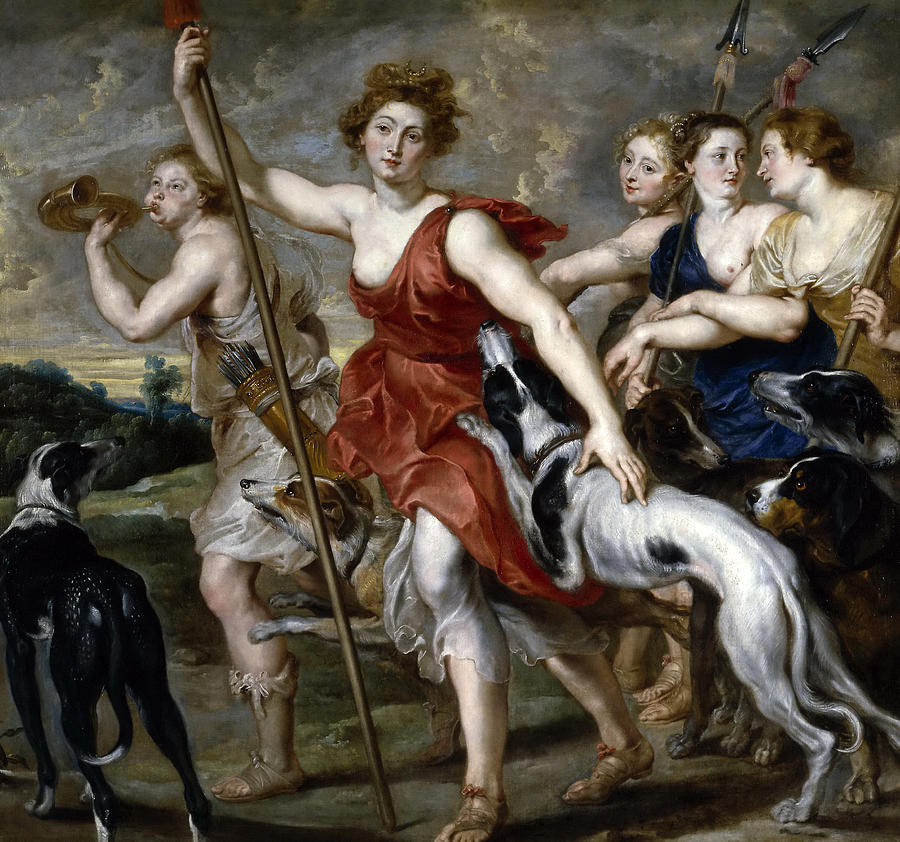
“Diana the Huntress” presents the Roman goddess of the moon and the hunt at the very height of her power. In this painting Peter Paul Rubens shows her striding forward at the head of a lively procession of nymphs and hunting dogs, filling the canvas with strength, motion, and physical presence. The goddess dominates the center, dressed in a vivid red garment that swirls around her muscular body. Her gaze is direct and unflinching, while her companions stream behind her, forming a layered rhythm of bodies, draperies, and weapons.
The work belongs to Rubens’s mature mythological style, where dynamic movement and sensual flesh are combined with rich color and dramatic contrasts of light and shadow. Rather than presenting Diana as a distant, cold deity, he shows a vital and tangible woman who commands the hunt with confidence. The sky behind her is restless, the landscape is lush, and the pack of hounds surges toward us, turning the scene into an almost theatrical entrance.
At first glance the painting can be read simply as a celebration of hunting and aristocratic sport, perfectly suited to the tastes of Rubens’s noble patrons. At a deeper level, however, it explores themes of leadership, chastity, female strength, and the thin boundary between the civilized world and raw nature. The goddess and her entourage are human in their bodies and emotions, yet they exist in a realm of myth where every gesture acquires symbolic weight.
Mythological Background of Diana
Diana, equivalent to the Greek Artemis, is traditionally the virgin goddess of the hunt, the moon, and wild animals. She is both protector and avenger, rewarding those who honor nature and punishing those who violate her sacred spaces. Rubens was steeped in classical literature and iconography, and in this painting he gathers several of Diana’s familiar attributes.
She carries a spear and a quiver of arrows, affirming her role as a huntress and a skilled archer. The crescent-shaped diadem in her hair alludes to her lunar aspect. Her attendants, youthful and energetic, recall the nymphs who accompany her through forests and mountains. The pack of hunting dogs is an essential part of her mythological entourage, emphasizing her mastery over the animal world.
Yet Rubens adapts these classical sources to his own sensibility. Instead of the slender, almost boyish Diana preferred by earlier Renaissance artists, he offers a robust goddess whose form matches the Baroque ideal of beauty. The story is not tied to a specific myth such as Actaeon or Callisto. Instead Rubens suggests a more general image of the divine hunt, a moment of departure as Diana leads her companions out into the wilderness. This choice allows him to focus less on narrative suspense and more on the celebration of movement, physical vigor, and the splendor of the female body.
Composition and Arrangement of Figures
The composition is built on a powerful diagonal that runs from the lower left corner, where the dogs cluster, up through Diana’s spear and out toward the stormy sky. This diagonal line conveys forward thrust and momentum, as if the entire group is surging out of the painting into the viewer’s space. Diana’s body is slightly twisted. Her torso faces us while her legs stride sideways, and one arm reaches forward with the spear. This contrapposto twist adds tension and dynamism, a hallmark of Rubens’s Baroque style.
Behind her, the nymphs form a kind of rippling echo. Each figure is posed differently, yet they are linked by gestures and glances. One blows a hunting horn, cheeks puffed with effort. Another grips a spear and turns to speak with a companion. These overlapping bodies create depth and complexity, drawing the eye from one face to another. The result is a human chain that binds the foreground to the horizon, balancing the weight of the central figure.
Rubens organizes the scene so that no space feels empty. Draperies swirl into the gaps between limbs, hounds weave between legs, and spears cut through the air. Despite this apparent complexity, the geometry of the composition remains clear. The red mass of Diana’s dress anchors the center, while paler tones of flesh and cloth radiate around it. The viewer can always find their way back to the goddess’s face, which acts as the visual and emotional core of the painting.
Light, Color, and Atmosphere
Light washes over the figures from the left, illuminating their flesh and highlighting the sheen of satin, leather, and fur. Rubens uses a warm, golden light that stops short of sentimentality. It sharpens contours and emphasizes the volume of the bodies, yet it also softens transitions, creating a luminous atmosphere that envelops the entire group.
The color scheme is rich and harmonious. Diana’s red clothing is the most striking element, its saturated hue instantly drawing attention. This red is balanced by the creamy whites of skin and tunics, the deep blues of the nymphs’ garments, and the earthy browns and blacks of the dogs. Even the cloudy sky participates in the color drama, with slate gray and pale yellow streaks echoing tones found in the landscape and costumes.
The sky itself is significant. Massive clouds roll across the upper part of the canvas, hinting at changing weather and the unpredictable forces of nature. The landscape in the distance appears calm but not entirely serene. This unstable atmosphere heightens the drama of the hunt. The viewer senses that the group is heading into a wild domain where the boundaries between safety and danger, order and chaos, are fluid. Rubens uses this interplay of light and sky to reinforce the goddess’s role as mediator between civilization and wilderness.
Depiction of Movement and Energy
Movement is at the heart of this painting. There is hardly a static element. Diana’s stride, the dogs’ leaps, the swirling draperies, and the raised trumpeting arm of the nymph all convey a sense of urgency. Rubens suggests this energy through several technical means.
First, he employs flowing contours that guide the eye from one part of the canvas to another. The curve of Diana’s arm leads into the arch of a dog’s back, which in turn transitions into the sweep of a nymph’s garment. These linked curves give the composition a rhythmic pulse.
Second, he plays with the tension between smooth and broken brushwork. Flesh is rendered with soft blending so that it looks supple and alive. In contrast, the fur of the dogs, the edges of leaves, and the folds of cloth are painted with more energetic strokes. The result is a visual vibration that suggests motion even in a still image.
Finally, Rubens freezes his figures in mid action rather than posing them in a static, completed gesture. The horn blower is caught in the moment of inhaling and exhaling, the sound almost audible. One dog jumps up against Diana, front paws raised, while another turns its head toward some unseen stimulus. The goddess herself appears to have paused only for a heartbeat to look outward before plunging forward again. This sense of suspended motion invites the viewer to imagine what will happen in the next instant.
The Dogs and the World of the Hunt
The hunting dogs are more than decorative accessories. They play a substantial role in the composition and meaning of the painting. Their muscular bodies echo the strength of the human figures, and their taut attention reinforces the idea that the group is on the verge of action.
Rubens paints each dog with careful observation. Coats are varied in pattern and color, eyes are alert, ears are pricked. One hound stretches upward toward Diana’s hand, acknowledging her authority and affection. Another turns its head toward the viewer, drawing us into the scene and making us feel as if we are standing in the path of the onrushing pack. Their sleek forms and powerful legs emphasize speed and endurance, traits prized in hunting.
Symbolically, the dogs represent loyalty, instinct, and the raw energies of nature channeled into disciplined pursuit. Under Diana’s control, they embody the harmonious relationship between humans and animals in the idealized world of myth. At the same time, their physical closeness to the female bodies reminds the viewer of the sensual dimension of the painting. Flesh touches fur, hands rest on flanks, and the boundary between human and animal becomes porous. This tension between control and instinct, between civilization and animal energy, is a recurring theme in Rubens’s mythological works.
Femininity, Power, and the Body
One of the most striking aspects of “Diana the Huntress” is its presentation of female power. Rubens diverges from the fragile, ethereal versions of goddesses that can be found in some earlier art. His Diana is robust, muscular, and physically capable. Her arms are strong, her legs are sturdy, and her posture conveys command. She is not idealized into an impossible abstraction but built as a believable body that could actually lead a hunt and draw a bow.
This physicality does not diminish her femininity. On the contrary, Rubens emphasizes the softness of skin, the flowing hair, and the draped fabrics that reveal as much as they conceal. The goddess’s dress slips off one shoulder, exposing a powerful yet sensuous torso. The nymphs behind her are rendered with equal attention to curves, expressions, and individual character. Some seem focused on the hunt, others engage in conversation, adding a note of everyday sociability to the divine scene.
The painting thus balances two ideals. On one side, Diana stands as a chaste virgin goddess, set apart from male desire and devoted to her domain of forests and animals. On the other, Rubens cannot resist exploring the beauty of the female body. The result is a vision of femininity that unites strength and allure rather than playing them against each other. The viewer is invited to admire not just the physical attractiveness of the figures, but also their capability, solidarity, and agency.
Rubens’ Painterly Technique and Workshop Practice
Rubens was known for working with a large studio, where assistants might help with secondary elements, while the master concentrated on the central figures and crucial passages of flesh and expression. In “Diana the Huntress” one senses this collaboration in the different degrees of finish across the canvas. The figure of Diana herself is rendered with exceptional care, especially in the modeling of her face, shoulders, and arms. The nymphs and dogs, although skillfully painted, display a slightly broader handling in some areas, suggesting the efficient division of labor typical of a busy Baroque workshop.
The technique combines precise drawing with fluid brushwork. Rubens typically began with a dynamic underdrawing and a monochrome sketch to organize light and shade. He then built up layers of color in transparent and opaque glazes, allowing light to bounce through the paint films and produce a glowing effect. In this painting the flesh tones are particularly subtle, shifting from rosy highlights to cool shadows that capture the play of light on living skin.
Another hallmark of Rubens is his ability to integrate different textures into a unified whole. The viewer can almost feel the difference between the roughness of the dogs’ fur, the softness of hair, the crispness of linen, and the heavier weight of the goddess’s red garment. These textural contrasts reflect his deep study of Venetian painting, particularly the work of Titian, yet Rubens infuses them with his own sense of energy and immediacy.
Emotional Tone and Viewer Engagement
Beyond its technical brilliance, the painting exerts a strong emotional pull. This is achieved not only through the figures’ actions but also through their expressions. Diana’s face combines concentration with a faint suggestion of challenge, as if she has noticed the viewer and is unafraid of our gaze. The nymphs behind her display a range of moods, from the focused horn blower to the more relaxed companions who exchange glances and conversation.
This variety of expression encourages the viewer to read the painting as a moment plucked from an ongoing story. The group might be leaving a sacred grove, answering the call of the horn, or about to enter a forest where game has been sighted. We sense camaraderie among the women, an almost sisterly bond forged through shared activity. Unlike many mythological scenes where female figures are passive objects of observation, here they are active participants in a collective enterprise.
The placement of the figures very close to the picture plane intensifies engagement. Dogs and legs spill toward us, and the spear reaches high into our space. There is little separation between the viewer and the world of the painting, which aligns with the Baroque desire to break down the barrier between art and life. Standing in front of the canvas, one feels almost swept up in the forward rush, as if it might be necessary to step aside to avoid being trampled by the pack.
Place of “Diana the Huntress” in Rubens’ Oeuvre
“Diana the Huntress” fits within Rubens’s broader exploration of mythological subjects, where gods and heroes act as vehicles for expressing human emotion, political ideals, and artistic virtuosity. He returned several times to the figure of Diana, painting her in more intimate moments of bathing or resting, as well as in dramatic confrontations. Compared to those works, this painting emphasizes the public, commanding aspect of the goddess. She is not in a secluded grove but striding across an open landscape, a leader surrounded by followers.
In the context of Rubens’s career, the painting also reflects his connections with aristocratic patrons who valued images of hunting as symbols of status, control over land, and noble leisure. By casting the hunt under the patronage of a classical deity, Rubens transforms a courtly pastime into an allegory of virtuous rule. Diana’s disciplined yet vigorous hunt becomes a metaphor for ruling passions and governing territories.
At the same time, the painting illustrates many of the qualities that made Rubens so influential for later generations. His combination of robust forms, swirling movement, and luminous color would inspire artists across Europe, from the French Rococo painters to the great Romantic masters. In “Diana the Huntress” one can already see the seeds of that later tradition. The work fuses myth, nature, and human energy into a single, compelling image that continues to speak to modern viewers about power, freedom, and the allure of the wild.
By bringing the goddess so close, granting her a fully embodied presence, and surrounding her with a living world of companions and animals, Rubens turns a classical subject into a vivid encounter. The viewer does not simply observe a story from antiquity. Instead, one feels momentarily included in the procession of Diana and her nymphs, sharing the thrill of the hunt as the party strides into the untamed landscape beyond the frame.