Image source: wikiart.org
Introduction
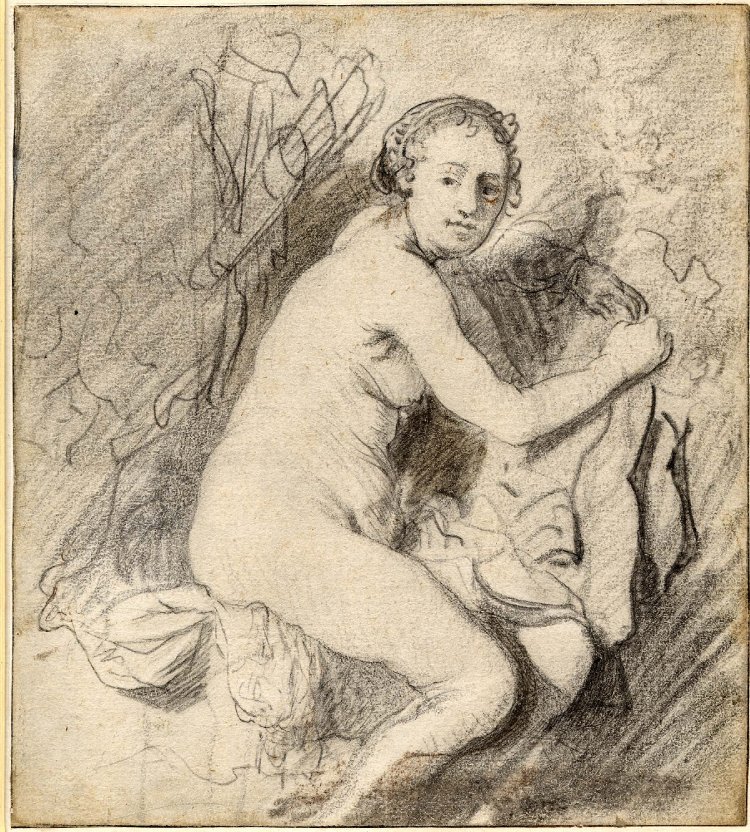
Rembrandt’s “Diana at the Bath” (1631) reveals a young master testing how the most intimate human moments can carry mythic weight. Created at the threshold between Leiden and Amsterdam, the work embodies the immediacy of a studio study and the poetry of a finished composition. Rather than the pageantry of a goddess surrounded by nymphs, Rembrandt offers a single figure turning toward us, caught at the brink between privacy and discovery. The result is a scene that feels startlingly modern: a myth translated into the language of lived experience, rendered with the grain of charcoal and the glow of light on skin.
A Myth Reimagined as an Encounter
Diana, the Roman goddess of the hunt and chastity, appears most often in art amid crescent moons, quivers, and companions. Here the narrative collapses to a solitary bather. The goddess sits at the water’s edge, torso twisting, head turned over the shoulder with an alert, searching gaze. There is no overt emblem of divinity; the myth is present as atmosphere rather than iconography. This decision reframes the subject from spectacle to encounter. We do not witness a ceremony; we intrude upon a moment. Rembrandt thus reorients the classical theme toward intimacy, empathy, and the psychology of being seen.
Composition Carved from Light and Gesture
The composition turns on a compact spiral. Diana’s seated body forms a curve from the shoulder to the knee, an S-shape that compresses energy and directs the eye through the scene. Her raised right arm anchors the curve and points toward a cluster of drapery and foliage; her left leg steps into the foreground, widening the base of the figure like the foot of a pyramid. This spiral-within-a-triangle is a Rembrandt hallmark, stabilizing the pose while retaining a sensation of life. Because the figure turns to look outward, the drawing actively includes the viewer in its geometry. The line of sight completes the composition, extending beyond the page and implicating us in the story.
The Language of the Line
Rembrandt’s line alternates between brisk notations and lingering caresses. The contour of the back and thigh is made with economical strokes, while the face and hands receive dense, exploratory hatching. This Italianate balance—bold silhouette married to delicate internal modeling—was learned from study of prints and the life model, but the handwriting is unequivocally his. Short, flexible clusters describe the soft edge where illuminated skin dissolves into shade. Longer, parallel strokes carve shadow into the bedding, cloth, and tree trunk. The contrast between supple figure lines and angular surroundings heightens the sense that we are looking at life pressed against the material world.
Chalk, Wash, and the Glow of Flesh
The medium itself serves the subject. Black chalk and graphite, possibly heightened with a light wash, produce a tonal range capable of suggesting both atmosphere and anatomy. Rembrandt lays a gentle veil across the background and then lifts the modeling around shoulders, flank, and knee, as if the light were awakening the body from within. The highlights are not pure white; they are reserved paper, preserved by restraint rather than added pigment. This makes the skin look luminous and breathable, an effect that paint often struggles to match. The paper’s warm tone plays the role of reflected light, turning shadow into something living rather than opaque.
The Face That Looks Back
Diana’s head is the psychological fulcrum. The features are modeled with patient hatching, the eyes wide and questioning, the mouth slightly parted as if caught in a breath. It is neither a coy invitation nor a theatrical shock. Instead, the expression feels like recognition: a boundary has been crossed. In visual terms, that boundary is the picture plane. The goddess’s look pulls us into an ethical relationship with the image. Rembrandt avoids the voyeur’s one-way gaze; he gives the subject the dignity of awareness. This precise attention to the inner life of the face is what will, in later years, make his portraits and biblical scenes unequaled.
Drapery, Foliage, and the Drama of Edges
Rembrandt composes the scene with a set of textured foils. To the left, a rough tree trunk rises like a stage wing; behind the figure, tangled foliage and a thrown cloth create a backdrop that fluctuates between pattern and shadow. The drapery at the hip is rendered with vigorous, broken strokes that refuse finish and thereby set off the smoother passages of skin. Edges matter: where cloth meets flesh, the line thins and softens; where foliage meets negative space, it frays into atmospheric scribbles. These transitions describe not just surfaces but the feeling of touch—linen sliding over thigh, leaves brushing air—so that the drawing becomes sensorial as well as visual.
The Body as Knowledge
One senses the presence of a live model. The weight on the left hip, the twist through the waist, the slight lift of the right heel—these are observed truths. Rembrandt never idealizes anatomy into marble; he looks until the form breathes. The lower back compresses as the torso turns, skin folding at the flank in a way that feels unposed. The hand gripping the cloth is not a generic gesture but a study of tendons rising and releasing. Through such particulars, the body ceases to be a symbol and becomes a person. Myth survives this humanization not as lost grandeur but as renewed meaning: divinity glimmers in ordinary flesh.
Privacy, Modesty, and the Ethics of Depiction
The theme of bathing in art has long courted voyeurism. Rembrandt counters that potential with compositional modesty. The goddess is turned away; the frontal plane is protected by the contrapposto of torso and thigh. Cloth gathers at strategic points, not in prudish concealment but in acknowledgment of a private act. Most crucially, the subject looks back, placing the viewer under the authority of her gaze. This reciprocity converts seeing into a form of conversation rather than consumption. The drawing thus explores the ethics of looking—a topic that permeates Rembrandt’s oeuvre, from self-portraits to scenes of spiritual revelation.
The Moment Before Narrative
Because Rembrandt strips away the entourage of nymphs and the drama of Actaeon’s intrusion, the picture occupies the instant before any narrative eruption. We are inside a pause. The goddess has not yet resumed her bath, nor has she fled or punished; she has merely noticed. Suspense, not action, carries the image. In that charged stillness, the drawing finds its voice. It is about attention—the way light attends the body, the way the world attends a person at rest, the way a gaze attends another gaze. This attention becomes a kind of devotion, not religious but humane.
Leiden Precision and Amsterdam Atmosphere
Dated 1631, the work bridges Rembrandt’s Leiden years and his move toward Amsterdam. The Leiden manner is visible in the minute linear description and the tightly wound composition. Yet the broader atmospherics—the smoky background, the softly pooled shadows—anticipate the Amsterdam style of larger canvases and nocturnal interiors. The drawing functions, then, as both summation and prophecy: it codifies the discipline of close observation while opening toward the theatrical light that will define his mature painting.
Dialogue with the Etching
Rembrandt’s etched “Diana at the Bath” from the same year provides a revealing foil. In the print, the setting becomes more elaborate, the water more defined, the surface more metallic in its sheen. The drawing, by contrast, keeps the world provisional, allowing the figure to lead the scene rather than the scenery dictating the figure. This flexibility suits the medium. Paper encourages rehearsal and discovery, and Rembrandt uses that latitude not to sketch for its own sake but to compose with immediacy. The two works together show a mind thinking across media, testing how a subject can be tender in chalk and declarative in copper.
Sensation of Water Without Its Description
Although the title locates the scene at a bath, the water itself is barely stated. A few soft strokes near the foot suggest a reflective surface; the rest is implied by posture and setting. This restraint underscores Rembrandt’s priority: the experience of bathing, not its depiction. The coolness of air on wet skin, the weight of damp cloth, the privacy of the posture—these sensory cues summon the missing element more effectively than a detailed pool would. In a sense, the drawing teaches the viewer to complete the world, engaging our imagination as a partner in the image.
The Paper as Space
Rembrandt exploits the page as if it were a shallow stage. Background strokes slant diagonally, pushing the figure forward; the lower right corner is left more open, giving the goddess room to occupy our space. The margins read like thresholds. We feel that the figure might step across the edge or withdraw behind the tree at any moment. This use of the sheet’s edges to create presence is one reason Rembrandt’s drawings feel so alive. They respect the material limits of paper while persuading us that life exceeds them.
Connoisseurship and the Hand of the Artist
The drawing’s character—its searching line, the mix of firmness and softness, the humane psychology—aligns with Rembrandt’s authorship in 1631. Even so, the work possesses the freshness of something made quickly, perhaps in the presence of a model in the studio. That spontaneity, far from diminishing its stature, is the source of its authority. We are close to the act of making, to decisions left visible, to the speed at which vision translates into mark. The drawing is both artifact and performance, a record of seeing converted to touch.
Light as Narrative
No candles or skies appear, yet light is the protagonist. It arrives from the left, washes across shoulder and cheek, glances off the hip, and fades into the compressing shadow behind the knee. This voyage of illumination maps the viewer’s journey through the drawing, teaching the eye where to rest and where to move. In the absence of a fully rendered environment, light itself constructs the scene—just as it will in Rembrandt’s interior paintings of the 1630s, where windows and doorways become instruments of revelation.
The Human Scale of Divinity
Perhaps the most lasting contribution of “Diana at the Bath” is the way it locates the divine in human scale. There are no thunderbolts here, no orchestration of clouds. The sacred enters through attention, light, and posture. By granting a goddess the vulnerability of a woman at her bath, Rembrandt restores to myth the humanity from which myths are born. That humanism does not demote the divine; it makes it legible. We are invited to recognize dignity in ordinary gestures and to understand that the extraordinary often hides in the everyday.
Legacy and Influence
Rembrandt’s approach to the nude—truthful, alert, empathetic—will shape Northern art for generations. Later Dutch and Flemish artists echo his refusal of idealization and his reliance on light to articulate form. In the modern era, the drawing resonates with artists who value process and presence: the immediacy of Degas’s bathers, the searching lines of Kollwitz, the psychological nearness of Freud. What persists across these centuries is the conviction that a body honestly seen can carry stories older than any one culture.
Conclusion
“Diana at the Bath” condenses Rembrandt’s early brilliance into a page alive with breath and light. The drawing is intimate without being invasive, classical without being cold, spiritual without being doctrinaire. It asks us to look carefully and, in looking, to honor the subject’s presence. That ethical attention—to faces, to bodies, to the circumstances that surround them—would become the foundation of Rembrandt’s most enduring achievements. In this 1631 sheet, the future is already visible: a world in which art grants the ordinary its rightful radiance.