Image source: wikiart.org
Introduction to “Diana and her Nymphs Surprised by the Fauns”
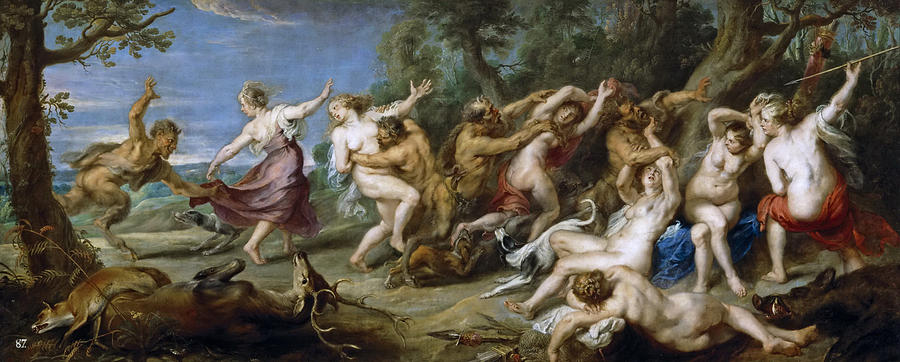
“Diana and her Nymphs Surprised by the Fauns,” painted by Peter Paul Rubens around 1640, is a late, highly charged mythological scene that captures the Baroque fascination with movement, emotion, and sensuality. The long horizontal canvas teems with figures: Diana’s retinue of nude and semi-draped nymphs suddenly ambushed by fauns who burst into their woodland sanctuary. Bodies twist, arms flail, and draperies stream in the air as the peaceful world of the hunt is shattered by chaotic desire.
This work brings together several core aspects of Rubens’s art. It showcases his mastery of the human figure in complex poses, his ability to orchestrate large multi-figure compositions, and his interest in mythological subjects where divine or heroic beings are placed in situations that test their virtues. Here the chaste goddess of the hunt must defend herself and her followers against lustful forest spirits, turning the painting into a powerful meditation on vulnerability, resistance, and the volatile boundary between order and impulse.
Mythological Background and Narrative Choice
Diana, known to the Greeks as Artemis, is the virgin goddess of the hunt and protector of chastity. She dwells in the forest accompanied by a retinue of nymphs who share her vow. In classical literature, Diana’s purity is frequently threatened or violated: Actaeon glimpses her bathing and is turned into a stag; Orion pursues her nymphs and is punished.
Rubens’s painting draws on this tradition of threatened chastity. Fauns – half-man, half-goat creatures associated with Pan, wine, and unrestrained sexuality – erupt into Diana’s camp while she and her nymphs are resting from the hunt. Unlike some versions where the goddess metes out harsh retribution, Rubens freezes the action at the height of confusion. We see the ambush at its peak: some nymphs struggle to escape, others fight back, a few already seem half-entangled with their assailants. The narrative is not resolved; instead, the drama lies in the moment of crisis itself, a favorite strategy of Baroque art.
Composition and Sweeping Movement
The painting’s panoramic format allows Rubens to stage the scene as a continuous frieze of bodies across the width of the canvas. The composition builds from left to right in a wave of action. On the far left, a nymph flees toward the woods, her purple cloak flying as she runs, chased by a faun and accompanied by a dog. Moving toward the center, the figures become denser and more entangled: nymphs recoil, twist, and push away their attackers; fauns lunge forward, arms outstretched. On the far right, the tumult climaxes with a group of struggling figures and a faun raising a spear.
Rubens organizes this complexity through a network of diagonals. Arms and legs thrust in opposing directions, creating crisscross patterns that propel the eye. Draperies swirl in arcs that echo the lines of limbs and torsos. The fallen stag and scattered hunting gear in the foreground introduce horizontal elements that anchor the composition, while the trees at either edge frame the scene like stage wings.
Despite the chaos, the structure is clear. Diana herself, slightly left of center, acts as a visual fulcrum, her raised arms and turning body connecting the fleeing figures on the left with the more overwhelmed nymphs on the right. The viewer experiences the painting almost as a cinematic sequence of reactions radiating out from the goddess’s position.
Diana: Chaste Authority Under Threat
Rubens presents Diana as both goddess and woman. She is identifiable by her short, practical hunting tunic and the crescent moon that often adorns her head, though here the emphasis is more on her dynamic pose than on attributes. Her body is turned in a powerful twist, one foot planted, arms flung outward as she reacts to the intrusion. Her expression is alert and commanding, not helpless.
Unlike some of her nymphs, who already appear half-subdued, Diana resists energetically. She seems to be calling out orders or warning cries, her raised hand perhaps summoning dogs or signaling retreat. Rubens thus underscores her role as leader and protector, even in a moment of surprise.
At the same time, the goddess’s own physicality is on display. Her legs are bare, her tunic whipped by the wind to reveal the contours of her body. Rubens walks a fine line between celebrating her chastity and depicting her as an object of the fauns’ desire. This tension between ideal and vulnerability gives the figure psychological depth: she is both an embodiment of virtue and a target of the forces that would undermine it.
Nymphs and Fauns: Bodies in Conflict
The surrounding nymphs and fauns are where Rubens’s virtuosity with the human figure becomes most evident. Each pair forms a small drama of pursuit or resistance. Some nymphs wrench their bodies away, arms upraised in a gesture of horror; others push against the fauns’ chests; one lies sprawled on the ground, her body arching in a mixture of panic and exposure. The diversity of poses allows Rubens to explore the female nude from every angle, in keeping with his long-standing interest in voluptuous, dynamically posed figures.
The fauns, with their muscular torsos, wild hair, and animal features, represent raw physical force. They are painted with earthy tones that contrast with the paler flesh of the nymphs. Their gestures are urgent and often aggressive: grabbing wrists, pulling hair, reaching out toward fleeing bodies. Yet Rubens avoids demonizing them entirely; some seem more astonished than malicious, caught up in the frenzy rather than premeditated violence.
This interplay creates a complex emotional register. The scene is not a simple allegory of evil attacking good but a more ambiguous collision between instinct and restraint, desire and dignity.
Landscape and Setting as Emotional Stage
The forest landscape is more than a backdrop; it is an active participant in the drama. The scene unfolds in a clearing surrounded by trees whose trunks and branches frame the figures and echo their movements. The sky, largely blue on the left, becomes darker and more tumultuous toward the right, mirroring the growing intensity of the action.
In the foreground, the results of the preceding hunt lie scattered: a dead stag with antlers sprawled, hunting spears and quivers of arrows abandoned on the ground. These objects tell us that the nymphs once held power over the wild, yet now find themselves hunted. The reversal of roles heightens the sense of violation and chaos.
The landscape also provides moments of calm contrast. The distant horizon and soft blue hills suggest a peaceful world beyond this momentary eruption of disorder. This juxtaposition between tranquil distance and violent foreground intensifies the drama, typical of Rubens’s ability to orchestrate emotional contrasts within a single canvas.
Light, Color, and Sensual Atmosphere
Light floods the central area of the painting, bathing the pale bodies of the nymphs in a warm glow that emphasizes their softness and vulnerability. The fauns, often positioned slightly behind or to the side, receive somewhat less light, their bodies shaded and earthier in hue. This contrast separates victim and aggressor visually while also unifying them within a shared atmospheric envelope.
Rubens’s color palette is rich but orchestrated. Flesh tones range from pearly whites to rosy pinks and warm ochres, enlivened by touches of blue and violet in the shadows. Draperies contribute bold accents: Diana’s purple skirt, a deep blue cloth around a seated nymph, flashes of red and russet in the fauns’ garments. The greens of the foliage and browns of tree trunks and earth provide a naturalistic setting that prevents the scene from becoming overly decorative.
The handling of paint is loose and energetic, especially in the foliage and sky, where brisk strokes suggest leaves, clouds, and flickers of light. This painterly freedom adds to the sense of immediacy, as if the scene were unfolding before our eyes.
Erotic Tension and Baroque Drama
“Diana and her Nymphs Surprised by the Fauns” sits at the intersection of eroticism and violence. The nudity of the nymphs, typical of mythological painting, is here charged by the context of forced encounter. For Baroque viewers, such scenes offered both titillation and moral reflection. The viewer is invited to feel the shock and fear of the women while also confronted with the palpable appeal of their bodies, depicted with Rubens’s characteristic sensuality.
This duality is central to the Baroque aesthetic, which often sought to engage viewers physically and emotionally, using beauty and drama to explore complex themes. The painting can be read as a warning about unbridled passion – the fauns’ failure to respect divine chastity leads to chaos. At the same time, it acknowledges the power of desire itself, which here overwhelms the ordered world of the hunt.
Rubens does not provide a clear resolution. We do not see Diana punishing the fauns or the nymphs regaining composure. The tableau remains suspended at the height of tension, leaving the viewer to contemplate both the danger and allure present in the scene.
Rubens’s Late Style and Workshop Involvement
Created around the end of Rubens’s life, this painting reflects his mature style: expansive compositions, robust figures, and vigorous brushwork. By 1640, the artist was a celebrated master who frequently collaborated with a large workshop. Assistants would often block in parts of large canvases, especially background elements, while Rubens reserved key passages—faces, hands, focal figures—for his own touch.
In this work, the overall design, the dynamic groupings, and the most expressive figures bear the stamp of Rubens’s imagination. The blending of bodies into complex knots, the sweeping gestures, and the rhythmic alternation of light and shadow all demonstrate his orchestration. Some secondary figures and sections of landscape may reveal workshop participation, but this collaborative method was standard for ambitious Baroque projects and allowed Rubens’s vision to be realized on a grand scale.
The painting also reconnects with themes Rubens had explored earlier in his career, such as bacchanals and mythological revels. It revisits those subjects with an even more fluid, confident handling, as though the artist were giving a final flourish to the genre he helped define.
Themes of Vulnerability, Power, and the Wild
Beneath the immediate spectacle, “Diana and her Nymphs Surprised by the Fauns” invites broader interpretation. One can see it as an allegory of the precariousness of order. Diana’s disciplined world of hunting, symbolized by the organized weaponry and well-trained animals, is easily overturned by sudden eruptions of instinctual desire. The fauns represent the untamed forces of nature and human passion that lie just beyond the boundaries of civilization.
The painting also touches on power dynamics between genders and between divine and mortal. Although the nymphs are temporarily overpowered, the mythological context reminds us that Diana ultimately holds divine authority. The viewer may anticipate later retribution even though it is not shown. This tension between temporary victimization and underlying power complicates the emotional response: pity for the nymphs is tempered by awareness of Diana’s eventual dominance.
On a psychological level, the scene can be read as a visualization of inner conflict—reason and restraint ambushed by impulses that lurk in the subconscious. Rubens, attuned to both classical learning and human emotion, layers these meanings beneath the surface of a vividly painted myth.
Legacy and Contemporary Viewing
Today, “Diana and her Nymphs Surprised by the Fauns” stands as a quintessential example of Rubens’s mythological imagination and the Baroque fascination with dynamic, emotionally charged scenes. Its treatment of erotic violence can be unsettling to modern viewers, raising questions about consent, the gaze, and the historical use of mythology to stage fantasies of power. Yet it also offers an opportunity to examine how earlier eras grappled with themes of desire and danger through art.
From a purely artistic standpoint, the painting remains a tour de force of composition and figure painting. Students of art still study its complex poses, its use of diagonals and rhythm, and its integration of figures and landscape. The canvas demonstrates how Rubens could orchestrate large numbers of bodies into a coherent, visually gripping whole without sacrificing individual expressiveness.
Encountering the painting today, we can appreciate both its technical brilliance and its layered meanings. It invites us to look closely, to follow the chain of gestures from Diana’s commanding stance through the struggling nymphs to the distant horizon, and to reflect on the perpetual interplay between control and chaos, purity and passion, that animates human experience.