Image source: wikiart.org
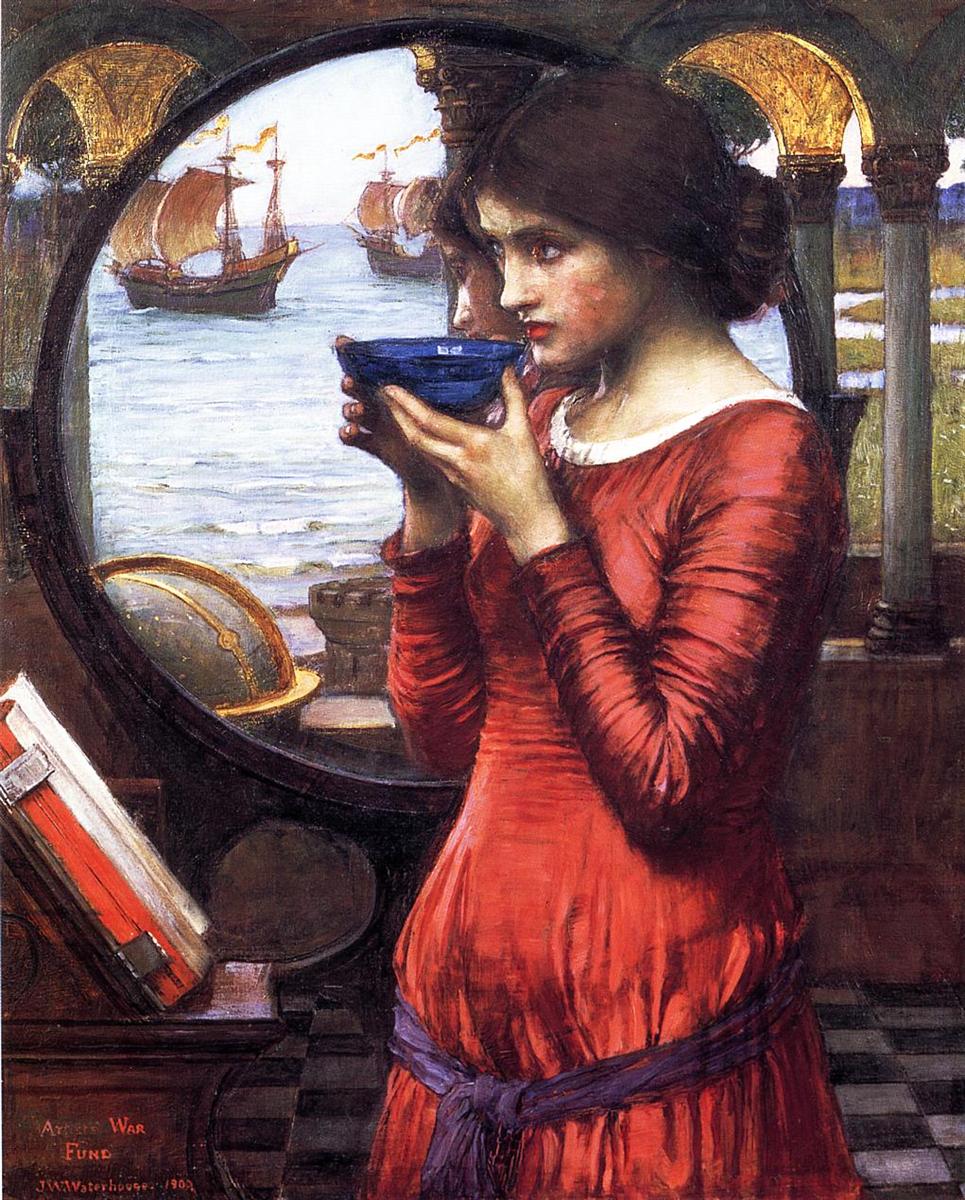
Overview of Destiny by John William Waterhouse
Painted in 1900, Destiny sits at a fascinating point in John William Waterhouse’s career, when his mature style could merge narrative clarity with a deliberate sense of mystery. Waterhouse is often associated with the Pre-Raphaelite revival, yet he was never simply repeating earlier formulas. In Destiny, he turns a quiet interior moment into an image that feels suspended between the everyday and the mythic, between private thought and the vastness of the world beyond the walls. The title does a lot of work, because it frames what could be an ordinary act, a woman raising a cup, as an allegory of fate.
What makes Destiny especially compelling is how it communicates its theme without theatrical gestures. There is no dramatic struggle, no explicit mythological spectacle, no crowd to witness a turning point. Instead, the painting offers a concentrated mood: contemplation that borders on omen. Waterhouse invites the viewer to read the scene the way one reads a sign, slowly, attentively, and with the awareness that meaning might be layered rather than stated.
Waterhouse in 1900
By 1900, Waterhouse had developed the visual language that many viewers immediately recognize: a poised female figure, richly handled drapery, a psychologically charged stillness, and an atmosphere that suggests a story continuing beyond the frame. While earlier Pre-Raphaelite painters often emphasized jewel-like detail and literary exactness, Waterhouse tends to simplify and unify. He focuses on mood, on the emotional temperature of a scene, and on the way symbolic objects can quietly shape interpretation.
In Destiny, this approach becomes almost architectural. The figure is not only placed in a room, she is placed inside a carefully designed system of shapes that guide attention and imply ideas. The painting feels composed around thought itself: inwardness set against distance, reflection set against horizon, the human scale set against the scale of the sea.
A Close Look at the Scene
At the center stands a young woman in a deep red dress, lifting a blue cup or shallow bowl close to her lips. Her posture is restrained and deliberate, as if the act is ceremonial rather than casual. Her expression is serious, absorbed, and slightly guarded. The stillness is not passive. It feels like a pause taken for listening, for sensing, for waiting.
Behind her, a large circular opening dominates, reading at once as a window, a mirror-like frame, or an emblematic roundel that turns the background into an image within the image. Through this circle, the sea appears with ships moving across the water. The contrast is immediate: the enclosed interior with its objects and measured space versus the open, shifting expanse outside. Near the woman are additional details that anchor the interior as a place of study and symbols: an open book, and a globe-like object that implies knowledge, travel, or the world as a concept. Architectural elements, including columns and arches, lend the setting a Renaissance or medieval flavor, which helps the scene feel timeless rather than contemporary.
Even without an explicit narrative, the painting feels like a moment loaded with meaning. Waterhouse places everyday-looking things into a structure that encourages allegory: a cup becomes more than a cup, a window becomes more than a view, ships become more than scenery.
Composition and the Geometry of Fate
One of the most powerful devices in Destiny is the circle behind the figure. Circles carry an immediate symbolic charge: cycles, return, completeness, inevitability. In a painting titled Destiny, the circular frame reads like a visual thesis. It also operates compositionally, because it creates a halo-like emphasis without turning the woman into a saint or a literal icon. The circle is both formal and suggestive: it centers attention while implying something eternal.
Waterhouse balances that circle with verticals and horizontals. The woman’s body forms a steady upright presence, echoed by the architectural supports. The sea line in the distance introduces calm horizontals. Meanwhile, the cup interrupts the flow with a small, intense focal point: a concentrated shape that the woman cradles, making it feel precious, possibly potent. The viewer’s eye moves from her face to the cup, then outward through the circle to the ships, then back again. That motion mirrors the theme: inner life and outer world, choice and inevitability, present moment and approaching future.
The space feels staged but not artificial. It is more like a symbolic chamber built to hold a single psychological event. In that sense, the composition itself becomes a metaphor for destiny: an invisible structure shaping how a life is seen and understood.
Color, Light, and Emotional Tone
Waterhouse uses a restrained but emphatic color conversation. The red of the dress is warm, bodily, and immediate. It reads as life, passion, and presence. Against it, the blue cup feels cool, concentrated, and enigmatic. Blue often connotes depth, distance, or the spiritual, and here it also links visually to the sea behind her. That connection subtly suggests that the cup and the ocean belong to the same symbolic world. What she holds in her hands echoes what lies beyond the window.
The surrounding interior tones are earthier and quieter, allowing the figure to carry the emotional weight. Light is handled with softness rather than sharp drama. It does not slash across the scene, it settles. This kind of lighting supports the theme of contemplation, because it avoids urgency and encourages slow looking. The painting’s mood is not explosive fate, it is the steady pressure of fate.
Waterhouse’s control of material effects matters too. The dress appears heavy yet supple, with folds that have been observed and idealized. The cup appears smooth and glazed, its surface catching light in a way that makes it feel tactile. These sensory cues pull the viewer into the scene, making symbolism feel embodied rather than purely intellectual.
The Figure as a Psychological Center
The woman’s expression is one of the great achievements of the painting. She does not smile, she does not plead, she does not perform. Her gaze is directed slightly away, as if focused on something that cannot be pointed out to the viewer. This is crucial to the painting’s power. Waterhouse creates the sensation that the true subject is internal, a thought, a realization, a premonition.
Her hands are careful with the cup, suggesting intention. The act of drinking, or preparing to drink, can be read as acceptance, testing, initiation, or ritual. It could also be read as hesitation: the cup is at her lips, but the moment is held in suspension. That suspended instant becomes the emotional heartbeat of Destiny. The viewer is left to wonder whether she will drink and what that act might mean, even if nothing literally happens in the next second. The painting’s drama is interpretive, not event-based.
This is a hallmark of Waterhouse at his best. He frames a woman not as an accessory to a plot, but as the plot’s consciousness. The story is not simply what happens to her, it is what she understands.
The Cup, Fortune, and the Ritual of Choosing
A cup can carry many meanings in Western art: communion, poison, prophecy, pledge, libation, or the vessel of one’s lot. In Destiny, the cup’s prominence and the woman’s seriousness encourage symbolic reading. It feels less like refreshment and more like a chosen act that might bind the future.
The title pushes the viewer toward fate, but Waterhouse does not eliminate agency. The cup is in her hands, and she is the one deciding when and how to lift it. That tension between destiny as inevitability and destiny as decision is part of the painting’s enduring interest. Waterhouse seems to suggest that destiny is not only an external decree but also something internalized through consent, through ritual, through the moments when a person accepts a path.
The cup’s strong blue color intensifies this feeling. It reads as special, not incidental. It is as if the object has its own gravity, an item that draws thought toward it and makes the act of drinking feel like crossing a threshold.
The Circular Opening, Reflection, and the World Beyond
The large circle behind the woman is a brilliant ambiguity. If it reads as a window, it becomes the portal to the world, with the sea and ships representing distance, travel, and the unknown. If it reads as a mirror, it becomes a metaphor for reflection and self-knowledge, and the background becomes less a literal view and more an inner projection, the mind’s image of what lies ahead.
Waterhouse does not force a single interpretation, and that openness fits the theme. Destiny is often experienced as something half-known: felt strongly, understood partially, interpreted through signs. The circular opening becomes the painting’s visual equivalent of that psychological state. It is clear, dominant, and still not fully explained.
The sea itself adds another layer. Seas in art frequently symbolize uncertainty, change, and the passage between worlds. Here, it also provides a calm distance. The ships are not in storm. They glide. That calmness changes the meaning of fate. It suggests destiny as a steady current rather than a catastrophic event. A person may move toward what is coming not through violence but through time.
Books, Knowledge, and the Limits of Understanding
The presence of an open book near the figure is quietly important. Books can symbolize learning, tradition, prophecy, or the written record of lives and myths. An open book implies something being consulted, something mid-thought, as if the woman’s action with the cup belongs to a larger inquiry. If destiny is a question, the book suggests the human attempt to answer it through knowledge.
Yet the book is not being looked at in the moment we see. Her attention has shifted. That shift can be read as a statement: knowledge alone does not settle the matter. At some point, you leave the page and face the world, or face yourself. The painting becomes a meditation on what can be known versus what must be lived.
The globe-like object adds a parallel note. It suggests the world as totality, the scope of life beyond the room. Together, book and globe hint at systems that try to map existence, learning and geography, thought and travel. Against them, the cup represents an experiential choice, something taken into the body rather than held at a distance.
Ships and the Allegory of Life’s Journey
The ships in the background are the painting’s quiet epic. They make the scene feel larger than one room and one person. In allegorical terms, ships can represent departure, fate, the soul’s voyage, or the passage from one stage of life to another. They can also suggest longing, because ships imply elsewhere.
Waterhouse positions the ships so that they feel connected to the woman’s moment. She does not turn toward them, but they hover within the circle behind her like an unspoken future. The implication is not necessarily that she will board a ship, but that her life is oriented toward movement, change, and distance. Destiny, in this light, is less a single event than a trajectory.
The ships also introduce time. They are in motion, and motion means the moment cannot last. The woman’s pause becomes more poignant because the world behind her is already going forward. That contrast gives the painting its subtle tension: stillness surrounded by progress.
Pre-Raphaelite Echoes and Waterhouse’s Differences
Destiny resonates with Pre-Raphaelite interests: the central female figure, the medievalizing setting, the symbolic objects that make the scene read like a poem. But Waterhouse’s handling is more unified and atmospheric than many of his predecessors. He is less interested in displaying separate details for their own sake, and more interested in orchestrating a single mood.
The woman in Destiny feels like a cousin to Waterhouse’s many heroines from myth and literature, yet she is not locked into a named story that the viewer must recognize. That choice changes the experience. The painting becomes more universal. Instead of asking, “Which tale is this?” the viewer asks, “What kind of moment is this?” That shift aligns perfectly with the theme of destiny, since destiny is something every viewer can project into.
Waterhouse also avoids melodrama. The symbolism is present, but it is woven into the logic of the scene. The result is an allegory that feels lived-in rather than staged.
Time, Fate, and the Painting’s Emotional Afterimage
The title Destiny can lead viewers to expect certainty, but the painting delivers something subtler: a meditation on how destiny feels from the inside. It feels like contemplation. It feels like the weight of a choice. It feels like watching the world move while you stand at a threshold.
This is why the painting lingers. Waterhouse captures the particular psychological sensation of being on the edge of something: not yet acted, not yet transformed, but already changed by awareness. The woman is not simply holding a cup, she is holding a moment of decision. The viewer recognizes that sensation even without a clear plot.
The painting also invites rereading. On one viewing, the cup may seem central. On another, the circle may become the main symbol. On another, the ships may feel like the true subject. That flexibility is not vagueness. It is a deliberate structure that mirrors the way destiny is interpreted in life: through objects, through memories, through signs, through shifting emphasis.
Why Destiny Still Captivates Viewers
Destiny remains memorable because it transforms an intimate scene into a universal allegory without losing realism or tenderness. Waterhouse offers beauty, but not empty beauty. The woman’s face carries seriousness. The space carries meaning. The background carries distance. Everything works together so that the painting feels calm and charged at the same time.
For admirers of John William Waterhouse, this work also highlights his distinctive gift: he can give symbolic painting a human pulse. His figures are not mere types. They feel like people with interior lives. That human quality keeps the allegory from becoming cold or purely intellectual.
In the end, Destiny is persuasive because it does not tell the viewer what destiny is. It shows how destiny is contemplated, held, feared, accepted, or tasted. It makes fate not a thunderbolt from above, but a moment in the hands.