Image source: wikiart.org
Introduction
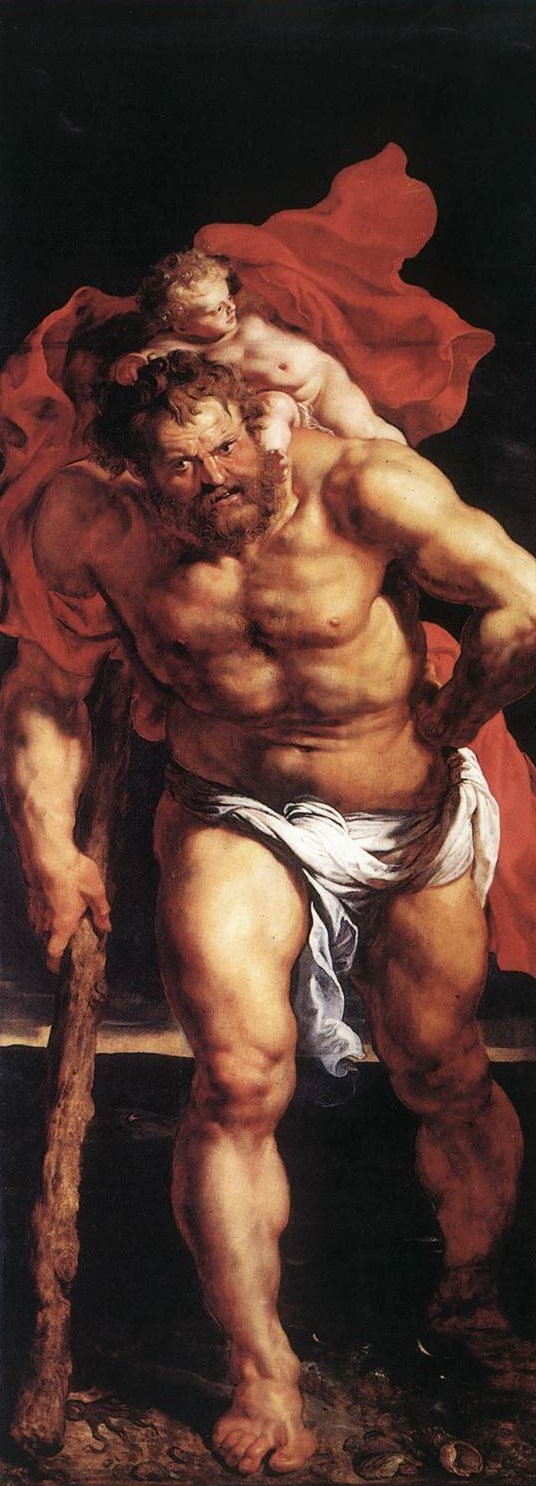
Peter Paul Rubens’s “Descent from the Cross (outside left panel)” is one of the most unforgettable single figures in Baroque art: the giant saint Christopher wades through a dark river, bent under the mysterious weight of the Christ Child perched on his shoulder, while a scarlet cloak billows like a storm cloud behind them. Painted around 1614 for the outer face of the triptych’s wings in Antwerp’s Cathedral of Our Lady, this panel meets parishioners not with sorrow but with a heroic promise. Before the altarpiece is opened to reveal the Passion scenes inside, viewers encounter the drama of bearing Christ across perilous waters—an image of service and strength that frames the entire cycle.
Historical Context
Rubens created the triptych in the fervent decades of the Counter-Reformation, when the Church asked artists to present doctrine with clarity and feeling. He had just returned from Italy, where he studied ancient sculpture, Venetian color, and the muscular narrative style of the Carracci. In Antwerp he translated that learning into a language locals immediately understood. Saint Christopher had long been beloved in the Low Countries as a protector of travelers and a safeguard against sudden death; his image often greeted worshippers at church entrances. By placing the giant saint on the outside of the wing, Rubens honors that devotion and prepares viewers for the weight of the story within.
Subject And Legend
According to legend, the pagan giant Reprobus sought the greatest master to serve. After discovering that kings feared Christ, he vowed to serve the unknown Lord by ferrying travelers across a dangerous river. One night he lifted a small child onto his shoulders and stepped into the current. With each stride the burden grew heavier, until the giant staggered and leaned on his staff. On the far bank the child revealed himself as Christ, whose weight was the weight of the world he carried. Rubens condenses the tale into one concentrated instant: the stride, the lean, the effort, and the piercing recognition.
Composition And Scale
The panel’s tall, narrow format makes Christopher tower like a living column. Rubens plants the saint’s right foot deep in the riverbed while the left foot lifts to find purchase—an exaggerated contrapposto that gives the whole body the rhythm of trudging forward. The diagonal of the tree-trunk staff echoes the tilt of the torso, creating a second support that visually braces the weight. The Christ Child curls along the saint’s shoulder, his arm around Christopher’s head, his body tucked into the red cloak. The composition draws the eye upward from river stones to gnarled staff, along the corrugated ridges of torso and shoulder, and finally to the soft gravity of the Child.
Baroque Body And Living Stone
Rubens turns the saint into a triumph of anatomy. The body is not a studio pose but a machine engaged in labor. The trapezius knots under the Child’s grasp; pectorals and deltoids swell as the arms clutch staff and bundle; the abdomen is tight from the effort of balancing; thighs and calves bulge with the strain of pushing through water. It is a body that convinces the eye and the imagination, and precisely because it is so physically credible, the allegory persuades. Christopher is the Church’s strong back, bearing Christ to the world through work that is difficult and muddy.
Light And Chiaroscuro
A raking illumination washes from the left, turning the saint’s skin into warm bronze cut with cold reflections. Highlights explode on shoulder, chest, and knee, then fall away into a brown-black ground that swallows space and time. The light is practical—showing us the shapes needed to read the movement—and theological, separating the human colossus from the night that surrounds him. On the Child, that light softens, wrapping small limbs in pearly halations and turning hair into a corona. The result is a graded light that moves from blazing strength to gentle radiance, a visual echo of the legend’s meaning.
The Cloak As Banner Of Salvation
Rubens unfurls the saint’s red cloak behind the Child like a sail catching an invisible wind. It is both garment and sign. As color, it is the painting’s engine, balancing the massive flesh with a swath of saturated red that announces warmth and life. As symbol, it functions as the mantle of salvation under which the faithful are carried. The cloak also binds figures together: it nestles the Child against the saint and completes a circular movement that keeps the eye revolving within the frame rather than sliding out of it.
The Christ Child And The Mystery Of Weight
The Child is not a decorative accessory; he is the active giver of weight. Rubens shows him not as a fragile doll but as a living presence with compact muscles, pressed cheek, and watchful eyes. The Child’s hand hooks around the giant’s head with the casual intimacy of a toddler and the quiet authority of a king. His small body is the compositional counterweight to the saint’s mass, and his identity explains the miracle: matter loaded with meaning becomes heavier than stone. The painting thus invites a double reading—physical and metaphysical—without forcing a choice between them.
Water, Footing, And The World Below
At the saint’s feet Rubens paints the riverbed with tactile specificity: shells, pebbles, ripples, and the sucking darkness between submerged stones. The big toes curl and splay as they search for traction, the skin pruned and slick from the current. These small details emphasize danger and give the picture sonic life. One can almost hear the clink of shells and the rush of water around the staff. The earthiness of the river sets off the transcendence of the task; grace arrives, but not in a vacuum. It comes while you are wet and straining and half-blind in the dark.
The Staff As Cross And Pilgrim’s Tool
The staff is a stripped tree trunk, crooked, heavy, and practical. It bears the scars of nature and work. Rubens weds emblem and object: as pilgrim’s tool it redistributes weight and steadies the body; as symbol it prefigures the cross. Its diagonal thrust organizes the panel and gives the saint something to push against visually and spiritually. When Christ later tells his followers to take up their cross, this is one form that command takes—a tool that is first necessity and then sign.
Psychology And Expression
Christopher’s face is furrowed with strain and concentration, but it is not grim. The mouth opens slightly as if drawing breath; the eyes glance upward toward an unseen bank; the brow is knit with the math of weight and distance. The expression carries the moment just before recognition—the narrative instant when the burden still seems inexplicably heavy. The Child’s face, by contrast, is calm and alert, the look of one who knows a secret and is patient for its unveiling. Rubens tells the story through this contrast of expressions: human labor approaching epiphany, divine knowledge held in tender reserve.
Color And Flesh
Rubens modulates skin with warm ochres, russets, and cool pearl grays, a Venetian lesson recast in northern light. The saint’s body is sun-browned except where the shoulder catches cold reflection from the cloak and the sky. The Child’s flesh is paler, almost luminous, modeled with gentle transitional tones that make the small form breathe. The white loincloth at the saint’s hips is painted with quick, thick touches that catch highlights and link the palette to the luminous whites within the larger triptych. Throughout, color remains subordinate to form and meaning; it serves movement, weight, and narrative.
Relationship To The Triptych
As the exterior image, Saint Christopher functions like a threshold. He offers the faithful a promise of help for the journey that culminates in the central mysteries displayed when the wings open. The outside left panel declares that the bearing of Christ—whether by a giant ferrying travelers or by the Church celebrating sacraments—requires strength and steadiness. When closed, the triptych shows the world at night and in transit; when opened, it reveals the events of salvation. Rubens thus uses the mechanics of the altarpiece to turn a legend into liturgy.
Classical Sources And Baroque Transformation
The sculptural grandeur of the saint’s torso recalls the ancient Hercules, a model Rubens knew intimately from Roman marbles and medals. Yet this is not a muscle display; it is a body under a task. By taking the classical hero and converting his strength to service, Rubens performs a quintessential Baroque maneuver: he baptizes antiquity. The heroic scale that once celebrated civic pride now declares Christian charity. The transfer is persuasive because the painter grounds it in credible anatomy and lived gesture.
Movement, Time, And The Viewer’s Body
The panel is composed to make spectators feel motion in their own legs and shoulders. The lifted foot, the forward lean, the flexed hands on staff and bundle trigger the viewer’s kinesthetic memory of carrying and wading. That empathy anchors interpretation. We do not merely admire; we participate. Rubens’s gift is to yoke that bodily participation to theology: to feel the effort is already to grasp the meaning, because the meaning is effort willingly undertaken for another.
Material Splendor And Moral Clarity
As always with Rubens, paint itself becomes argument. The scarlet cloak’s thick ridges glint in real church light; the wet sheen on skin reads at thirty paces; the wood of the staff seems rough enough to rasp the palm. This sensuousness never distracts from the moral clarity of the scene. Instead, it makes the lesson stick. The more convincing the matter, the more indelibly the meaning presses into memory: carry, steady, step, breathe—bear Christ where you are.
Devotional Uses And Popular Appeal
In the seventeenth century the image of Saint Christopher was more than edifying; it was practical. Travelers invoked his protection; urban dwellers prayed to him against sudden, unprepared death. Rubens respects that popular piety by giving the saint a face both strong and approachable, a giant one could trust. Placed on the exterior, the picture blessed passersby even when the church was closed. Its value was not confined to the Eucharistic moment; it served daily life, turning the act of crossing any street or river into a small imitation of the saint’s task.
Comparisons Within Rubens’s Oeuvre
Rubens loved monumental single figures engaged in action—Samson, Hercules, sileni, and mythic boatmen. Saint Christopher belongs to this family but stands apart for its tenderness. The giant’s force is yoked to care, his stride to a child’s clinging hand. Compared to the philosopher-king gravitas of his Roman heroes, Christopher’s nobility is simpler and more immediate: he is noble because he carries. The panel also balances the ease of the Christ Child in other Rubens canvases with the heavy, quiet gravity he bears here.
How To Look
Begin by letting the scale do its work: stand back and feel your own body match the saint’s stride. Then trace the diagonals—the staff, the tilt of head and shoulders, the swirl of cloak—that stabilize the composition. Step closer and read the micro-dramas: the Child’s fingers pressing into hair, the gleam on the saint’s knee, the furrowed brow, the gnarl of the staff’s bark, the crushed shells underfoot. Finally, let the legend reassemble from these sensations. The moment you feel the heaviness and the forward pull, the meaning has already arrived.
Enduring Relevance
The panel continues to speak because its message is embodied and universal. Everyone knows what it means to carry something heavy for someone small. Rubens dignifies that common act, tying it to the central mystery of faith. The painting is, in the end, a proposal about power: real power is not domination but bearing. Real greatness is not detachment but weight taken gladly. In Christopher’s stride a city of merchants and artisans could recognize its own virtues; a modern viewer can, too.
Conclusion
“Descent from the Cross (outside left panel)” transforms a beloved legend into a towering image of charitable strength. Rubens fuses Herculean anatomy with the intimacy of a child’s embrace, dramatic light with tactile detail, and popular devotion with theological depth. Before the triptych opens to show the drama of Christ’s Passion, this wing announces the terms on which that drama meets the world: someone must carry Christ across the waters. Rubens shows us how—one step, one breath, one faithful shoulder at a time.