Image source: wikiart.org
Introduction
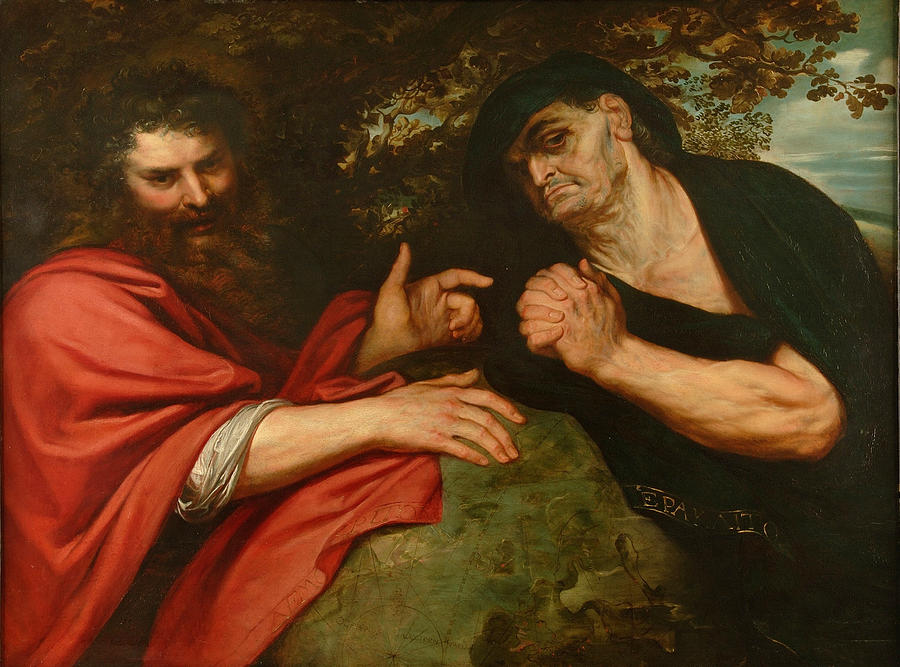
Peter Paul Rubens’ “Democritus and Heraclitus” is an arresting double portrait of two ancient Greek philosophers who came to symbolize opposite ways of responding to the world. Democritus, the “laughing philosopher,” is usually associated with a cheerful acceptance of human folly, while Heraclitus, the “weeping philosopher,” is known for his melancholic awareness that all things are in flux. Rubens turns this well-known contrast into a vivid Baroque encounter: two powerful half-length figures lean over a globe, their bodies almost touching, their hands and expressions revealing very different attitudes to the same reality.
More than a historical illustration, the painting is a meditation on how we confront history, politics, and the uncertainty of life. The globe beneath their hands evokes the fate of the world; the philosophers’ opposing responses become a mirror in which viewers can examine their own way of facing change and instability. With his typical mastery of color, gesture, and psychological expression, Rubens uses the ancient pair to speak directly to the moral anxieties of his own century—and to ours.
Philosophical and Iconographic Background
Democritus and Heraclitus were already a familiar pairing in Renaissance and Baroque art and literature. Writers loved to contrast them: Democritus, who laughed at the vanity and irrationality of human affairs, and Heraclitus, who lamented their tragedy. Together they stood for the two temperaments of philosophy, one wryly amused, the other sorrowfully compassionate. By Rubens’ time, this pair had become a kind of moral emblem. To picture them together was to stage a debate about the proper attitude toward the world.
Rubens, a humanist as well as a painter, would have known the literary tradition that associated Democritus with the study of nature—especially atoms and the void—and Heraclitus with the doctrine of perpetual change: “everything flows.” These ideas resonate with a seventeenth-century Europe racked by war, plague, and political upheaval. In such a context, the question of whether to laugh or weep at the state of the world acquires sharp relevance. The inclusion of a terrestrial globe underlines this: what they contemplate is not an abstract diagram but the map of human history and power.
A Dramatic Double Portrait
Compositionally, the painting is a double portrait framed by an overarching canopy of foliage. The two figures fill almost the entire width of the canvas, pressing toward each other and toward the viewer. There is no background architecture or distant landscape to dilute their presence; only the thick, leaf-laden tree above them hints at the larger world. The focus is on heads, hands, and the round mass of the globe that anchors the center.
This tight framing creates the impression that we have intruded upon an intense private conversation. The philosophers lean over a stone ledge or the curved surface of the globe; their arms rest upon it as if the weight of the world literally lies beneath their hands. The closeness of the figures, matched by their strikingly different moods, gives the painting an almost theatrical tension: two actors in a moral drama, frozen at the peak of dialogue.
Democritus: Warmth, Insight, and the Half-Smile
On the left, Democritus appears as a robust, curly-haired man wrapped in a voluminous red cloak. His beard is full, his cheeks flushed, his eyes lively. Rubens gives him a subtle, knowing smile—a mouth that seems on the verge of laughter without caricature. The expression suggests not mockery but a kind of amused understanding, as if he recognizes the vanity of human schemes yet remains good-natured about it.
His body language reinforces this impression. Democritus leans forward, left arm draped casually across the ledge, right hand gesturing with a bent thumb, as though explaining or pointing out something on the globe. The pose feels open and expansive. The bright red of his cloak, so typical of Rubens’ coloristic bravura, radiates warmth and energy. It connects Democritus with passion and life, yet the relaxed folds and the soft light on the fabric keep the tone friendly rather than aggressive.
Rubens does not turn Democritus into a frivolous jester. Instead, he appears as a philosopher whose laughter springs from insight. The slightly furrowed brow and the intense gaze show that he has looked deeply into the world’s disorder; his smile is the resilience of someone who has accepted that imperfection is inevitable and chooses to respond with tolerant humor.
Heraclitus: Gravity, Sorrow, and the Burden of Flux
On the right, Heraclitus forms a dramatic contrast. Cloaked in black, his head covered by a hood or cap, he bends over the globe with a deeply furrowed brow and downturned mouth. His hands, clasped tightly together, rest on the stone as if he needs physical support to bear the weight of what he sees. The lines etched into his face and neck make him appear older, more worn, as though years of contemplation have carved themselves into his flesh.
The dark clothing and sharp modeling of his muscles lend him a monumental, almost sculptural presence. Whereas Democritus’ red cloak opens out in fluid curves, Heraclitus’ drapery falls in heavy, angular folds. His gaze does not meet Democritus or the viewer; he looks downward, inward, immersed in sorrowful reflection. The overall effect is one of brooding gravity. Rubens allows us to feel the compassion behind his sadness. Heraclitus does not despise the world; he suffers with it, mourning the instability and injustice he perceives.
This emotional heaviness echoes the philosopher’s traditional reputation as the one who wept at human affairs. At the same time, Rubens suggests that such sorrow emerges from a profound sensitivity: Heraclitus feels the tragedy of flux more intensely than others. In his clasped hands and tense shoulders we sense a struggle to reconcile insight with hope.
The Dialogue of Hands and Gestures
The painting’s psychological drama plays out not only in the faces but in the hands. Democritus’ hands are active and communicative. His right hand forms a loose gesture, thumb raised, index finger pointing sideways, as if explaining a detail on the globe or making a philosophical point. His left hand, resting lightly on the stone, appears relaxed, fingers gently curved. These hands indicate openness, a willingness to engage and interpret.
Heraclitus’ hands, by contrast, are clenched together in a tight, almost prayer-like pose. The knuckles are prominent, the veins and tendons under the skin tense. Rubens uses these hands to show emotional compression: grief and concern folded inward, contained but powerful. They are the hands of someone who struggles not to be overwhelmed by his own sensitivity.
Together, the two sets of hands create a visual dialogue. On one side, a gesture outward, explaining and contextualizing; on the other, a gesture inward, bearing the weight of feeling. The globe between them becomes the unspoken object of their debate—whether to interpret the world with ironic acceptance or mournful compassion.
The Globe and the Fate of the World
At the center of the painting lies the globe or mapped surface on which both philosophers rest. Though partly obscured by the figures, we can see faint outlines of continents and seas. This detail transforms the scene from a purely personal encounter into a meditation on the state of the world itself.
For Rubens and his contemporaries, a globe was not only a scientific object but a symbol of empire, exploration, and human ambition. It stands for global politics, wars, trade routes, and territorial claims—topics Rubens knew well from his own diplomatic experiences. By placing Democritus and Heraclitus around this globe, the artist suggests that their philosophical attitudes are responses to real historical conditions, not abstract puzzles. They contemplate the same troubled earth, yet react differently.
The stone-like texture of the globe’s surface hints at its stubborn reality; human emotions cannot easily reshape it. At the same time, the philosophers’ hands show that our interpretations and decisions do matter. The world lies literally under the hands of those who think about it, a reminder that ideas influence actions and that the way we emotionally frame events can shape our choices.
Color, Light, and Emotional Atmosphere
Rubens’ use of color intensifies the contrast between the two figures. The warm reds and flesh tones surrounding Democritus bathe his side of the canvas in a golden glow. Light falls softly on his face and beard, catching the curls and giving his features a gentle radiance. The red cloak, with its thick, sensuous folds, seems almost alive, echoing the philosopher’s warm disposition.
On Heraclitus’ side, the palette darkens. Blacks, deep browns, and muted greens dominate, and the light is more subdued. Shadows carve out the hollows of his cheeks and the wrinkles on his forehead, heightening the sense of inner turmoil. Even the leaves of the tree behind him appear denser, more shadowed, as though nature itself sympathizes with his mood.
Yet the painting is not split into two separate color zones; there is a subtle transition where their forms meet. Light from the left spills across the globe and touches the lower part of Heraclitus’ arm, hinting that the two attitudes are not wholly isolated. Rubens suggests that laughter and sorrow, warmth and darkness, are intertwined dimensions of the same human response to the world.
Brushwork and Physical Presence
As in many of Rubens’ works, the brushwork here is vigorous and tactile. The beards, hair, and draperies are built up with thick, confident strokes that catch the light and create a sense of volume. The skin of both philosophers shows the artist’s sensitivity to flesh: subtle gradations of color model the muscles and veins, giving their arms and hands a strongly physical presence.
This emphasis on physicality matters philosophically. Rubens does not portray the thinkers as ethereal intellectuals detached from the body. Instead, they are robust, muscular men whose thoughts are inseparable from their embodied existence. Their emotions register in physical tension: Heraclitus’ clenched jaw, Democritus’ relaxed shoulders, the way each leans over the heavy globe.
Such palpable corporeality makes their debate feel grounded and human. It reminds viewers that philosophy is not an abstract game but a way of living, choosing how to carry the “weight” of the world in our own bodies and hearts.
Humanist Meaning and Moral Reflection
At a deeper level, “Democritus and Heraclitus” functions as a moral mirror. Rubens juxtaposes two temperaments without declaring one superior. The painting invites viewers to consider their own inclination: are we more like Democritus, responding to human folly with humor and resilience, or like Heraclitus, grieving over injustice and transience?
The work also suggests that both attitudes are necessary. Laughter can prevent despair, granting distance from our own pretensions. Sorrow, however, keeps us sensitive to suffering and prevents cynicism. If we only laughed, we might become callous; if we only wept, we might be paralyzed. By placing the philosophers in such close proximity, Rubens hints that wisdom lies in holding both responses in tension.
The presence of the globe encourages another layer of reflection: in a world marked by war and political turmoil, how should rulers and citizens respond? Democritus’ humor might guard against fanaticism and pride, reminding leaders that schemes are often undermined by chance. Heraclitus’ melancholy might make them more compassionate and aware of the costs of power. Rubens, himself a diplomat working to negotiate peace, had every reason to contemplate these questions.
Place within Rubens’ Oeuvre
This painting fits within Rubens’ broader interest in classical antiquity and in the expressive capacities of the human figure. Throughout his career he painted philosophers, saints, and heroes not as static icons but as psychologically complex individuals whose faces and bodies reveal inner conflict. “Democritus and Heraclitus” is exemplary in this regard: a tightly focused composition dedicated entirely to the drama of thought and feeling.
Compared with his large altarpieces and mythological epics, the canvas is relatively small and intimate. Yet it shares the same Baroque energy. The swirling drapery, powerful hands, and engaged expressions all bear Rubens’ unmistakable signature. At the same time, the work reflects the artist’s intellectual curiosity; it is as much a conversation with ancient philosophy as a display of painterly virtuosity.
In the context of seventeenth-century Flemish art, the picture stands out for its combination of portrait-like realism and allegorical meaning. It belongs to a tradition of “philosopher portraits,” but Rubens elevates the genre, giving the figures monumental scale and embedding them in a rich, emotionally charged dialogue.
Conclusion
“Democritus and Heraclitus” is far more than a decorative pairing of ancient thinkers. In Rubens’ hands, the laughing and weeping philosophers become powerful embodiments of two enduring human responses to the turbulent world. Democritus, wrapped in warm red, gestures with open hands and a knowing smile, ready to interpret the globe with wry humor. Heraclitus, cloaked in black, clasps his hands and bows his head, weighed down by the sorrow of constant change. Between them lies the image of the earth itself, the shared object of their concern.
Through masterful composition, nuanced color, and deeply felt characterization, Rubens transforms a classical theme into a timeless reflection on how we confront history, politics, and mortality. The painting does not force us to choose between laughter and tears; instead, it suggests that genuine wisdom might spring from an honest acknowledgment of both. Standing before this intense double portrait, viewers are invited to ask themselves: when we contemplate the state of the world, do we laugh, weep, or somehow do both at once?