Image source: wikiart.org
Introduction
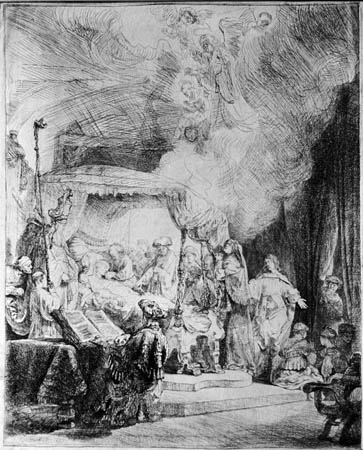
Rembrandt’s “Death of the Virgin” (1639) is one of the most ambitious prints of the Dutch Golden Age. In a single etching he gathers apostolic witnesses, clerics, attendants, furniture, books, a canopy bed, and a radiant company of angels pouring down like a waterfall of light. The scene is crowded yet legible, intimate yet theatrical. Rather than present Mary’s passing as a solitary moment, Rembrandt stages it as a communal vigil that opens toward heaven. The drawing needle becomes an instrument of light: dense nets of lines carve a cavern of shadow, while open paper glows to shape figures, textiles, and the cloud-borne glory above. The result is both a narrative image and a meditation on presence—the presence of friends at a bedside, of scripture in a room, and of grace that cannot be contained by architecture.
Subject and Tradition
The theme comes from the late-medieval and early modern tradition often called the Dormition or Death of the Virgin. Artists typically show the apostles assembled miraculously around Mary’s bed, Peter reading prayers, and angels receiving her soul. Rembrandt inherits this iconography but reworks it with his own priorities. The epicenter is not a ritual object or a singular miracle; it is a human room where scripture, prayer, and affection converge. The print honors Catholic precedent while speaking in a language of lived observation that Protestant viewers in Amsterdam would recognize: a group gathered to keep watch, to read, to care.
The Room as Stage
All of the action unfolds within a high chamber capped by an arched vault. The space is heavy with fabric: the bed is curtained, a coverlet pulls into folds, and a great drape at right falls like a velvet wing. Rembrandt uses these textiles to choreograph light. The canopy creates a proscenium over the bed, concentrating attention; the broad drape at right plunges into darkness, preventing the eye from drifting offstage; smaller curtains and tassels generate a rhythm of curves that counter the architecture’s hard lines. The room feels at once domestic and ceremonial—a household space transfigured by the gravity of the event.
The Bed and the Blessed
At the center lies Mary, her body propped and gently turned toward the reader-priest. She is small compared to the crowd, yet the most luminous shape in the human register. Rembrandt refuses melodrama: her face is peaceful, the mouth slightly open as if mid-prayer, the hands at rest. The pillows yield softly, the coverlet draws across her body with gravity rather than flourish. By not idealizing or theatricalizing death, he permits tenderness to do the work of pathos. The bed is raised on a shallow platform; that small elevation, together with the canopy, underscores honor without isolating the dying from the living.
The Company of Witnesses
Rembrandt arranges a semicircle of apostles and attendants, each with an individualized posture. Some lean forward in concentration; others draw back in grief; one seems to whisper a psalm; another folds hands in quiet resignation. This variety of gestures prevents the crowd from becoming a decorative pattern. Every figure is busy with the act of watching—an activity that Rembrandt treats as a sacred craft. He scatters a few figures in the shadows at far right and left, so the vigil seems to extend beyond the edge of the plate, as if people have been coming and going for hours.
The Reader and the Book
At the left foreground stands a cleric or elder with a crozier-like staff, while before him lies a great book spread open on a reading desk. The folios catch the brightest earthbound light in the print, second only to the bed linens. The placement is deliberate. Scripture and prayer are the room’s axis; Mary’s body is aligned to that axis. The splayed pages, described with a masterly economy of parallel lines, feel heavy and authoritative, yet they also flicker—Rembrandt suggests the sheen of paper by leaving patches of white that look like light pooling on the surface. We almost hear the faint rasp of a turned leaf.
The Descent of Angels
From the upper vault a cascade of angels enters, their approach shaped not by rigid outlines but by vaporous hatching and reserves of untouched paper. Broad arcs of parallel lines create a cloudburst that breaks into winged forms and faces. The central angel stands nearly full length, hands clasped, framed by a nimbus of radiant white. Others cluster around in a choir that seems to sing the room into brightness. This vision is Rembrandt’s most daring invention: heaven does not politely appear in a window; it presses down through the air, drawing the eye upward and connecting earthly vigil to cosmic welcome.
Chiaroscuro in Etched Line
The print is a tour de force of value made from line alone. Rembrandt thickens his hatching where he wants structural darks—the right-hand drape, the vaulted ceiling, the far recesses of the bed. He spaces lines wider and bends them gently to model the big forms—the canopy’s scallops, the cloud’s billows, the folds of pillows. Where he desires the highest light, he simply leaves the paper bare: Mary’s face, a sliver of her linen, the pages of the book, the angelic glow. Drypoint burr adds velvet to certain edges, especially in the massed darks at right, so that the scene breathes even in its shadows.
Orchestration of Attention
The viewer’s journey through the plate is carefully plotted. We enter via the brilliant book, move diagonally to the bed, climb along the line of the canopy to the cloud of angels, descend through the crowd at right, and then return to the reader to complete the circuit. This path is also a theological sequence: Word read, comfort given, heaven opened, community consoled, Word returned to. The print thereby functions as a visual homily; it teaches by arranging the eye’s pilgrimage.
The Spectrum of Emotion
Although quiet reigns, the image contains a vast emotional register. Some faces are lit with calm; others sink into their hands. A kneeling woman turns away, her attention captured by private grief; a figure at far right leans back as if the influx of light has struck with unexpected force. Rembrandt does not assign a single meaning to death. He allows the company to model a range of responses—prayer, sorrow, astonishment, fatigue—so that viewers may find their own place among them. The crowd becomes a mirror for the living.
Fabric, Furnishing, and the Poetics of Texture
The print is filled with objects that speak quietly: the finial of a bedpost, the embroidered edge of a curtain, the low-set stool, the chair in the right foreground with its empty seat. These touches, recorded with brisk yet precise strokes, confer credibility and supply contemplative anchors. The empty chair is particularly eloquent: it holds a space into which any viewer might sit, transforming spectatorship into attendance. Rembrandt’s tactility—his way of making cloth feel soft, wood solid, metal cool—turns a doctrinal scene into a room we might enter.
Heaven’s Light and Earth’s Shadow
One of the print’s most subtle achievements is the way heavenly brightness mingles with earthly light. The angelic radiance pours in, yet a separate, lower light bathes the book and the bed. The two do not compete; they collaborate. The lower light speaks of lamps, windows, and human care; the higher light speaks of a reality that answers that care. By staging both, Rembrandt avoids triumphalism. Grace does not erase the room’s shadows; it inhabits them and makes the community’s work visible.
The Architecture of the Canopy
The bed’s canopy is a marvel of drawing. Its roof is treated like a shallow vault within the larger vault of the room, and its drapery sculpts air. The inward curves press gently on the company below, intensifying the sense of huddled proximity. At the same time, the canopy’s scalloped edges echo the cloud shapes above, visually rhyming furniture and heaven. This echo reassures viewers that the two realms are contiguous: heaven’s shapes can be glimpsed in the decent forms of human making.
Sound, Breath, and the Sense of Time
Good prints suggest more than sight. Here we imagine muffled prayers, the stuttering breath of the dying, the soft hiss of a candle, the hush that falls as the angels near. Rembrandt creates this acoustic through density and openness: the left side busier with marks where speech and reading occur, the right side more open where spectating and wonder dominate. Time, too, is palpable. The company does not look like a tableau frozen in a single instant; it looks like people who have been present for hours and will remain after the image ends.
Between Doctrine and Daily Experience
Rembrandt always steers between abstraction and genre. The death of Mary was, for Catholic viewers, a theological moment; for Protestants, an occasion for meditating on Christian death more broadly. The etching satisfies both by translating doctrine into human presence. We do not watch a miracle spectators; we attend a bedside with friends while heaven draws near. That universality accounts for the print’s persistent appeal across confessional boundaries.
The Role of the Artist Within the Scene
One senses the artist’s own pictorial conscience embodied in the reader at the left foreground. He keeps the book open and the words flowing, even as light and vision threaten to dissolve the need for text. Rembrandt, a maker of images, refuses to pit image against word. He allows both to serve the event: the book gives the community something to say; the image offers something to see when words thin out. The etching thus becomes a credo about art’s vocation—to accompany, not to replace.
Comparisons and Lineage
The composition recalls earlier treatments of the subject—Mantegna’s structured architecture, Titian’s flowing groups, Caravaggio’s realism—but it feels like none of them. Rembrandt’s angels owe something to baroque theatrics, yet their tenderness is his own. His apostles are neither saints carved from marble nor peasants dragged from the street; they are believable men touched by sorrow. By binding Italian grandeur to Dutch observation through the language of etching, he builds a synthesis unique to his art.
Technique and States
Many impressions of the print show slight differences in the strength of the upper darks and the burr on the denser hatchings, reminding us that etching is as much performance as plan. The atmospheric grain that envelops the angels likely arises from controlled foul-bite and from Rembrandt’s habit of playing the plate’s accidents into cloud textures. This acceptance of chance harmonizes beautifully with the subject: the room is ordered, but life and grace overflow the lines.
The Viewer’s Inclusion
Rembrandt leaves a generous foreground space by the reading desk and the empty chair. Those areas function like thresholds. We stand on that floor with enough room to kneel, sit, or draw closer. The design insists that death is not an image to contemplate from a safe remove; it is a rite to which we are invited—not as voyeurs, but as attendants. The print’s empathy arises from this structural hospitality.
Why the Image Endures
The etching endures because it combines opposites without collapsing them. It is densely populated yet spiritually focused, doctrinal yet human, solemn yet tender, theatrical yet intimate. It displays virtuoso draftsmanship but never for its own sake. Above all, it honors the ordinary work of care at the end of life, even as it opens a window to glory. Viewers across centuries recognize in it both the rooms where they have kept watch and the hope they have tried to hold.
Conclusion
“Death of the Virgin” is a masterclass in how etching can stage light, gather community, and make doctrine tangible. Rembrandt turns a chamber into a sanctuary, a bed into an altar of tenderness, and a book into a lamp. Angels descend, but they do not erase the human scene; they complete it. In the quiet orchestration of faces, gestures, and fabrics, we feel the dignity of a death observed in love. The print asks only that we look with the same attention the figures give Mary—and in that careful looking, it teaches us how to keep vigil.