Image source: wikiart.org
Introduction to “Death of the Inquisitor Pedro de Arbués”
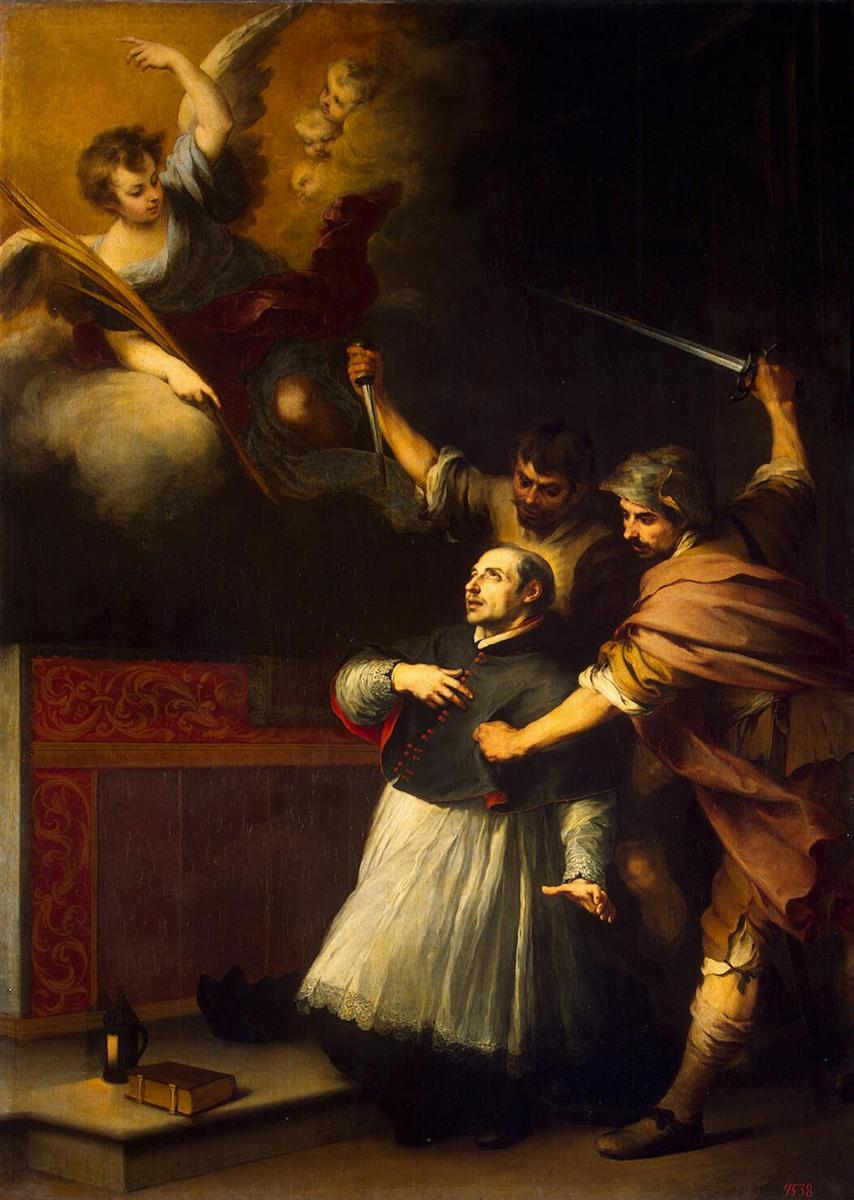
“Death of the Inquisitor Pedro de Arbués,” painted by Bartolome Esteban Murillo in 1664, is one of the artist’s most intense and theatrical religious works. The painting captures the assassination of Pedro de Arbués, the inquisitor of Aragon, who was murdered while praying in the cathedral of Zaragoza in 1485. In the seventeenth century he was venerated as a martyr for the Catholic faith, and Murillo’s scene presents his death not as a simple act of violence but as a moment of spiritual triumph.
At first glance the viewer is drawn to the kneeling cleric dressed in white and black. Two men restrain and stab him, their bodies twisted in tension. Above, in a golden cloud, an angel descends holding a palm of martyrdom, accompanied by cherubic heads that emerge from the light. The contrast between brutal action and heavenly vision creates a powerful meditation on sacrifice, grace, and religious fervor within the Spanish Baroque world.
Historical and Religious Background
Understanding the subject increases the impact of Murillo’s painting. Pedro de Arbués served as inquisitor during the turbulent years after the establishment of the Spanish Inquisition. His assassination in Zaragoza was attributed to conspirators who resisted the Inquisition’s power, and later Catholic tradition portrayed him as a defender of orthodoxy who died for the faith. By Murillo’s time, Arbués had been beatified and his cult as a martyr was promoted throughout Spain.
Murillo painted this work for a religious institution in Seville at a moment when Spain strongly associated national identity with Catholic orthodoxy. Images of martyrs, especially those linked to the Inquisition, served both devotional and political purposes. They encouraged reverence, emphasized the costs of defending the faith, and suggested that those who opposed church authority were aligned with violence and chaos.
Within this context, Murillo had to produce a painting that was emotionally stirring but also clearly supportive of Arbués’s sanctity. The result is a complex work that balances historical drama with spiritual exaltation.
Composition and Spatial Structure
The composition is built on a strong diagonal that runs from the upper left, where the angel appears in a radiant cloud, down to the lower right, where the assassins and the dying inquisitor struggle. This sweeping line unites heaven and earth, suggesting that what happens below is immediately answered above.
Pedro de Arbués kneels near the center of the painting, slightly toward the left. He is placed close to the viewer, almost at the edge of the picture plane, which heightens the sense of immediacy. Behind him, the dark interior recedes deeply, although Murillo keeps most of the setting in shadow. Only a portion of the altar rail, decorated with warm red and gold patterns, is clearly visible. On the step in the lower left, a book and a lantern lie abandoned, tangible reminders of Arbués’s interrupted prayer.
The two attackers stand to the right of the inquisitor. One grips him around the torso, preventing escape, while the other raises a sword for a second blow. Their muscular forms and tense poses contrast with the more static, surrendered posture of the victim. Above, the angel and cherubs occupy a large cloud of golden light that expands across the upper left quadrant, balancing the dark mass of figures below.
By arranging the figures in such a dynamic yet balanced structure, Murillo creates a visual path that guides the viewer’s eye from the earthly violence to the heavenly response.
The Figure of Pedro de Arbués
Murillo presents Arbués not as a distant legendary figure but as a very human cleric caught in the fatal moment. He kneels in a white surplice with fine lace at the hem, over which he wears a dark rochet or mozzetta adorned with small red buttons. His garments glow in the strong light that falls upon him, creating a stark contrast with the dark surroundings.
The inquisitor’s body tilts backward as one assassin drags him, yet his knees remain on the ground, a sign that he was praying when attacked. His left hand presses to his chest, near the wound, while his right hand opens as if in plea or surrender. His face, turned upward, catches the same light that illuminates the angel, creating a luminous link between martyr and heavenly visitor. The expression is not one of terror but of startled awe, as if he suddenly glimpses the reality beyond his suffering.
Murillo’s attention to physiognomy is evident in the subtle lines around Arbués’s mouth and eyes, which suggest maturity and experience. The bald head and tonsure emphasize his clerical status. By humanizing him and focusing on his reaction rather than on graphic bloodshed, Murillo invites the viewer to feel reverence rather than horror.
The Assassins and the Drama of Violence
The two attackers are painted with great energy. The man behind Arbués grips him around the shoulders and thrusts a dagger into his side. His face, partially shadowed, shows determination. Muscles and veins stand out in his forearm, emphasizing the physical effort involved. The second assassin, positioned further right, holds a sword raised high, ready to strike again. His mouth is set, his brows knit, and his stance wide and braced.
These figures are clad in the rough garments of ordinary men: simple shirts, short doublets, and cloaks draped over their shoulders. The earthy tones of their clothing reinforce their distance from the refined white and black of the inquisitor’s vestments. Murillo does not caricature them as monsters, but he does emphasize their worldly, grounded nature. They are guided by earthly anger, not spiritual light.
The diagonals created by their arms and weapons contribute to the overall sense of movement. The dagger that pierces Arbués points upward toward the angel, ironically linking violence with divine glory. The raised sword, glinting in the light, forms a sharp contrast with the soft curves of the heavenly cloud above.
The Angel and Heavenly Vision
One of the most striking aspects of the painting is the apparition in the upper left corner. Emerging from a golden cloud, an angel in a blue robe descends, holding a palm branch, the traditional symbol of martyrdom. The angel’s face is youthful and serene, framed by soft curls, and the gesture of the extended arm directs the palm toward the dying inquisitor. Around the angel, cherubic heads emerge from the radiant vapor, witnesses to the heavenly welcome awaiting Arbués.
This vision functions on several levels. Theologically, it asserts that Arbués’s death is not defeat but victory. The palm promises eternal reward, and the angel’s calm expression assures viewers that justice lies beyond earthly events. Visually, the luminous cloud counterbalances the dark, crowded scene below. It also provides the primary source of light that bathes the inquisitor, linking his inner state with the celestial realm.
Murillo’s handling of the cloud is particularly expressive. Soft edges and layered tones of gold, cream, and warm gray suggest a supernatural presence that blends light and mist. The transition from this luminous area to the darker upper right reinforces the sense that heaven is breaking into a shadowed world.
Light, Shadow, and Baroque Atmosphere
“Death of the Inquisitor Pedro de Arbués” is a textbook example of Baroque chiaroscuro. The space around the figures is enveloped in deep shadow, while light focuses on key elements: the face and garments of Arbués, the angel and cherubs, and the exposed arms and weapons of the assassins. This spotlight effect heightens the drama, making the viewer feel as if witnessing a sudden revelation on stage.
The contrast between warm golden light and cool darkness is central to the painting’s emotional impact. The warm tones come primarily from the heavenly cloud and from reflections on the inquisitor’s clothing and skin. Dark browns and deep blacks surround them, especially on the right side where the attackers loom. The tension between these zones of light and shadow mirrors the moral conflict between sanctity and sin, innocence and aggression.
Murillo also uses light to guide interpretation. The book and lantern on the step are dimly illuminated, enough to be seen but not to distract from the central action. They symbolize learning and vigilance, but in this moment both lie temporarily abandoned. Light glances off the sword blade and the raised dagger, emphasizing their threat. Yet the brightest area remains the face of Arbués and the angel, insisting that spiritual meaning outweighs physical violence.
Symbolic Objects and Meanings
Several objects in the painting carry symbolic weight. The lantern and book at the foot of the steps suggest prayer and study. They may refer to Arbués’s nightly devotions or his role as a guardian of doctrine. Their placement on the ground indicates that his work is interrupted, yet they remain close by, ready to be taken up again in the spiritual realm.
The palm branch held by the angel is the clearest symbol. In Christian art it indicates martyrdom and victory over death. Its placement directly above Arbués and nearly aligned with his uplifted gaze demonstrates that his suffering is immediately recognized as meritorious in heaven.
The sword and dagger, in contrast, signify worldly power and violence. They are instruments of murder, but Murillo allows them to point toward higher realities. The dagger aimed upward and the sword slicing diagonally across the space visually connect the earthly action with the heavenly response, showing how divine providence transforms even acts of injustice into pathways toward glory.
Psychological and Emotional Tension
Murillo excels at conveying emotion through gesture and expression. In this painting, three different emotional worlds collide. Arbués himself is caught between shock and acceptance. His eyes show surprise and dawning recognition of the heavenly vision. His hand on his chest indicates both physical pain and an inner offering of himself.
The assassins display determination and perhaps anger, but also hints of unease. The man at the back glances sideways, as if checking for witnesses or unsure of the outcome. The one with the sword concentrates on his work, yet his tight mouth suggests strain rather than joy. They are men committing an act from which there is no turning back, and Murillo captures that psychological tension.
The heavenly figures, in contrast, exude calmness. The angel’s posture is relaxed, almost gentle, and the cherubs look on without alarm. This difference reinforces the idea that, from the perspective of heaven, the martyr’s death is not tragedy but fulfillment. The painting thus leads viewers to adopt that same perspective, to see beyond immediate horror to a larger horizon.
Murillo’s Style and the Spanish Baroque
Although Murillo is often associated with softer devotional images of the Virgin and child, this painting reveals his capacity for intense drama and complex narrative. The composition, the bold chiaroscuro, and the muscular vigor of the attackers situate the work firmly within the Spanish Baroque tradition, which valued emotional intensity and clear moral messages.
Yet Murillo’s personal touch remains visible. His figures retain a certain warmth and humanity. Arbués’s face is individualized and sympathetic. The assassins, though villainous, are not grotesque. The angel has the same gentle beauty found in many of Murillo’s cherubs and heavenly visions. The painter’s characteristic golden light softens the harshness of the scene and infuses it with hope.
Compared with more brutal depictions of martyrdom, Murillo’s painting avoids graphic detail. Blood is suggested more than shown. This restraint keeps the focus on spiritual rather than sensational aspects, aligning the work with the pastoral tone that made Murillo so beloved among Seville’s religious communities.
Contemporary Resonance
Today, viewers may approach this painting with mixed feelings, given the complex history surrounding the Inquisition. Regardless of historical debates, the work remains a powerful exploration of conviction, conscience, and the costs of faith. The central theme is the willingness to accept death rather than abandon deeply held beliefs, a theme that transcends any specific institution or period.
The painting also offers a vivid example of how art can be used to shape public memory. By presenting Arbués as a serene martyr welcomed by angels, Murillo and his patrons helped solidify a particular narrative about his death and about the role of the Inquisition in Spanish history. The work reminds contemporary audiences to consider how images influence collective understanding of the past.
At the same time, viewers can appreciate the painting purely as a masterful work of Baroque art. The interplay of light and shadow, the skillful drawing of bodies in motion, and the rich symbolism speak across centuries. In museums or digital reproductions, “Death of the Inquisitor Pedro de Arbués” still captivates with its blend of human drama and spiritual mystery.
Conclusion
“Death of the Inquisitor Pedro de Arbués” stands as one of Bartolome Esteban Murillo’s most gripping compositions. It unites historical narrative, intense emotion, and spiritual symbolism in a single dramatic moment. The kneeling inquisitor, assaulted yet illuminated, becomes the focal point of a cosmic encounter between violence and grace. The assassins represent human rage and resistance, while the angel and cherubs embody the peace and assurance of the divine realm.
Through careful composition, luminous color, and expressive figures, Murillo invites viewers to contemplate not only the tragedy of a murdered churchman but also the broader themes of martyrdom, justice, and spiritual victory. The painting exemplifies the Spanish Baroque’s capacity to fuse theatrical energy with deep religious feeling, making it a compelling subject for anyone interested in art, history, or the enduring power of faith depicted on canvas.