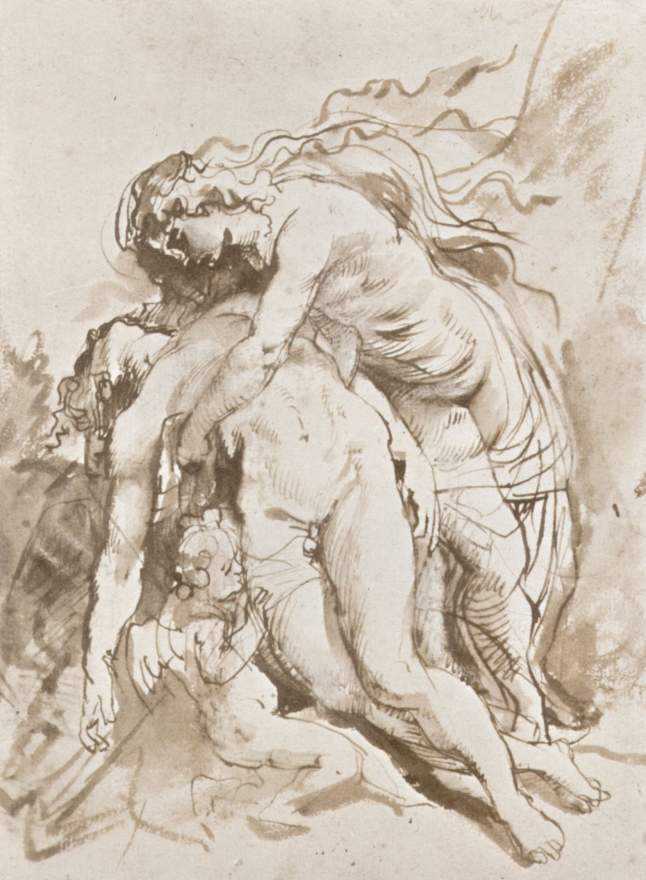
Image source: wikiart.org
Introduction
Peter Paul Rubens’s “Death of Adonis” (1612) compresses mythic tragedy into the speed and candor of drawing. Executed in pen and brown ink with brown wash heightened over swift under-sketching, the sheet captures the instant when Venus discovers the dying body of her beloved. The god’s beauty collapses into limp weight; the goddess leans forward in a surge of grief; a small putto gathers near the wound as if to staunch the loss of life itself. There are no marble columns, no theatrical landscape, no shock of color—only line, wash, and breathless motion. In this reduced register Rubens is at his most direct: invention, emotion, and anatomy arrive before adornment, and the vigor of the hand reveals how the Baroque imagination thinks.
A Myth of Love, Hunt, and Irreparable Wound
The story is familiar from Ovid: Adonis, a mortal of surpassing beauty, is loved by Venus. Ignoring warnings, he goes hunting and is gored by a boar. Venus, hearing his cries, finds him dying and laments; his blood will give rise to the anemone. Rubens chooses the moment of finding and holding—not the strike of the boar, not the ritual lament with attendants, not the floral afterlife. The sheet is about contact: a goddess touching a mortal whose beauty is vanishing even as she tries to secure it. That choice gives the drawing its power. The scene is private, almost unstageable on a public altar, and therefore intimate enough to touch the viewer’s own sense of sudden loss.
Composition as Embrace and Collapse
The drawing’s structure is a braid of opposing forces: Venus surges forward while Adonis slides down and away. Rubens sets a diagonal from the goddess’s head down through her torso to the hero’s dropped leg and slack foot. Against this he counterpoises a second diagonal running from Adonis’s shoulder down through the putto to the ground, a vector of gravity and fate. The two diagonals cross at the hero’s hip, the hinge on which the scene turns. Around this fulcrum the figures interlock—Venus’s arm thrown over Adonis’s chest, her thigh pressed against his flank, the putto’s small body wedged near the wound. The mass reads as one organism, grief and death bound together in a single contour.
The Lightness of Paper and the Weight of Bodies
What astonishes is how a few layers of diluted brown wash convey bodily mass. Rubens lets the paper stand as light, uses wash for shadow, and reserves crisp pen lines for edges where the eye must believe. The darkest accents lie under the hero’s arm and at the turn of his back; lighter, feathery strokes model the belly and the fall of the thigh; quick hatchings concentrate at knees and hips to tighten joints. Venus is built with broader sweeps, her weight thrown forward by a heavy shade that falls from shoulder to hip. Even without color, the figures feel warm and heavy, capable of slipping from a grasp that is already failing.
Gesture and the Rhetoric of Hands
Rubens writes his feeling in hands. Adonis’s left hand droops open, a small theatre of surrender; the right arm, partly hidden, trails behind in the line of a body sliding down the earth. Venus’s near hand braces the hero while her far hand, more sketched than finished, hooks over his chest in the universal grip of someone trying to keep a beloved from leaving. The putto’s chubby fingers, gathered near the wound, are not medical so much as devotional—a child’s instinct to press where life seems to leak out. Each hand is an inflection; together they compose a grammar of loss: let go, hold fast, help.
Faces on the Threshold
The heads are wonderfully abbreviated. Adonis’s profile tilts back, mouth slightly open, eyes closed or sliding toward closure, a map of the instant where breath fails. Venus’s face bends forward, hair streaming in long, urgent curves that amplify the rush of her body; the features are set with a few economy lines that still capture anguish and focus. The putto’s round head turns down, the tilt a miniature echo of the goddess’s larger arc. Drawing allows Rubens to keep the expressions malleable—suggested rather than locked—so that the viewer’s mind completes them and thus participates in the scene.
Hair, Drapery, and the Baroque Wind
Though the space around the figures is minimal, everything moves. Venus’s hair streams like a pennant; the thin drapery behind her becomes a net of lines describing both fabric and air; even the ground line flutters as if shaken by the weight of the fall. Rubens uses these agitated contours to blow weather through the sheet. The effect is not a literal wind but the psychic gust that accompanies catastrophe. It is as if grief itself stirred the air and set strands and cloth in motion.
Drawing as Laboratory and Performance
This sheet reads as both study and finished performance. One sees the artist searching anatomy: tentative strokes at the hero’s back, alternate contours near the goddess’s thigh, exploratory loops around the putto’s shoulders. Yet the overall effect is surefooted, a single sweep from conception to execution. Rubens uses wash to bind disparate experiments into harmony; he uses darker ink lines to assert decisions. The viewer thus witnesses the painter thinking aloud, taking risks, finding the exact posture where love and death meet.
The Tactile Logic of Wash
Rubens’s brown wash is not a generic tint; he modulates it like a musician. Pooled wash at Venus’s flank gives flesh thickness; semi-transparent veils over Adonis’s abdomen keep the skin cool and luminous; dry-brush flicks along the goddess’s hair add frizzed energy. The wash also builds atmosphere: areas of soft, clouded tone push the figures forward without resorting to heavy outlines. In places, the wash runs slightly, creating small blooms that mimic tears or sweat. What could be accident becomes eloquence.
Anatomy Learned in Italy, Freed in Antwerp
Rubens’s decade in Italy supplied a repertory of heroic bodies—Michelangelo’s torsos, antique river gods, Roman sarcophagi in which reclining figures twist with expressive force. In this drawing those memories are liberated from marble gravity. Adonis carries the hero’s breadth but not his stony fixity; the musculature is credible yet surrendering. Venus, far from being a static mold of ideal beauty, is a rushing force pitched forward by love. The Italian lesson is absorbed, not quoted; the northern hand gives it warmth and motion.
A Private Scale for a Public Theme
Rubens painted the subject of Adonis several times on grand canvases, crowded with huntsmen, hounds, and landscape. This drawing tightens the lens. There are no dogs, spears, or boars; the forest is barely indicated. The scale becomes intimate enough for the viewer to feel like a witness at arm’s length, perhaps even a participant who might catch the slipping body. The proximity makes the myth modern. Loss is not a spectacle; it is something that happens in someone’s lap, on someone’s knees, under someone’s hands.
The Putto as Emotional Conductor
The small cupid at the base is not a decorative cherub but an emotional conductor. On one level he is the emblem of Venus’s realm: love is present even here. On another, he acts like a child in a house where grief has suddenly arrived—fumbling to help, reaching toward the wound, not knowing that some injuries cannot be pressed closed. His smallness increases the sense of scale around the fallen hero and the goddess’s urgency, and his round forms soften the hard edges of death just enough that tenderness can breathe.
Rhythm, Repetition, and the Echoing Body
Rubens organizes the drawing through echoes. The curve of Venus’s back repeats the curve of Adonis’s spine, though they move in opposite directions—one forward in embrace, the other backward in collapse. The line of the goddess’s extended leg rhymes with the hero’s drooping limb, making a sorrowful couplet of thighs and feet. Even the long streamers of hair repeat the vector of the hero’s arm, as if every element of the goddess were trying to reach and wrap what is falling away. These repetitions create a music the eye can hear—a lament in line.
The Ethics of Proximity
The drawing carries a subtle ethic. It insists that the proper response to a dying body is closeness. Venus does not stand aloof in divine composure; she clings, braces, and lowers herself to the mortal level. The putto delivers assistance scaled to his means. Such proximity has a contemporary resonance. In hospitals, in homes, the grammar of care still begins with bodies leaning toward other bodies, hands making themselves useful in the small economies of help. Rubens’s myth becomes a lesson in human nearness.
Time, Breath, and the Instant Before
The sheet is saturated with “before”—before the final slackness, before the goddess’s cry rips the air, before companions arrive, before the flower blooms. Rubens captures this by staging a delicate imbalance: the center of gravity lies just beyond the supporting leg, the torso not yet settled, the head not yet fallen to its final angle. The viewer feels time thinning; the next second will complete what line and wash have foretold. Drawing—faster than paint—fits this temporal edge.
Comparisons and Rubens’s Mythic Language
In painted “Death of Adonis” compositions, Rubens often multiplies figures and enriches the narrative with landscape and still life of the hunt. In the present drawing, none of that dilutes the axis of meaning. If one compares it to “Mars and Rhea Silvia” or “Venus and Adonis” in oils, the same muscular lyricism appears, but here the lyric is sung solo, unaccompanied. The vocabulary is barer: curve, counter-curve, lift, fall. The drawing reveals the skeleton of Rubens’s mythic language, and because it is a skeleton, the feeling toughens and clarifies.
Paper as a Place of Prayer
Although the theme is pagan, the sheet’s atmosphere has the hush of a pietà. Swap names—Adonis for Christ, Venus for Mary, cupid for a small attendant—and the posture remains one of compassion for a body removed from breath. Rubens understood how stories rhyme across traditions. Without didacticism he lets the viewer register the kinship: love meeting death with the only answer it possesses, which is closeness.
The Viewer’s Eye and the Path Through the Scene
Rubens conducts the eye with both sympathy and cunning. We begin at the dark accent of Venus’s face, sweep down her back into the bright plane of Adonis’s shoulder, follow the wash along the rib cage to the knotting at the hip, then curve through the putto’s head and back up the goddess’s extended leg. The route is circular, allowing us to stay with the figures rather than escape into the margins. The outermost areas—sketchy rock, shadowy ground—keep their distance, so that attention remains where the emotional temperature is highest.
Technique, Revisions, and the Breath of Making
Look closely and the drawing shows revisions: alternative contours at the goddess’s calf, exploratory hatchings at the hero’s back, corrected lines at the dropped hand. These do not weaken the image; they quicken it. The viewer sees choices being made in real time, which confers authenticity—Rubens did not arrive at this pose by formula; he searched until the body spoke truth. The wash, laid in after the pen, binds these trials into a single atmosphere, the way memory softens the hard edges of raw experience.
Afterlife and Influence
The economy and charge of sheets like this helped shape academic practice for generations. Students learned from Rubens that a drawing could contain the seed of a complex painting, but also that it might hold an energy not recoverable on larger stages. Eighteenth- and nineteenth-century artists studying the pathos of the human figure—Géricault, Delacroix—would recognize in this page a crucial lesson: that tragedy draws its strength from the clarity of bodies in action, not from decoration.
Conclusion
“The Death of Adonis” distills Rubens to essentials—velocity of line, authority of anatomy, and a heart steeped in the theater of human feeling. Venus’s forward surge and Adonis’s backward fall bind embrace and loss into one contour. Wash and line carry weight and breath; hands teach the grammar of help; a putto kneels where life pours out. The myth’s flower has not yet opened; the sheet keeps us at the moment where love can do nothing more than hold. In that candor lies the drawing’s greatness. It is both study and finished lament, a Baroque pietà in pagan dress, and an undimmed lesson in how the simplest means can bear the heaviest meanings.
