Image source: wikiart.org
A Court Drenched In Sound And Shadow
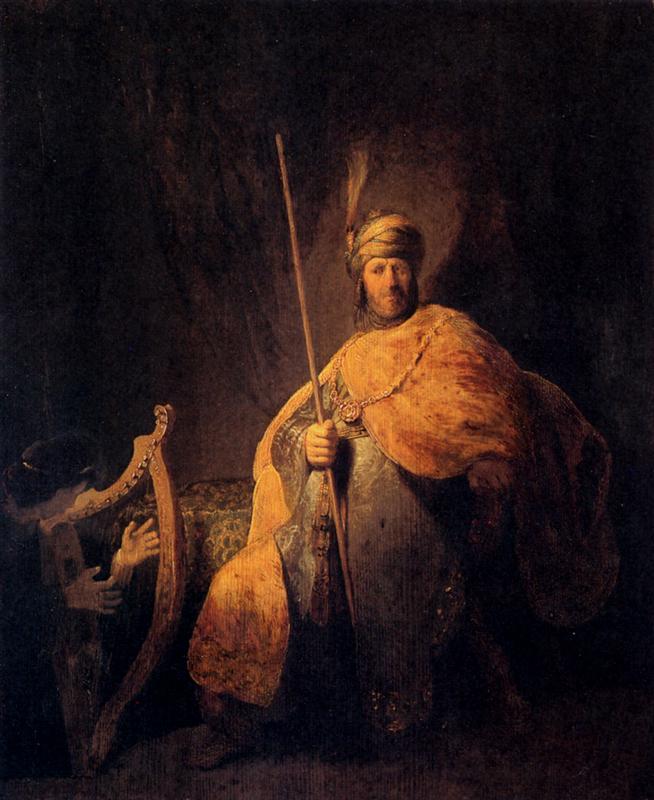
Rembrandt’s “David Playing the Harp to Saul” (1629) transforms a biblical episode into a charged nocturne where sound seems to shape light. The young David crouches at the far left, his body half-occluded by the carved frame of the harp, while King Saul dominates the composition in a throne-like seat, wrapped in massive robes and crowned with a turban and plume. A slender staff rises like an axis through the picture, and a dark, cavernous backdrop swallows everything that is not essential to the drama. Rather than narrate the entire story, Rembrandt arrests a single, loaded instant: music has begun to work upon a troubled mind, and power, pride, and prophecy briefly hold their breath.
The Chosen Moment From The Book Of Samuel
The scriptural source recounts how David was summoned to soothe Saul when an evil spirit tormented the king. Many artists show the soothing aftermath or the moment of Saul’s rage with a thrown spear. Rembrandt chooses the interior of the episode, the time when therapy and threat coexist. Saul sits inert but coiled, his hand gripping a spear-like staff that doubles as scepter and weapon. David’s head bows with concentration; his fingers test the strings. The narrative hangs between potential calm and potential violence. This suspended condition is what the painting makes visible and tactile.
Composition That Makes Power Visible
The geometry of the picture clarifies hierarchy without speech. The king occupies the center-right, a pyramidal mass of cloth and authority. The young musician is compressed into the lower left corner, his harp’s curved arm forming a tender shield between him and the monarch. The staff cuts the space like an exclamation mark, tethering Saul’s body to the floor and ceiling while bisecting the two figures. The eye moves from the bright cloth at Saul’s shoulder down the staff to David’s pale hands, then back up to Saul’s dim, watchful face. Every route through the canvas returns to that pendulum swing between power and service.
Light As The Language Of Sound
Light in this painting behaves like music. It pours most generously across Saul’s layered robes, the metallic hems glittering like low, resonant notes. It brushes David’s hand and the harp’s frame in a purer key, as if the higher register of melody were literally catching fire. The surrounding darkness is not emptiness; it is acoustics, the soft chamber in which notes carry. Rembrandt already understands how to turn chiaroscuro into psychology. The king’s face lives in a slow, inward shadow, while David’s hands gleam with alert nerve. The viewer feels the sound move from left to right as light, and then back again as reflection.
Fabrics, Metal, And The Weight Of Office
Rembrandt’s textures are never mere decoration. The russet-gold mantle over Saul’s shoulders is thick, furred at the edges, and heavy enough to anchor him in his seat. Its very mass stands for the burdens of rule. Underneath, a cooler, blue-green garment provides a recessional tone that prevents the figure from becoming a gaudy emblem. Metallic threads and studs catch the lamplight in tiny bursts, reminders of the glitter that accompanies power. David’s clothes are simpler, in shadow, and his identity is largely given through hands and instrument. The contrast in material richness becomes a contrast in existential burden: Saul wears weight; David carries purpose.
The Staff As Double Sign
At first the vertical staff reads as scepter, the rod of command. Yet the hand that holds it is high, tense, and too ready. The staff thus hints at the spear Saul will later hurl. Rembrandt avoids literal weaponry to keep the moment ambiguous, but he lets the pose carry the threat. The thinness of the staff compared with the acreage of robe makes it feel like a pin in a great balloon of dignity, a single, volatile line that could puncture calm at any instant. This slender form is the painting’s emotional fulcrum.
David’s Harp As Architecture And Shield
The harp does pictorial work beyond instrumentality. Its carved upright and curving arm establish a second vertical and a counter-curve to the staff, building a visual duet that mirrors the musical one. At the same time the instrument serves as a barrier. David’s torso is partially hidden behind it, a subtle acknowledgment that music is both offering and protection. Rembrandt places the harp at the threshold between court and servant, making art the liminal object through which power is addressed without direct exposure.
Faces That Reveal Interior Weather
Saul’s face is a study in guardedness. The eyes, narrowed under the turban’s shadow, do not soften; the lips set into the prudent line of a man mastering himself rather than surrendering to consolation. David’s features, by contrast, are concentrated and modest. We see more of his intent than his identity, a choice that respects the episode’s focus on the act rather than the actor. The tension between a watchful king and an attentive musician is legible even at a distance because Rembrandt calibrates the angle and value of each face with surgical care.
An Early Statement Of Rembrandt’s Program
Executed near the end of his Leiden period, the painting condenses several principles that will guide Rembrandt’s career. He reduces cast and stage to what is necessary, trusting a few bodies and a disciplined light to carry epic meaning. He makes gesture and surface do theological work. He refuses spectacle in favor of human interiority. He allows ambiguity to sharpen truth rather than blur it. The picture is an early oath kept later in masterpieces: art’s task is not to trumpet events but to reveal the soul in its moment of decision.
The Psychology Of Scale And Distance
The king’s volume is monumental, but Rembrandt keeps the viewing distance intimate. We are not audience in a hall; we are a few paces away, within the glow of the same lamp. That proximity complicates our role. We can almost hear the strings as David plucks them; we can almost see the king’s knuckles blanch. The closeness makes us complicit in the uncertainty, as if our quiet were also helping to keep the room from breaking. The painting thus enlists the viewer as a witness who must also practice patience.
Color As Moral Temperature
The palette is restrained yet expressive. Warm ochres and burnt oranges dominate Saul’s mantle, softening into tawny browns where the cloth retreats from light. These hues register royal warmth but also the heat of agitation. Cooler, blue-gray notes in the under-robe lower the temperature around his middle, a visual sigh under the pressure of office. David’s zone carries more neutral browns and a chalky off-white at the hands, a practical, workmanlike set of tones. The harmony prevents melodrama while letting temperatures shift meaningfully across the surface.
The Stage Of Darkness And The Ethics Of Restraint
So much of the canvas is dark that one might think information is being withheld. In fact the darkness is a form of honesty. The story takes place in a state of mind, not in architecture, and Rembrandt refuses to distract with columns or curtains he cannot justify. The near-void behind Saul amplifies his solitude; the pocket of shadow around David concentrates the music. By stripping away everything that doesn’t contribute to the drama, the young painter exhibits an ethic of restraint that is both aesthetic and moral.
Gesture As Theology
Every movement here means. Saul’s grip on the staff is command trying to domesticate fear. His slightly turned torso suggests a man listening against his own stubbornness. David’s bent head and hands shaping sound describe service, but not servility; it is attention that contains courage. The small drift of light down the staff toward David’s fingers reads as grace traveling from throne to musician by way of acceptance. In this choreography, art appears as the mediator that can temper power without humiliating it and uplift the lowly without inflating pride.
The Sound We Imagine
Though the painting is silent, it conjures a specific sound world. The thick drapery and bare wall combine to produce a mellow acoustic; the harp’s notes would arrive rounded and full, not thin and sharp. The viewer senses a measured tempo—no dance, no triumphal march, but a calm, repeating pattern that presses agitation into order. Rembrandt achieves this auditory illusion through the rhythm of highlights on cloth and instrument, spaced like beats, and through the broad, quiet passages of darkness that function like rests.
The Historical Taste For “Oriental” Costume And Its Use Here
Northern artists of the seventeenth century often clothed biblical figures in “Oriental” dress—turbans, robes, and feathers—to transport scenes into a timeless ancient East. Rembrandt uses that convention yet restrains its theatricality. Saul’s turban and plume do not turn him into an exotic caricature; they supplement his mass and majesty and give the light something sumptuous to strike. David remains largely uncostumed, anchoring the scene in human scale. The result is an image that feels both historically remote and psychologically immediate.
The Harp’s Carving As A Map Of Touch
Rembrandt lingers on the harp’s carved edges, giving the wood a tactile reality that invites the viewer’s hand. The ornament is not ostentation; it is evidence of use and care. Its smooth curves and burnished surfaces tell us the instrument has served other rooms, other moods, other hands. By making the harp a character with its own history, the painting extends the theme of service beyond people to objects. Artifacts, too, carry memory and can mediate between interior storms and public duty.
The Spear That Is Not Yet A Spear
The staff’s ambiguity carries narrative potential. We know from later in the story that Saul will throw a spear at David. Rembrandt keeps that violence offstage but lets the staff foreshadow it. Because the king’s hand rides high and the pole runs nearly the whole height of the frame, it reads as an action waiting to happen. The painter thus folds future into present without literal prophecy. The viewer experiences this as unease—an almost audible click as the staff aligns with dread.
The Viewer’s Path Through The Painting
The picture is a guided walk. We enter with the beam that discovers Saul’s shoulder and lap, descend the staff to the bright hands, linger on the harp’s curve, and then return via the dark slope of the robe to the king’s watchful face. Each circuit reinforces the story’s hinge: power that could crush, art that could heal. Repetition breeds intimacy; intimacy compounds tension. This deliberate pathfinding is part of Rembrandt’s early mastery. He doesn’t merely show; he conducts.
What The Painting Says About Power And Art
At its core the canvas proposes a relationship between power and art that remains timely. Power is heavy, anxious, and solitary; art is nimble, attentive, and intercessory. The painting does not flatter either. David’s role is risky, not glamorous; Saul’s role is sympathetic, not monstrous. Yet the image insists that music can touch what command cannot reach. The staff is long; the harp’s strings are thin; the victory, if it comes, will be inward. The young Rembrandt stakes his art on that wager.
Seeds Of Later Greatness
This early work points ahead to Rembrandt’s mature language. The dramatic isolation of figures, the deep, breathable shadows, the ruthlessly selective light, the interchange of textures and meanings, the preference for the single decisive instant over crowded narrative—all are here. Even the compassion that will flood his late portraits is present in the fairness with which he shows a king haunted rather than merely hateful and a youth brave without swagger.
How To Look Slowly
Begin at the pale oval of David’s left hand and hear a first chord. Let your eye follow the stringed curve to the pale sliver of his face, then cross the staff like a bridge into the draped continent of Saul’s mantle. Climb the ridge of cloth to the jeweled clasp and feel its coolness, then slide to the king’s guarded eyes as if listening for the next note. Ride the staff back down. Repeat this loop until the room’s air settles, until the silence feels shaped by music, until you sense both danger and mercy sharing the same breath.
Enduring Resonance
“David Playing the Harp to Saul” endures because it captures the drama of interior change. Without crowd or spectacle, the painting lets us witness what power rarely admits in public: the wish to be soothed and the fear of surrender. It honors art as a precise instrument able to work at that threshold. It shows a young painter already convinced that light can do what rhetoric cannot, that gesture can say what speeches hide, and that a room of darkness can hold the exact amount of illumination a soul can bear.