Image source: wikiart.org
A Triumph Presented With Humility
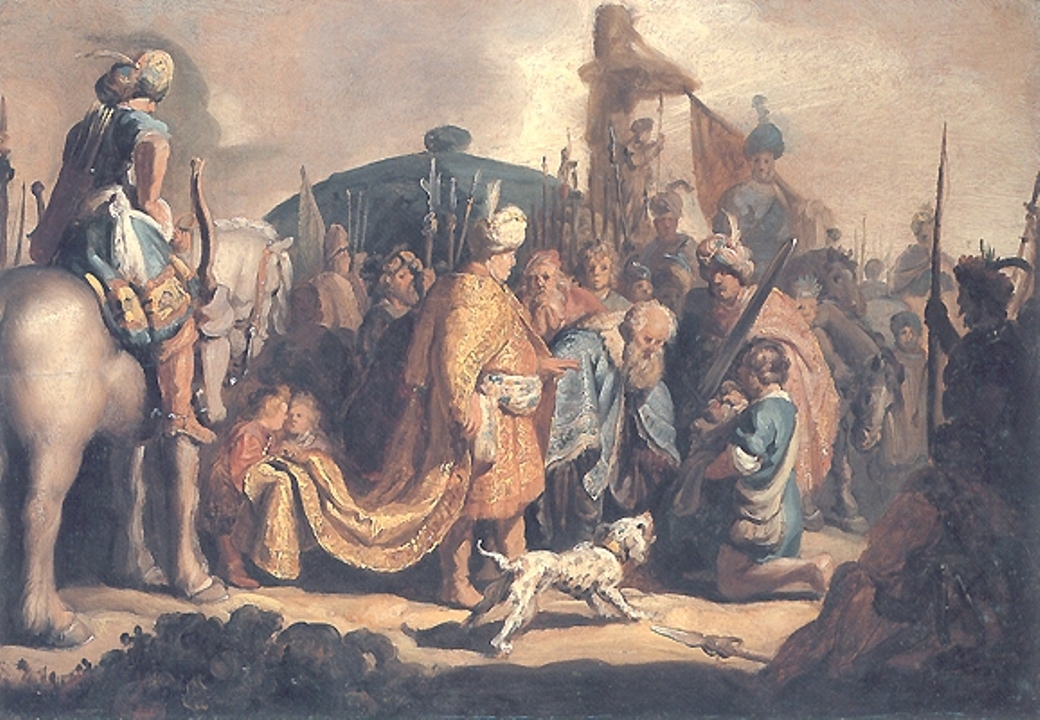
Rembrandt’s “David Offering the Head of Goliath to King Saul” (1627) captures the breathless minute after victory, when a shepherd-boy kneels before a king and war quiets into protocol. The scene is crowded, ceremonial, and alive with glancing reactions: astonishment, calculation, relief, and the thin pride of survivors who now remember to arrange themselves for history. Where many painters emphasize the duel, Rembrandt lingers on what victory does to a community. Power shifts in real time; a boy’s courage must be translated into courtly language; a nation watches to see who will be what, tomorrow.
Leiden Ambition And The Theatre Of History
Painted in Rembrandt’s early Leiden period, the picture belongs to the years when he aimed to prove himself in the most prestigious genre of his day: history painting. The influence of Pieter Lastman—his short-term teacher in Amsterdam—is audible in the busy ensemble, in the antique-looking costumes, and in the clear, legible gestures that help viewers “read” the story at a glance. Yet the handling is unmistakably Rembrandt’s. Light rather than architecture carries the narrative. Faces, not armor, drive the drama. The canvas displays a young painter who understands that the most convincing history is not a pageant of types but a congregation of particular lives.
The Moment Chosen
Rembrandt fixes the instant when David, still kneeling and breathless, offers proof of what God and nerve have achieved. King Saul stands at the center left under a tide of attendants; pages gather his train; guards bristle with spears; a mounted officer keeps watch from his saddle. Near David a veteran bends forward to inspect, while a young standard-bearer leans in with gleaming curiosity. The ugly trophy—the severed head—appears as a dense, shadowed mass near David’s sword and hands, treated with gravity rather than gore. The painter refuses sensationalism; the spiritual and political implications of the act eclipse its brutality.
A Composition Of Converging Allegiances
Two diagonals orchestrate the scene. One runs from the rider’s horse at far left through Saul’s court to the bowed elder and on to the kneeling hero—a parade of rank descending toward humility. The other arcs from the standards behind Saul down the line of spears and forward to the little dog that bounds across the foreground, a nervous counter-melody of alertness and motion. Between them, a circular traffic of gazes forms around David and the head of Goliath. Eyes travel inward to the proof and outward again to the king who must interpret it. The arrangement produces a civic vortex in which authority, faith, and youthful daring meet.
Light As Recognition
Light enters from high at the left and travels across gilded robes, polished helmets, and the silvering rumps of horses before coming to rest on David’s bare legs, sleeves, and attentive face. The king glows with a ceremonial radiance; the hero shines with a more practical brightness, as if fresh air still clung to the boy who came from the field. The severed head remains comparatively dark, a moral decision that refuses to glamorize violence even as it validates the narrative. The eye follows light from crown to courage, and in that journey the painting declares where honor truly lies.
Costume, Texture, And The Politics Of Fabric
The court is a festival of cloth: brocaded mantles edged in metallic threads, turbans layered in moiré bands, quilted sleeves, and belts heavy with tassels. Pages handle Saul’s trailing garment like a river of gold, proof that victory renews rituals and rituals renew authority. David’s clothing is simpler, closer to the practical dress of a field fighter; its restrained decoration sets him apart as an instrument rather than an ornament of glory. Rembrandt uses these textures not as mere display but as a visual sociology of the moment: power is embroidered; courage is worn.
Hands That Speak
Gesture performs as language. Saul’s right hand extends with a calm, adjudicating motion; he receives and defines what the crowd feels. David’s hands, one near the sword and one presenting the grisly evidence, enact the transfer of credit and responsibility. The veteran’s hands fold and point as if verifying the story. Pages clutch the royal train, embodying the work of continuity. Guards’ fists close on spear-shafts, signaling a readiness that has not yet relaxed. Read in sequence, these hands recite the event better than any inscription.
The Crowd As Moral Weather
Rembrandt excels at turning crowds into a weather system of reactions. Behind the king, faces gather in tiers: sober elders, intrigued youths, a few skeptics whose mouths draw tight. Children in the left middle ground are pressed into service, not as soldiers but as stewards of ceremony, and their sweet seriousness against the drape they carry reminds us that public life is learned task by task. At the right edge a dark silhouette of a guard frames the stage like a heavy curtain; to the left the monumental horse backs the composition with animal certainty. No face is filler. Each is a vote cast in silence.
The Dog As Needle Of Attention
The small dog in the foreground dashes between king and victor, sniffing the path of honor with bright impatience. The animal is not a trivial flourish. Dogs in seventeenth-century imagery often signify loyalty, alertness, and the testing of truth through the senses. Here the little body stitches the composition together and humanizes the solemnity, a reminder that even as nations pivot, life’s ordinary curiosities persist. The dog’s whiteness, struck by the same light that touches David and Saul, keeps the bottom of the picture alive and pulls the viewer’s gaze back into the circle of exchange.
Space, Depth, And The Moving City
The background is a low, rolling field of tents, standards, and crowds that carries the story beyond the royal platform. The victory belongs to a people, and the painter lets that people exist as a murmuring horizon. The tent at center—a green dome—anchors the middle distance and throws the foreground into relief. In contrast to later interiors where Rembrandt compresses space, this open setting breathes in long measures; the air feels dusty and used, like a field after a great exertion. Against this breadth the dense knot of figures at center reads all the more intense.
Color And The Temperature Of Reward
A warm earth palette dominates—ochres, coppery browns, and muted reds—punctuated by cool blues in sashes and mantles and by the pale, animal tones of horse and dog. Saul’s golds hold the chromatic center; David’s cooler notes temper the heat, preventing the picture from slipping into triumphal excess. The severed head stays within a low, cool register that refuses spectacle. Rembrandt’s color is never merely descriptive; it is ethical temperature control, making joy sober and horror quiet.
Theological Undercurrent
The painting is full of Old Testament resonance: a young champion raised by faith, a king whose authority is both confirmed and threatened by a subordinate’s virtue, a nation whose future is decided in the handling of success. Rembrandt does not dramatize the miracle with visions or halos; the divine enters as order, as light that knows where to fall, and as humility in a kneeling figure. The painter’s theology—already in place in his twenties—prefers the sacramental thickness of ordinary bodies doing consequential things.
Psychology Of A Turning Point
Look closely at David’s posture. Kneeling, yes, but not supplicant; his spine is straight, his head lifted, his face attentive. It is the posture of someone presenting facts without self-advertisement. Saul, for his part, does not lunge; he weighs. The veteran elder, bent with years, leans in as if memory were comparing this day with others. The standard-bearer half-smiles, already imagining how the story will be told at night around the fires. These micro-dramas mark the moment as a hinge. Tomorrow, songs will be written, politics will shift, a friendship with Jonathan will be born. Rembrandt’s early genius lies in letting us feel the before-and-after contained in one breath.
The Head As Proof, Not Spectacle
Rembrandt’s handling of Goliath’s head is tactful. He paints weight, not gore; shadow, not stain. The darkness serves three functions. It prevents sensational distraction; it focuses attention on the living actors; and it acknowledges that victory carries a cost better contemplated than paraded. The boy has done what needed doing. The painting preserves dignity by letting evidence remain evidence, not entertainment.
Echoes Of The Artist’s Own Ambition
The scene can be read as a parable of a young artist before authority. A newcomer brings proof of skill to a court that must decide what to make of him; a public looks on; older professionals appraise with guarded respect. The analogy is not far-fetched. In 1627 Rembrandt was staking his claim in the marketplace of patrons. Like David, he stood at a threshold: acknowledged for nerve and accuracy but not yet enthroned in reputation. The painting functions, intentionally or not, as a manifesto: value the deed, not the ornament; judge by light, not pomp.
Brushwork And The Pleasure Of Making
Even under the formalities of a courtly subject, the paint surface remains lively. Cloths are built with quick, loaded strokes that catch the light along ridges; hair breaks into animated filaments; armor glitters with small, decisive touches; the dog is flicked into being with agile whites. Faces receive the most careful attention—small, warm glazes around eyes and mouths that keep flesh moving under light. The whole canvas breathes. You sense the young painter’s hand enjoying the challenge of moving from soft pelt to engraved metal to wrinkled cheek, one after another, without losing the rhythm of the crowd.
Gesture Of Mercy Within Triumph
One of the most affecting passages is the bowed elder between Saul and David. He leans forward as if to smell the truth of the event, his hand hovering near the trophy. He stands for those who test victory with conscience. His presence prevents the picture from sliding into a propaganda poster. Triumph must pass through wisdom before it is legalized. Rembrandt thus gives the scene a moral moderator, as if reminding the viewer that nations are healthiest when the old are allowed to advise the new.
From Field To Court: The Arc Of Narrative
The painting compresses the entire biblical episode into a single architectural chord. Horses and spears recall the battlefield; tents and standards mark the camp’s temporary city; the royal train and steps declare the politics of peacetime. David’s kneel stitches these worlds, bringing raw heroism into the grammar of ceremony. Rembrandt understands that history is not merely what happened but how what happened was received. The canvas is less an epilogue than the first sentence of the story’s next chapter.
Looking Closely Today
For contemporary viewers, the painting functions as a meditation on how communities handle success. Do we glorify violence or acknowledge its sorrow? Do leaders receive courage with grace or feel threatened by it? Do crowds convert spectacle into songs that ennoble or into gossip that divides? Rembrandt asks these questions without rhetoric. He arranges bodies under a lucid light and lets our own judgment awaken in the looking.
How To Read The Picture Slowly
Start at the left with the horse’s massive hindquarters and the mounted officer’s calm silhouette. Let your eye follow the golden river of Saul’s train as pages gather it; climb to the king’s measured hand; drop to the elder’s bent head; then rest on David’s attentive face and the dark, heavy proof he presents. Follow the dog’s path across the foreground, then climb the forest of spears into the murmur of the waiting army. Each circuit reveals a new reaction, a new corner of the crowd’s intelligence, until the whole scene feels less like a still image than a living council.
Why This Early Work Matters
“David Offering the Head of Goliath to King Saul” matters because it turns a famous climax into a study of reception—how the fact of courage passes through light, rank, ritual, and memory to become history. It also announces several habits that will define Rembrandt’s mature art: storytelling through illumination, compassion for every face no matter how marginal, and a preference for moral complexity over easy spectacle. The young painter takes a national myth and returns it to human scale, where gratitude, prudence, and hope can speak.