Image source: wikiart.org
Introduction to “Dante and Beatrice” by John William Waterhouse
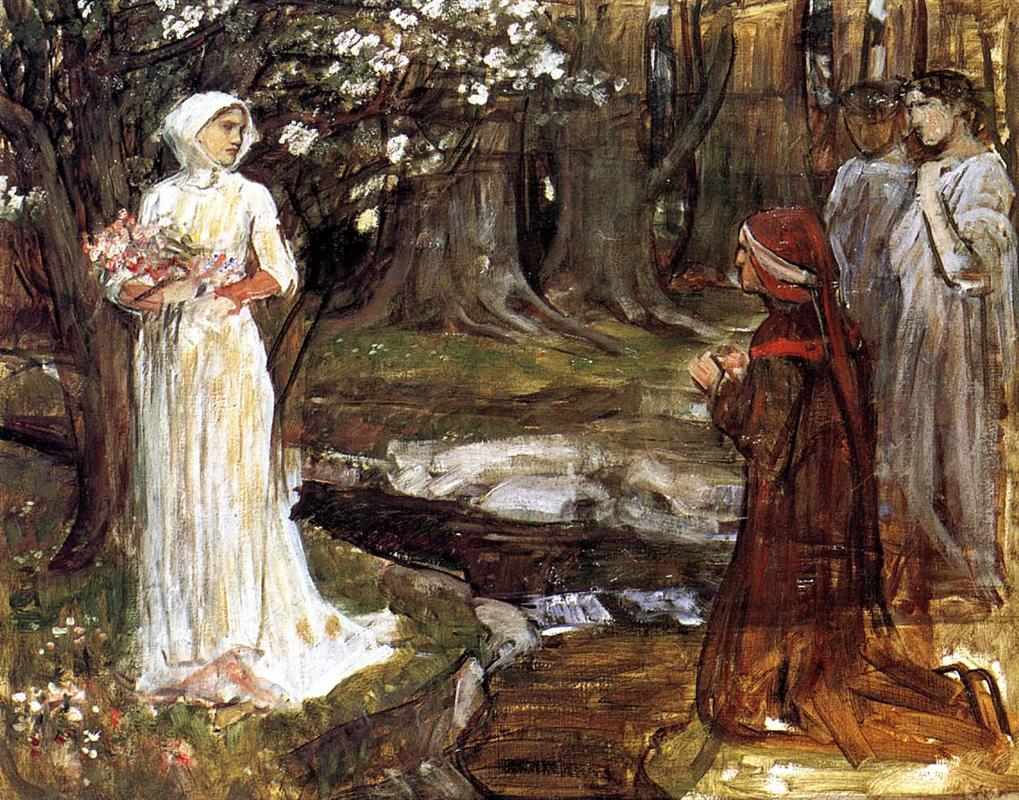
John William Waterhouse’s “Dante and Beatrice” (1914) revisits one of the most enduring love stories in Western literature, but it does so with a quiet, hushed intensity rather than grand spectacle. The scene is simple at first glance: a woman in luminous white stands beneath flowering branches, holding a bouquet; a man in red kneels opposite her; two robed figures linger behind him like witnesses. Yet Waterhouse builds an entire emotional universe out of those few elements. The painting feels like a moment suspended between breath and speech, a threshold where devotion, shame, longing, and reverence all gather at once.
Waterhouse was drawn again and again to narratives where desire becomes fate, and where the past presses into the present like a memory that refuses to fade. “Dante and Beatrice” is not only about a meeting between two people. It is about the idea of an encounter so powerful that it reorganizes a life, turning ordinary time into a before and after. In 1914, near the end of his career, Waterhouse’s handling becomes looser and more suggestive, relying less on crisp detail and more on atmosphere, gesture, and color weight. That change suits this subject perfectly. Dante’s love for Beatrice is famously both real and unreal, personal and cosmic. Waterhouse responds by painting a scene that looks tangible, yet feels half like a dream.
The Narrative Source and Why Dante and Beatrice Matter
Dante Alighieri’s devotion to Beatrice, first recorded in the Vita Nuova and later transformed into the spiritual architecture of the Divine Comedy, is not merely romantic. It is love treated as a guiding force, a moral compass, and eventually a path toward the divine. Beatrice becomes an image of grace, the person through whom the poet learns to see beyond himself. In art, this story often risks becoming either overly sentimental or overly allegorical. Waterhouse finds a third approach: he lets the symbolism exist, but he anchors it in human posture and distance.
The painting’s emotional logic depends on separation. Beatrice stands apart, radiant but reserved, while Dante kneels at the far edge of her world. Their eyes do not meet in a straightforward, mutual exchange. Instead, the arrangement suggests a love that is intensely felt and yet constrained by circumstance, etiquette, spiritual awe, or all three. The presence of attendants reinforces this. Love here is not a private embrace; it is an event observed, judged, and remembered.
Composition and the Drama of Distance
The composition is built like a quiet argument between two sides of the canvas. Beatrice occupies the left, framed by dark tree trunks and flowering branches that form a natural canopy around her. Dante occupies the right, rooted to the ground in his kneeling pose. Between them runs a stream or narrow channel of water, creating a literal gap that reads instantly as emotional and symbolic distance. It is not a violent barrier, but it is unambiguous. Water is movement, change, time passing. It suggests that what separates them is not just a step or two, but something flowing and irreversible.
Waterhouse also controls the viewer’s movement through subtle diagonals. The line of the stream pulls the eye inward, while the flowering branches pull the eye back to Beatrice’s head and bouquet. Dante’s bowed posture creates another diagonal, a downward slope that emphasizes humility. Even the background trees, painted in vertical bands, heighten the feeling of solemnity. This is a scene of devotion, not pursuit. Dante does not reach for Beatrice. He offers himself in stillness.
Beatrice as Light, Spring, and Unapproachable Grace
Beatrice is painted in white that reads as both fabric and illumination. The dress is long and simple, with soft shadows that keep it from becoming flat, but Waterhouse clearly intends the figure to glow against the darker forest. She stands near flowering branches, and those blossoms echo the bouquet in her arms. Together they cast her as spring embodied: renewal, innocence, and a kind of gentle authority. She is not posed as flirtatious or coy. Her body is turned slightly away, her gaze angled off to the side, as if she belongs to a realm where direct possession is not even a question.
The bouquet is crucial. Flowers are a traditional emblem of love, but here they feel like an offering that goes both ways. Beatrice holds them close, not extending them toward Dante. It is as if love exists, but it remains contained, ceremonially held rather than given away. The blossoms overhead amplify this feeling of a love that is everywhere in the air, yet never fully graspable. Waterhouse makes Beatrice the still center of a living world, while Dante becomes the one who must cross inwardly, not physically.
Dante’s Kneeling Figure and the Language of Devotion
Dante kneels in a reddish-brown robe, and that red is the painting’s emotional anchor. It is the color of earthly passion, of blood and warmth, set against Beatrice’s cool radiance. The contrast makes the relationship feel asymmetrical in experience: Dante burns, Beatrice shines. His posture is reverent, almost prayer-like, hands gathered close, body leaning forward yet held back. This is not the posture of a lover demanding attention. It is the posture of someone who believes the beloved is also a moral horizon.
Waterhouse’s Dante is not presented as triumphant poet or public figure. He looks like a pilgrim in his own life, caught in the vulnerable moment when feeling becomes confession. The kneeling pose also makes time seem slower. Kneeling is what you do when a moment matters enough to stop walking. In that sense, the painting captures the way Dante’s story treats Beatrice: as the person who stops him, redirects him, and ultimately defines the shape of his inner journey.

The Witnesses Behind Dante and the Social Weight of Love
Two robed figures stand behind Dante, pale and almost spectral. They do not dominate the scene, but they matter because they introduce social reality. Love, especially idealized love, often pretends it exists outside the world. Waterhouse refuses that escape. These figures suggest chaperones, companions, or the broader gaze of society. Their garments are light in tone, but their presence feels heavy. They watch, and their watching makes the moment feel more formal, more fated, and more constrained.
They also function like echoes of Dante’s future. The Divine Comedy is filled with guides, witnesses, and intermediaries. Even if Waterhouse is not illustrating that later epic directly, the painting carries the logic of being led, observed, and judged. Dante is never entirely alone with his longing. The witnesses turn desire into a kind of ceremony, something that must be endured with dignity.
The Forest Setting and the Meaning of the Natural World
Waterhouse places this encounter in a wooded landscape where trunks rise like pillars. The forest feels both protective and enclosing, like a chapel made of bark and shadow. Nature here is not simply decoration. It behaves like mood. The darker trees behind Beatrice intensify her lightness, while the open ground and stream between the figures becomes a quiet stage.
The blossoms overhead do more than suggest springtime. They imply an instant of fleeting beauty. Blossoms arrive, shimmer, and vanish. That transience suits a story where Beatrice is both present and absent, both a real person and a memory transformed into an ideal. The environment hints that the moment is precious precisely because it cannot last. The viewer senses that if the wind shifted or the light changed, the encounter would dissolve like a vision.
Color, Brushwork, and the Late Waterhouse Atmosphere
Compared to some of Waterhouse’s earlier, more polished works, “Dante and Beatrice” has a freer touch. The brushwork feels quick in places, especially in the background and along the ground near the stream. This looseness is not careless; it is expressive. It makes the scene feel like a recollection rather than a documentary record. The world is there, but it is not insisting on itself. The painting prioritizes emotional clarity over material precision.
The palette is dominated by earth tones, deep browns, mossy greens, and muted golds, with Beatrice’s white and Dante’s red providing the essential contrast. That contrast is the story in color. White reads as purity, distance, and elevation. Red reads as desire, mortality, and urgency. The two colors do not blend; they face each other across water. The result is a visual metaphor for a love that cannot become ordinary. It must remain charged, separate, and transformative.
Symbolism of Water and the Threshold Between Worlds
The stream is the painting’s most quietly powerful symbol. It is narrow enough that Dante could plausibly step across, yet Waterhouse makes it feel uncrossable. That is the genius of the image: it captures the experience of longing, where the obstacle is not always large, but it is absolute. The water suggests boundary, like the line between youth and adulthood, or between human desire and spiritual aspiration.
In Dante’s writing, Beatrice functions as a bridge to something higher, yet she is also a reminder of what is lost. The stream can be read in both directions: it separates them in the present, and it hints at the flow of time that will carry Beatrice away. Waterhouse does not need dramatic gestures to express tragedy. He only needs that thin, reflective strip of moving brightness to say: this cannot be held.
Emotional Tone: Reverence, Restraint, and the Ache of the Unsaid
One of the most striking qualities of “Dante and Beatrice” is how much it refuses theatricality. The emotion is intense, but it is contained. Beatrice does not rush forward, and Dante does not collapse in despair. Instead, Waterhouse gives us a moment that feels like the beginning of a sentence that will never be finished. The figures are close enough to speak, but no speech is painted. That silence becomes the real subject.
This restraint makes the painting unusually modern in feeling. It understands that the deepest emotions often appear as stillness, not display. Dante’s kneeling reads as reverence, but it also reads as helplessness. Beatrice’s calm reads as grace, but it also reads as distance. The viewer is left in the gap between them, feeling the tension of what is desired and what is permitted.
Waterhouse, Pre-Raphaelite Legacy, and a 1914 Meditation on Ideal Love
Although Waterhouse is often associated with the Pre-Raphaelite orbit, by 1914 he is working in a world that has changed. The late nineteenth-century appetite for medievalism, romance, and literary painting remains, but it is now shadowed by modern uncertainty. “Dante and Beatrice” can be read as a late meditation on ideal love at a moment when the old ideals were beginning to feel fragile. The painting does not mock the ideal, and it does not fully embrace it without question. It simply presents the ideal as something beautiful and painful, inseparable from loss.
That is why the work endures. It does not ask the viewer to believe in a fairy-tale reunion. It asks the viewer to recognize a familiar human experience: loving someone who becomes larger than life, loving someone who changes what you are, even if you never truly possess them. In Waterhouse’s hands, Dante’s story becomes a visual poem about the way longing can elevate and wound at the same time.