Image source: wikiart.org
A First Glance At Truth In The Half-Light
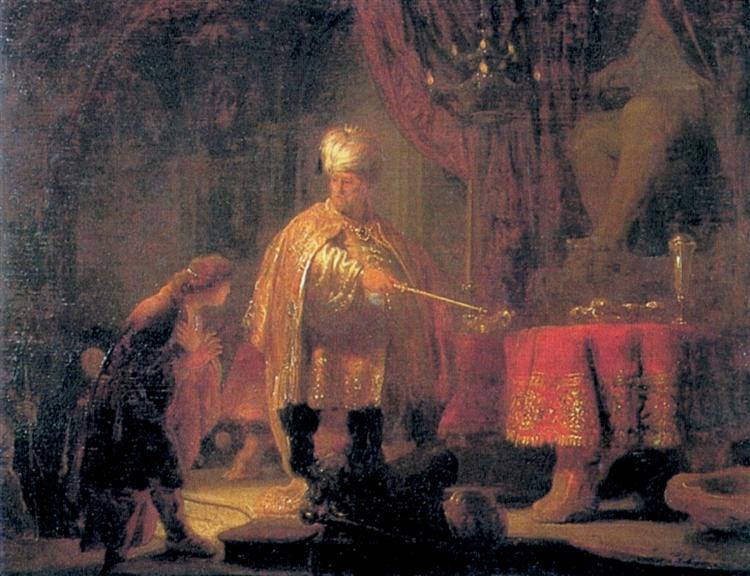
Rembrandt’s “Daniel and King Cyrus in front of the Idol of Bel” stages a confrontation between spectacle and conscience. The chamber glows with warm, muffled light that rests on gold brocade, thick carpets, and draperies, yet it also leaves deep wells of shadow in which a silent statue looms. At the center, a richly dressed monarch gestures with a staff, while Daniel—slender, alert, and deferentially bent—meets the king’s gaze without surrendering his conviction. The painting catches the decisive instant when glittering ritual collides with a clear-eyed test of truth.
The Biblical Episode And Rembrandt’s Choice Of Moment
The subject comes from the ancient narrative known as “Bel and the Dragon,” attached to the Book of Daniel. The king reveres Bel, a Babylonian god whose priests claim consumes nightly offerings. Daniel, certain that idols neither eat nor breathe, proposes a trial that will reveal the trick. After the offerings are placed, he secretly spreads ashes on the temple floor; by morning, footprints expose the priests who sneak through hidden doors to feast on the food. Rembrandt chooses the charged moment of demonstration, when Daniel’s proof confronts the king’s grandeur and the idol’s mute authority. The painting is therefore less about dramatic destruction and more about illumination—how truth arrives in a room designed for awe.
Composition As An Argument
The composition argues before any figure speaks. A strong diagonal runs from the bowed Daniel at left to the massive idol at right, with King Cyrus standing at the fulcrum. He anchors the scene, his golden cloak falling like a cascade of authority as his baton extends toward the table of offerings. Daniel’s body forms a counter-diagonal, a slender line of conscience resisting the weight of spectacle. The idol sits high and partially veiled by heavy textiles, a shadowed monument to tradition whose inaccessible perch contrasts with Daniel’s grounded presence. Rembrandt rationalizes the moral drama into spatial relations: the king mediates between person and object, living counsel and carved habit.
Light That Disentangles Appearance From Reality
Rembrandt’s light is diagnostic. It isolates what matters, warms what deserves attention, and allows the rest to recede. The richest glow falls on the king’s robe and turban, then rolls to the scarlet cloth covering the offering table, where metal vessels and bread glint. Daniel’s head and hands are more modestly lit, yet the lighting clarifies his intent as clearly as if it were speech. By contrast, the idol’s bulk recedes into a darker register. In this value scheme, light becomes judgment. It neither humiliates the king nor mocks the idol; it simply sets priorities, assigning living weight to conscience and measured scrutiny to ritual.
Costumes, Fabrics, And The Theatrics Of Power
The scene’s textiles and ornaments are not mere exotic garnish; they enact the politics of persuasion. Cyrus wears layered velvets and metallic threads whose brilliance declares legitimacy. The tent-like drapery above functions as canopy, turning the chamber into a throne room even in the god’s presence. Embroidered hems around the offering table and the patterned carpet underfoot extend the rhetoric of wealth into the very ground. Daniel contrasts this sumptuousness with simplicity—plain cloth, little jewelry, a posture that organizes attention rather than capturing it. Rembrandt makes material splendor the language of earthly authority while allowing restraint to speak for truth.
Gesture And Gaze As The Grammar Of Conviction
Cyrus’s arm extends, the baton pointing toward evidence. His body is heavy and planted; his chin lowers as if weighing a claim that will carry consequences. Daniel bends forward, one hand near his chest in a restrained act of address. Their eyes meet in the triangle between baton, offering table, and footprints implied along the floor. The gestures are quiet but decisive. There is no shouting, no violent conversion. Rembrandt casts persuasion as patient demonstration, a grammar of hands and sight lines that teaches the viewer how truth passes between people.
The Idol As A Silent Actor
The idol dominates the right side like a sleeping giant, its bulk filtered through the burgundy curtain. We do not see a vivid, individualized face; we see mass, scale, and theatrical placement. That choice matters. Rembrandt denies the statue a charismatic personality, rendering it instead as a heavy set piece that requires drapery, platform, and ritual to feel potent. In doing so, he shows how the authority of objects often relies on stagecraft. The god’s very immobility underscores Daniel’s claim: what is carved cannot eat, judge, or speak.
The Proof On The Floor And The Ethics Of Evidence
Although the ashes and footprints are not aggressively spotlighted, their implication structures the scene. The low, warm light grazes the floor planks and steps, giving them an unusual importance. Our eye travels there because the figures’ gestures and the table’s gleam create a corridor of attention across the ground. Rembrandt thus paints a courtroom without a courtroom. The floor becomes witness, the light becomes testimony, and truth is grasped not by thunderbolt but by quiet observation of marks that cannot lie.
Chiaroscuro As Theater And Thought
The painting’s chiaroscuro is theatrical, but its drama is intellectual. Pools of radiance collect around problem areas—garments, table vessels, the king’s face—while shadow carves out space for thought. The drapery’s darkness does not threaten; it hushes the room, letting the dialogue register. In Rembrandt’s hands, shadow is not the enemy of knowledge; it is the medium through which light acquires meaning. The story requires contrast because faith and deception, conscience and habit, must be distinguished with care.
The Sound Of The Room
Though silent, the image carries sound. We sense the weighted rasp of the king’s robe, the faint jangle of chains, the muffled fall of a baton against cloth as it extends, and the hush of attendants who understand that something consequential is being decided. The offerings’ platters, half in shadow, seem to tingle with the memory of being placed. Rembrandt’s textures are acoustic; they let the viewer hear, in imagination, the shift from ritual noise to investigative hush.
The Psychology Of The King
Cyrus is no caricatured fool. Rembrandt paints him as a capable ruler suddenly confronted with a challenge to his assumptions. The furrow at his brow, the heaviness of his stance, and the measured extension of his arm suggest a mind prepared to judge rather than react. This nuance is crucial. The scene becomes not a humiliation of pagan belief but an education of power. The king’s dignity remains intact even as his worldview is tested. Rembrandt shows respect for the process by which a leader receives unwelcome truth.
Daniel’s Courage As Intellectual Poise
Daniel’s bravery is of a quiet kind. He does not posture; he proposes. His bowed head shows respect for the crown while his straight-backed torso shows respect for conviction. The painting therefore frames courage as intellectual poise rather than defiance. He trusts evidence and invites scrutiny. For Rembrandt, who often explored the moral life of looking, Daniel exemplifies the ethics of attention: to observe carefully, to test claims, and to present proof without contempt.
Color As Moral Temperature
A warm spectrum saturates the scene: reds and russets in the drapery, burnished golds in the garments, and creamy highlights along cloth folds and metal. Against this warmth, cooler notes appear sparingly—the faint greys of the architecture and stone, the dim blue undertones in shadow. The predominance of warmth suggests a human theater—fallible, comfortable, richly made—within which a cooler impulse of truth arrives. Rembrandt’s palette thus inflects the moral mood without didactic signage.
The Architecture Of The Chamber
The setting is both palace and temple, with thick columns suggested behind the drapery and a platform that elevates the idol toward the ceiling. A chandelier hangs like a metallic constellation, half lost in the dark. These structures create a vertical hierarchy: the king and Daniel occupy the middle ground of governance, while the god presides in elevated recess. The architecture naturalizes habit—things have long been arranged this way—making Daniel’s demonstration feel all the more radical. To shift belief in such a room is to move a mountain carefully built over years.
Materiality And The Truth Of Things
Rembrandt’s materialism—his love of paint as substance—serves the story’s theme. The gold thread looks heavy enough to drag a sleeve; the tablecloth’s embroidery catches light in tiny hooks; stone steps hold weight; wood drinks light differently than fabric. Such certainties of matter reinforce Daniel’s argument about reality. If cloth and metal obey honest laws of light, then surely the trail in ash speaks with the same authority. The painting makes natural truth palpably trustworthy.
The Role Of The Table Of Offerings
The table occupies the right middle distance, its scarlet cloth vibrant against the surrounding dusk. On it, vessels gleam and loaves or offerings lie ready for their supposed consumer. The table is a hinge between belief and skepticism. To the faithful, it records devotion; to Daniel, it records opportunity for test; to the king, it presents a ledger of facts soon to be reinterpreted. Rembrandt composes it like a stage altar—something meant to focus attention—then repurposes that focus for inquiry.
The Drama Of Drapery
The drapery performs the logic of concealment. Heavy folds hide the idol’s full form and the temple’s deeper recesses, echoing the priests’ hidden doors in the narrative. Drapery is theater’s tool and also its temptation. It can turn the ordinary into the “sacred” by framing and covering, but it can also hide deceit. Rembrandt allows viewers to savor its beauty while sensing its complicity. In the glow, the cloth is gorgeous; in the story’s moral geometry, it is a collaborator with illusion.
Early Rembrandt And The Rhetoric Of Splendor
Painted in 1633, the work belongs to Rembrandt’s early Amsterdam period, when he delighted in historical and biblical scenes energized by precious fabrics, reflective metals, and potent light. Yet the splendor is never idle. It sets the stakes. Belief in an idol thrives in rooms where spectacle persuades; truth must therefore arrive with enough visual seriousness to compete. Rembrandt matches the era’s taste for opulence with a conscience that insists on discernment.
Suspense Without Violence
What is remarkable in the painting is its refusal of sensational climax. No idol topples, no priests are dragged out. Instead, we watch the delicate hinge of recognition. The baton’s direction, the floor’s evidence, and Daniel’s calm create a suspense more sophisticated than catastrophe. The viewer senses that words are about to carry the day and that a mind is being changed. Rembrandt trusts the power of persuasion and teaches the viewer to trust it too.
The Viewer As Witness To Judgment
The vantage places us just left of center, near enough to feel the textures and read expressions, but far enough to take in the whole tribunal. We are not forced to side with a perspective; we are asked to witness the process and to weigh what our own eyes disclose. That invitation turns the painting into a mirror for the viewer’s habits of belief. Do we revere surfaces? Do we honor evidence? Do we allow our understandings to change when proof arrives?
A Contemporary Resonance Of Ancient Skepticism
The scene’s relevance persists because it dramatizes a problem that modern life knows well: how to test claims in a world of images and rituals. Whether the “idol” is a brand, a political myth, or a cherished assumption, the method remains. Pay attention. Mark the floor. Follow the footprints. Rembrandt’s image dignifies that method by giving it a royal setting and a humane tone. Skepticism here is not a sneer; it is care for truth in a room full of reasons to accept appearances.
Closing Reflection On Light As Conscience
In “Daniel and King Cyrus in front of the Idol of Bel,” light behaves like conscience that has learned how to see. It caresses human faces, acquits evidence from obscurity, and refuses to flatter objects that ask for worship. The king is framed with honor but guided toward recognition; Daniel is modest yet luminous; the idol is grand yet inwardly inert. The painting does not bludgeon. It asks us to watch the mind’s eyes adjust, and in that adjustment to find a model for our own looking. Rembrandt turns a contest between belief and fraud into a meditation on how light, attention, and humility cooperate to reveal what is real.