Image source: wikiart.org
First Encounter With Play, Light, And Breath
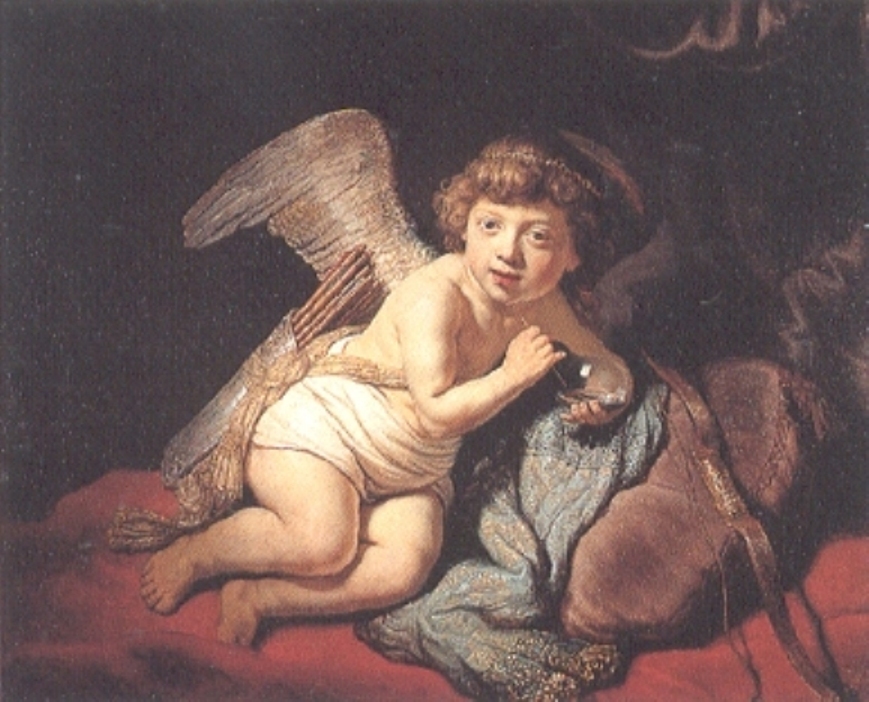
Rembrandt’s “Cupid Blowing Soap Bubbles” (1634) is a small, intimate drama that turns a child’s game into a meditation on time. A golden-haired Cupid leans on a cushion, cheeks gently puffed as he prepares to send a translucent bubble into the dark. Feathery wings press against a crimson ground; satiny draperies bunch into folds that seem to breathe with the child; the darkness behind him is cavernous and tender. In a single glance, the painting registers as delightful—a cherub at play—then deepens into something weightier: a vanitas allegory in which love, beauty, and life shimmer for a moment and vanish.
A Dutch Vanitas In Disguise
Seventeenth-century Dutch painters loved the vanitas theme—the fragility of earthly things—often expressed with skulls, extinguished candles, tipped hourglasses, or wilting flowers. Rembrandt chooses a more inventive vehicle: a bubble made by Cupid’s own breath. The symbol holds multiple meanings at once. Bubbles are exquisite and brief; they flash with color, travel aimlessly, and pop at a touch. When Cupid makes one, love itself becomes subject to breath’s limits: desire is beautiful, spirited, and mortal. Instead of lecturing the viewer, Rembrandt sets a scene in which the lesson arrives gently through delight.
Composition Built On A Diagonal Of Anticipation
The picture is organized along a sweeping diagonal from the upper left wing to the lower right cushion. Cupid’s torso follows that descent; his gaze and slightly parted lips redirect our attention back upward to the dark space where the bubble will lift. This interplay—body falling, breath rising—charges the composition with expectancy. The curve of Cupid’s back echoes the roundness of a bubble; the flexed toes and tucked legs provide a counter-thrust that keeps the figure lively and poised. Nothing is static: the posture promises motion, the breath promises a moment, the dark promises a stage.
Chiaroscuro That Turns Breath Into Light
The background is nearly black, yet not dead; it hums with warm browns that hold the child like a velvet theater. Against that dusk, light strikes Cupid’s shoulder, cheek, and upper thigh with Rembrandt’s signature clarity. Notice the way the highlight on the upper arm breaks into tiny gradations as it rolls toward shadow—this diffusion mimics the soft dispersal of breath. Shadows are full and humane; they never swallow anatomy. The brightest surface after flesh is the linen wrapped at the child’s waist and the glinting silk of the blue-green drapery. Light behaves as if it has been summoned by breath; illumination is not just on the body, it is of the body.
The Tactility Of Paint And The Truth Of Childhood
Rembrandt’s paint handling persuades the hand before it persuades the mind. Impasted strokes define the pearly highlight on Cupid’s shoulder and the tiny, moist lip; thinner, elastic passages describe the translucent wings, where the pigment seems feathered by the brush itself. Skin is not an idealized marble but living, with rosy heat at the knees and toes and a faint bluish note at the wrist where veins would lie. This fidelity to childhood—plumpness, soft musculature, miniature fingernails—grants the allegory dignity. Because the body is true, the idea it carries feels trustworthy.
Wings And Ribbons As Visual Music
Cupid’s wings are compact and practical, their feathers edged with narrow gilded lights. They tuck behind the child like folded instruments ready to open at any second. Around the torso, a gold ribbon ties in a knot that behaves like a leitmotif; it reappears as glints on the cushion, on the sash that binds drapery, and along the seams of fabric. These repeated notes organize the color harmony, guiding the eye in a calm circuit so that we never lose the figure within the sumptuous setting.
The Velvet Red That Grounds Everything
The crimson cloth beneath Cupid is more than luxury. Its saturated tone supplies warmth to the entire palette and pinions the composition to the earth. Reds intercept the surrounding dark so that shadow feels plush rather than empty. The folds of the cloth are mapped with patient transitions: the upper planes receive orange-tinged lights; the troughs sink into maroon; border tassels flash with tiny gilded threads. Red is the color of blood and ardor—appropriate for Eros—and it quietly prepares us for the lesson of the bubble: every pulse beats in time.
Drapery That Performs Theatrically But Serves Psychology
To the right, a pale, blue-green textile pools into heavy folds beside a brown cushion. The material is painted with Rembrandt’s practiced relish for textures: the high threads catch light like tiny scales, then dissolve into dusky hollows. Yet these folds are not mere decoration. They curve around Cupid as if protecting a private stage for play, a children’s fort of fabric within which the world briefly shrinks to breath and shine. The drapery creates intimacy, a spatial hushedness in which small phenomena gain importance.
The Bubble As Missing But Present
Many versions of this subject show the bubble fully formed. Rembrandt chooses a more psychologically acute instant: the bubble not yet blown, the liquid and pipe ready, the mouth shaped. We imagine, rather than see, the globe that will rise. That absence turns the viewer into a collaborator. Our mind supplies the fragile sphere and, in supplying it, acknowledges the transience it embodies. The choice also intensifies suspense—by fixing the moment before the bubble appears, Rembrandt lets us feel how close beauty is to not existing at all.
The Face That Holds Both Mischief And Philosophy
Cupid’s expression is frank, curious, and alert. He looks not at the pipe but toward us, as if inviting us to watch the next second with him. The eyes are bright, the lower lip moist, the cheeks full but not over-sweetened. There is a hint of mischief—a child pleased with a trick—softened by the painter’s refusal to caricature. The result is a protagonist who can carry two registers at once: playful innocence and the philosopher’s demonstration. Through that gentle doubleness, the allegory never ossifies; it keeps the quick breath of a child.
Materials That Echo The Theme
Bubbles are made of water, soap, and air—the simplest of things—yet they can mirror the world in rainbow skins. Rembrandt echoes this alchemy with his materials. Thick lights bloom like tiny globes of paint on shoulder and wing; oily glazes create shadow pools where an image could dissolve. The artist mixes plainness (linen, skin, hemp cord) with sumptuousness (silk, gold braid) so the lesson addresses everyone: emperors and infants share the same vanishing breath. The mixture of humble and rich makes the painting a moral still life wrapped in putto charm.
A Cabinet Picture For A New Audience
Dated 1634, the work belongs to Rembrandt’s early Amsterdam years, soon after his move from Leiden. He was courting prosperous burgher collectors who favored small “cabinet” pictures they could hang in domestic galleries. “Cupid Blowing Soap Bubbles” fits that market perfectly: intimate scale, high finish, tactile splendor, and a witty emblem understood by educated viewers. Yet it also reads across time because its intelligence is visual, not merely encoded. You need not know emblem-books to understand that bubbles vanish.
The Sound Of The Image
Although a painting is silent, Rembrandt loads this surface with implied sound. You can nearly hear the faint intake as Cupid fills his lungs, the straw’s whisper at the lip, the soft wisp when air leaves the body, and the almost inaudible pop a second later. The crimson ground muffles the room like a theater’s velvet. That imagined acoustic helps slow the viewer’s looking. We linger long enough to notice the small half-shadow under the wrist, the tiny highlight on the pipe’s rim, the golden flecks stitched along the sash—details that reward patience, just as bubbles reward a calm breath.
Iconography Of Cupid And The Ethics Of Delight
Classical Eros enters Dutch Protestant Amsterdam trimmed of overt eroticism and recast as a moral teacher. Rembrandt navigates that translation by keeping Cupid unabashedly childlike—no erotic charge, only radiant life. The lesson is therefore delivered ethically through delight, not admonition. Pleasure becomes the carrier of wisdom: we enjoy the boy’s play even as we grasp that everything we enjoy depends on breath that fails. That balance—pleasure equal to wisdom—explains why the painting feels affectionate rather than scolding.
Comparison With Northern Contemporaries
Painters like Gerrit Dou and Jan van Bijlert also pictured children blowing bubbles, usually in candlelit interiors with glassware and reflective bric-a-brac. Rembrandt departs from the tabletop genre by staging the act as a little myth. He escalates the theme from everyday to emblematic without forfeiting nearness. The figure owns the space; there is no proliferating still life to crowd the allegory. The bubble’s frailty is placed inside a human, winged presence, not merely outside on a saucer. This choice makes transience intimate.
The Psychology Of Touch
Look at the left hand: it gathers the drapery with a sure grip, tiny dimples opening where fingers press. The right hand steadies the bubble pipe with a careful pinch. Those two touches—one firm, one delicate—mirror the painting’s double nature, both sturdy in craft and fragile in theme. Rembrandt repeatedly gives the viewer tactility and ephemerality in the same second. The hand that feels the weight of cloth is the hand that holds a tool for making weightless bubbles. Touch is the hinge between matter and air.
The Ethics Of Darkness
Rembrandt’s dark backgrounds have often been read as pure drama. Here the darkness has courtesy. It recedes, allowing the child to glow without glare. It shelters the bubble’s brief life from winds of distraction. It creates an arena of quiet in which attention becomes a form of care. In an age that floods the eye with brightness, the painting feels contemporary for the modesty of its optics. It trusts a single, well-placed light.
Lessons For Painters And Photographers
The image is a tutorial in shaping intimacy. Establish a dominant diagonal that proposes motion; keep the brightest values on the protagonist; balance satin highlights with absorbent shadow; vary edges so that wings read soft, limbs firm, and textiles articulate; stage the “moment before” rather than the moment itself; and let a single, simple symbol carry complexity. The result is a picture that can be read in a heartbeat and re-read for years.
Why The Picture Still Feels Fresh
Because its truth—beauty is brief—is delivered without bitterness. The boy’s smile is not warning but invitation. Viewers are asked to love the shimmer while it exists. The bubble is not an emblem of futility; it is a reason to treat moments gently, people kindly, pleasures gratefully. That generosity makes the painting durable. It honors both the intelligence and the appetite of those who stand before it.
Closing Reflection On Breath, Love, And The Shimmer Of Time
“Cupid Blowing Soap Bubbles” is Rembrandt at his most intimate and humane. A child on velvet gathers breath, and a whole philosophy condenses around him. Love is real, embodied, and sweet; it is also moment-shaped. The painter’s craft—thick light on skin, soft dark behind, ribbons whispering of luxury—never drowns the small sound of air leaving the body. We feel the second expand, then release. When the bubble pops (as it will, just off the canvas), we are left not with despair but with a sharpened appetite for the next shimmer, the next kindness, the next breath.