Image source: wikiart.org
Introduction to Cup of Water and a Rose on a Silver Plate
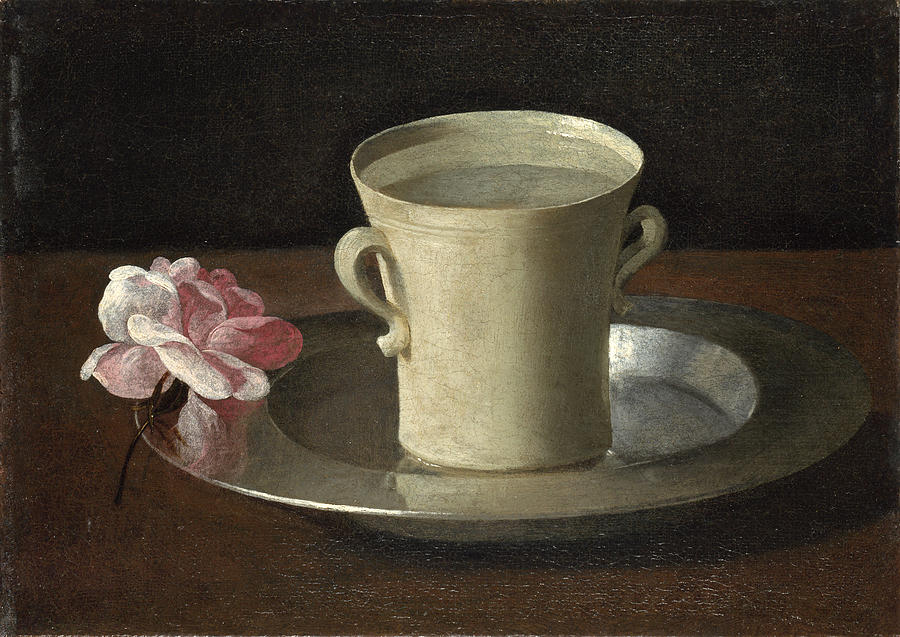
Francisco de Zurbaran’s “Cup of Water and a Rose on a Silver Plate,” painted around 1630, is one of the most quietly powerful still lifes of the Spanish Baroque. At first glance the composition seems disarmingly simple. A plain white cup filled with water stands on a silvery plate, accompanied by a single pink rose. The background is almost entirely dark, the wooden table plain and unadorned. Yet from this minimal arrangement Zurbaran creates an image full of spiritual resonance, technical refinement and meditative calm.
The painting belongs to the tradition of the Spanish bodegón, a type of still life that typically portrays humble objects with intense realism, often imbued with religious or moral symbolism. In “Cup of Water and a Rose on a Silver Plate,” Zurbaran distills this tradition to its essence. Every element is carefully chosen, every reflection and shadow meticulously observed. The result is a work that invites prolonged contemplation, where the viewer moves from the physical reality of objects to the suggestion of a deeper, invisible meaning.
Historical Context and Zurbaran’s Devotional Vision
Zurbaran painted this still life in Seville, a major artistic and religious center in early seventeenth century Spain. The city’s monasteries, convents and churches commissioned paintings that would support their spiritual life and teach the faithful through images. Zurbaran became one of their favorite artists because of his ability to combine rich naturalism with intense piety. His figures of monks, martyrs and saints are well known, but he also produced a small group of still lifes that reveal another side of his talent.
“Cup of Water and a Rose on a Silver Plate” may have been intended for a monastic setting, perhaps even for a Carthusian or other contemplative order. The austerity and silence of the composition echo the atmosphere of a cell or small chapel where the routine of daily life is oriented toward prayer. In this context, the still life is not simply an exercise in realism but a visual aid for meditation. The viewer is encouraged to see the ordinary objects as symbols of spiritual truths, much as a monk might contemplate a single flower or a cup of water as reminders of divine creation and grace.
The painting also reflects wider currents in Counter Reformation spirituality. The Catholic Church in this period emphasized clarity, simplicity and emotional accessibility in religious art. Instead of confusing allegories, artists were urged to create images that spoke directly to the heart and senses. Zurbaran’s still life follows this guidance. The objects are recognizable, their arrangement straightforward, yet the atmosphere points beyond the visible world.
Composition and Balance
The composition of “Cup of Water and a Rose on a Silver Plate” is remarkably balanced and harmonious. The central vertical axis is occupied by the cup, which rises from the plate like a column. Its height gives the painting an almost architectural stability. To the left, the rose reclines gently, its horizontal orientation counterbalancing the upright cup. The plate acts as a circular stage tying both elements together.
Zurbaran places the objects slightly below the center of the canvas, leaving a large area of dark background above. This distribution of space emphasizes the low, intimate viewpoint and creates a feeling of quiet isolation. The viewer’s gaze is drawn downward to the table, as if sitting at the same level as the plate. The edges of the table and the background wall are barely defined, so the objects appear to emerge out of darkness into a softly lit zone.
Despite the small number of elements, there is a subtle dynamism in the way the handles of the cup curve outward and how the petals of the rose open toward the viewer. These gentle curves prevent the composition from feeling static. At the same time, the strict geometry of the cup and plate maintains a disciplined order. Zurbaran achieves a delicate equilibrium between natural spontaneity and compositional control.
Light, Shadow and the Atmosphere of Silence
Light plays a crucial role in defining the mood of the painting. A single, soft light source illuminates the cup, plate and flower from the left, casting gentle highlights and shadows. The background remains largely in darkness, allowing the objects to stand out with almost sculptural clarity. This strong contrast between lit objects and dark ground is characteristic of Baroque tenebrism, but here it is employed in an unusually serene and restrained way.
The water in the cup catches a faint gleam along its rim, suggesting both transparency and stillness. The metallic surface of the plate reflects light more sharply, especially along its outer edge, creating subtle arcs of brightness that echo the circular form. The rose, with its delicate pink and white petals, receives a softer, more diffused light, which enhances its fragile appearance.
The shadows on the table are not entirely black. Careful observation reveals variations of warm brown and cool gray. These transitions give the scene a tangible depth, while the overall low key palette preserves an atmosphere of quiet. There is no sense of movement or disturbance. It is as if time were momentarily suspended, allowing the viewer to focus entirely on the presence of these simple objects.
The Cup of Water as Symbol and Object
The cup of water is the most prominent element in the painting. Its shape is straightforward but distinctive, with slightly flared rim and two small handles curving outward. Zurbaran paints it in a creamy, off white tone that contrasts with the darker surroundings. Close inspection suggests that the cup might be made of ceramic or some modest, unglazed material. It is not luxurious, yet it possesses a certain dignity through its simplicity and upright form.
As an object, the cup showcases Zurbaran’s technical skill. He carefully models its cylindrical shape using subtle gradations of light and shadow and finely indicates the thickness of the rim. The reflection of the plate along the base of the cup and the faint line where water meets the inner wall show a keen understanding of how light behaves on different materials.
Symbolically, water has long associations with purity, cleansing and spiritual rebirth in Christian tradition. A simple cup of water can evoke the humility of daily sustenance, the refreshment offered by divine grace or the purity of the Virgin Mary. In some interpretations, especially given Zurbaran’s devotion to Marian themes, the cup has been read as an allusion to the Virgin, who contained within herself the living water of Christ. Whether or not the painter consciously intended this specific reading, the cup certainly carries a sense of modest yet profound significance.
The Rose and Its Meanings
Next to the cup lies the rose, its stem extending just beyond the edge of the plate. The flower is painted with careful accuracy. The petals are slightly wilted or relaxed, not in rigid bloom, suggesting natural impermanence. Pink and white tones blend together, with hints of shadowed crimson in the folds. The rose not only softens the austerity of the composition but also introduces an element of tenderness.
In Christian iconography, the rose is frequently associated with the Virgin Mary, charity and the joy of paradise. A single rose may represent the beauty of divine love or the fleeting nature of earthly life. In combination with the cup of water, the flower suggests a dialogue between purity and love, simplicity and beauty, life and its inevitable fading. The fact that the rose is placed directly on the plate, its petals brushing against the reflective metal, heightens the sense of intimacy between the objects.
The reflection of the rose on the polished surface is particularly memorable. It is slightly blurred, more a suggestion of color and shape than a precise mirror image, yet it deepens the sense of reality and underscores Zurbaran’s mastery of subtle optical effects. This small detail invites the viewer to linger, noticing how the rose is doubled, as if its beauty extended into another dimension.
The Silver Plate and Reflections
The silver plate provides the unifying base for the composition. Its cool gray tone contrasts with the warm wooden table and supports both cup and flower. Zurbaran paints the plate with a delicacy that balances realism and simplicity. He suggests its metallic nature not through elaborate engraving or decoration but through the way it reflects light and objects.
The circular rim catches the strongest highlights, forming a luminous ring around the cup. Inside the rim, the surface shows soft reflections of the cup’s lower portion and the colors of the rose. Near the front edge, the reflections are less distinct, blending into the surrounding shadows. These gradations give the plate a sense of depth and curvature.
Silver, in spiritual symbolism, can represent purity, wisdom and redemption. In this painting it may also evoke the liturgical vessels used in religious ceremonies, though the plate here is intentionally plain. It contributes to the sense that the everyday objects of the table have been elevated to an almost altar like status. The viewer is prompted to approach them with the same reverence one might feel in front of a chalice or paten in a church.
Minimalism and Spiritual Concentration
One of the most striking aspects of “Cup of Water and a Rose on a Silver Plate” is its radical economy of means. In an age when many Baroque still lifes were filled with abundant fruit, elaborate glassware and rich textiles, Zurbaran chooses just three modest items and a bare table. This simplicity is not a sign of poverty of invention but an intentional artistic choice.
The limited number of elements allows for intense focus. Each object can be contemplated individually and in relation to the others. The viewer becomes aware of minute details: the slight irregularities in the cup’s surface, the subtle veins of the rose petals, the faint scratches on the plate. By stripping away distractions, Zurbaran invites a meditative engagement akin to prayer. The painting becomes a visual counterpart to the spiritual discipline of concentrating on a single thought or phrase.
This minimalism also reflects the ideals of monastic poverty and simplicity. The cup, rose and plate are not ostentatious objects of wealth but humble items that anyone might have seen on a table. Their elevation into an artwork resonates with the Franciscan and other mendicant traditions that valued everyday life as a place where God’s presence could be found. In this sense, the still life is both an affirmation of the material world and a call to see beyond it.
Technique and Surface
From a technical standpoint, the painting exemplifies Zurbaran’s precise and economical brushwork. The surface appears smooth, with little obvious texture, yet the artist subtly varies his handling to suggest different materials. The cup is rendered with even strokes that emphasize its solid form. The rose petals display more nuanced, feathery touches, conveying fragility. The plate combines broader, sweeping strokes for the metallic surface with fine highlights along the rim.
The color palette is restrained, dominated by whites, grays, browns and the gentle pink of the flower. This limited range enhances the painting’s unity. Small differences in tone carry much of the visual interest. The transition from the dark background to the lighter table, the gradation along the side of the cup, the delicate blush of the rose all demonstrate Zurbaran’s ability to achieve richness with subtle means.
Crucially, the painting does not flaunt virtuosity for its own sake. Its technical refinement is always at the service of clarity and contemplation. The viewer may admire the skill involved, but the overall effect is one of naturalness, as if the objects had simply settled into place and the artist had captured them with quiet respect.
Relationship to Spanish Still Life Tradition
Spanish still life painting of the seventeenth century often differed from its Flemish or Dutch counterparts. While northern artists frequently depicted lavish displays of luxury, Spanish bodegones tended to focus on few objects, often linked to themes of work, nourishment and humility. Painters like Juan Sánchez Cotán and later Zurbaran created compositions where fruit, vegetables, kitchen utensils or simple dishes were arranged against dark backgrounds with rigorous geometry.
“Cup of Water and a Rose on a Silver Plate” fits into this tradition but also introduces a particularly poetic and spiritual tone. The combination of a drinking vessel, a single flower and a reflective plate has an almost emblem like clarity. The painting can be read as a meditation on daily sustenance, spiritual refreshment and beauty offered to God. It demonstrates how Spanish artists could charge the most ordinary items with profound significance.
Zurbaran’s still life also anticipates later developments in European art where minimal still lifes and object portraits would become vehicles for introspection and symbolic exploration. The work’s modern appeal lies partly in this simplicity, which resonates with contemporary tastes for reduced, essential forms.
Emotional and Spiritual Resonance Today
For modern viewers, “Cup of Water and a Rose on a Silver Plate” offers a moment of visual and psychological rest. In a world often crowded with images and noise, the painting’s quiet concentration can feel deeply refreshing. The objects are so ordinary that anyone can relate to them, yet they are presented with such care that they seem to possess an inner life.
The cup of water suggests basic human needs and the possibility of refreshment. The rose evokes love, beauty and transience. The silver plate reflects and unites them. Together they form a small universe of meanings, open to each viewer’s personal associations. Some may see in the painting a reminder to appreciate simple things. Others may read it as a symbol of spiritual nourishment or as a visual poem about the interplay of material and spiritual realities.
Whatever interpretation is chosen, the painting’s enduring strength lies in its ability to transform the humble into the luminous. Zurbaran makes us pause before a cup, a flower and a plate and, in doing so, encourages a more attentive way of looking at the world. The still life becomes an invitation to contemplation, reminding us that depth and beauty often reside in the simplest of things.