Image source: wikiart.org
Historical Context of Murillo’s “Crucifixion”
Bartolome Esteban Murillo painted “Crucifixion” in 1682, during the last phase of his career, when his style had matured into a blend of emotional tenderness, luminous color, and soft, atmospheric light. Seville in the seventeenth century was a deeply religious city marked by processions, confraternities, and intense devotion to the Passion of Christ. Painters were expected to create images that did more than recount familiar stories. They had to move the heart, inspire repentance, and invite meditative prayer.
The subject of the Crucifixion lay at the very center of Christian devotion. As a result, countless artists tackled it, from medieval altarpieces to monumental Baroque canvases. Murillo approached the theme with a characteristic combination of realism and compassion. Rather than fill the composition with soldiers, crowds, or dramatic landscape details, he focuses on the intimate group at the foot of the cross: the Virgin Mary, Saint John the Evangelist, and Mary Magdalene. This emphasis reveals his desire to lead viewers into a personal contemplation of Christ’s sacrifice through the emotions of those closest to him.
Painted near the end of Murillo’s life, this “Crucifixion” is imbued with a quiet intensity. It shows a master artist who has refined his visual language and stripped the scene to its essentials, allowing the mystery of the Cross to speak with immediacy and clarity.
First Impression and Overall Composition
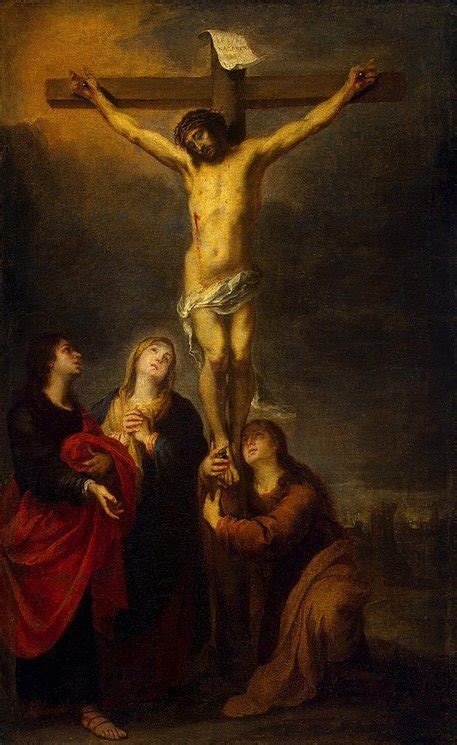
At first glance, the viewer’s attention is captured by the tall vertical of the cross dominating the center of the canvas. The body of Christ hangs slightly slumped, head tilted to the side, eyes closed, and torso gently twisted. Above the cross is a dark, clouded sky, heavy with the weight of the event. Below, three figures gather in grief and reverence, their faces turned upward toward the crucified Savior.
Murillo arranges the composition as a triangle with Christ at the apex and the group of mourners forming the base. John stands to the left, draped in dark garments with a vivid red mantle. The Virgin occupies the central position beneath the cross, her hands clasped, her head lifted in sorrowful contemplation. To the right, Mary Magdalene kneels at the foot of the cross, clinging to the wood and looking up with an expression of intense devotion.
This grouping creates a strong sense of unity. The figures are physically close, their bodies overlapping slightly, which conveys their shared emotional bond. At the same time, their different postures and expressions reflect distinct responses to the tragedy: contemplative acceptance in Mary, compassionate sorrow in John, and passionate love in Magdalene. The viewer is invited to join this small circle, to stand mentally among them at the foot of the cross.
The Figure of Christ on the Cross
Central to the painting is the figure of Christ. Murillo portrays him with a combination of realism and idealization. His body is slender yet strong, the muscles of his chest and abdomen subtly defined. The arms stretch high along the crossbeam, hands pierced by nails. The legs are slightly bent, feet crossing one over the other, secured by a single nail. A modest white loincloth wraps around his hips, fluttering slightly as if touched by a faint breeze.
The head of Christ is gently inclined, crowned with thorns that press into his brow. Strands of hair fall over his shoulders, and a trickle of blood runs from the wound in his side. Murillo avoids excessive physical brutality. There are signs of suffering, but they do not dominate the image. Instead, he emphasizes the calm stillness of the final moment. Christ’s eyes are closed, his mouth slightly parted, suggesting that the cry “It is finished” has already been uttered.
The body is bathed in a warm, golden light that separates it from the darker sky. This illumination gives Christ a quiet radiance, hinting at the divine nature that remains present even in death. The cross itself is solid and simple, its wood rendered in earthy browns. At the top is the small tablet bearing the inscription “INRI,” indicating “Jesus of Nazareth, King of the Jews.” The stark vertical of the cross acts as an axis that connects heaven and earth, emphasizing the theological meaning of the event.
The Virgin Mary and the Language of Sorrow
Directly beneath Christ stands the Virgin Mary, the emotional heart of the painting. Murillo portrays her as a mature woman with pale, luminous skin and a face marked by gentle suffering rather than theatrical despair. She wears a blue mantle over a red gown, colors traditionally associated with her role as Mother of God and symbolizing both her humanity and her spiritual royalty.
Mary’s hands are clasped just below her chest, fingers interlaced, in a gesture of prayer. Her head tilts backward, her upturned eyes fixed on her crucified Son. This posture expresses deep pain, yet there is also a sense of acceptance. She appears to be offering her grief to God rather than being overwhelmed by it. Murillo avoids distorting her features with violent emotion. Instead, he presents an image of dignified sorrow, inviting viewers to contemplate the mystery of a mother who believes even as she watches her child die.
Her proximity to the cross is crucial. The vertical beam seems almost to rest upon her, a visual reminder of the traditional belief that Mary participates in Christ’s redemptive suffering. The shadow of the cross falls over her, uniting her fate with that of her Son. The viewer is drawn to her face as a mirror of compassion and an example of steadfast faith in the midst of tragedy.
Saint John the Evangelist as Witness and Companion
To the left of Mary stands Saint John, the disciple whom Jesus loved. He wears a dark tunic with a flowing red mantle that catches the light, adding a vibrant note to the otherwise subdued palette. John’s youth is evident in his smooth face and long hair, yet his expression is somber. He looks upward toward Christ with eyes that seem filled with tears.
John’s presence fulfills the Gospel account in which Jesus entrusts Mary to his care. Murillo suggests this special bond through John’s proximity to the Virgin. His body leans slightly toward her, as if offering support. His hands are loosely clasped, conveying a mixture of reverence and helplessness. He is a witness to the event, representing the faithful disciple who remains near the cross despite danger and sorrow.
In devotional terms, John serves as a model for the viewer. Where Mary embodies maternal love and cooperation with God’s will, John illustrates loyal friendship and contemplative attention. Standing near him in imagination, the viewer is encouraged to hold fast to Christ even in moments of apparent defeat.
Mary Magdalene at the Foot of the Cross
On the right side, Mary Magdalene kneels with both arms reaching up to embrace the base of the cross. Her long hair falls over her shoulders, and her brownish robe clings to her body as she leans forward. Her face is turned upward toward Christ, eyes wide and lips slightly parted, expressing an intense mixture of grief, love, and adoration.
Murillo gives Magdalene a distinctly physical presence. Her kneeling posture, hands gripping the wood, and flowing hair emphasize her embodied devotion. Traditionally associated with penitence, she represents the sinner who has experienced forgiveness and now clings to the source of her salvation. By placing her at the very foot of the cross, Murillo underscores the idea that the repentant soul finds refuge and transformation at this place of suffering.
Her earthy garments create a bridge between the divine figure above and the ground below, between the transcendent mystery and the human heart. Many viewers over the centuries have identified with Magdalene’s passion, seeing in her posture the longing to hold onto Christ even as he seems to be taken away.
Light, Color, and Atmosphere
Murillo’s mastery of light is especially evident in this “Crucifixion.” The scene unfolds beneath a darkened sky, evoking the Gospel accounts of the sun being obscured at the moment of Jesus’ death. Yet within this darkness, a warm light illuminates the figures, particularly Christ and the small group at the base of the cross. This contrast highlights the theological meaning of the event: within the apparent triumph of darkness, the true light of salvation is revealed.
The colors are rich but controlled. The red of John’s mantle and hints of red in Magdalene’s garment echo the blood of Christ, visually linking them to his sacrifice. Mary’s blue mantle brings a cool counterpoint that balances the warmth of the other hues. Christ’s pale body stands out against the darker tones, bathed in a golden glow that emphasizes both his suffering humanity and his divine role.
The background is largely indistinct. Hints of a distant city or rocky landscape appear in the lower right, but they remain blurred and shadowy. This lack of detailed environment keeps the viewer’s focus firmly on the figures and the cross. The sky is rendered in swirling dark clouds, perhaps tinged with a faint light near the top, suggesting that beyond the grief of Good Friday lies the hope of resurrection.
The overall atmosphere is one of solemn stillness. Despite the horror of the crucifixion, there is no crowd of shouting soldiers, no chaotic motion. The silence seems almost palpable. Murillo invites viewers into a contemplative space where they can quietly ponder the meaning of Christ’s death without distraction.
Baroque Sensibility and Murillo’s Personal Style
As a painter of the Spanish Baroque, Murillo shared with his contemporaries a love for drama, emotion, and the use of light to create spiritual intensity. In “Crucifixion” he employs these elements with restraint and refinement. The dramatic subject could easily have led to overt theatricality, but instead he opts for a more intimate and focused drama centered on the small group of faithful figures.
Murillo’s characteristic soft brushwork is evident in the delicate modeling of faces and the gentle transitions between light and shadow. Edges blur slightly, especially in the background, giving the painting a poetic, almost dreamlike quality. This softness does not diminish the realism of the figures; rather, it envelops them in a luminous haze that suggests the presence of grace.
Color is used expressively rather than descriptively. The vivid red of John’s cloak, for example, not only enriches the visual harmony but also symbolizes love and sacrifice. The interplay of warm and cool tones directs the viewer’s emotional response, guiding the eye from Christ’s body to the grieving figures below and back again.
Murillo’s style here reflects a lifetime spent painting religious subjects. He has learned how to communicate complex theological ideas through gesture, gaze, and subtle visual symbolism. The result is an image that feels both accessible and profound.
Devotional and Theological Significance
For the faithful of Murillo’s time, this painting would have served as more than an illustration of a biblical episode. It was a visual aid to prayer and meditation on the Passion. The placement of the figures invites viewers to imagine themselves kneeling alongside Mary, John, and Magdalene, sharing their sorrow and love.
Theologically, the painting emphasizes several key themes. First, it underscores the humanity of Christ. His body is not purely idealized; it bears the marks of suffering, reminding viewers that redemption is achieved through real pain and death. Second, it highlights the idea of companionship in suffering. Mary, John, and Magdalene remain at the cross when many others have fled. Their presence suggests that authentic discipleship involves staying near Christ in difficult moments.
Third, the painting affirms the hope contained within the tragedy. The light that falls on Christ and the saints hints that the crucifixion is not the final word. Even in the darkest hour, divine light continues to shine. This implied hope would have been particularly meaningful in a city like Seville, which had endured plagues and economic hardship. The painting offers consolation by showing that God is present in suffering and that love can turn defeat into victory.
Emotional Impact and Contemporary Relevance
Although painted in the seventeenth century, Murillo’s “Crucifixion” continues to resonate with modern viewers. Its emotional power lies in its simplicity. There are no extraneous details, no dramatic gestures that feel distant from everyday experience. Instead, we see a small group of people watching a loved one die. The scene transcends specific religious belief, touching on universal themes of loss, loyalty, and the search for meaning in suffering.
For those who approach it from a Christian perspective, the painting remains a potent aid to reflection during Holy Week or personal times of trial. The calm dignity of Christ, the steadfast sorrow of Mary, the faithful presence of John, and the passionate devotion of Magdalene provide models of how to confront pain with courage and love.
In a broader sense, the image invites viewers to consider where they stand in relation to the suffering of others. Are they distant observers, or do they draw near as these figures do? Murillo’s work suggests that solidarity in suffering is a path to deeper humanity.
Conclusion
“Crucifixion” by Bartolome Esteban Murillo, painted in 1682, is a powerful synthesis of Baroque spirituality and the artist’s distinctive tenderness. Through its balanced composition, expressive figures, and evocative use of light and color, the painting offers a profound meditation on the death of Christ and the responses of those who loved him most.
Murillo strips away peripheral drama to focus on the central mystery of the Cross. Christ’s body hangs in quiet dignity, bathed in a golden glow that hints at both his suffering and his glory. Beneath him, Mary, John, and Mary Magdalene form a small community of faithful love, each embodying a different facet of devotion. The darkened sky and minimal landscape heighten the solemn stillness, inviting viewers into contemplative silence.
Across the centuries, this “Crucifixion” continues to engage hearts and minds. It calls viewers to stand at the foot of the cross, to share in the sorrow that leads to hope, and to recognize in the outstretched arms of Christ an embrace offered to the world.