Image source: wikiart.org
Introduction
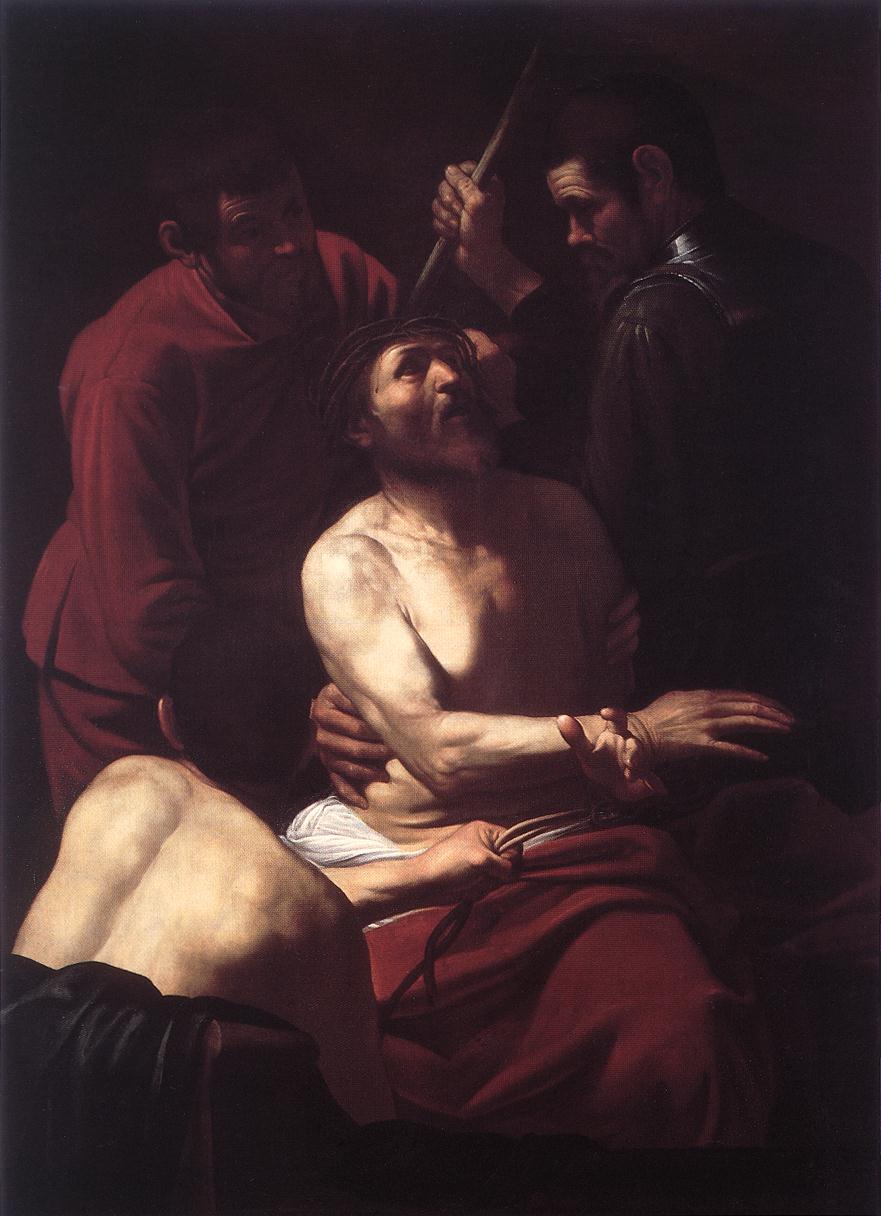
Caravaggio’s “Crowning with Thorns” (1603) stages cruelty with a terrible, intimate quiet. Christ sits half-naked in a pocket of darkness, his torso modeled by a raking beam as three men close in around him. One grips his bound wrist, another hauls the cloth at his waist, and a third, looming at the right, presses the reed scepter downward as a ring of thorny branches is forced onto his brow. No architecture and no crowd distract from the knot of bodies. The painting turns the humiliation of the Passion into an immediate human event, using light, gesture, and touch to tell a story of power, mockery, and endurance.
Historical Context
By 1603 Caravaggio had already transformed Roman painting with tenebrism, naturalistic models, and a taste for the decisive second. This canvas belongs to that mature phase, when the artist was answering Counter-Reformation demands for clarity while pushing narrative into astonishing proximity. The subject comes from the Gospels’ account of soldiers mocking Jesus as “King of the Jews” before crucifixion. Earlier Renaissance versions often framed the scene with thrones or colonnades and organized its actors in orderly tiers. Caravaggio rejects such ceremony. He compresses the action to a few figures and a bare stage, trusting flesh and fabric to carry the theology.
The Chosen Instant
The painting freezes the instant when pain and recognition meet. Christ’s hands are bound; his torso twists slightly as the reed is thrust down; his head tilts back to accommodate the crown. We are not witnessing the first jab or the final outcome but the moment when the instruments of mockery have become part of his bearing. He does not resist. The face turns upward in a mixture of discomfort and inward focus, a physical acceptance that foreshadows the acceptance of the cross. Around him, the men are intent on their practical tasks. They are not caricatured as monsters; they are workers tasked with a job, which makes the violence worse by being ordinary.
Composition and the Engine of Diagonals
Caravaggio builds the image from interlocking diagonals that converge at Christ’s head. The reed descends from the upper right; Christ’s torso rises from the lower left; the bound forearms thrust forward in a counter-line; the handlers’ arms arc around him like parentheses. This geometry creates a visual vise. The viewer’s eye is pulled again and again to the crown being forced downward, as if vision itself collaborated in the pressure. The figures fill the frame from edge to edge, eliminating escape routes. The bottom ledge of deep red fabric anchors the composition and doubles as a reminder of the royal mantle used to mock him.
Chiaroscuro and Light as Judgment
A single, directional light pours from above and left, falling on the surfaces that matter: Christ’s chest and face, the sinews of the bound wrist, the reed gripped at its midpoint, the shoulder and cheek of the man who kneels to haul the cloth. Darkness swallows the rest, including the upper faces of the tormentors. This is not simply stage lighting; it behaves like judgment. The beam declares what shall be visible in the moral record, while shadow withholds the spectacle of gloating expressions. The tormentors are reduced to hands, arms, and practical torsos, as if history would remember what they did more than who they were.
The Body of Christ and the Ethics of Attention
Christ’s body is presented without idealization. The chest is narrow, the muscles modest, the skin marked by the cool blue-grey that Caravaggio uses for living flesh under duress. A faint down on the forearms catches the light; veins rise along the wrist where cords bite. The anatomy persuades because it is not heroic. The man who suffers is palpably mortal. Caravaggio’s attention to such small truths—creases at the elbow, the weight of the head on the neck, the breath that seems caught high in the throat—converts piety into compassion. The viewer is asked not to admire but to notice.
The Faces and the Refusal of Caricature
Only one tormentor’s face is fully legible: the man at the right, half turned, cheekbone sharp in the light. His expression is focused, almost bored—someone finishing a task. The man in red behind Christ shows a coarse curiosity, the look of a bystander who leans in as the action tightens. The kneeling figure at the lower left has his back to us; his bowed head gives the scene an odd humility, though it is the humility of service to violence. By avoiding grotesque exaggeration, Caravaggio brings the image into the realm of daily ethics. Cruelty here is not flamboyant; it is the grim efficiency of people doing what they have decided is necessary.
Gesture as Moral Speech
Meaning is delivered through hands. Christ’s bound hands push forward involuntarily, fingers extended in a reflex somewhere between protest and offering. The kneeling handler’s fist grips the cloth at Christ’s waist, its knuckles whitened with effort; the gesture reeks of routine procedure. The standing man’s palm wraps the reed with a working man’s hold, wrist flexed, elbow raised to gain leverage. The man in red cradles Christ’s torso under the arms, not unkindly but without care, as one might hold an uncooperative patient. This choreography of grips and pressures is the painting’s rhetoric. Words are unnecessary.
Fabric, Reed, and the Credibility of Matter
The red mantle that pools across the lower half operates on two registers. As fabric, its weight and nap are undeniable; Caravaggio models it with long slopes of shadow that break into sharp ridges of highlight. As symbol, it recalls the robe used to parody kingship and points forward to the blood of the Passion. The reed is slender but stubborn, catching a thin highlight along its spine. Its very flimsiness makes the humiliation keener: a scepter of grass. The white loincloth, pulled tight by the kneeling figure, creates a painful diagonal that both exposes and protects, a reminder that humiliation in the Passion is not only physical.
Color and Emotional Climate
The palette is a triad of flesh, red, and black. Caravaggio avoids decorative hues; everything contributes to the mood of severity. The skin tones move from waxen cools in the shadows to warmer notes where light pools on Christ’s chest and forearm. The red mantle burns quietly, not a festive scarlet but a heavy, almost clotted crimson. The surrounding blacks are deep and breathable, layered glazes that make the lit zones feel carved out of night. This economy of color keeps the viewer’s nervous system tuned to the moral frequency of the scene.
Space, Proximity, and the Viewer’s Seat
There is no architectural depth, no palace corridor, no audience. The background is a void close enough to touch. That proximity turns spectators into witnesses. We stand within the ring of men and feel the pressure of their bodies hemming us in. The cropping at the shoulders and backs intensifies claustrophobia. Caravaggio’s shallow stage cuts away everything but the event—a common strategy in his Passion scenes that asks a disturbingly modern question: What do you do when injustice is happening at arm’s length?
From Mockery to Coronation
Theologically, the episode inverts kingship. A thorny circlet and reed scepter parody royal regalia, yet the painting denies the parody’s power. Christ’s upward, inward gaze and the composed carriage of the torso insist that the mockery cannot touch the identity it targets. Caravaggio lets this claim emerge without emblems or inscriptions. No halo blazes; no scroll proclaims. The redefined royalty is carried in posture, not props. The crown that wounds is the sign of a kingship that will be proven on the cross.
The Silence Inside the Violence
Sound seems to belong to the picture—breaths, the scratch of thorns, the rasp of cloth—but the image itself is acoustically muted. Caravaggio cultivates this silence by draining the background and controlling expressions. The result is a tension between implied noise and painted quiet that forces the viewer inward. The painting becomes a meditation on patience: the patience to endure, the patience to refrain from spectacle, the patience to keep looking when it would be easier to avert one’s eyes.
Comparisons Within Caravaggio’s Passion Cycle
Seen alongside “Taking of Christ” and “Flagellation of Christ,” this work occupies the middle register between arrest and execution. The “Taking” explodes with metal and crowd; the “Flagellation” isolates three torturers at a column. “Crowning with Thorns” binds humiliation to handling—less theatrical than the arrest, less kinetic than the scourging, but psychologically denser. Across the group, Caravaggio’s grammar is consistent: a shallow stage, hands that do the telling, and light that testifies. This canvas is the most interior of the three, perhaps because it stages not a blow but a wearing down.
The Humanity of the Tormentors
Caravaggio’s realism extends to those who harm. The men’s sleeves are creased from normal labor; their necks thicken where a lifetime of effort has built muscle; their faces are common. By keeping them credible, the painter refuses the comfort of monsters. The viewer recognizes neighbors in these bodies—men who might share a bench at market. Such recognition asks for self-scrutiny. The cruelty on display is not the property of a distant “they” but a potential in “us,” exercised whenever duty numbs conscience.
Technique and Paint Handling
The painter’s method is disciplined and restrained. Large, opaque masses establish the ground—the red mantle, black void, and dark garments. Over these Caravaggio lays translucent veils for flesh, letting warm underpaint glow through cooler top tones. Edges are sharpened only where light breaks decisively: the thorn’s point, the knob of the wrist, the ridge of a cheekbone. Small impastos pick out highlights on fingernails and the reed. The brush remains invisible as signature; what matters is the event’s legibility. Even the thorns are not fussy; they are believable enough to hurt without turning into botanical exhibition.
Iconography Without Excess
Traditional symbols appear in minimal form: the thorny crown, the reed scepter, the mock-royal red. There is no dog, no banner, no elaborate architecture. This restraint guards the painting from moralizing clutter and keeps attention on the exchange of force and consent. The iconography lives in action: the crown is an instrument, not an emblem; the reed is a lever, not a sign. Caravaggio’s art insists that meaning must be incarnate to be convincing.
The Psychology of the Central Gaze
Christ’s eyes do not plead or confront; they rise as if searching the edge of sight for a farther horizon. The mouth is slightly open, perhaps in breath, perhaps in a word unsaid. The expression gives the body’s endurance its interior dimension. This is suffering understood rather than simply suffered. The gaze also organizes the composition: while arms and tools cross the picture horizontally and diagonally, the eyes lift vertically, creating a silent axis that pierces the darkness above.
Color Notes and the Breath of Flesh
Look long at the transitions across the chest and arms. Pale greys modulate into ochres and delicate roses; cool notes settle in shadowed hollows while warm ones bloom where blood nears the surface. Caravaggio’s flesh is never a single hue. It is a living mixture that changes with pressure, light, and motion. In this sensitivity the painter parallels the subject: a humanity responsive to touch and wound. The crown’s pricks redden the skin at the hairline; the cord at the wrists raises a subtle welt. Such observations keep the scene anchored in the body’s truth.
How to Look
Enter at the bound hands and feel the torque of the wrist as fingers involuntarily extend. Follow the forearms up to the sternum where light collects, then climb to the crown where the reed presses down. Let your gaze drift to the man in red’s shadowed face, then to the right where the handler’s cheekbone lifts from darkness. Drop to the kneeling back—a broad plane of flesh that mirrors Christ’s own—and return by way of the heavy red folds. Each circuit tightens the vise until the silence seems to ring.
Reception and Afterlife
The painting’s refusal of spectacle has kept it compelling for centuries. It influenced Caravaggisti who learned from its concentrated staging and moral sobriety, and it continues to attract contemporary viewers who find in it a psychology of humiliation that feels painfully current. In churches and museums, the image often slows traffic; people recognize that it requires stillness. The canvas has also spoken across confessional lines because it relies on human truths—touch, weight, breath—more than on doctrinal signage.
Conclusion
“Crowning with Thorns” distills one of the Passion’s most difficult moments into a scene that persuades by nearness. Caravaggio eliminates scenery, reduces actors to their necessary roles, and lets light choose what will be remembered. The result is an image where instruments of mockery become instruments of meaning, where hands speak aloud, and where a man’s quiet endurance reads as royalty redefined. In its severe economy the painting proposes that the sacred can survive humiliation because it answers to another measure. The viewer leaves with the awkward knowledge that cruelty can be efficient, consent can be strong, and truth can shine without spectacle.