Image source: wikiart.org
Introduction
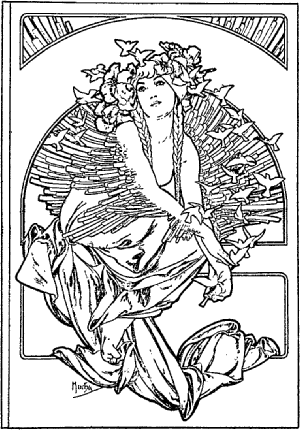
Alphonse Mucha’s “Coverage for the Volume of Grandmothers’ Songs” (1897) is a tender piece of Art Nouveau draftsmanship that proves how much feeling can be carried by pure line. There is no color and no typographic shout; only a young woman wrapped in tumbling drapery, a radiant halo built from clustered reeds or organ pipes, and a wickerwork of doves and flowers that seem to rise with her breath. The picture was created as a book cover design, which means it had to hold its own on a crowded shelf and also usher a reader into a particular mood. Mucha answers with a quiet, lyrical emblem where memory and melody meet. The image reads like a lullaby drawn in ink.
Historical Context
In the late 1890s Mucha stood at the center of Paris visual culture. His lithographic posters for Sarah Bernhardt had redrawn the possibilities of commercial art, and publishers quickly realized that his language of arabesques, halos, and iconic figures could give even modest books a sense of ceremony. The title “Grandmothers’ Songs” signals a collection of older airs, lullabies, and folk verses. Mucha’s task was to craft a cover that honored age without stiffness, that evoked transmission across generations, and that promised readers a world of melody remembered rather than staged. By choosing a monochrome solution he aligned the design with the intimate economies of book production while demonstrating that Art Nouveau could thrive without the opulence of color lithography.
Composition and Architectural Frame
The composition is a harmony between figure and frame. A rectangular border contains a large central circle, cropped at the top and bottom, that functions as a halo and as an architectural soundboard. The woman sits slightly off center, her body forming a supple triangle whose base is the cascade of cloth and whose apex is the crown of flowers nesting in her hair. Mucha fills the circular backdrop with radiating bars that read at once as reeds of a harmonium, beams of light, or a stylized burst of song. Small rectangular windows in the upper corners break the frame’s severity and keep the design from becoming a mere emblem; they hint at daylight and domestic interior, the world in which grandmothers actually sing.
The Figure as Personification of Song
Mucha’s women often operate as personifications, and here the figure is best understood as the spirit of song itself, youthful not because the book is childish, but because music renews the household with each generation. She does not face us directly. Her chin lifts slightly, the gaze drifts upward, and the braids fall like paired staves. The pose is less theatrical than contemplative, almost as if she hears a tune return. Hands gather the hem in a small knot, a gesture that reads as both modesty and rhythm; fingers pull the fabric into a beat. The body becomes a score that the eye reads from feet to crown.
Line as Melody
Because the design is purely linear, line must do all the work of timbre, harmony, and tempo. Mucha answers with a vocabulary of strokes so varied that one can almost hear them. Hair is written in looping, continuous filaments; drapery falls in long phrases that thicken and thin like a cello line; the ring of doves and petals flickers in small, quick notes around the slower beats of the folds. Even the frame participates. The circle’s clean curve is a held tone, the rectangles are measured rests, and the reeds or flutes radiating behind the figure provide a sustained chord. The drawing gathers these instruments into a single chorus without a trace of crowding.
Doves, Blossoms, and the Atmosphere of Memory
Birds spiral around the figure as if released by the song. They are neither naturalistic nor purely symbolic; they have the simplicity of dream visitors. Doves suggest peace, but in this context they also convey a domestic lyricism, the flutter of life in a garden where children might have dozed to the sound of old ballads. Mucha interleaves the birds with small blossoms, a device that turns air into tapestry and memory into pattern. One senses that the tune has been sung many times, and that the room fills with the familiar forms that tunes summon.
The Role of Drapery
Mucha was a master of drapery, not because he loved fabric for its own sake, but because length of cloth is the most sympathetic medium for line to travel. Here the dress piles in front like a landscape of folds, each crease answering another in slow counterpoint. The drapery also anchors the floating lyricism of the halo and birds; it gives the page a base note. The viewer feels the weight of the cloth even as the head rises into a zone of pure pattern. That balance—gravity below, melody above—perfectly suits a book of inherited songs, where ordinary life carries the music and the music in turn lightens the day.
The Halo of Instruments
The circular backdrop filled with parallel bars has sparked many readings. Some see organ pipes; others see a fanned stack of sheet music; still others read pure rays of sound. What matters is the way the bars compress near the figure’s shoulders and open outward toward the edge of the circle. The visual pressure near the body suggests the inner concentration from which singing rises, while the outward splay enacts projection into space. Mucha also uses the small gaps between bars to keep the field breathing; the halo feels alive, not mechanical. It is reverberation made visible.
Monochrome and the Book Arts
Mucha’s choice of black line on white ground was both practical and poetic. Book covers and title pages often relied on letterpress or zincography, processes that favored clear outlines over tonal depth. Instead of lamenting the absence of color, Mucha pushes linear possibilities to their expressive limit. The design reproduces cleanly at different scales, retains legibility when embossed or stamped in a single ink, and invites printers to add colored papers or foils without compromising the drawing’s integrity. The economy of means suits the subject: the old songs do not need gilding to move us.
Typographic Imagination Without Words
Although the surviving drawing is devoted to image, it is easy to imagine where the title and publisher’s imprint would have nestled. Mucha’s frames are typographic architectures even in the absence of type. The rectangular reserve at the bottom right invites a block of lettering, while the upper corners and the arc above the halo suggest banners or cartouches. This latent hospitality to words is what made Mucha so beloved by publishers: he could offer images that already knew how to converse with text.
Grandmothers, Transmission, and the Feminine Ideal
The subject’s title asks the image to honor elder women without depicting age directly. Mucha solves the problem by staging lineage rather than chronology. The youthful figure bears braided hair, a style that reaches backward to childhood and forward to motherhood; the wreath in her hair is a circle of return; the doves are the children who learn the tune and leave the room to carry it elsewhere. Art Nouveau ideals of the feminine—graceful, fertile, harmonious with nature—are here enlisted to describe cultural transmission. The woman does not perform; she keeps something alive.
Decorative Ethics and Everyday Use
Art Nouveau often proposed that the everyday deserved beauty. A book of familiar songs, often sung in kitchens and parlors, could be treated with the same ceremonial dignity as a deluxe album. Mucha’s design embodies that ethic. It is elaborate but never showy, crafted but not precious, and its symmetries are meant to be handled, thumbed, and seen repeatedly. The more one lives with the image, the more its rhythms become companionable, like a refrain that returns at the right hour.
Comparisons Within Mucha’s Work
Placed beside the full-color posters he designed for the theater, the cover looks modest, yet the underlying grammar is identical. A central figure, a circular aura, a vegetation of ornaments, and an architectural frame are the building blocks of both. What changes is temperature. In the posters, color and scale produce a public voice; in this cover, line and closeness cultivate an intimate register. The drawing also looks forward to Mucha’s pages for “Le Pater,” where sacred text receives similarly concentrated linear accompaniment. In both cases, monochrome is not lack but focus.
The Reader’s Path
The eye encounters the cover much as the ear meets a song. The upward tilt of the face is the opening note; the arc of the halo is the sustaining chord; the downward fall of cloth to the lower right is the cadence that returns us to earth. The frame of rectangles allows a small rest before the melody repeats. Because books are handled, this path is performed hundreds of times; the body that lifts a book rehearses the same arc as the figure’s movement. Mucha binds the act of reading to the act of listening.
Technique and Touch
Even in reproduction the drawing carries traces of the artist’s hand. Lines swell unexpectedly, terminate in delicate hooks, and sometimes double back lightly to thicken a contour. These small incidents are the visual equivalent of breath in singing. They remind us that the image was made in a single, sustained attention, not manufactured by a machine. That touch becomes an ethical statement about the songs themselves, which survive because bodies keep singing them, imperfectly and with love.
Cultural Resonance
The cover’s fascination today stems from the same qualities that secured its original success. It treats tradition as living rather than antique; it presents feminine imagery without a hint of cynicism; and it demonstrates how design can be both ornamental and intelligible. In a culture that often separates usefulness and beauty, the page proposes their reunion. The grandmother’s songs are not museum pieces; they are the daily architecture of feeling, and the book that holds them deserves an architecture to match.
Conclusion
“Coverage for the Volume of Grandmothers’ Songs” distills Mucha’s art to essentials: an emblematic figure, a halo of rhythmic pattern, and a frame that invites words into friendship with image. Without color or elaborate scenery, the drawing conjures a room where music is a household inheritance and where memory behaves like flight. In the discipline of his line and the generosity of his ornament, Mucha shows that a book cover can be more than packaging. It can be a prelude, a first bar that sets the key for everything to follow, and a reminder that the most durable songs are those sung close to home.