Image source: wikiart.org
Introduction
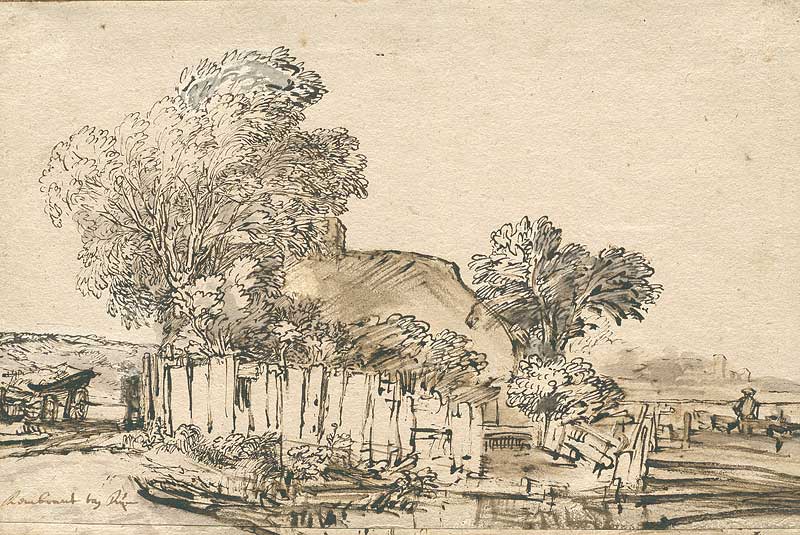
Rembrandt’s “Cottage with Wooden Fence amid Trees” (1648) is a small, quickened landscape that feels like a breath taken outdoors. Made in pen and brown ink with washes of diluted tone, it catches a corner of the Dutch countryside where a rambling fence encloses a cottage and a screen of trees rakes the sky with living gesture. Nothing here is grand. The subject is ordinary land under ordinary weather, seen by a painter who loved how line can move like wind and how a single wash can pin light to the page. What results is a deeply modern vision of place: specific, provisional, and full of human proximity.
The Ordinary Subject and Its Quiet Stakes
The scene locates us at the edge of a yard. A rough wooden fence, made of vertical planks and improvised posts, runs in a crowning arc. Behind it, leafy masses rise—one towering tree at left, a pair of smaller trees at right—and in the hollow their canopies form sits a low thatched or earthen roof. The cottage barely declares itself; it is the life around it—fence, growth, path, ditch—that claims our eye. Rembrandt treats this not as a backdrop for figures but as a protagonist in its own right, a lived environment that shapes the tempo of daily work. The drawing’s stakes are local and ethical: how a place is made, tended, and felt.
Composition as a Circle of Shelter
The composition is built from enclosing arcs. The fence curves around in a shallow amphitheater; the crowns of trees mirror that curve in the air; the cottage nestles where these two rings intersect. This circular logic turns the open countryside into a pocket of dwelling. The left foreground carries a diagonal sweep—probably a shallow ditch or track—that funnels the eye toward the fence’s gate-like interruption. To the far left, a shed leans into the path; to the far right, a tiny figure or two animate a distant causeway. These satellites keep the central enclosure from feeling cut off. The whole sheet breathes like a clearing.
The Wooden Fence and the Grammar of Making
Rembrandt lavishes attention on the fence because it tells the human story. Posts are irregular; some lean, some split; crosspieces are nailed on by necessity rather than symmetry. The pen strokes are short, angular, and overlapped, the very marks a carpenter’s hand might make if drawing with wood. This grammar of lines announces a rural economy where boundaries are built from what is at hand. The fence is both practical and expressive: it keeps animals out, children in, and it states, visually, that a home has been claimed within the wider land.
Trees as Actors, Not Props
The trees carry the drawing’s strongest rhythms. At left, Rembrandt stacks looping feathered strokes to build a tall, wind-caught crown; the trunk below is a muscular column with quick cross-hatching that reads as rough bark. At right, the smaller trees are all splay and flicker, their leaf-spray drawn with ragged clusters that imply flutter. These are not generic trees. Each has a personality and a motion. Their mass balances the fence’s verticality and stabilizes the composition while animating it. The trees become neighbors, guardians, and timekeepers whose growth records the years of the cottage.
Ink, Wash, and the Speed of Perception
The sheet is an object lesson in how Rembrandt uses minimal means to conjure depth. Pen outlines set the drawing’s scaffolding; liquid wash flows in to anchor shadow and suggest weight. A diluted brown spreads under the tree at left, giving it volume and coolness; a deeper wash tints the cottage’s roof and the earth beyond the fence, setting it back in space. The alternation between crisp linearity and soaked tone mirrors how the eye operates outdoors—switching from sharp edges to large fields of value as light changes. The visible joins, drips, and overlaps are not mistakes; they are the drawing’s weather.
Light and Atmosphere Without Sky
Although the sky is barely marked—only a few searching strokes and faint speckle—the drawing feels bathed in air. Rembrandt achieves this through contrast: the white of the paper stands as open light, and every wash placed against it reads as cloud shadow or foliage shade. The left side seems slightly brighter, as if a break in cloud had cleared; the right, with its tighter hatching, feels denser and more humid. No sun is depicted, yet one senses where it must be by the disposition of washes and the cast of the fence’s darks. The atmosphere is achieved through restraint.
Human Presence in Small Keys
Figures are tiny, but their absence would be felt. At right a minute personage, hat or head a single dot, moves along a low bank or road, while to the far left a light structure suggests a work shed with someone perhaps stooped within. These fragments keep the landscape civil. They also tune scale: the tremendous tree at left becomes more monumental when measured against a human dot, and the fence registers as the height of a man’s chest. Rembrandt lets people be part of the land’s grammar, not the headline.
Space, Distance, and the Dutch Eye
Depth is created through the interlock of verticals and diagonals. The fence forms a near wall; beyond it, the low roof and a screening hedgerow push back; farther still, a bare slope leads the eye into a treeless horizon, the suggestion of a town or church ghosting at the very edge. This cascade of distances is handled with thinning ink and fewer marks—classic atmospheric perspective—but the real trick is how the foreground path invites us in. It is a picture one can walk, step by step: ditch, gate, yard, house, field, distance.
The Drawing as Thinking Out Loud
This sheet feels like thinking made visible. Rembrandt tests the crown of the left tree with exploratory loops that remain even where he has added wash; he scratches extra stakes where the fence needs bracing; he leaves a ghostly rectangle of unfilled paper where a gate might swing. One sees choices midflight and corrections allowed to coexist with decisions. The drawing’s honesty about its making is part of its charm. It teaches how to look by showing how it was looked at.
Rhythm, Repetition, and Musical Line
There is music in the marks. The fence stakes are repeated beats, some long, some short, like a syncopated bar line that accelerates near the right-hand opening. The foliage is a kind of trilling arpeggio, with quick up-down loops clustered into phrases. Washes enter like low sustained notes that undergird the melody. Reading the sheet this way reveals a Rembrandt who hears the countryside as well as sees it—the click of wood, the hiss of wind, the soft slap of water in a ditch.
Season, Weather, and the Work Year
Though the drawing declines to specify season, the trees are full and the path wet-edged; it could be late spring or summer after rain. The fence’s raw light planks suggest recent repairs or new construction—evidence of the maintenance cycle that keeps a smallholding intact. A thatch or earthen roof shaded with wash may indicate dampness gathered on a cool day. These understated cues place the scene within the farmer’s year, a web of chores and checks. The drawing thereby honors not just a place but a schedule, the recurrent time of rural life.
Enclosure, Privacy, and the Ethics of Dwelling
The fence encloses without forbidding. Gaps between stakes let air and view pass; shrubs spill outward; paths cut along both sides. This is not a fortress; it is a declaration of stewardship. Rembrandt balances privacy and openness, suggesting an ethic of living with the land rather than owning it outright. The cottage is protected but porous; the trees serve as both walls and neighbors. It is a humane vision of property that would have resonated with Dutch viewers who prized both independence and communal responsibility.
The Dutch Landscape Tradition and Rembrandt’s Difference
Mid-seventeenth-century Dutch art excelled at polished landscapes populated by tiny staffage and bathed in luminous sky. Rembrandt’s landscapes—especially his drawings—often feel rougher, more immediate, more about the act of seeing than about finished display. This sheet fits that side of his practice. It is not composed for sale as a framed gem; it is a page from a walk, ready to be turned and followed by another page. Yet within that modesty lies innovation: the emphasis on enclosure, the celebration of improvised carpentry, the centrality of the single tree as character. These choices shaped later artists who sought truth over polish.
Materiality: Paper, Ink, and the Trace of the Hand
The paper’s warm tone and the way wash sinks into its grain are not neutral. They produce a ground that already feels earthy, so that added lines sit like hedgerow sticks and the wash reads as damp turf. Pen pressure varies—firm where posts need weight, gliding where foliage should flicker—externalizing the pulse in the draughtsman’s wrist. The tiny signature at lower left joins the scene like another blade of grass. Everything about the physical object confirms that the beauty here is not held at arm’s length; it is handmade, close, and tactile.
Movement, Sound, and the Life Around the Cottage
The drawing is quiet but not static. One senses a breeze ruffling the crowns, water tickling into a ditch, a cart murmuring in the far right distance, perhaps a hen scuttling near the fence. Rembrandt cues these sensations through restless line and the little diagonal dashes that signify ripple and rustle. The scene becomes an inventory of small, durable pleasures—shade, enclosure, air—rather than a monument. That modesty is its power.
The Viewer’s Path and Participation
Rembrandt positions us just outside the fence, slightly to the left of the opening. We are not intruders peering in; we are passing neighbors whose path follows the ditch and who pause to admire a homestead well kept. The fence’s height is ours; the view is at eye level. This shared vantage invites empathy with the unseen occupants and situates the viewer within a social geography of lanes and hedges instead of above it. The sheet therefore acts not as a map but as a greeting.
Echoes of Biography and the Artist’s Walks
In the 1640s Rembrandt took frequent excursions around Amsterdam, sketchbook in hand, recording mills, cottages, dikes, small bridges, and trees. These outings coincided with a period of personal strain and renewal in his life; his landscape drawings often read like restorative practices. This cottage drawing has that restorative tone. It keeps faith with the ordinary and finds—in the patient description of a fence and a few trees—a sense of steadiness. The artist’s eye seems to rest here, and the viewer’s eye can, too.
Legacy and Lessons for Looking
The sheet continues to instruct. It demonstrates that a few kinds of mark—loop, dash, hatch, wash—can, in the right hands, deliver a full experience of place. It shows how to treat the unnoticed elements of land—the fence, the ditch, the shed—as worthy subjects. It models how to balance accuracy with liveliness, and how to leave enough undone that the paper’s own light takes part in the scene. For artists, it is a manual in economy; for viewers, a reminder that attention is a form of care.
Conclusion
“Cottage with Wooden Fence amid Trees” is not an epic. It is a page of the world read attentively. Rembrandt makes the humble fence a record of labor and belonging, the trees a choreography of weather and time, and the cottage a tender nucleus of shelter. Pen and wash travel quickly, but the result feels slow, settled, and kind. In an age renowned for polished panoramas, this drawing offers a counter-example: the greatness of the ordinary, seen up close and trusted to hold meaning. The more one studies its loops and washes, the more one feels the companionship of a place made by hands and seasons, a place that—like the drawing itself—remains open, breathable, and alive.
