Image source: wikiart.org
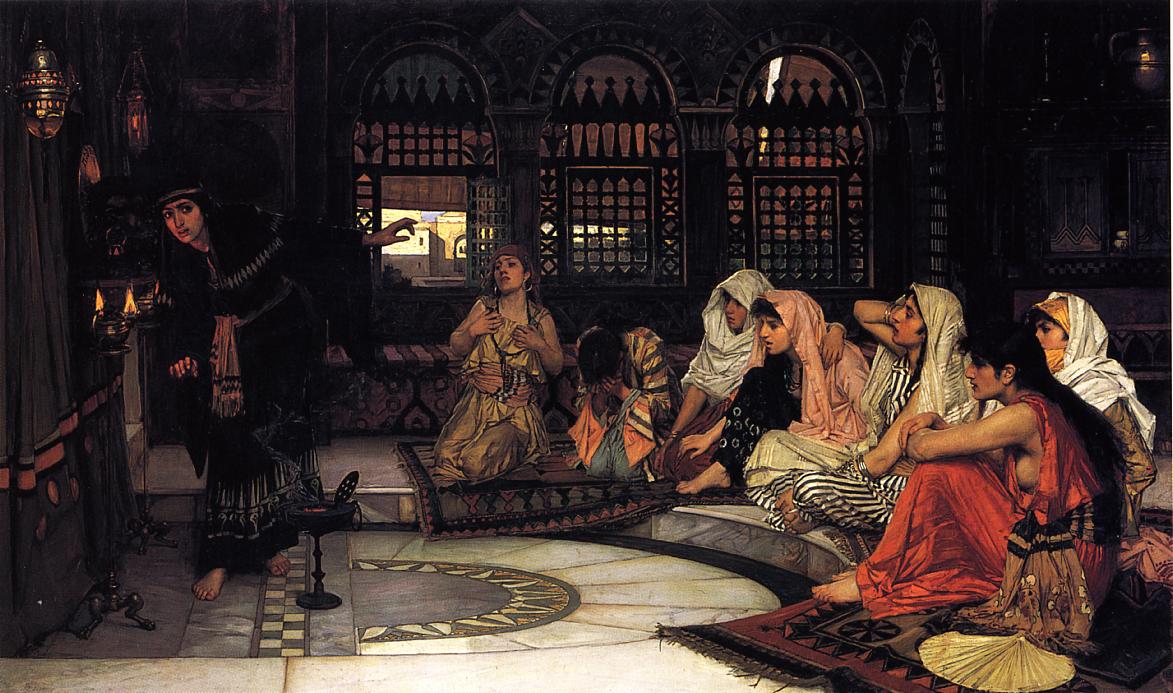
“Consulting the Oracle” (1884) stages a moment that feels both intimate and ceremonial: a group of women gathered in a dim interior, waiting for meaning to arrive from somewhere beyond the visible world. John William Waterhouse builds the scene around suspense rather than action. Nothing “happens” in the obvious sense, yet everything is charged. The women’s bodies lean, fold, and hold stillness in different ways, as if each posture is a separate answer to the same question: what will be revealed, and what will it cost to know?
A room built for prophecy
The setting is more than a backdrop. It is a purpose made chamber where light is rationed, sound seems muffled, and privacy is guarded by architectural layers. Waterhouse places us inside a richly patterned interior with arched openings and latticed screens that filter the outside world into fragments. Through those openings, the exterior reads as distant and ordinary, almost indifferent, while the interior feels dense with ritual attention. The effect is psychological: the oracle’s knowledge is not merely “information,” it belongs to an atmosphere, a threshold space where everyday logic loosens.
The room’s design also suggests separation and hierarchy. The oracle figure stands apart at the left, nearer to the wall lamps and the implements of divination. The petitioners occupy the right side, seated close together on carpets and textiles, like an audience whose role is to wait and interpret. That division shapes the narrative: the oracle has proximity to the instruments and the light, the group has proximity to one another and to uncertainty.
The oracle as director of attention
Waterhouse’s oracle is not depicted as a theatrical magician. She appears grounded, almost practical, and that restraint makes her authority more convincing. Dark clothing merges her into the shadows, while her face catches just enough light to hold the viewer’s focus. One arm extends, not dramatically but decisively, as if indicating the correct place to look, or the correct stage in the rite. This gesture is crucial. It turns the scene into a lesson in attention: prophecy is framed as something that must be approached correctly, with rules, with patience, and with a willingness to accept what cannot be controlled.
Her stance also implies control over the pacing of revelation. She is upright, mobile, capable of moving between the lamps, the wall, and the unseen object or sign that the group seeks. By contrast, the women seated on the right appear fixed in anticipation. The oracle’s power is not only knowledge, but timing.
A chorus of reactions
The right side of the painting reads like a study in emotional variety. Waterhouse gives each woman a distinct physical response to the same shared situation. One leans forward, attentive and tense, another reclines with an arm lifted in a posture that suggests exhaustion, impatience, or a practiced attempt at calm. One figure bows her head, folded inward, as if overwhelmed by the weight of the question. Another gazes outward with a searching expression that feels less like curiosity and more like need.
This range matters because it turns divination into a social event rather than a solitary one. The oracle is consulted, but the waiting is collective. Waterhouse shows how uncertainty spreads through a group, how it becomes contagious, how it is managed through closeness and shared space. The women’s proximity suggests comfort and solidarity, yet their individual postures show that no one can fully share another person’s dread or hope. The painting quietly argues that fate is communal in its consequences but private in its impact.
Composition and the slow pull of the gaze
The composition is designed to make your eyes travel deliberately. The darkest masses gather at the far left and along the upper architecture, while the brightest plane is the pale floor and the luminous textiles in the group. This creates a push and pull. You are drawn to the figures on the right by brightness and color, then you are tugged back toward the oracle by the logic of the scene: she is the source, the operator, the one who “knows.” Waterhouse uses that motion to mimic the emotional rhythm of consultation. Attention drifts to the crowd’s feelings, then returns to the authority that might relieve them.
The arches and screens above function like visual brackets. They frame the group and compress the space, making the room feel enclosed and intentional. The horizontal arrangement of figures suggests a frieze, a lineup of states of mind. Yet the diagonal cues, especially the oracle’s gesture and the angles of bodies, prevent the scene from becoming static. Even stillness feels like a kind of movement, the movement of thought.
Light as a moral and emotional force
Light in “Consulting the Oracle” is not neutral illumination. It is selective, almost judgmental. Lamps glow warmly at the left, but much of the room remains submerged in shadow. Faces emerge and recede. Patterns on fabric appear, then dissolve into darkness. This chiaroscuro does two things at once. It creates a mood of secrecy, and it suggests that knowledge is partial. Even in the presence of an oracle, not everything can be made clear.
Waterhouse also uses light to separate roles. The oracle stands in the zone where lamplight is nearest, as if she controls access to visibility. The petitioners inhabit a softer, more diffused light, which emphasizes their waiting rather than their agency. The brightest areas tend to be surfaces that catch light easily: pale cloth, polished floor, exposed skin, reflective ornament. These highlights give the scene a tactile realism and remind you that ritual is enacted through materials, not just beliefs.
Color, fabric, and the language of surface
One of the painting’s strongest pleasures is its material richness. Waterhouse lingers on textiles, stripes, veils, embroidered edges, patterned rugs, and layered garments. These surfaces do more than decorate. They become a vocabulary for personality and status, and they also help stage the emotional temperature. Warm reds and oranges concentrate near the front right figure, whose vivid garment seems to carry intensity and urgency. Paler veils and muted tones create quieter notes, suggesting hesitancy, vulnerability, or reserve.
The palette is carefully balanced. Deep browns and blacks anchor the shadows, while warm highlights and patterned cloths add pulses of life. The result is an interior that feels both luxurious and heavy. Color does not liberate this space, it thickens it. That thickness suits the theme: prophecy is not a bright revelation, it is a dim negotiation with uncertainty.
Objects of ritual and the suggestion of unseen forces
The painting includes implements that hint at ceremony: lamps, stands, and the arrangement of the chamber itself. Waterhouse does not insist on a single explicit “oracle device” that solves the narrative. Instead, he relies on implication. The viewer senses that something is being done, that signs are being read, that a process is underway. This restraint is important because it preserves mystery. If everything were spelled out, the painting would become illustration. By leaving the mechanism partially obscured, Waterhouse keeps the focus on the human cost of seeking answers.
The architecture contributes to that suggestion of the unseen. Screens imply separation between inner and outer knowledge. Arches imply passage and threshold. The chamber feels like a place where ordinary categories do not fully apply. Even the floor’s circular motif can be read as a quiet symbol of cycles: time, fate, repetition, the return of fear.
Performance, belief, and the psychology of prophecy
“Consulting the Oracle” can be read as a drama about belief itself. The women are not simply waiting for a verdict. They are negotiating with possibility. Each posture becomes a way of handling the unbearable openness of the future. Some faces look outward, as if demanding clarity. Others turn inward, as if bracing for disappointment. In this reading, the oracle’s role is both spiritual and theatrical. She is a mediator who provides structure for uncertainty, turning dread into a ritual that can be endured.
Waterhouse suggests that prophecy is as much about the present as the future. The act of consultation reveals what the petitioners already carry: longing, fear, expectation, rivalry, solidarity. The oracle may pronounce a fate, but the painting shows that fate begins as a psychological condition long before it becomes an event.
Waterhouse and the allure of the distant past
Created in 1884, the painting belongs to a period when Victorian audiences were fascinated by imagined antiquity and by “exotic” settings presented as sites of mystery and sensual detail. Waterhouse often explored stories and scenes where emotion meets myth, where desire and dread take symbolic form. Here, he chooses an episode that is not tied to one famous mythic name in the image itself, which allows the theme to feel universal. The oracle could belong to many ancient stories because the human impulse behind the scene is timeless: the wish to ask the world for certainty.
This also connects to the broader artistic climate that valued meticulous surface detail and narrative suggestion. While Waterhouse is frequently associated with the Pre-Raphaelite Brotherhood, his work has its own rhythm: less about strict historical reconstruction and more about emotionally persuasive theatre. “Consulting the Oracle” exemplifies that balance. It looks convincing as a world, but it functions primarily as a mood.
Stillness, suspense, and the ethics of knowing
The painting’s tension comes from what it refuses to show. We do not see the oracle’s answer. We do not know the question. We are placed in the moment before language becomes destiny. That choice makes the scene ethically complicated. Seeking an oracle can be read as desperation, but also as a surrender of responsibility. If fate speaks, what happens to choice? Waterhouse does not resolve this. Instead, he lets the room hold the ambiguity.
The group’s expressions make that ambiguity feel real. Hope and fear live side by side. The warm lamplight suggests comfort, yet the shadows suggest risk. The painting invites you to wonder whether knowledge will soothe or shatter. In doing so, it reflects a mature understanding of prophecy stories: the tragedy is rarely ignorance, it is interpretation. What the oracle says matters, but what the listener hears matters more.
Why the scene stays compelling
“Consulting the Oracle” remains memorable because it treats the supernatural as a human problem. The oracle is not the spectacle. The spectacle is waiting, worrying, needing to know. Waterhouse’s craft makes that emotional state visible through composition, through the choreography of bodies, through the hush of a dark interior and the glow of controlled light. The painting does not demand that you believe in prophecy. It asks you to recognize the feeling that produces prophecy.
In the end, the work is about the vulnerability of asking. To consult an oracle is to admit you cannot carry uncertainty alone. Waterhouse captures that admission with empathy and precision. The women gathered on the rugs are not simply characters in an antique fantasy. They are portraits of a familiar moment: when the future feels too large, and the present becomes a room where everyone listens for a sign.