Image source: wikiart.org
Collioure, 1905: The Summer That Changed Painting
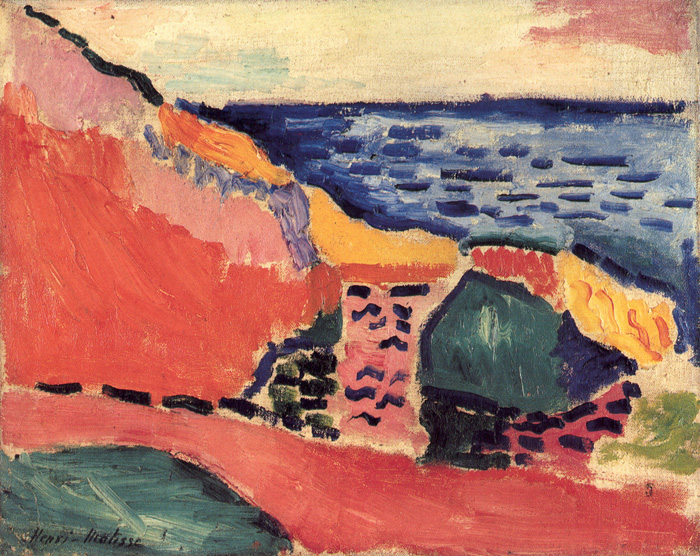
Henri Matisse painted “Collioure in the Summer” in 1905, during the incandescent months on France’s Mediterranean coast that gave birth to Fauvism. In Collioure, working alongside André Derain, Matisse abandoned the careful tonal modeling of the nineteenth century and the optical science of Neo-Impressionism for a language in which pure color carries structure, light, and feeling. This canvas distills that breakthrough into a compact, vivid statement: cliffs melt into bands of vermilion and rose, the sea becomes a field of inky blues set with short dashes of darker tone, and a path of yellow light threads the composition like a hot breeze. It is both a view and a manifesto, a coastal turn translated into chords.
First Look: A Coastline Reduced to Essential Pressures
The scene is simple—a high headland, a steep descent, a cove, and beyond it an open belt of sea under a bleached sky—yet Matisse treats each part as a zone of color rather than an object to be described. The left two-thirds of the painting is a sloping ramp of red and pink earth that reads as sunstruck rock. Near the center a vertical panel of salmon, notched by dark steps or terraces, sinks toward the shore. To the right a deep green promontory turns its shoulder to the bay; flanking it are wedges of yellow that behave like beaches or bands of blazing light. The sea is a dense, ultramarine sheet, its surface animated by broken, horizontal strokes. Nothing is blended; everything is decided.
Compositional Architecture: Triangles, Lanes, and a Belt of Sea
Matisse builds the picture on interlocking diagonals. A great red plane sweeps down from the upper left toward the center, then breaks at a ledge where a pink shaft drops vertically to the water. This structural triangle is countered by the dark green headland at right, which forms another triangle thrusting back toward the cliff. The sea runs across the upper third in a calm horizontal, a cooling band that pins the composition and keeps the tilting land from sliding out of frame. Two small lanes—one the salmon strip descending at center, the other the yellow ribbon slipping around the green rock—guide the eye to the water and back again. Perspective gridlines are unnecessary; direction and temperature do the work.
Color as Structure, Not Ornament
Everything here is engineered by hue. Warm colors—cadmium reds, corals, and pinks—build the mass of the cliff, while cool colors—greens and blue-black notes—stabilize and deepen the coves. The sea’s blues are not a single tone but a chord, thickened by darker dashes that sit on top like flecks of wind. Where water meets land, Matisse does not draw a line; he places a thin seam of yellow or lilac and lets contrast declare the edge. Complementary relationships govern the whole: orange-red against blue, yellow against violet, green against pink. These pairings are not simply pretty; they are structural hinges that hold the composition together while generating the sensation of heat and glare that defines the Mediterranean afternoon.
The Productive Role of Black and Deep Darks
Among the high keys and citrus brights, Matisse threads in small bands of black and near-black—under the cliff’s lip, in the terraced steps at center, and in the broken pattern beside the green rock. Rather than deadening the palette, these darks act like ballast. They tune the surrounding colors upward, the way a bass note sets off a trumpet’s brilliance, and they give the cliff its geological weight. The sea’s darkest marks serve a similar purpose: they suggest depth, steady the surface, and keep the broad blue belt from becoming merely decorative.
Brushwork and Material Presence
The paint sits assertively on the canvas. In the sea, short horizontal touches build a woven surface that reads as rippled water. On the cliffs, broader, directional sweeps leave the trace of bristles and exude heat. In the yellow passages the strokes are dragged thinly so the white ground glows through, producing glare without resorting to thick white pigment. This varied handling lets the viewer feel the day as well as see it: the sticky density of oil in the blues mimics the weight of water; the scumbled yellows feel like light lifted and smeared across rock; the reds carry a sun-baked rasp. Technique becomes climate.
Light and Atmosphere: Noon Without a Sun
The sky is pale and warm, scrubbed thin so that the canvas participates as brightness. Shadows in the land are not gray but violet and blue-black; highlights are not white but yellow and pink. Everything signals a steep, dry light—the kind that simplifies forms into planes and heightens color. Rather than painting the sun, Matisse paints what it does: it bleaches the distance, burns edges to seams, and turns the sea into a pane of darkened glass. The atmosphere is a consequence of temperature relations, not a separate veil laid over the motif.
Space Without Linear Perspective
Depth in “Collioure in the Summer” is conjured by overlaps, scale shifts, and temperature, not by converging orthogonals. The red plane advances because it is warm, big, and unbroken; the green headland sits slightly back because it is cooler and contained; the sea recedes further still because its horizontal rhythm and lower saturation imply distance. A few small devices—like the descending salmon strip punctuated by dark steps—give the sense of traversable ground without sacrificing the painting’s proud flatness. We feel we could walk down to the water, yet we never forget we’re looking at paint.
Edges, Reserves, and the White Ground
One of the canvas’s great pleasures is the way Matisse uses the primed ground as active light. Around the sea he lets a hairline of raw canvas flash between blue and sky, a glint that reads like atmosphere. Along the yellow bands he scumbles thinly so that the ground shines through and turns pigment into glare. At the left cliff’s peak, slivers of white slip between red and pink strokes, imparting sparkle. These reserves are not unfinished business; they are structural decisions that keep the palette clean and the surface breathing.
The Rhythm of the Shoreline
Although the picture holds still, movement is everywhere. The sea’s dashes form a measured beat; the jagged seam of shoreline scratched in yellow and lilac snakes like a melodic line; the broken pattern of black blocks near the water’s edge hints at rocks or shadows that pulse in time with the waves. The viewer’s gaze follows this internal rhythm—down the cliff, along the seam, into the dark blues, and back—so that looking becomes a coastal walk performed in color.
Abstraction and Recognition Held in Balance
Stand close and the painting verges on abstraction: fields of red, blue, green, and yellow interlock like cut paper. Step back and the headland reassembles convincingly. This double life is central to Matisse’s 1905 revolution. He wants the viewer to experience both the physical reality of the surface and the sensed reality of place. The canvas succeeds because it is exact about effect—heat versus cool, weight versus shimmer—while allowing details to dissolve. The cliff does not need texture; it needs temperature; the sea does not need a horizon line; it needs a felt depth and a wind-skimmed surface.
Context Within the Collioure Cycle
Across the summer of 1905 Matisse explored Collioure from many angles: olive groves under pink canopies, sun-blasted streets, and high headlands facing dark water. This painting sits near the leanest end of that spectrum. Compared with the dappled olive-grove scenes that breathe with thousands of short strokes, “Collioure in the Summer” is built from larger, simplified planes. Compared with more descriptive seascapes, it pushes toward diagram, almost map-like in its clarity. The compositional courage—the willingness to let a single red wedge dominate half the canvas—is a signature of the period and a clue to where Matisse was headed: toward interiors where color becomes architecture outright.
The Psychology of Temperature
Color here is mood. The red cliff reads as heat and audacity; the yellow lanes feel like quick routes of blazing sun; the green rock offers a pocket of coolness, a visual refuge that keeps the high key from exhausting the eye; the blue sea provides depth and steadiness, the painting’s slow breath under its bright talk. These temperature zones do more than describe a place—they stage a feeling of summer: the glare you squint against, the relief you seek in shade, the calm you find staring out to a dark, steady band of water.
Why It Still Feels New
“Collioure in the Summer” remains fresh because it solves with uncommon candor the painter’s hardest problem in bright climates: how to express intense light without bleaching color. Matisse’s answer is to let color do the building, to use reserves instead of heavy highlights, and to accept radical simplification as a path to truth. The result looks modern not because it ignores the world, but because it understands how the world is perceived in heat. It shows that accuracy of sensation can outrank accuracy of detail.
A Way to Look: Following the Painting’s Path
Let the eye begin at the lower left corner, where the red ground curves upward; feel how that warm plane climbs like a ramp until it breaks near center into a pale salmon shaft. Follow the shaft downward, hearing the cadence of dark steps, then slip across the thin yellow seam into the water. Ride the sea’s horizontal dashes to the right and sense the pull of depth; turn down along the green headland to where yellow flares again; cross back into the red wedges of foreground and arrive where you began. The painting invites this loop, a summer circuit executed in color.
Materiality, Scale, and Intimacy
Though modest in size, the canvas asserts a strong physical presence. The brushstrokes retain their individuality; edges remain slightly ragged; small scrapes and stops record the painter’s hand adjusting to the motif in the wind. That tactility is not incidental. It ties the viewer’s body to the place: rough paint for rough rock, smooth scrubs for glare, layered blues for heavy water. The intimacy of scale intensifies the encounter; you lean in and the coastline becomes a negotiation of marks, as if you could retrace them with your fingertip.
Anticipations and Afterlives
Seeds planted here sprout throughout Matisse’s later career. The reliance on color to construct space becomes the organizing principle of the great interiors of 1908–1911 and culminates in “The Red Studio,” where color is both wall and air. The bold use of black as a structural partner to bright hues appears again in portraits and Nice interiors. The will to simplify natural form into decisive planes blossoms in the paper cut-outs, where color and edge literally become one. “Collioure in the Summer” is thus both a record of place and a rehearsal for decades of invention.
Conclusion: A Summer Headland, A New Grammar
What begins as a coastal view becomes a grammar lesson in color. A red ramp, a green shoulder, a yellow seam, a dark blue belt—these simple elements, placed with conviction, generate a full experience of light, depth, and temperature. “Collioure in the Summer” shows Matisse at the moment he learned to let color lead completely. The painting asks the viewer to trust that a handful of hues, rightly chosen and strongly placed, can carry the weight of the world—and in this small, blazing canvas, they do.