Image source: wikiart.org
First impressions and the dramatic premise
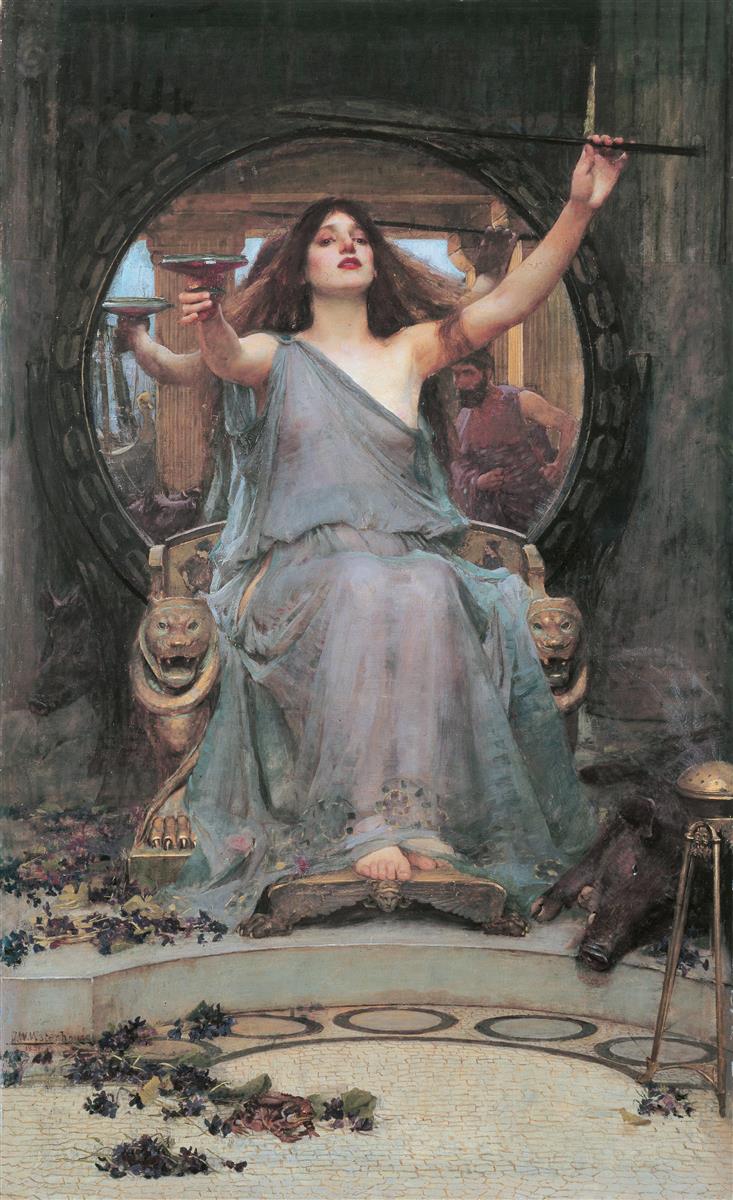
John William Waterhouse’s Circe Offering the Cup to Ulysses (1891) stages a single, charged instant from classical myth and stretches it into a psychological tableau. At first glance the scene reads clearly: the enchantress sits enthroned, arms extended, presenting a dark drink in a shallow cup while lifting her wand as if the spell is already in motion. Yet the longer you look, the more the painting feels like an argument about power, looking, and choice. The subject is not simply a meeting between sorceress and hero, but a confrontation between seduction and resistance, between the promise of pleasure and the threat of transformation.
Waterhouse makes that confrontation physical. Circe is centered and enlarged, her posture commanding the whole pictorial space. The viewer is positioned where Ulysses might stand, close enough to accept the cup, close enough to be implicated. It is a smart compositional strategy because it turns an ancient story into an immediate test: will you step forward, or do you hesitate? The painting’s drama comes from this uneasy intimacy. The enchantment is not happening somewhere else in an epic distance. It is being offered directly outward.
Circe in Homer’s Odyssey and Waterhouse’s Victorian lens
In Homer’s Odyssey, Circe is the island sorceress who welcomes Odysseus’s men, serves them a drugged drink, and turns them into swine. Odysseus approaches her later, protected by Hermes and the herb moly, and forces her to undo the spell. It is a myth that already contains multiple tones at once: hospitality that becomes entrapment, appetite that becomes humiliation, and a hero’s self control tested against a figure who seems to rule nature itself.
Waterhouse, painting in late nineteenth century Britain, inherits more than the Homeric narrative. He also inherits a cultural fascination with the “dangerous” woman of myth and legend, the femme fatale who threatens male autonomy. Victorian audiences were deeply interested in classical stories, but they often used them as mirrors for modern anxieties about desire, morality, and social order. Waterhouse does not paint Circe as an abstract symbol. He gives her a body, a face, a deliberate gaze, and a throne. She becomes an active intelligence rather than a decorative mythological accessory.
At the same time, Waterhouse avoids turning the story into a simple moral poster. Circe’s beauty is not merely bait, and her menace is not merely theatrical. The painting allows both to coexist. That ambiguity is part of why Waterhouse’s myth paintings feel so durable: they dramatize inner conflict rather than settling it.
Composition, viewpoint, and the sense of a trap
The composition is built on circles and thresholds. The most obvious is the large circular mirror behind Circe, which frames her like a halo while also acting as a portal into another space. That circle is echoed below in the mosaic floor pattern, where rings and arcs suggest ritual, repetition, and enclosure. These circles imply containment, the idea that once you step into Circe’s domain you are within a system that follows her rules.
Circe’s body forms a commanding triangle, wide at the shoulders with arms spread like a barrier and a welcome at once. The cup is thrust outward, close to the viewer, while her wand rises to the upper right, creating a diagonal line that energizes the stillness of her seated pose. The diagonals and circles work together: the circle holds the scene, the diagonals activate it.
Waterhouse also makes the space feel shallow and stage like. The throne sits close to the picture plane. The ledge and the scattered flowers press toward us. This compression increases the sense of confrontation. There is nowhere for the viewer’s eye to retreat without passing back through Circe’s gesture and gaze.
Circe’s pose, expression, and the performance of authority
Circe is not painted in the middle of an action she cannot control. She performs control. Her chin is lifted, her lips slightly parted, and her gaze is steady, almost cool. She does not plead or entice in a nervous way. She offers. That difference matters. The cup becomes a test that she administers, not a trick she worries might fail.
Her arms amplify that authority. The left hand extends the drink like a ceremonial offering. The right arm raises the wand in a gesture that resembles a conductor’s baton or a priestly instrument. It implies that the spell is not only in the cup, but in the act itself, in the ritual of offering and accepting. Waterhouse makes magic look like procedure.
Her clothing reinforces the idea. The drapery falls in soft, translucent layers, classical in reference, but arranged to emphasize her central mass and calm stability. The fabric is less about modesty or exposure than about atmosphere: it suggests smoke, mist, or seawind, a veil between ordinary reality and Circe’s altered one.
The mirror as narrative device and psychological symbol
The great circular mirror behind Circe is one of Waterhouse’s most effective inventions in the painting. On a narrative level, it expands the story. It shows figures and architectural elements that imply the arrival of Odysseus and his men, as if the myth’s broader world is present but displaced into reflection. The mirror becomes a stage within the stage, a way to compress time by showing what is approaching while keeping the decisive moment in the foreground.
On a symbolic level, the mirror speaks to self knowledge and illusion. Circe’s magic in the Odyssey turns men into animals, which can be read as a revelation of appetite, a stripping away of civilized identity. A mirror traditionally shows the self, but this mirror shows the approaching others, as if Circe already knows them better than they know themselves. It is also a reminder that in myths of enchantment, the victim often participates through desire, curiosity, or pride. The mirror quietly suggests that the true transformation begins in the mind, in the choice to look and the willingness to be drawn in.
The mirror’s dark rim also resembles a boundary, almost like the mouth of a cave or the aperture of an eye. Circe sits before it like the center of a vision. Waterhouse turns reflection into a form of surveillance: Circe sees what comes, and we feel seen too.
Color, light, and the mood of intoxication
The palette is subdued but strategically rich. Cool greens, smoky grays, and muted blues dominate Circe’s drapery and the surrounding stone and shadow. These tones create a damp, marine atmosphere, appropriate for an island sorceress and for the idea of an intoxicating potion. Against these cool fields, Circe’s skin and lips appear warmer, more alive, and therefore more magnetizing.
The cup itself is a concentrated accent. Its dark red tone reads as wine, blood, or a dangerous medicine, and Waterhouse places it near the centerline of the painting where the viewer’s eye naturally lands. The red is not splashed everywhere. It is focused, like a single irresistible note in music.
Light is handled in a way that favors psychological emphasis over literal realism. Circe’s face and upper body catch enough illumination to separate her from the murkier background. The surroundings feel heavy, as if the air is thick with smoke or incense. This makes Circe seem like the source of clarity inside a realm of haze, which in turn suggests her dominance. Even the clarity is hers.
Objects of ritual: cup, wand, incense, and scattered flowers
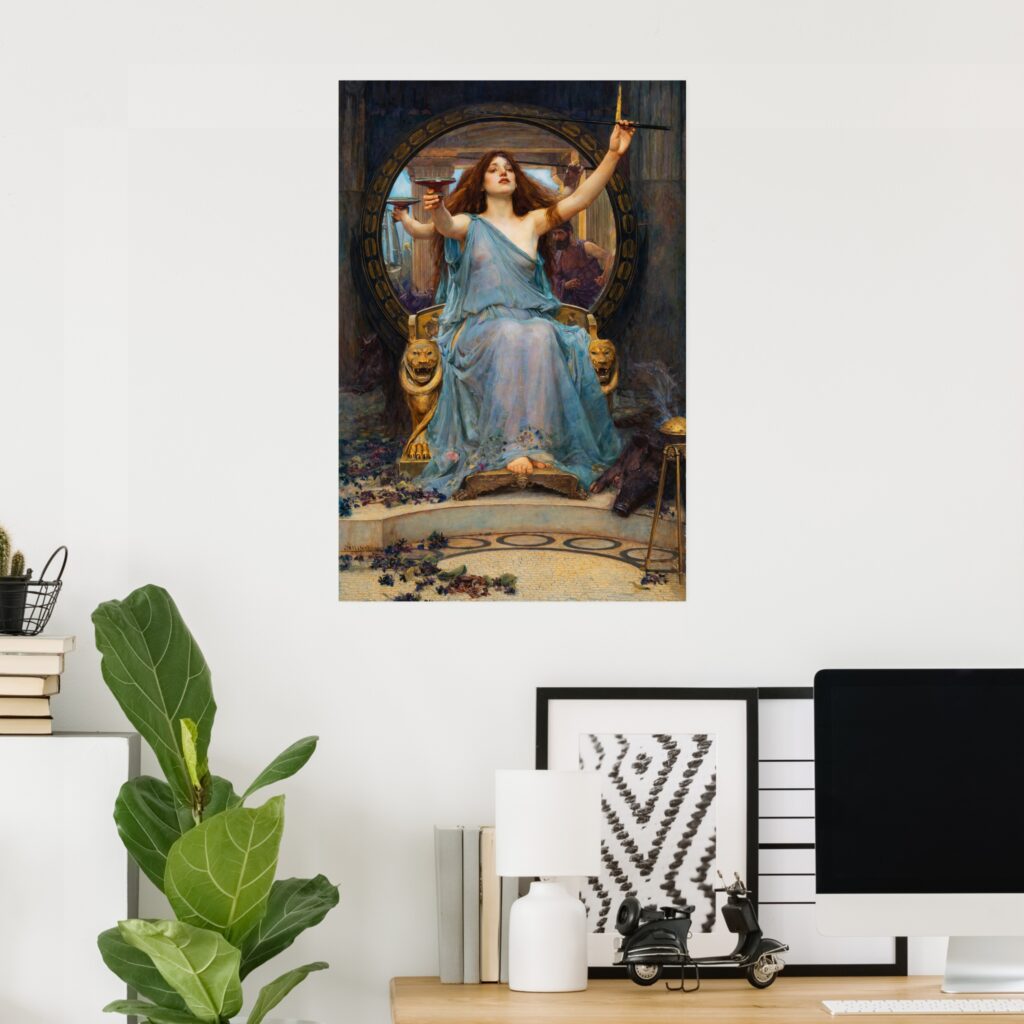
Waterhouse fills the scene with objects that read as ceremonial rather than casual. The wand signals directed will, the authority to alter reality. It also gives Circe the visual language of a magician or priestess, reinforcing that what happens here follows rules, but rules she controls.
The brazier on its tripod releases a pale plume of smoke. This detail is easy to miss at a distance, but it anchors the painting’s atmosphere. Smoke implies sacrifice, trance, and altered perception. It turns the space into a temple of transformation. The viewer is not just witnessing a conversation. They are standing at the edge of a rite.
The scattered flowers and leaves across the ledge and floor introduce a note of beauty that is also a warning. Flowers can mean luxury, hospitality, and sensual pleasure, but strewn petals also suggest aftermath and consumption. They look like the remains of previous offerings. In Circe’s house, beauty is never neutral. It is part of the mechanism.
The presence of the transformed and the threat behind the invitation
One of the most unsettling elements is the animal form at Circe’s feet, which evokes the fate that awaits those who drink unprotected. In the Odyssey, Circe’s victims are not killed, they are altered, reduced, and contained. That is crucial to the painting’s tension. The danger here is not annihilation, it is loss of human status, loss of speech, loss of agency.
Waterhouse places this threat low and to the side, so it does not compete with Circe’s face, but it remains in the viewer’s peripheral awareness like a shadow thought. This placement mirrors temptation itself: the promise is front and center, the consequence is off to the edge, easy to ignore until it is too late.
Even the throne contributes to that sense of menace. Its carved animal heads and paw like supports make Circe’s seat feel predatory, as if her authority is literally built on beasts. The furniture is not merely ornate. It is thematic. Circe rules by turning the human into the animal, and her environment proudly displays that hierarchy.
Waterhouse’s technique: softness, detail, and controlled realism
Waterhouse balances meticulous description with a softness that keeps the painting dreamlike. The figure is rendered with care, especially the face, hands, and the fall of fabric across the body. At the same time, edges dissolve in places, particularly in the darker background and the smoky areas, so the scene never feels fully anchored in everyday reality. This is a painterly equivalent of enchantment: things look real enough to believe, but not stable enough to trust.
Textures are chosen to tell the story. The stone and mosaic surfaces suggest cold permanence, a domain that outlasts visitors. The drapery suggests fluidity and change. Smoke suggests transience. These oppositions support the myth’s theme: Circe offers a change that can feel like pleasure, but it is delivered inside a place that keeps its grip.
Waterhouse’s realism is also theatrical, in the best sense. He wants the viewer to read the image quickly and clearly, then to remain, caught by details. That combination, immediate legibility and lingering uncertainty, is a hallmark of his mythological paintings.
Themes: temptation, agency, and the politics of the gaze
At the heart of Circe Offering the Cup to Ulysses is the question of agency. Who controls the outcome of this meeting? Circe clearly controls the setting, the ritual, and the terms of engagement. Yet the myth also grants Odysseus a form of resistance through knowledge and preparation. Waterhouse compresses that tug of war into a single visual proposition: the cup extended toward you.
The gaze is central. Circe looks outward with a calm that can be read as confidence, superiority, or boredom, as if she has seen this story repeat. The viewer becomes the one who is looked at, evaluated, and measured. This reverses a common pattern in art where the female figure is offered for passive viewing. Here, the figure in control is the one who sees, chooses, and acts.
Temptation in this painting is not only sensual. It is also the temptation of experience, the curiosity to cross into the forbidden, the desire to test oneself. The potion can be read as pleasure, but also as knowledge. Myths about witches and sorceresses often carry this double meaning: the forbidden woman offers a shortcut to what you want, but she also reveals what you are.
Circe as archetype: enchantress, femme fatale, and modern resonance
Circe in Waterhouse’s hands becomes an archetype that extends beyond Homer. She is the enchantress who turns desire into captivity, the hostess whose gift is a trap, the woman who refuses to be conquered by charm and instead uses charm as a weapon. Late nineteenth century art and literature were full of such figures, and Waterhouse taps into that atmosphere without turning Circe into a simple stereotype.
What keeps the painting compelling today is that Circe can be read in multiple directions. She can be seen as villain, as predator, as a symbol of dangerous temptation. She can also be seen as a figure of autonomy, a woman who refuses the passive roles assigned to her and instead commands her own realm. The painting does not resolve these readings. It holds them in tension, which is why it feels psychologically modern.
The myth itself supports that complexity. In the Odyssey, Circe is not only an antagonist. She becomes a source of guidance, and Odysseus stays with her for a time. Waterhouse’s painting focuses on the perilous beginning, but the story’s broader arc haunts the scene. The cup is not only a threat. It is the opening move in a relationship built on negotiation, cunning, and mutual recognition.
Waterhouse and the enduring appeal of myth in painting
Waterhouse repeatedly returned to Greek and Roman mythology because myth offered him a language for emotion that felt timeless but could be tuned to contemporary feeling. In 1891, painting Circe allowed him to explore themes of control, seduction, and moral uncertainty with a character already loaded with meaning. The result is a painting that feels like a still from an epic, but also like a private psychological drama.
The work also shows how mythological painting can be both narrative and symbolic. You do not need to know every detail of Homer to feel the tension, but knowing the story deepens the stakes. The cup is not a generic goblet. It is the hinge on which identity turns. The wand is not a stage prop. It is the sign that desire is being engineered.
This is why Circe Offering the Cup to Ulysses remains one of Waterhouse’s most discussed myth paintings. It is visually memorable, but it is also conceptually sticky. It asks the viewer to confront the seductive surface and the darker consequence at the same time, and it does so with a compositional clarity that makes the question hard to avoid.