Image source: wikiart.org
Introduction: A Human Christ in a Room of Warm Shadow
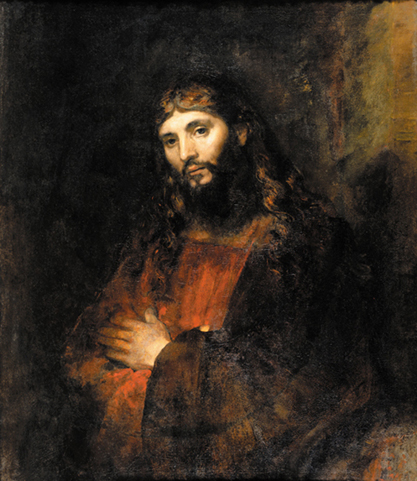
Rembrandt’s “Christ with Arms Folded” (1661) is one of the most intimate and searching depictions of Jesus in European art. The figure stands half-length against a dark, breathing ground; the head inclines, the gaze meets ours with calm gravity, and the hands cross gently over the chest. Nothing theatrical intrudes—no throne, no haloed blaze—only a quiet light that lifts the face and a red garment that carries warmth through the dusk. Painted late in Rembrandt’s career, when his style had hardened into candor, the picture turns the subject of subjects into a presence one could meet in a doorway. The work feels less like an icon offered to a crowd and more like a conversation with a single person.
Historical Moment: Late Rembrandt and the Search for a Truer Likeness
By 1661 Rembrandt had survived bankruptcy, loss, and shifting fashion. The elegant polish prized by Amsterdam patrons gave way in his work to an ethics of attention: earth colors, humane chiaroscuro, tactile surfaces, and emotional restraint. In these years he returned repeatedly to the theme of Christ, often using Jewish models from his neighborhood to root the image in lived features rather than inherited convention. “Christ with Arms Folded” belongs to this cluster of late devotional portraits. It refuses rhetoric. Instead, it searches for a likeness that could sustain prayer—an image that recognizes Christ’s Jewishness, embodies compassion without sentimentality, and treats divinity as a mystery that shines through ordinary human presence.
Composition: A Stable Triangle and a Gentle Counter-curve
The composition is built from a calm triangular mass. The shoulders form the base; the head, slightly tilted, is the apex; the folded arms cross the midline and lock the structure. Within this triangle plays a counter-curve: hair falling in soft arcs, the neckline’s sweep, the diagonal of the garment’s edge. The head turns three-quarters to our left, but the eyes remain near frontal, creating a relational tension—withdrawal softened by attention. Cropping is intimate. Rembrandt excludes every narrative prop so that the viewer’s eye moves from face to hands to face again, the route of a person taking in another person.
Light and Chiaroscuro: Illumination as Mercy
A warm, directional light falls from the upper left, opening the forehead and cheek, traveling down the bridge of the nose, and dissolving into the beard before catching on the knuckles that rest against the crimson robe. This is not a theatrical spotlight; it is the gentle illumination of a high studio window. Late Rembrandt lets darkness serve as privacy, not menace. The shaded side of the face breathes with half-tones rather than going blind, and that breathing makes the expression readable: listening, restrained, and kind. Light works here the way grace works in Rembrandt’s theology—small, steady, sufficient.
Color and Tonal Harmony: Red as Warmth, Earth as Ground
The palette centers on earth browns and olive blacks animated by a deep, embered red in the tunic. That red is not imperial but human—less purple of royalty than warmth of blood and friendship. It gathers under the crossed arms like a hearth. Around it, cooler browns and smokier greens create air rather than emptiness; the figure does not float but stands in a room we can almost smell. Highlights are rationed: a touch on the eyelid, a faint glint along the nose, a soft flare at the hands. Because chroma is restrained, value and temperature carry expression. The painting feels like a climate—calm, breathable, consoling.
Texture and Surface: Paint That Remembers Touch
Rembrandt’s handling in the late period is a language by itself. Hair is suggested by supple strokes and small ridges, catching real light like strands. The robe is built with broader, more absorbent passes that mimic woven weight. The face shows a delicate alternation of thin glazes and thicker, decisive touches—a raised highlight at the nose’s crest, a firm stroke to set the upper eyelid, a softened scumble to temper the mouth’s line. None of this is fussy; all of it is felt. The surface keeps the record of decisions, which is why the image remains alive under prolonged looking.
The Face and Gaze: Attention Without Performance
The head tilt suggests deference, but the eyes do not turn away. They meet ours without pleading or challenge. The mouth rests in a line that could become a smile but does not need to. The eyebrows carry a little weight; the lids are not wide but attentive. This is the psychology of a person who listens before speaking. Rembrandt avoids idealization: the nose is strong, the beard uneven, the hair not arranged for display. The result is a face that can bear the viewer’s scrutiny because it is already honest with itself.
The Gesture of Folded Arms: Self-possession and Peace
Folded arms often signal closure, but here they read as gathered peace. One hand lies across the forearm with a softness that denies defensiveness; the fingers are relaxed, not interlaced. The gesture anchors the torso and holds warmth close, like a person keeping breath steady. In iconographic terms, the crossed arms echo the shape of the cross without literalizing it: a quiet allusion embedded in posture. Compositionally, the gesture provides a horizontal counterweight to the vertical head-and-shoulders column, stabilizing the whole.
Costume and Iconography: Humility Over Pageant
Christ’s clothing is simple—no jeweled clasp, no embroidered cape—just a red garment and dark cloak. The humility is deliberate. Rembrandt is uninterested in courtly Christ or philosopher-king. He renders the teacher whose authority resided in presence and speech more than in insignia. The redness keeps the figure warm against the room’s cools; the cloak’s darkness prevents the tunic from becoming spectacle. Everything serves the face.
Space and Background: A Chapel of Brown Air
There is almost no architecture, only a modulated field of warmth and shadow. This brown air is the late Rembrandt chapel: a space that protects the subject from noise and invites the viewer to attend. The faint, luminous patch to the right of the head—the remnant of a scraped and reworked passage—functions like a spiritual undertone, a suggestion of light beyond the figure that never asserts itself as literal window or halo. The background is not emptiness; it is hospitality.
Theology Without Emblems: Incarnation as Likeness
Rembrandt’s theology is embodied rather than allegorical. By choosing a recognizably Jewish model, by refusing triumphal props, and by painting with a light that dignifies ordinary flesh, he argues visually for the doctrine of Incarnation: God made human, not hidden by grandeur. The picture does not preach; it makes belief imaginable by making Christ humanly credible. The authority in the image is moral and relational—located in the gaze, the gathered hands, and the restraint of the painter’s choices.
Comparisons Within the Christ Series: A Family of Faces
“Christ with Arms Folded” sits beside other late Rembrandt heads of Christ—some seen in profile, others with hands raised or resting on a book. Compared with the tender “Head of Christ” panels, this canvas offers more body and a more explicit conversational relationship with the viewer. Compared with earlier, more theatrical treatments of sacred subjects, it is strikingly sober. What unites the series is the insistence that likeness emerges from attention, not formula, and that compassion is best shown without spectacle.
Technique and Revisions: Edges That Think
Close looking suggests adjustments: a softened contour at the far cheek where an earlier, sharper edge was reduced to let air flow; restated highlights on the right hand, warming the flesh after the robe’s red was deepened; thin scumbles across the background, calming a brighter underlayer so the head could lead. These pentimenti matter. They show a painter thinking in paint, refining the balance between presence and quiet until the image breathes.
The Viewer’s Place: Conversational, Not Devotional Alone
While the painting supports private devotion, it also meets a secular viewer as portraiture of exceptional humanity. We stand at the distance of a conversation, recognized but not judged. The eyes acknowledge us; the hands keep the body’s warmth; the tilt of the head invites us to speak if we wish. The work models a reciprocity rare in sacred art: the person depicted regards us as persons.
Material Symbolism: Flesh, Red Cloth, and Living Shadow
Materials carry meaning without emblem. Flesh, built from honeyed whites and earths, declares the dignity of the body. Red cloth holds warmth and suggests the inner heat of love and suffering without resorting to literal blood. Living shadow—variegated, scumbled, never dead—stands for mystery that protects rather than obscures. Rembrandt’s paint lets matter take on theology by behaving truthfully.
Modern Resonance: An Image for a World Allergic to Posture
Contemporary audiences weary of posturing respond to this Christ because nothing in it is insincere. The face is not idealized into anonymity; the clothing does not flatter; the surface keeps the record of work. The picture persuades by its integrity. It offers a model for leadership that is quiet, attentive, self-possessed, and warm—a counterimage to charisma addicted to display.
What the Painting Teaches about Looking and Making
Spend time with the picture and it teaches craft and attention. It shows how a narrow palette can be abundant when values are tuned; how a single, steady light can carry feeling; how transitions, not outlines, make the form breathe; how hands can communicate more than many props; how revision left visible becomes part of truth. It suggests that the highest aim in portraying sacred subjects may be the same as in portraying anyone: to look long enough, and kindly enough, that presence arrives.
Legacy and Endurance: A Face That Keeps Company
“Christ with Arms Folded” endures because it keeps company rather than delivering a program. Museums hang it like a low, steady note; visitors pause because the painting pauses with them. It neither demands nor withdraws; it waits. In that waiting, viewers experience a small grace: to be seen, quietly, by a gaze that neither flatters nor condemns.
Conclusion: The Quiet Authority of Late Rembrandt
In 1661 Rembrandt gathered earth colors, a soft window’s light, and a patient hand to make an image of Christ that trusts humanity as the medium of glory. The head inclines; the eyes attend; the hands fold; the red garment warms the room; the dark makes space for thought. Nothing is forced. Everything is exact. The authority of the painting—like the authority of the figure it depicts—arrives as calm, truthful presence.