Image source: wikiart.org
Introduction to “Christ Triumphant over Sin and Death”
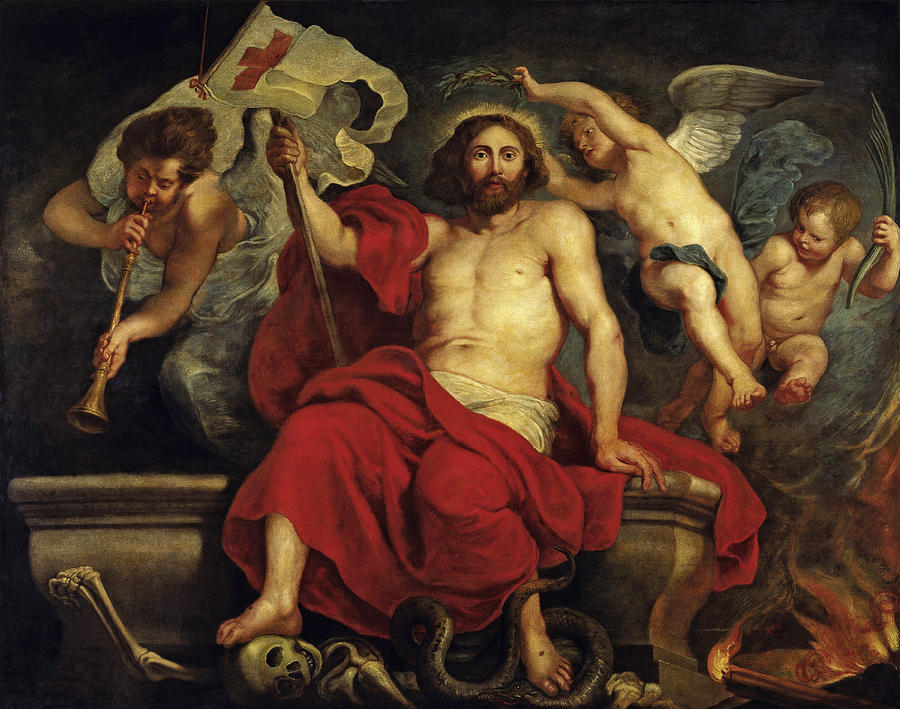
“Christ Triumphant over Sin and Death” by Peter Paul Rubens is a vivid, theatrical celebration of Christ’s victory at the Resurrection. At the center of the composition, Christ sits on the edge of a stone tomb, his body half wrapped in a red drapery, surrounded by angels and signs of both destruction and salvation. Beneath his feet lie a skull, bones, and coiling serpents, while fire burns at the edge of the scene. The painting compresses complex theology into a single, striking image, transforming doctrines about sin, death, and redemption into something immediate and emotionally gripping.
Rubens does not show the moment of Christ stepping out of the tomb in surprise. Instead, he offers a triumphant Christ who has already conquered. His body is solid and muscular, his gaze direct and commanding. Around him, angels sound the trumpet and crown him with a laurel, while another angel presents a palm of victory. The painting is a statement about the power of Christ’s sacrifice and the hope it offers to believers. At the same time, it is a showcase of Rubens’s Baroque style, filled with movement, intense contrasts, and richly modeled flesh.
Historical and Devotional Context
The subject of Christ defeating sin and death was especially important in the early seventeenth century, when Europe was marked by religious conflict and spiritual anxiety. Rubens, a devout Catholic working primarily in the Spanish Netherlands, frequently painted altarpieces and devotional works that emphasized the victorious and compassionate aspects of Christ. This painting belongs to that tradition. It would likely have served as a powerful reminder of the promise of resurrection and eternal life, meant to inspire trust in God’s mercy despite earthly suffering.
At the time, Catholic art was shaped by the Counter Reformation, which encouraged artists to present religious truths in clear, emotionally persuasive images. Rubens responded perfectly to that call. He fused the grandeur of Italian Renaissance figures with the drama and immediacy of the Baroque. In this painting, theological ideas about Christ’s conquest over sin are not abstract but visible. Death becomes a skull at his foot, sin appears as serpents, and hell glows in the flames at the lower right. Viewers can read the painting as a visual sermon, one that reaffirms orthodox doctrine while stirring the emotions.
Christ as the Central Vision of Victory
At the heart of the composition sits Christ, larger and more luminous than any other figure. He is shown in a moment after suffering, yet not weakened. His torso is muscular and idealized, reminiscent of classical sculpture. Rubens often combined Christian subjects with classical forms, using the visual language of heroic nudes to convey spiritual power. Here, Christ’s body suggests both the vulnerability of his human nature and the invincible strength of his divine nature.
His pose is relaxed yet authoritative. One arm supports a white banner bearing a red cross, the traditional symbol of the Resurrection. The other arm rests over his knee, pointing downward toward the conquered forces beneath him. His gaze meets the viewer head on, creating a sense that he is not a distant figure from an old story but someone who is present and powerful now. The expression is serious rather than sentimental. This is not a gentle, sorrowful Christ but a triumphant king who has accomplished a decisive victory.
The red drapery that wraps around him carries multiple meanings. Red is associated with blood, sacrifice, and love. It calls to mind the Passion and the shedding of Christ’s blood during the Crucifixion, but in this scene the garment flows freely and richly, more like a royal mantle than a cloth of suffering. The combination of bare torso and luxurious fabric reinforces the idea that the same Christ who suffered is now glorified.
The Angels and Their Roles
Surrounding Christ are three angelic figures who help interpret the central mystery. On the left, a powerful angel blows a trumpet. The sound is not audible, yet its force is visible in the tension of the cheeks and the firm grip on the instrument. The trumpet is the signal of the Last Judgment, the call that announces resurrection and the end of time. By including it, Rubens connects Christ’s victory not only to his own resurrection but to the final triumph that awaits all believers.
Above Christ, another angel leans in delicately, placing a laurel wreath upon his head. In classical tradition, the laurel crown is the prize for victors in athletic contests and battles. In a Christian context, it symbolizes the triumph of martyrdom and virtue. Crowning Christ with laurel emphasizes that his death was not defeat but the path to victory. The angel’s expression is tender and reverent, reinforcing the idea that heaven itself honors Christ’s achievement.
To the right, a smaller, childlike angel carries a palm branch, another symbol of victory and martyrdom. The palm recalls Christ’s entry into Jerusalem on Palm Sunday and is also associated with the triumph of the saints who follow his example. This angel looks toward Christ while moving forward, as if ready to offer the palm to the faithful. The trio of angels thus creates a visual commentary: one proclaims the victory with sound, one crowns the victor, and one holds the sign of triumph for those who share in it.
Symbols of Sin, Death, and Hell
The lower part of the painting is crowded with ominous details. Directly beneath Christ’s left foot lies a skull, partially covered by the slithering bodies of serpents. The skull is the classic memento mori, a reminder of human mortality. It recalls Adam, whose sin brought death into the world. Christ’s foot resting on the skull visually states that he has crushed the power of death. The viewer sees that death is still present but no longer dominant.
The serpents represent sin and the devil. In Christian iconography, the serpent echoes the tempter in the Garden of Eden. Rubens paints them coiling and twisting, but their placement beneath Christ’s feet indicates they are subdued. Rather than threatening, they are controlled. The artist uses the energy of their forms to underscore the idea that Christ’s victory required confronting active evil, not a passive obstacle.
On the right side of the composition, near the tomb, flames leap up from below. This fiery zone suggests hell or the realm of the damned. The contrast between the glowing fire and the luminous body of Christ dramatizes the distance between salvation and condemnation. Christ sits above the void, close enough to show that he has descended to its depths, yet clearly separated from its destructive power. The viewer is reminded of the phrase that Christ descended to the dead and rose again, bringing back prisoners from the realm of darkness.
The bones scattered near the skull emphasize the universality of death. They are anonymous, without any sign of identity. In contrast, Christ is fully embodied, recognizable, and alive. The painting makes a visual argument that while all humans share the fate of bodily death, the resurrection of Christ offers the promise that death does not have the final word.
Composition and Movement
Rubens organizes the composition so that every element reinforces Christ’s centrality and the theme of triumph. The tomb forms a stable horizontal base, while Christ’s body and the banner create a strong vertical axis. Angels swirl around this axis in dynamic curves, producing a sense of motion that contrasts with Christ’s relative stillness. The viewer’s eye moves in a circular path from the trumpet on the left, up to the laurel wreath, across to the palm branch, and then back down along the drapery to the skull and flames. This circular movement echoes the idea of a cosmic drama that encompasses heaven, earth, and the underworld.
Diagonal lines also contribute to the painting’s energy. The banner pole angles upward, leading toward the angelic host. The line of Christ’s right leg and foot points down toward the symbols of sin and death. These diagonals create tension and then resolve it in Christ’s calm, frontal posture. The result is a composition that feels both turbulent and controlled, like a storm that has just been mastered.
Spatially, Rubens pushes the scene very close to the picture plane. Christ’s knee and foot almost project into the viewer’s space, as if he is stepping toward the world beyond the frame. This closeness makes the theological theme personal. It suggests that the victory over sin and death is not remote but immediately relevant to the viewer’s life.
Light, Color, and the Drama of Baroque Painting
Light plays a crucial role in “Christ Triumphant over Sin and Death.” The primary illumination seems to come from an unseen source above and slightly to the left, striking Christ’s torso and the nearby angels. This light is warm and golden, bathing the flesh in a gentle glow. In contrast, the background remains dark, with shadowy clouds that serve as a backdrop for the central figures. The effect is a strong contrast between light and dark that heightens the drama and draws attention to the message of divine revelation.
The color palette is rich and saturated. The red of Christ’s drapery is especially prominent, standing out against the muted browns and grays of the stone and bones. This red connects Christ visually to the fiery tones at the bottom right, suggesting that the same sacrifice that involved suffering also fuels the light of redemption. The whites of the banner and the angels’ wings add brightness and purity, balancing the darker elements.
Rubens’s brushwork varies across the painting. In the depiction of skin and fabric, the handling is smooth and carefully blended, giving a sense of softness and volume. In the clouds and flames, the strokes become looser and more energetic, conveying movement and turbulence. This contrast in texture keeps the eye engaged and reinforces the difference between the solid reality of Christ and the shifting realms of spirit and judgment around him.
Theology Translated into Image
At its core, the painting is a visual meditation on key Christian beliefs. Christ’s resurrection signifies that he has overcome the powers of sin and death. This is translated into image by showing Christ physically dominating symbols of mortality and evil. His bare chest and wounded side remind viewers of the suffering he underwent, while his upright posture and alert gaze affirm that he now lives in glory.
The combination of banner, laurel, and palm connects biblical events with classical imagery, echoing the idea that Christ is the true victor who surpasses all heroes. The trumpet signals that his triumph will culminate in the final resurrection, when the dead will rise. The flames and bones warn of the consequences of rejecting grace, while the angels’ presence assures that heaven celebrates the victory of mercy.
Rubens thus weaves together different layers of meaning. On one level, the painting offers reassurance that Christ has broken the chains of sin and death. On another, it challenges viewers to consider their own response to that victory. Will they align themselves with the light that shines on Christ’s body or remain in the shadows near the flames and bones? By presenting the doctrine in such tangible form, the painting invites contemplation and decision.
Rubens’s Artistic Identity in the Work
This painting also reveals much about Rubens as an artist. His interest in strong, heroic bodies, inherited from the study of classical sculpture and Italian masters, is evident in the robust figure of Christ. At the same time, his Flemish background appears in the attention to detail and the complex symbolism embedded in the composition. Rubens does not simply illustrate a text. He interprets it through his own artistic sensibility, turning theology into a living drama.
The emotional intensity of the work reflects the Baroque aim of moving the viewer’s heart. The combination of awe, solemnity, and hope invested in Christ’s expression and posture is characteristic of Rubens’s religious paintings. He believed that art should engage the senses fully in order to uplift the soul. Here, the swirling angels, the glowing colors, and the sharp contrasts between life and death all work together to create a powerful emotional effect.
Furthermore, the painting highlights Rubens’s skill in integrating multiple figures into a coherent whole. Despite the complex movement of the angels and the clutter of objects at the bottom, nothing feels accidental. Every element, from the curve of a wing to the tilt of a trumpet, contributes to the central theme. This orchestration of visual motifs is one reason Rubens is considered one of the great composers of pictorial drama.
Lasting Impact and Contemporary Resonance
For modern viewers, “Christ Triumphant over Sin and Death” can be appreciated on several levels. Even for those who are not religious, the painting stands as an impressive example of Baroque art at its most expressive. The muscular modeling of the human body, the skillful handling of light, and the dynamic choreography of figures show the height of seventeenth century painting.
For viewers interested in spiritual themes, the work continues to speak powerfully. It presents not a distant, untouchable Christ but a figure who is physically present, fully human and fully victorious. The contrast between the serene composure of Christ and the ominous skulls, serpents, and flames captures the tension many people feel between hope and fear, life and death. Rubens resolves this tension by placing Christ firmly above the darkness, offering a vision of confidence that can still inspire.
The painting also prompts reflection on how art can make abstract ideas visible. Sin and death are not simple to picture, yet Rubens succeeds by bringing together symbols drawn from nature, classical mythology, and Christian tradition. In doing so, he shows how images can serve as bridges between doctrine and experience, helping viewers understand through sight what might otherwise remain purely intellectual.
Ultimately, “Christ Triumphant over Sin and Death” endures because it unites spiritual depth with artistic brilliance. It is both a statement of faith and a masterpiece of visual storytelling, reminding us that the most lasting images often arise when artists pour their deepest convictions into their work.