Image source: wikiart.org
Introduction to Christ the Good Shepherd
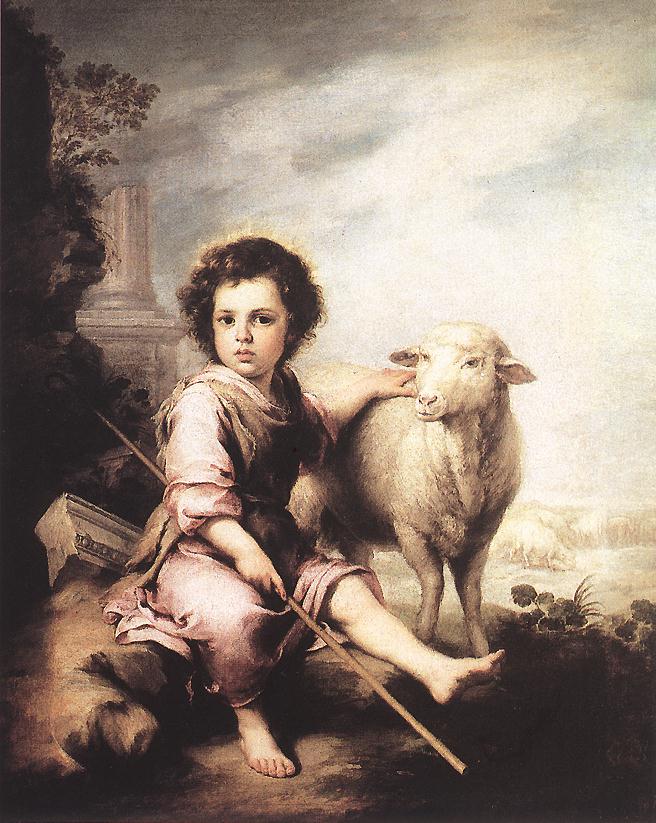
“Christ the Good Shepherd,” painted around 1660 by Bartolome Esteban Murillo, is one of the most tender and memorable images of the child Jesus in Spanish Baroque art. Instead of depicting Christ as a majestic ruler enthroned in heaven, Murillo shows him as a young shepherd seated on the ground, barefoot, with a lamb leaning affectionately against him. The setting is a gentle landscape and the atmosphere is quiet and intimate.
This painting belongs to a larger devotional tradition in which Christ is identified as the Good Shepherd who cares for and protects his flock. Murillo translates this theology into a scene that feels almost like a childhood portrait. The viewer is invited not only to reflect on religious doctrine but also to feel an emotional closeness to the child who will later give his life for humanity. Luminous color, soft modeling and a subtle play of gesture and gaze all contribute to the persuasive power of this work.
Composition and Overall Structure
The composition is organized around the diagonal line of Christ’s staff and the triangular relationship between the child, the lamb and the surrounding landscape. Christ sits on a rock in the left foreground, turned three quarters toward the viewer. His left leg is bent while his right leg extends outward, leading the eye to the lower corner of the canvas. Across his lap he holds a long shepherd’s crook, which stretches from the bottom edge toward the upper left.
Beside him, slightly to the right, stands a lamb. The child’s left arm rests protectively along the animal’s back, gently pressing it toward him. This physical contact establishes a close bond between shepherd and sheep. Behind them the landscape opens onto a soft, distant horizon where other sheep graze in pale light. On the left, architectural ruins and rocky formations rise vertically, balancing the horizontal spread of the plain to the right.
Murillo uses light to unify the composition. A soft illumination falls from the right, bathing the faces of both child and lamb. Their forms stand out against a more subdued background of gray sky and muted earth tones. The triangular arrangement of figures, staff and background elements forms a stable yet lively structure that keeps the viewer’s attention fixed on the central pair.
The Child Christ as Shepherd
Perhaps the most striking aspect of the painting is the way Murillo portrays Christ as a real child. His face is round and soft, his hair curls naturally around his forehead and neck, and his bare feet rest casually on the earth. There is nothing rigid or overly formal about his posture. One hand holds the staff, but not with martial stiffness. The other rests on the lamb in a relaxed yet caring gesture.
The child’s clothing combines simplicity and symbolic richness. He wears a pink tunic with rolled sleeves and a brownish mantle that is draped loosely around his body. The colors are gentle, avoiding the heavy golds and reds often associated with royal portraits. Yet the combination of rose and earthy brown also echoes traditional Marian and Christological color schemes, linking this humble shepherd boy to his divine identity.
Christ’s expression is thoughtful and somewhat serious. He looks out toward the viewer rather than at the lamb, as if inviting us to recognize ourselves among the sheep entrusted to his care. The gaze is direct but not confrontational. It feels mindful and compassionate, as though he sees both our vulnerability and our potential. This balance between childhood innocence and spiritual depth is one of Murillo’s special strengths.
The Symbolism of the Lamb
The lamb is a central symbol in Christian iconography. It stands for purity, sacrifice and the people of God. In many images Christ is the Lamb of God who takes away the sins of the world. In Murillo’s painting, however, the lamb is also one of the flock that Christ protects. This dual role enriches the meaning of the scene.
The animal presses close to the child’s side, its head turned slightly toward the viewer. Its wool is rendered with soft, feathery strokes, capturing both the physical texture and the symbolic softness of a creature needing protection. The lamb’s calm demeanor conveys trust. It accepts the shepherd’s touch and seems content to remain near him.
By placing the lamb at the same level as the child and ensuring that both are similarly illuminated, Murillo suggests a deep union between Christ and those he cares for. The flock is not distant or abstract. It is close, almost within the circle of the viewer’s own body. The implication is that believers, like this lamb, can find rest and security beside Christ. At the same time, the lamb quietly foreshadows Christ’s own sacrificial death, since he will eventually be the lamb offered for all.
Landscape, Ruins and Atmosphere
The landscape around Christ and the lamb plays a crucial role in shaping the painting’s mood. Murillo does not create a harsh wilderness, but a gently varied terrain. In the middle distance a flock of sheep grazes peacefully, their forms softened by atmospheric perspective. The sky is pale and hazy, evoking either the early morning or late afternoon. The overall feeling is one of calm and quiet, free from threats or storms.
To the left, however, an interesting detail appears: a section of classical architecture rising behind the rocky outcrop. It looks like a ruined column or a partial structure. This motif appears frequently in Baroque art, where ruins often symbolize the passing of worldly power and the transience of earthly glory. In contrast to these crumbling remains, the child shepherd and his living flock represent the enduring kingdom of God, which is based not on monumental stone but on loving care.
The rocky ground in the foreground, with scattered plants and a small satchel or bundle near Christ’s feet, emphasizes the earthly reality of the scene. Christ is not isolated from the harshness of life. He sits directly on the rock, barefoot, touching the soil that will one day receive his blood. Yet the gentle color transitions and soft lighting keep the environment from becoming bleak. Instead, it is a place where divine tenderness meets human frailty.
Light, Color and Murillo’s Baroque Style
Murillo is renowned for his luminous handling of color and his ability to bathe scenes in warm, diffused light. In “Christ the Good Shepherd” these qualities are on full display. The palette is dominated by gentle pinks, creams, browns and grays, with subtle touches of green in the foliage. There are no harsh contrasts of pure primary color. Instead, everything is softened and harmonized.
The light seems to come from the right side of the canvas, casting delicate shadows on the child’s face and body. His features are modeled with smooth transitions, creating a sense of roundness and life. The lamb’s wool catches the light in soft highlights, while the shadows beneath its body and legs ground it firmly on the earth. The ruins, rocks and distant sheep are handled with looser, more atmospheric brushwork, which helps keep the focus on the central pair.
This combination of clear, gently focused light and muted color is characteristic of Murillo’s mature style. It supports the emotional tone of the painting by creating an environment where harshness is diminished and grace is emphasized. The viewer feels as if the scene were suffused with a kind of spiritual glow.
The Good Shepherd Theme in Christian Art
The image of Christ as the Good Shepherd has ancient roots. In early Christian catacombs, shepherd figures appear frequently, symbolizing Christ guiding souls to safety. Later, images of Christ carrying a lamb on his shoulders or standing among sheep became popular, emphasizing his care for the lost and vulnerable.
Murillo’s version contributes something distinctive to this tradition. Many earlier representations show an adult Christ with a lamb, or a purely symbolic shepherd without explicit reference to the historical Jesus. Here, however, the shepherd is clearly a child. This choice intensifies the sense of gentleness and innocence. It also aligns with Baroque piety, which often encouraged devotion to the Christ Child as a more approachable and emotionally engaging figure.
By combining the Good Shepherd theme with a child portrait, Murillo offers a synthesis of Christological symbolism and human tenderness. The painting invites viewers to experience Christ not only as the divine ruler of souls but as a companionable child who understands vulnerability from within.
Murillo’s Approach to Childhood and Devotion
Murillo’s art is filled with images of children, both sacred and secular. Street urchins eating fruit, playful boys and girls, the young Christ, the Virgin as a child, and cherubic angels all appear throughout his oeuvre. These figures are never mere decorative details. They express Murillo’s deep interest in innocence, simplicity and direct feeling.
In “Christ the Good Shepherd” this sensitivity is evident in the way the child’s body is posed and the way his face is painted. There is an almost portrait like immediacy, as if Murillo had observed a real child sitting in front of him and then elevated that likeness into a sacred image. The child is neither overly idealized nor weighed down with grandeur. He is simply present, attentive and open.
For seventeenth century viewers in Seville, such a painting would have functioned as a devotional image for the home or a small chapel. It offered a way to cultivate affection for Christ, to feel him near in the ordinary rhythms of life. The accessible humanity of the child would encourage personal prayer, while the symbolism of the shepherd and lamb would remind viewers of deeper theological truths.
Emotional and Spiritual Impact
The emotional impact of the painting lies in its combination of serenity and implicit sacrifice. Nothing violent or tragic is depicted. The child sits calmly, the lamb stands contentedly, the distant flock grazes without disturbance. Yet for those familiar with Christian narrative, every element hints at the future. The shepherd will one day lay down his life for the sheep. The lamb that rests at his side prefigures the sacrificial Lamb of God. The ruins in the background suggest the fall of earthly kingdoms before the power of this gentle love.
Murillo’s technique reinforces this layered meaning. The soft light and rounded forms create a feeling of safety, inviting the viewer to rest in the scene. At the same time, the child’s serious gaze and the symbolic staff he holds keep the painting from dissolving into mere sentimentality. There is a quiet gravity behind the sweetness.
For modern viewers, the painting can still speak powerfully. It addresses the human longing for guidance, protection and unconditional care. The image suggests that such care is not distant or abstract but as close as the child’s hand on the lamb’s back. It also challenges viewers to consider how genuine leadership, both spiritual and social, should resemble a shepherd’s service rather than the grasping of power.
Place within Murillo’s Career and Spanish Baroque Art
“Christ the Good Shepherd” dates from Murillo’s mature period, when he had become one of Seville’s most celebrated painters. At this time he was producing large altarpieces, devotional images for religious orders and intimate works for private patrons. The painting embodies many qualities that made him so admired: warmth, clarity of narrative, delicate handling of light and an ability to move the viewer without resorting to extreme drama.
Within the broader context of Spanish Baroque art, Murillo’s softness stands out. While artists such as Ribera or Zurbarán often emphasized stark contrasts, intense realism and dramatic chiaroscuro, Murillo favored more gentle transitions and tender expressions. His approach suited the devotional climate of later seventeenth century Seville, which sought images capable of nurturing emotional closeness to Christ and the Virgin.
The painting also reflects the Catholic Church’s emphasis on approachable, humanized depictions of holy figures after the Council of Trent. By showing Christ as a lovable child, the work invites lay viewers of all ages to cultivate a familial relationship with him. This approach to sacred imagery helped shape popular piety in Spain and beyond.
Conclusion
“Christ the Good Shepherd” by Bartolome Esteban Murillo is a masterful union of theological symbolism and human tenderness. Through a simple scene of a barefoot child seated beside a lamb in a peaceful landscape, Murillo communicates the core message of the Good Shepherd: Christ’s attentive, sacrificial care for each soul.
The composition’s triangular harmony, the intimate bond between boy and animal, the soft light that bathes their faces and the quiet presence of ruins in the background all contribute to a rich, layered meaning. The painting invites viewers into a space where they can feel both comforted and challenged, both cherished and called to recognize the depth of divine love.
More than three centuries after its creation, the image continues to resonate. It offers a vision of leadership grounded in care rather than force, and a reminder that the sacred can appear in disarmingly humble forms. Murillo’s child shepherd, with staff in hand and lamb at his side, remains one of the most gentle yet profound embodiments of Christ in Baroque art.