Image source: wikiart.org
Introduction
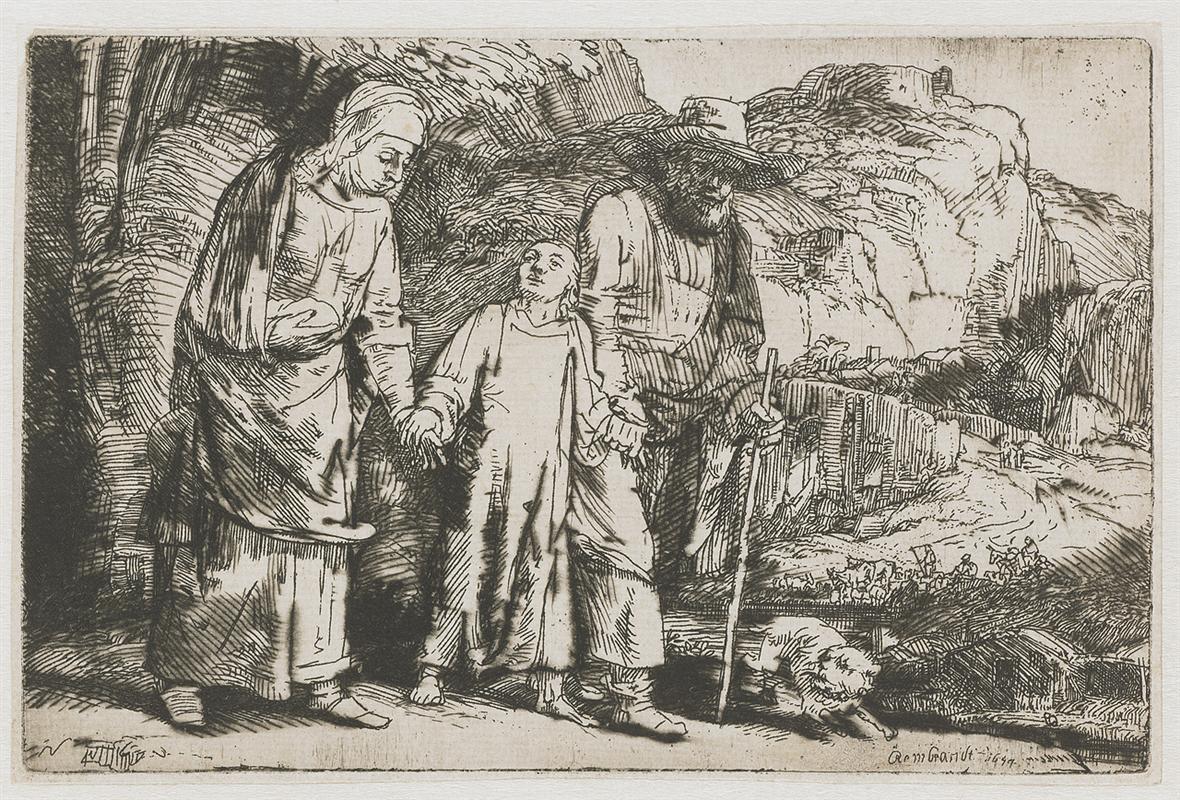
“Christ Returning from the Temple with His Parents” (1654) is a compact yet searching etching in which Rembrandt shines a warm, human light on one of the Gospel’s most intimate family episodes. The moment follows the twelve-year-old Jesus’ astounding conversation with scholars in the Temple; found by Mary and Joseph after an anxious search, he returns with them along the road. Rather than dramatizing the debate or the rebuke, Rembrandt dwells on the walk home—small hands held, dust underfoot, the long line of travelers winding through a rocky landscape. With a few vibrating lines, he makes the air feel lived-in and the emotions legible: relief, amazement, responsibility, and a child’s poised independence. The result is a work in which theology is carried by touch and gesture more than symbolism, turning sacred narrative into immediate human experience.
The Chosen Moment in the Gospel Narrative
Luke’s account tells how, after Passover in Jerusalem, Jesus remained behind in the Temple conversing with teachers while his parents began the return journey. After three days of searching they found him, and the young Jesus went home to Nazareth and “was obedient to them.” Rembrandt sets his scene in that quiet aftermath. The exchange of words is over; what remains is re-connection. Mary bends toward the boy, one hand clasping his; Joseph stands at the other side, sturdy and inward, staff in hand. Between them Jesus lifts his face, not pleading or sulking but awake and thoughtful, as if still hearing the echo of Temple voices. The story’s high drama dissolves into the daily practice of being a family again.
Composition and the Dialogue of Three Figures
The composition builds a triangular harmony around three bodies. Mary at left leans forward in a protective arc, her drapery falling in long, slow striations. Joseph at right rises more vertical, his broad hat casting a shadow like a canopy. The boy anchors the middle, a column of light clothing that bridges their dark tones. Their linked hands describe a subtle chain running across the front of the plate, making the viewer’s eye travel from one parent to the child and back. The three heads tilt at distinct angles—Mary downward in worry turned tenderness, Jesus upward in active listening, Joseph slightly toward the road in practical watchfulness—so that even before we read faces we feel the balance of care, curiosity, and duty.
Gestures, Touch, and the Psychology of Return
Rembrandt tells the story through touch. The small hand inside Mary’s palm is etched with a pressure that makes the grasp feel real; her other hand gathers her garment as if to keep pace with the boy’s step. Joseph’s hand wraps gently but firmly around Jesus’ fingers, while his other hand rests on the walking staff, the tool of a guardian leading a household home. Jesus’ posture is loose at the knees yet uplifted in the chest. He is both held and free, both son and learner. The faces reward close looking. Mary’s expression softens with the relief that follows fear. Joseph’s beard and hat obscure exact features, but his stance speaks of responsibility more than rebuke. The boy’s upturned head supplies the scene’s spark—the attention of someone who has glimpsed a larger horizon and cannot unsee it.
The Dog, the Staff, and Everyday Companions
At Joseph’s feet pads a small dog, its nose down near the path. This homely companion is not anecdotal filler. It adds the rhythm of ordinary life and underlines the theme of faithful return. Where the staff signals adult vigilance, the dog signals domestic continuity. Together they keep the episode grounded. The presence of a pet collapses sacred distance and invites identification: this is a family in the world, not figures on a pedestal.
Landscape and the Long Road
Behind the three figures the land rises in layered cliffs cut by paths and terraces. In the middle distance a small caravan of travelers threads the valley, a reminder that the Holy Family moves within a larger community. The rock walls are drawn with a mixture of sweeping curves and short cross-strokes, giving the scenery both geological weight and a gentle, rolling motion. The landscape is not a neutral backdrop. It mirrors the moral terrain of the story: a way that requires guidance, places to stumble, and vistas that open as one perseveres. The clifflike forms to the left cradle the family, while the more open right side pulls them forward, so the space itself participates in the psychology of return.
Light, Tonal Balance, and Quiet Emphasis
Rembrandt orchestrates light so the child glows without theatrics. Jesus’ tunic is the lightest field on the plate, set against darker passages in Mary’s layered garments and Joseph’s hat and vest. This tonal hierarchy reads as a moral one without sermonizing: the boy at the center is the source of the day’s wonder, the parents the bearers of care. In the right half of the print the etched lines thin and open, letting the paper’s brightness serve as air. The left half thickens with nestlike hatching—shadow that feels like shelter rather than threat. The light gathers around the trio and then dissipates into the road, just as a family conversation condenses affection and then releases it into travel.
The Language of Line and the Tactility of Etching
The print is a lesson in Rembrandt’s late graphic touch. Mary’s robe is built from long, evenly spaced hatches that drop like soft rain. Joseph’s vest and hat are rendered with rougher, more granular lines that create a durable texture befitting a working man. The boy’s garment is described with fewer strokes, letting the paper’s white assert itself and preserving a sense of youthful simplicity. In the landscape, lines curve and knot to suggest strata and scrub, while small dots and flicks animate the ground as gravel and grass. The variety of marks makes the scene tactile; one can almost feel cloth drag, rock rasp, and dust lift under sandals.
Human Scale and the Ethics of Smallness
The figures occupy the lower band of the plate, leaving the large landscape to rise above them. Yet because Rembrandt brings the trio close to the picture plane, they command us without grandeur. This ethics of smallness is crucial to the work’s persuasion. Instead of magnifying the event with pageantry, he locates significance in proximity—the scale of a hand inside a hand, the nudge of a staff, a dog’s trot. The sacred is not made big; it is made near. The choice draws the viewer into a neighborly rather than voyeuristic relation with the Holy Family.
Emotion Contained and Felt
Rembrandt refrains from theatrical grief or triumph. Mary’s head tilt and closed mouth convey relief and a residual sting—the memory of three anxious days. Joseph’s solidity confesses fatigue but does not complain. Jesus does not apologize or preach; he listens. The quietness is full, not flat. It respects the rhythm of a family who must keep moving among other travelers, who must save their longer conversation for the road’s pauses. In that restraint the print gathers a power of recognition: it feels like life as it is actually lived after a scare has passed.
Theological Undercurrents Without Emblems
There are no haloes, temple façades, or overt symbols. The theology enters through posture. The boy’s central brightness and upward gaze imply vocation without trumpeting it. Mary’s forward lean recalls the concern of a mother who “kept all these things in her heart.” Joseph’s staff and hat translate guardian care into everyday terms. The long road glancing toward the horizon provides the time in which growth will happen. By refusing emblematic shortcuts, Rembrandt makes the doctrine incarnate in patterns of walking, holding, and guiding.
Dialogue with Earlier and Contemporary Images
In many Renaissance and Baroque versions of this story, artists highlight the moment of finding—pointing hands, surprised faces, a court of scholars. Rembrandt’s decision to depict the walk home instead registers his mature interest in the spaces between events. The road allows him to concentrate on relationships rather than spectacle. He does not discount the wonder of Jesus among the teachers; he simply asserts that revelation continues as a family resumes its ordinary path. This approach places the etching in conversation with his other late works where travel and touch carry theological meaning—scenes like the “Flight into Egypt” and intimate domestic episodes drawn from daily life.
Dutch Eyes on a Biblical Household
Although the subject is ancient, the clothing feels close to Rembrandt’s world: Mary’s layered dress and head covering, Joseph’s broad-brimmed hat, the sturdy sandals and simple child’s shift. These choices situate the Holy Family within the visual language of seventeenth-century Dutch viewers, a deliberate act of translation akin to vernacular Scripture. The goal is not historical accuracy but imaginative access. By dressing the figures like neighbors, he invites the viewer to consider how wisdom might appear in one’s own household and how parental care might shepherd a calling without smothering it.
Rhythm, Movement, and the Pulse of the Road
The print has a bodily rhythm. The alternating steps of the three figures, the diagonal of Joseph’s staff, the angled path that ferries travelers across the middle distance—all create a visual heartbeat. Even the dog’s lowered head contributes to the sense of forward attentiveness. Rembrandt’s lines never sit like diagram; they move. This motion aligns with the narrative moment, when understanding must settle during the long, shared walk. We sense the time it will take for conversation to unfold, for Mary’s questions to be asked again, for Joseph’s silence to become counsel, for the boy to rehearse aloud what was discussed in the Temple.
Plate Tone, Wiping, and the Breath of the Scene
In many impressions of this etching, a gentle film of plate tone floats across the sky and far rocks, while the trio prints more cleanly. The effect is a soft haze that places the figures in breathable air. It reads like late afternoon light diffused by dust. This is more than technical flourish; it helps the scene feel traveled. The world is not a stage set but a place walked through, where light, heat, and fatigue mix with gratitude.
The Boy’s Upward Gaze and the Future
The most arresting detail remains the boy’s face turned upward to Mary. The gaze is affectionate and awake, as if he is already reframing the day’s events for his mother, not with precocious arrogance but with shared curiosity. The small gap between his feet suggests both eagerness and steadiness. He is secure in the grasp of his parents but not absorbed by it. The line between dependence and calling lies precisely where Rembrandt places him—held between hands, moving under a broad sky.
Why the Image Endures
The etching endures because it treats a famous episode as a family scene anyone can recognize. Its moral center is not the spectacle of precocity but the patient work of belonging to each other after surprise. We remember the roughness of the rocks, the swing of Joseph’s hat brim, the calm diligence of the dog, the way Mary’s shoulder slopes toward her son. These specifics make the story hospitable to contemporary readers who understand that most important hours are not the dramatic confrontations but the quiet walks home.
Conclusion
“Christ Returning from the Temple with His Parents” distills the essence of Rembrandt’s late graphic art: spare means, generous humanity, movement without noise. The plate honors both sides of the story—the child who is more than a child, and the parents whose care continues to shape his path. It does so not with symbols but with touch, space, and pace. In the linked hands and the long road lies a wisdom about growth that needs no caption: discoveries made in public must be carried in private, and revelation becomes character along the way home.