Image source: wikiart.org
Introduction
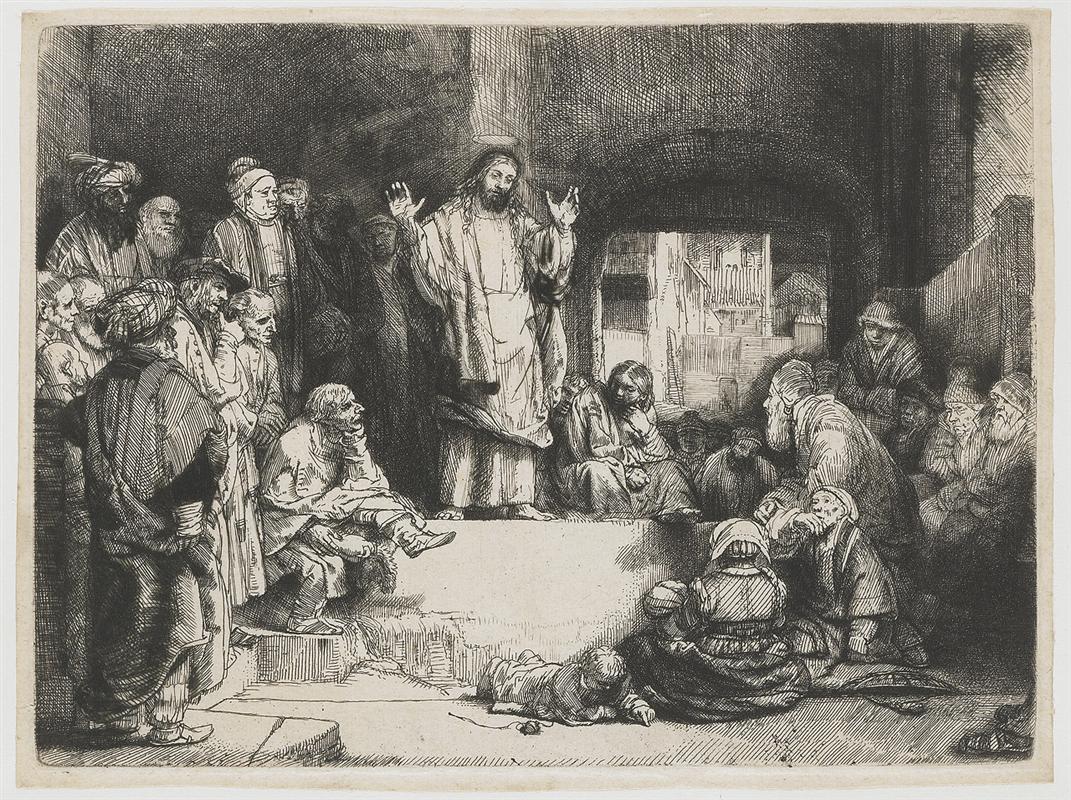
Rembrandt’s “Christ Preaching” is a breathtaking demonstration of how line, light, and human attention can turn a crowded scene into an intimate encounter. The etching—often nicknamed “La Petite Tombe” after an early collector—stages Jesus in a shallow architectural niche or gateway, flanked by a dense semicircle of listeners. He is neither enthroned nor distant. He stands on a slight step, hands lifted in a calm, open gesture, face turned with patient clarity toward those nearest him. The crowd presses close: the sick and the poor, scholars and townsfolk, mothers with children, the curious and the skeptical. Rembrandt builds the moment not around spectacle but around listening; the print becomes a portrait of a community assembled by a voice.
Composition As A Theater Of Listening
The composition organizes the multitude into legible, breathing groups. A low platform or step runs horizontally through the sheet, giving Christ a modest elevation and furnishing seats for several figures. On the left, a cluster of men in turbans and cloaks stand shoulder to shoulder, their silhouettes stacked like a column. At the right, kneeling and seated listeners arrange themselves in a descending diagonal toward the foreground, where a woman in a broad skirt faces Christ with unembarrassed openness. Between these masses, the niche behind Christ arcs like a dark cave, framing his body in a soft halo of brightness and guiding the eye toward his raised hands. The whole design is elastic: it holds many bodies without clutter, many glances without confusion.
The Choreography Of Hands
Hands are the grammar of this print. Christ’s palms open outward, not in theatrical blessing but in the generous cadence of teaching—“consider,” “behold,” “hear.” Around him, hands answer and echo. A man seated at the step hooks his fingers under his knee as if bracing himself for a difficult truth. A scholar pinches a beard, a habitual gesture of assessment. A woman at the front gently steadies the child slumped at her side. Another listener presses one hand to the ground, leaning in, anchoring attention with the body. Rembrandt’s etching needle makes a chorus of hands that together sing the theme: truth passes through gesture before it becomes words.
Light As Meaning
Rembrandt’s light is never mere description. Here, illumination flows from the left and from the open space behind Christ, catching his robe, forehead, and fingers, then sliding down onto the faces of those who listen. The surrounding darkness is rich with cross-hatched tone, especially in the arch that shelters the preacher. This chiaroscuro is theological without being didactic: light belongs where attention gathers. It is not the fireworks of miracle but a climate of understanding, a weather of recognition passing from face to face.
Faces As A Choir Of States Of Mind
One of the marvels of the print is its gallery of faces. Rembrandt gives every head a distinct temperature. There is a skeptical brow arched above a half-lidded eye; a hopeful, eager young face tilted forward; a weathered profile whose mouth tightens in pain; a serene woman’s gaze clear as water; an elderly man whose eyes shine with gratitude; a distracted onlooker who looks not at Christ but at the crowd, drawn to human company more than doctrine. The diversity of minds and motives prevents piety from hardening into stereotype. The scene feels like life because it accepts that people come to truth from many angles and at many speeds.
The Sick, The Poor, And The Ethics Of Proximity
Rembrandt anchors the foreground with need. A child stretches out prone; a beggar leans, his body twisted by infirmity; another figure stoops with age. The poor are not props. They are nearest in space and in meaning. The preacher does not hover above them; he stands among them on the same stone. This arrangement carries a moral argument: compassion and teaching are one motion; the first duty of truth is to draw near. Without a single sentimental flourish, the print declares the dignity of those most burdened by life.
Architecture As Social Stage
The setting—a deep, shadowed archway opening onto a bright city behind—works like a proscenium that focuses attention while hinting at a broader world. The niche domesticates public space: a shopfront or city gate becomes an ad hoc auditorium. Through the right-hand opening the viewer glimpses clustered roofs and scaffolding, a reminder that revelation happens in a living town with trades, noise, and work. Architecture here is social: it contains and amplifies speech, it offers steps for seats, and it frames the fleeting assembly of a crowd into a moment of civic learning.
Etching Technique And The Music Of Line
The print’s authority arises from Rembrandt’s mastery of etched line and drypoint burr. He reserves dense cross-hatching for the cavernous arch and for heavy garments, allowing faces and hands to breathe in lighter strokes. Drypoint burr enriches the darker passages with velvety softness, while the wiped plate tone settles into crevices like atmospheric dust. Where he wants brilliance—on Christ’s robe, on a kneecap, on the cheek of a kneeling woman—he clears the plate, leaving paper to radiate. The result is a musical score of mark-making: long legato hatchings establish tone; staccato flicks of the needle spark detail; quiet reserves of white paper hold silence.
The Central Gesture And The Poised Body
Christ’s body language is both humble and authoritative. He is not dynamically striding or pointing; he is lifted slightly on the balls of his feet, hands relaxed but firm, shoulders open. The stance signals availability rather than dominance. Even his head tilt, slightly to one side, reads as responsive listening while speaking. The effect is to soften hierarchy; this is not a king declaiming edicts but a teacher risking proximity. The power of the moment resides less in the speaker’s volume than in his nearness.
Time Suspended Between Saying And Hearing
Rembrandt selects the instant after words have left Christ’s mouth and before the next phrase begins. We feel the breath between sentences. That fine pause, alive with reception, is when real change happens: questions kindle; resistance tug-of-wars with assent; compassion finds its way from ears to hands. By freezing that suspended interval, the print honors listening as action and shows how a community is subtly reconfigured by a voice.
Clothing, Status, And The Social Mix
The crowd is a weave of fabrics and ranks. Voluminous cloaks, worn tunics, headscarves, turbans, and caps express different trades and origins. Rembrandt draws folds as moral facts: heavy cloth that has known weather; cuffs rubbed to softness; garments that dignify bodies without disguising poverty. Status is present but not determinative; proximity to Christ is not allocated by rank. The distribution of figures itself becomes a parable of inclusion.
Children In The Crowd
Children anchor both edges of the foreground—a little body sprawling at the center, a child kneeling at the right who turns to watch another listener as much as the preacher. Their presence matters for more than tender effect. Children register a crowd’s true temperature: if they feel safe enough to sprawl and lean, the space is hospitable. Their nearness to the speaker also underlines a recurring theme in Rembrandt’s sacred images: the kingdom belongs to those with unguarded attention.
The City Beyond The Arch
Through an opening behind the congregation a bright, linear city scape appears—walls, rooflines, scaffold or balcony rails. It is drawn with crisp parallel strokes, a foil to the deeply hatched interior. This window onto the world does two things. It stops the composition from becoming a sealed theater and it insists that preaching belongs to ordinary time—work hours, streets still bustling, buildings mid-repair. The gospel is not secluded; it moves openly through civic air.
The Rhetoric Of Steps And Stones
The steps at Christ’s feet are drawn with blunt, squared strokes, their edges chipped and irregular. They are ordinary public stones that have borne the load of feet for years. These practical forms give the scene weight and humility. The preacher stands not on a dais reserved for ceremony but on the same civic stones that hold commerce and daily passage. The choice makes doctrine walkable. It also feeds the eye with textures—it is a pleasure to feel the etched stone with the mind’s fingertips.
Parallels Within Rembrandt’s Sacred Prints
“Christ Preaching” speaks to Rembrandt’s “Hundred Guilder Print,” “Christ Disputing with the Doctors,” and candlelit interiors like the “Supper at Emmaus.” In each, the master replaces sensational miracle with patient human exchange. He choreographs crowds so that individuality survives, and he allows light to be an index of attention rather than an external effect. This plate, smaller and more compressed than the “Hundred Guilder Print,” concentrates that ethos into a pocket-sized amphitheater where every mark matters.
Sound, Breath, And The Senses
Though the sheet is silent, it is dense with implied sound: the rasp of a cough, the creak of a wooden sandal edge on stone, a child’s soft whimper, the rustle of cloth as bodies shift, and over all a voice steady and low. One can feel the heat of shared breath in the arch’s shadow and the cooler air that streams in from the bright opening behind. These sensory cues emerge from the tactile truth of the lines themselves—noisy cross-hatching where darkness thickens, quiet white reserves where air flows.
The Viewer’s Place In The Assembly
We stand at ground level, just inside the ring of listeners, close enough to see the texture of a sleeve and the bright bead of an eye. The vantage is not privileged; it is communal. We are invited to take our place among the kneelers and the curious, to lend our attention to the shared center. The sheet thus becomes participatory: not a remote picture to admire, but a scene that recruits the viewer into the discipline of listening.
Technique As Devotion
Rembrandt’s handling of plate tone suggests a devotional stance. He lets the ink remain in recesses to keep the whole bathed in a warm dusk, then wipes sharply where he wants clarity—on hands, faces, and edges that carry meaning. The act of printing becomes an analogue of preaching: remove excess so that essentials stand clear; keep enough atmosphere to preserve warmth and humility. Variations between impressions would alter this balance, making each pull a fresh “sermon” in ink.
Theological Reading Without Insistence
The print refrains from halos and rays, yet belief is palpable. What makes Christ recognizable is not iconographic hardware but the moral geometry of the scene: people gather freely; the poor sit closest; the speaker opens his hands; the light attends to those who attend. Theology is lived as social arrangement. The viewer need not share the faith to feel the rightness of that order.
Close Readings Of Key Passages
At the left edge, a man in a layered cloak stands with his weight on one hip, hands tucked, head slightly beware. His guardedness is rendered by the oblique angle of his body and the shadow that hides his eyes. Near the center, a seated listener throws one leg over the other—an ungainly, honest pose that makes his attention feel bodily and real. At the right foreground, the kneeling woman’s back forms a broad, luminous plane; the etched lines that describe her skirt flow like water, a calm counterpoint to the crowded textures above. In the niche, the vertical hatchings behind Christ subtly widen, creating a pale column that rises like a silent “amen” to his raised hands. These micro-decisions keep the image alive each time the viewer returns.
Why The Image Still Feels Contemporary
Modern audiences recognize this room. It is any space where a person speaks into a circle of mixed experience—community center, clinic waiting room, school hallway, café corner. The ethical stance the print models—attention to the vulnerable, humility in speech, the dignity of listening—has not aged. The etching also satisfies a contemporary taste for images that reward close looking: no single effect dominates; meaning emerges from accumulated particulars.
Conclusion
“Christ Preaching” is Rembrandt’s hymn to the city of ears. With etched line and printed dusk he builds a small republic of attention and sets within it a teacher whose authority is nearness. The steps are ordinary, the clothes worn, the crowd mixed, the light generous but disciplined. Out of these elements the artist composes a scene that feels both ancient and fresh, theological and civic, specific and universal. The print’s power lies in its refusal of spectacle in favor of the slow miracle of listening—how a room rearranges itself around a voice, how hands respond before words do, how light migrates to faces turned toward sense. Few images so compactly embody a way of living together. Few remind us so gently that the first act of faith—religious or secular—is to pay attention.