Image source: wikiart.org
Introduction
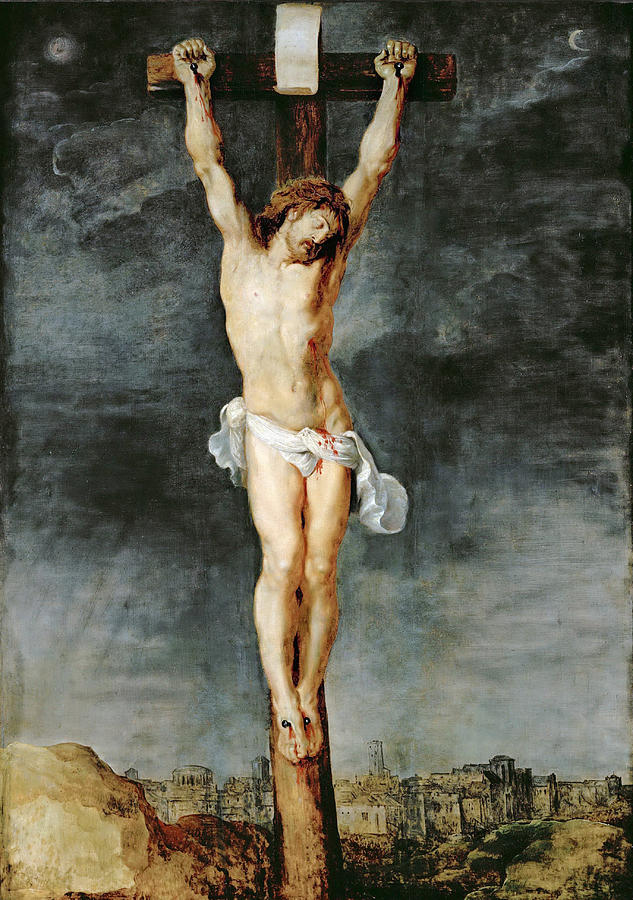
“Christ on the Cross” by Peter Paul Rubens presents one of the most intense and intimate interpretations of the Crucifixion in Baroque art. The painting shows Christ alone on the cross, suspended against a storm-darkened sky, with the distant city stretching across the bottom edge. The scene is stripped of the surrounding characters often found in depictions of Calvary: there is no crowd, no grieving Mary, no soldiers. Instead, Rubens isolates the suffering figure of Christ so completely that the viewer is confronted with the mystery of the Crucifixion as a solitary, cosmic event.
The vertical thrust of the cross, rising from the rocky ground into the heavy sky, divides the composition and pulls the eye upward from the world of stone and city walls toward the suffering body of Christ. Rubens fuses physical realism with spiritual drama, creating an image that is at once bodily and transcendent.
Historical and Religious Context
Peter Paul Rubens worked in the early seventeenth century, at the height of the Counter-Reformation, when religious images were meant to stir devotion, move the heart, and affirm the central doctrines of the Catholic faith. Paintings of the Crucifixion had a particular function: they were intended not merely to illustrate the Gospel story but to invite the viewer into meditative contemplation of Christ’s sacrifice.
In this work, whose exact date is unknown, Rubens embraces these aims by emphasizing Christ’s humanity and vulnerability. The absence of attendants on the hill of Golgotha gives the scene a liturgical clarity. It calls the viewer to imagine standing alone before the cross, just as worshippers in a church would gaze upon a crucifix above an altar. The painting can be understood as a visual companion to prayer, meant to help believers internalize the meaning of Christ’s Passion and the redemption it offers.
At the same time, Rubens was a deeply learned artist, familiar with classical sculpture, Italian Renaissance art, and the drama of contemporaries like Caravaggio. “Christ on the Cross” reflects this broad visual education. The idealized yet suffering body recalls antique statues of heroes, while the darkened atmosphere and stark lighting show Rubens’s awareness of theatrical light effects that heighten spiritual tension.
Composition and Central Focus
The composition is organized around the dominant vertical of the cross, which occupies the exact center of the canvas. Rubens places the cross slightly forward, making it feel as if it stands on a rocky ledge that juts toward the viewer. This simple yet powerful arrangement ensures that all attention goes first to Christ, then slowly expands outward to the sky and the city below.
Christ’s arms stretch upward in a wide diagonal, forming a subtle triangle with his head and feet. This triangular structure stabilizes the composition while simultaneously suggesting tension and strain. The slight tilt of Christ’s head and torso introduces a gentle curve that softens the geometry and makes the pose feel alive rather than rigid.
The scroll at the top of the cross, inscribed with the traditional “INRI” abbreviation, is rolled slightly, catching the light and breaking the dark silhouette of the timber. Rubens uses this small object to complete the vertical journey of the viewer’s gaze: from the rock at the bottom, through the bleeding feet and torso, up to the outstretched hands, and finally to the sign that proclaims Christ as King of the Jews.
The lower third of the painting is occupied by stony ground and the distant city. These forms are rendered in comparatively muted colors and softer detail, keeping them subordinate to the figure. Yet they are essential to the painting’s meaning: they anchor the spiritual drama in a recognizable world and remind the viewer that the Crucifixion occurred in human history, in a specific place and time.
The Body of Christ: Anatomy and Emotion
Rubens was renowned for his mastery of the human figure, and in “Christ on the Cross” this expertise becomes a vehicle for spiritual expression. Christ’s body is anatomically precise yet idealized, with long limbs, gently defined muscles, and carefully modeled planes of flesh. The weight of his body pulls downward, stretching his arms and elongating his torso, yet there is a certain grace to his posture, as though suffering and dignity are inseparably intertwined.
His head is bowed to the side, eyes closed, mouth slightly open. This ambiguous expression suggests both physical pain and a final surrender to death. The tilt of the head, combined with the gentle curve of the neck, introduces a note of tenderness that invites empathy. The viewer is not confronted with a grotesque spectacle of agony, but with a noble, human sorrow.
The wounds in Christ’s hands, feet, and side are clearly visible yet not exaggerated. Small streams of blood run down the wood of the cross and along the contours of his body. These crimson traces emphasize the reality of the crucifixion while avoiding sensationalism. Instead of overwhelming the viewer, the wounds serve as focal points that guide the eye along the body and through the narrative of suffering—hands pierced by nails, feet fixed to the wood, side opened by the soldier’s spear.
Rubens’s handling of flesh tones is especially striking. Against the cool, stormy sky, Christ’s skin appears almost luminous. Warm highlights pick out the shoulders, chest, and thighs, while subtle shadows define the ribs and muscles. This modeling gives the figure a sculptural solidity, as though the body were carved in marble yet animated by living breath. The result is a powerful sense of presence: Christ is not a distant symbol, but a real, physical being whose suffering the viewer can almost feel.
Light, Shadow, and Color
Light and shadow play a decisive role in the emotional impact of the painting. The sky behind Christ is restless and turbulent, filled with swirling greys and deep blues that suggest the approach of a storm or the unnatural darkness described in the Gospel accounts of the Crucifixion. The horizon is lighter, where the city catches a faint glow, while the upper sky deepens into a somber gloom.
Against this dark backdrop, Christ’s body stands out in a pale, almost golden light. Rubens directs the illumination so that it falls most strongly on the torso and legs, creating a high contrast between the figure and the surrounding environment. The cross itself is partly in shadow, which makes Christ appear to hover slightly in front of it and emphasizes his vulnerability.
Color is used sparingly but effectively. The dominant tones are earthy browns, muted greys, and cool blues. Against this restrained palette, the touches of red in the wounds, the faint flush in Christ’s cheeks, and the warm hues of the wood become especially poignant. The white of the loincloth provides one of the brightest accents in the painting. Its crisp folds catch the light and flutter slightly, suggesting movement and perhaps the breath of wind that passes across the bleak hill.
The overall effect of Rubens’s color and lighting choices is to create a mood of solemnity, awe, and quiet sorrow. The scene feels suspended in time, as though the moment of Christ’s death stretches beyond a single instant and encompasses the entire world.
The Sky, Sun and Moon, and the Cosmic Drama
One of the most intriguing features of this painting is the presence of celestial bodies in the darkened sky. On either side of the cross, Rubens places small, pale crescents that evoke the sun and moon, or perhaps two phases of the moon. Their eerie glow and distant placement suggest that the Crucifixion is not only an event on earth but a cosmic turning point.
In Christian theology, the death of Christ reconciles heaven and earth, God and humanity. By including the heavenly bodies as silent witnesses to the scene, Rubens visually expresses this doctrine. The sky itself seems to participate in the drama: its swirling, clouded forms reflect turmoil and grief, as though creation mourned the death of its creator.
The position of the crescents also frames the cross. They echo the shape of Christ’s outstretched arms and help draw the eye back to the central figure. This subtle repetition emphasizes that all elements of the scene, from city to sky, revolve around the crucified Christ.
The Landscape and the City Below
While the figure of Christ dominates the composition, the landscape at the bottom of the painting is carefully considered. The rocky hill on which the cross is planted is rough and irregular, with sharp edges and earthy tones. It suggests the harshness of Golgotha, the “Place of the Skull,” and acts as a visual metaphor for the hardness of the world that rejected Christ.
Beyond this rocky foreground stretches a cityscape rendered in small, blocky forms and muted colors. Towers, walls, and roofs cluster together under the gloomy sky. This city likely represents Jerusalem, the historical setting of the Crucifixion, but it also stands for the human world in general—crowded, distant, and seemingly unaware of the cosmic drama unfolding on the hill.
The placement of the city at the very bottom of the canvas reinforces this idea. Human civilization occupies only a narrow band of the painting, dwarfed by the towering cross and the immense sky. Rubens suggests that the fate of humanity, symbolized by the city, hangs on the figure of Christ above it. The cross becomes a bridge between the earthly realm and the heavens, between human guilt and divine mercy.
Symbolism of Blood, Wood, and Cloth
Every material object in the painting carries symbolic weight. The rough wood of the cross, with its vertical grain and visible knots, reminds the viewer that the instrument of execution was an ordinary object transformed into a sign of salvation. The wood’s deep brown color and heavy presence root the scene in physical reality while also evoking the tree of life and the tree of knowledge from the Book of Genesis. Where the first tree led to humanity’s fall, this new tree becomes the site of redemption.
The blood flowing from Christ’s wounds is slender yet unmistakable. It traces delicate paths down his arms and legs, stains the loincloth, and drips onto the cross. In Christian tradition, this blood is the price of atonement, cleansing humanity from sin. Rubens’s careful handling of these details invites the viewer to contemplate not only physical pain but sacrificial love.
The white loincloth itself plays a key symbolic role. Its pure color suggests innocence and holiness, while its slightly disordered folds introduce a sense of vulnerability and exposure. The cloth is the only garment Christ retains, underlining his humiliation and complete self-giving. At the same time, the brightness of the fabric recalls baptismal garments and liturgical vestments, linking the Crucifixion to the sacraments through which believers participate in Christ’s death and resurrection.
Rubens’s Baroque Style and Influences
“Christ on the Cross” is thoroughly Baroque in its emotional intensity, dynamic composition, and dramatic lighting. Rubens employs movement, contrast, and theatrical tension to engage the viewer’s senses and feelings. Yet this is not flamboyant drama; rather, the painting displays a controlled, focused energy appropriate to the solemnity of the subject.
Rubens’s knowledge of Italian art is evident. The robust anatomy and idealized beauty of Christ’s body recall Michelangelo and classical sculpture, while the interplay of light and darkness evokes the innovations of Caravaggio. However, Rubens adapts these influences to his own temperament. Where Caravaggio often emphasizes brutal realism, Rubens prefers a more harmonious and graceful vision, even in scenes of suffering.
The brushwork in the sky and landscape is broader and more expressive, while the figure of Christ is rendered with meticulous care. This contrast in handling strengthens the central focus on the body and gives the surrounding environment a slightly atmospheric, almost dreamlike quality. It is as if the entire world dissolves into mist while the reality of Christ on the cross remains sharply present.
Spiritual Meaning and Viewer Experience
The spiritual impact of “Christ on the Cross” lies in its directness. The absence of crowds or narrative details strips the scene down to its essential relationship: Christ and the viewer. Standing before the painting, one is drawn into a silent encounter with the crucified savior.
The upward thrust of the composition encourages contemplation. The viewer’s gaze travels from the earthbound city, across the rough rock, and up the length of the cross to Christ’s face. This visual journey mirrors a spiritual ascent from everyday concerns to the mystery of divine love. The bowed head of Christ, turned slightly toward the viewer, suggests that his sacrifice is offered personally, not abstractly.
The painting’s somber palette and stillness invite quiet reflection rather than sensational reaction. It encourages a form of meditative looking in which the viewer spends time tracing the anatomical details, the subtle play of light on skin, the faint glow of the crescents in the sky. Through this prolonged contemplation, the emotional meaning of the scene gradually deepens. The viewer senses not only pain but compassion, not only death but the promise of redemption.
Place of this Painting in Rubens’s Oeuvre
Crucifixion scenes appear repeatedly in Rubens’s work, from complex multi-figure altarpieces to more intimate devotional images. “Christ on the Cross” belongs to the latter category. Compared with grand compositions like “The Elevation of the Cross,” this painting is austere and concentrated, showing Rubens’s ability to express profound drama with limited means.
The solitary Christ here can be viewed as a summation of Rubens’s understanding of the Passion. Rather than crowding the canvas with narrative episodes, he distills the story into one decisive image: the moment when Christ hangs between life and death, between earth and heaven. This focus demonstrates Rubens’s sensitivity to the spiritual practices of his time, in which believers were encouraged to meditate on particular moments of Christ’s suffering.
Within Rubens’s broader career, “Christ on the Cross” also reveals his ongoing interest in the expressive possibilities of the human figure. The carefully balanced tension between ideal beauty and visible pain anticipates later artists who grappled with the challenge of depicting suffering without losing dignity. The painting thus occupies an important place in the evolution of religious art, bridging classical ideals and Baroque emotionalism.
Lasting Legacy of “Christ on the Cross”
“Christ on the Cross” continues to resonate because it brings together physical realism, theological depth, and emotional immediacy. Rubens transforms a familiar subject into a deeply personal encounter, where the viewer is not a distant observer but a silent witness at the foot of the cross.
The painting’s enduring power lies in its simplicity. A single figure, a single cross, a stormy sky and distant city—these few elements, orchestrated with masterful skill, convey the heart of the Christian story. The suffering body of Christ stands as a sign of sacrificial love, while the darkened heavens and overshadowed city remind us that this love extends over all creation and every human life.
In this work, Rubens shows how art can serve as a bridge between the visible and the invisible, the earthly and the divine. “Christ on the Cross” is more than a historical image; it is a visual meditation that continues to invite contemplation, sorrow, gratitude, and hope for all who pause before it.