Image source: wikiart.org
Introduction to Christ In The Garden Of Olives by Bartolome Esteban Murillo
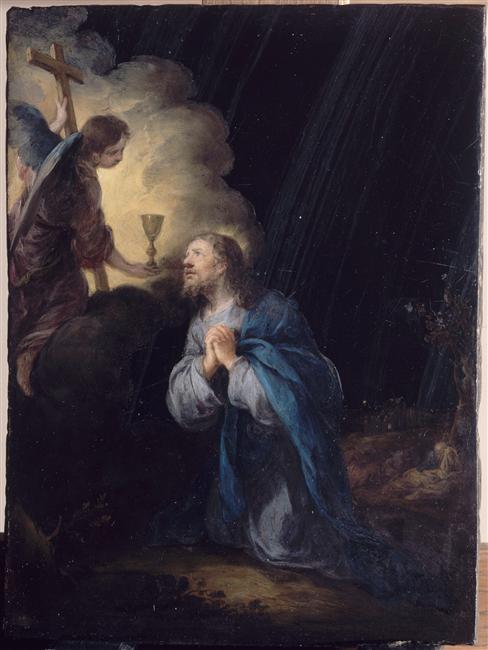
“Christ In The Garden Of Olives,” painted in 1670 by Bartolome Esteban Murillo, belongs to a long Christian tradition of images that focus on the night of Christ’s agony in Gethsemane. This painting condenses that dramatic moment into a compact, emotional scene. Christ kneels in prayer, wrapped in a deep blue mantle, while an angel appears in a luminous cloud, offering both a chalice and a cross. Around them, the rest of the garden sinks into darkness, with only faint glimpses of sleeping disciples and a distant landscape.
Murillo was one of the most important Baroque painters of Seville, known for his gentle religious scenes and sensitive depictions of spiritual feeling. In this work he brings those qualities to a subject that could easily be harsh and terrifying. Rather than showing Christ in extreme agony, he shows a man caught between fear and obedience, trembling yet already turning toward acceptance. The painting invites the viewer to step into that quiet but decisive moment, just before the arrest and Passion that will follow.
The Biblical Moment in Gethsemane
The painting refers to the Gospel accounts of Christ’s prayer in the Garden of Gethsemane just before his betrayal. After the Last Supper, Christ goes with his disciples to the Mount of Olives to pray. The disciples fall asleep while Christ, overwhelmed with sorrow, asks that the “cup” of suffering might pass from him, yet he finally submits to the will of the Father. In many traditional interpretations, the angel appears to strengthen him and present the symbolic cup that he must drink.
Murillo selects the moment when Christ looks up from his anguished prayer toward the angelic messenger. The chalice becomes the visual embodiment of the “cup” mentioned in Scripture. The cross, held by the angel, anticipates the coming Crucifixion. These two symbols summarize everything that will happen in the hours ahead. In a single glance, Christ sees both the suffering that awaits him and the salvation that will flow from it.
By focusing on this suspended instant, Murillo allows viewers to witness an interior battle. Christ is not yet arrested, yet the decision has effectively already been made. The painting visualizes the turning point where human fear is transformed into willing sacrifice.
Composition and Focal Points
Murillo’s composition is built around a diagonal meeting of heaven and earth. Christ kneels on the right foreground, his body inclined upward toward the angel on the left. The angel descends within a thick cloud that glows with warm, golden light. This cloud cuts through the darkness of the night and frames the interaction between the two figures.
The lower right is heavy, dark and rooted in the soil of the garden. The upper left is luminous, airy and filled with swirling vapor. Between these two zones, Christ’s raised face and clasped hands form the hinge of the composition. The viewer’s eye naturally follows Christ’s gaze toward the chalice and cross, then circles back down along the angel’s extended arm and the cloud’s contour to Christ again.
Murillo leaves the background largely in shadow. A small group of sleeping disciples lies off to the far right, almost swallowed by the night. A distant tree and suggestion of rocky ground extend into the depth, but they never compete with the main figures. This spareness allows the central drama to feel intimate and concentrated. Everything in the design directs attention to the dialogue between Christ and the angel.
Light, Shadow and Color
Like many Baroque painters, Murillo uses strong contrasts of light and dark to convey spiritual truths. The brightest light radiates from the cloud surrounding the angel. It is not a natural moonlight, but a supernatural glow that seems to emanate from the divine presence itself. The light falls softly across Christ’s face, shoulders and hands, leaving his lower body and the surrounding earth in shadow.
This distribution of light suggests that Christ’s consolation comes not from his environment but from above. The world around him is obscure and threatening, with streaks of rain slanting down across the dark sky. The cloud, however, is warm and golden, almost like a curtain parting to reveal another realm.
Murillo’s color choices reinforce this contrast. Christ’s robe is a rich blue, a color often associated with heavenly grace and purity. Underneath, his tunic is pale, catching the reflected light and framing his face. The angel wears a softer garment, tinged with rose and violet, harmonizing with the clouds. The rest of the garden is painted in deep browns and blacks. The effect is to isolate patches of blue, white and gold against an almost black stage, heightening the emotional intensity.
The Figure of Christ: Humanity and Divinity in Tension
Christ’s posture is the key to the painting’s emotional power. He kneels on the rocky ground, one leg forward, mantle pooling around him. His hands are clasped tightly, fingers interlaced, held just beneath his chin. This gesture conveys desperation and fervent prayer. His shoulders lean slightly upward, as if drawn by the light in the cloud, yet there is still a heaviness in his form that speaks of human fatigue.
Murillo gives Christ a gentle, sorrowful expression. His eyes are raised, not in defiance, but in pleading. There is moisture in his gaze, a suggestion of tears at the brink of falling. His mouth trembles between the impulse to ask for relief and the resolve to say “thy will be done.” The artist does not exaggerate the agony with contorted muscles or extreme gestures. Instead, he captures the quieter, interior agony of someone facing an unavoidable duty.
At the same time, Christ’s features retain a serenity that hints at his divine nature. The soft light outlining his face and beard can be read almost as a halo. The blue mantle and luminous skin separate him from the darkness around him. Murillo presents a Christ who is fully human in his fear, yet also already illuminated by the acceptance that will lead to salvation.
The Angel and the Chalice of Suffering
The angel descends toward Christ from within the cloud, leaning forward with a compassionate expression. One hand holds a large wooden cross, while the other presents a chalice that glows faintly in the light. These two objects are rich with symbolic meaning. The cross points to the instrument of Christ’s eventual death. The chalice refers to the cup of suffering in Gethsemane as well as the Eucharistic cup of the Last Supper.
Murillo’s angel is neither distant nor terrifying. The figure appears youthful, almost tender, with soft wings and flowing garments. The angel’s body language conveys sympathy, not command. Rather than imposing the chalice, the angel offers it, as if inviting Christ to embrace the path that has been set before him. The light that envelops the angel seems to be the light of divine assurance. Although the message is severe, its bearer is gentle.
The placement of the chalice near Christ’s line of sight is especially important. Viewers sense that Christ is not only looking at the angel’s face, but also at the cup itself. Within that simple object lies the entire destiny of the Passion. Murillo reduces complex theological ideas about sacrifice, redemption and obedience into a direct visual encounter between Christ and the symbol of his mission.
The Sleeping Disciples and the Distant Garden
On the far right of the painting, nearly hidden by the darkness, lies a small group of sleeping disciples. The forms are not sharply defined. We can make out suggestions of cloaked figures reclining on the ground, unaware of the spiritual drama unfolding nearby. Their presence echoes the Gospel story in which the disciples cannot stay awake to keep watch with Christ in his hour of need.
Artistically, the disciples create a secondary plane of action. They balance the composition and provide scale. Their drowsy stillness contrasts with Christ’s tension and the angel’s purposeful movement. While the main scene is filled with inner conflict and divine communication, the disciples represent ordinary human weakness and inattention.
Murillo also hints at the larger world of the garden. A barren tree leans out of the darkness. The ground is uneven, rocky and damp. Faint lines suggest that rain is falling across the entire landscape. All of this contributes to a sense of isolation. Christ is not only spiritually alone, he is physically separated from his companions in a world that feels cold and unwelcoming. Yet this harsh setting also makes the descending light from the cloud feel all the more precious.
Baroque Emotion and Spanish Spirituality
As a Baroque work, “Christ In The Garden Of Olives” is meant to move the viewer emotionally. Baroque art often emphasizes dramatic lighting, dynamic compositions and intense expressions to draw onlookers into sacred stories. Murillo adopts these strategies but softens them with a distinctly Spanish blend of tenderness and introspection.
Spanish religious culture in the seventeenth century valued images that encouraged meditation on Christ’s suffering. Viewers were invited to contemplate the wounds, tears and inner pain of Christ so they could respond with compassion and renewed faith. Murillo serves this spiritual goal by presenting Christ not as a distant judge but as a suffering friend whose struggle the viewer can share.
The dark night, the stormy sky and the glowing cloud are all theatrical, yet they are not merely decorative. They create an emotional environment that resonates with the feelings of fear, abandonment and hope that define the Gethsemane story. The painting aims to stir the heart, not simply to inform the mind.
Murillo’s Personal Style within the Baroque Tradition
Murillo is often contrasted with other Spanish masters such as Zurbaran and Ribera, whose religious works can be stark and severe. Murillo, by comparison, is known for his softer edges, diffused light and tender expressions. In “Christ In The Garden Of Olives,” his personal style is clearly visible.
The contours of Christ’s body and the angel’s form are gently blended rather than sharply outlined. The fabric of their garments flows in large, rounded folds that suggest movement without harsh angularity. The faces are idealized yet human, with smooth transitions of tone around the eyes and mouth. Even the cloud is painted with feathery strokes that make it look like a living vapor rather than a static backdrop.
This softness does not dilute the seriousness of the subject. Instead, it provides a visual language for compassion. Murillo seems less interested in shocking the viewer with brutal details than in inviting them into a quiet, shared sorrow. The painting is emotional but not violent, tragic yet full of consolation. This balance is a hallmark of his mature religious work.
Devotional Function and Viewer Experience
When this painting was first created, it would likely have hung in a church, chapel or private oratory where believers came to pray. Its purpose was not only to decorate the wall but to support personal devotion. The viewer could kneel before the image and contemplate Christ kneeling within it. The gesture of clasped hands, the raised eyes and the light from the angel offered a model for how to pray in times of trial.
The composition encourages a kind of spiritual identification. Standing before the painting, viewers might imagine themselves in Christ’s place, confronted with their own “chalice” of suffering. The image suggests that divine help is present even when the world seems dark and friends are asleep. The angel’s tender approach and the glow in the cloud communicate that God does not abandon those who struggle, but strengthens them to accept their path.
Even today, outside its original religious context, the painting can still speak to modern viewers. The theme of facing a difficult decision, feeling alone, yet slowly finding the courage to move forward remains deeply human. Murillo’s image of Christ in Gethsemane becomes an image of anyone wrestling with fear, duty and faithfulness.
Place of the Painting within Murillo’s Oeuvre and Christian Art
Murillo painted many scenes from the life of Christ, as well as numerous images of the Virgin and child, saints and beggar children. “Christ In The Garden Of Olives” fits into his broader interest in moments of tenderness, emotional vulnerability and everyday humanity within sacred stories. Compared to some of his more crowded compositions, this work is quite focused, containing only a few figures and a limited setting. This simplicity allows the psychological depth of the subject to come through clearly.
Within the wider history of Christian art, the Gethsemane theme has been interpreted in many ways, from dramatic scenes with multiple soldiers and disciples to very quiet, solitary images of Christ praying alone among the trees. Murillo negotiates a middle path. He includes the angel and the disciples, but keeps them secondary, so that the true drama remains interior. His contribution lies in the way he infuses the scene with gentle feeling, luminous color and a mood of compassionate sadness rather than sheer terror.
The painting captures a defining aspect of the Christian story: that salvation unfolds not only in public events such as the Crucifixion, but also in private decisions made in the stillness of the heart. Murillo’s Christ is not yet on the cross, yet his acceptance of the chalice already anticipates the sacrifice to come.
Conclusion: A Night of Struggle and Surrender
“Christ In The Garden Of Olives” by Bartolome Esteban Murillo is a deeply moving vision of one of the most intense nights in the Christian narrative. Through subtle composition, dramatic contrasts of light and dark, and a careful balance between fear and serenity, Murillo opens a window into the inner experience of Christ at Gethsemane. The kneeling figure in blue, the compassionate angel, the chalice and the cross, the sleeping disciples and the stormy sky all work together to show a soul caught within a decisive act of surrender.
The painting reveals Murillo’s gift for combining Baroque drama with a uniquely gentle touch. Rather than overwhelming viewers with horror, he invites them into a quiet, heartfelt contemplation. The work still speaks powerfully today, not only as a masterpiece of Spanish Baroque art, but as a visual meditation on courage, obedience and the mystery of suffering accepted in love.