Image source: wikiart.org
Introducing Francisco de Zurbaran’s “Christ Blessing”
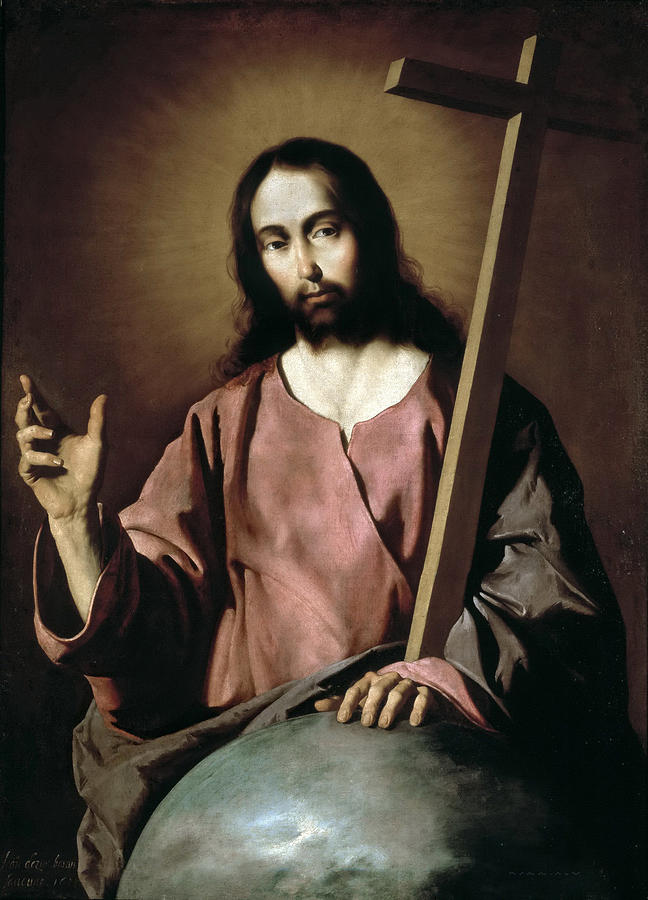
Francisco de Zurbaran’s painting “Christ Blessing” presents a calm yet powerful image of Jesus as Lord of the universe and source of spiritual grace. The composition is simple and frontal. Christ sits or stands behind a vast blue green sphere that represents the world, one hand resting gently on its surface while the other is lifted in a gesture of blessing. He holds a tall wooden cross close to his body, and a soft halo of light surrounds his head. The dark background throws his figure forward with remarkable force, turning this quiet devotional image into a commanding presence.
This work belongs to the broad tradition of images known as Salvator Mundi, or “Savior of the World.” Yet Zurbaran’s treatment is distinctly his own. Rather than glittering royal robes or elaborate settings, he gives us a very human Christ in a simple rose colored tunic and brown mantle. The focus lies on his thoughtful face, his expressive hands, and the symbolic objects of globe and cross. In this painting, Zurbaran condenses complex theology into a serene, almost intimate encounter between the viewer and Christ.
The Iconography of Christ as Savior of the World
The central elements of the painting follow traditional Christian iconography. The globe beneath Christ’s hand signifies his dominion over the world, both as creator and as redeemer. It evokes biblical passages that speak of the Earth as his footstool and of his kingship over all nations. Here the globe is not decorated with maps or crowns, but shown as a luminous, almost abstract sphere. This keeps the focus on the spiritual, rather than political, meaning of his authority.
The cross that Christ holds is plain and wooden, leaning diagonally across the image. It reminds viewers that his power does not come from worldly conquest but from sacrificial love. The cross is both a historical instrument of death and a cosmic banner of victory. By resting it against his shoulder while blessing the viewer, Christ appears as one who has already passed through suffering and now offers its fruits as mercy and forgiveness.
The raised right hand with two fingers extended and others folded is a classic gesture of blessing. In Christian art it often conveys both benediction and teaching, evoking Christ as priest and prophet. The hand here is painted with great attention. The fingers are slender yet firm, the skin carefully modeled with light and shadow. The gesture is directed outward toward the viewer, making the blessing feel personal rather than abstract.
Zurbaran’s Composition and Use of Space
The composition of “Christ Blessing” is strikingly economical. There is no architectural frame, landscape, or gathering of saints. Instead, Christ fills the center of the canvas, cropped at the waist, with the globe occupying the lower part of the image. This tight framing pushes the figure forward, as if he were very close to us.
The vertical of the cross and the vertical axis of Christ’s body anchor the composition. These lines are balanced by the gentle diagonal of the cross and the circular curve of the globe. His left arm, holding the cross, forms a subtle triangle with his torso and the edge of the sphere, adding stability. The right arm extends upward in a gentle curve that draws the eye from the globe to the blessing hand and then to the face.
The background is an undefined dark space that moves from deep brown to black. This void helps isolate the figure emotionally and spiritually. Christ seems to emerge from a realm beyond time, a luminous presence against the darkness that symbolizes sin, ignorance, or the unknown. At the same time, the lack of visible setting invites viewers to imagine themselves in front of him, without distraction or distance.
Light, Chiaroscuro, and the Halo of Glory
Light is one of Zurbaran’s primary tools for constructing meaning. A soft, focused illumination falls on Christ’s face, chest, and hands, leaving the edges of his body and the background in shadow. This use of chiaroscuro creates a sense of volume and depth, making the figure appear almost sculptural.
The halo around Christ’s head is not a sharply drawn disc but a radiant glow that gently softens into the surrounding darkness. It suggests an inner source of light rather than an external ornament. This luminous aura reinforces his divine nature while preserving the naturalism of his appearance. The viewer is invited to see holiness shining through a fully human face.
The globe reflects this light in a subdued way. Highlights on its curved surface give it a metallic or watery sheen, evoking both the solidity and the fragility of the world. The cross catches light along its edges, emphasizing its simple wooden form. The interplay of brightness and shadow across these elements guides the viewer’s eye through the painting and underscores the spiritual hierarchy. The brightest focus is the face of Christ, followed by his hand in blessing and the hand resting on the globe, then the cross, and finally the dim background.
Color and the Emotional Tone of the Painting
Zurbaran’s color choices contribute significantly to the emotional atmosphere. Christ’s tunic is a muted rose, a color seldom used for royal garments but rich in symbolic resonance. Rose can suggest love, compassion, and the heart. It gives the figure a gentle warmth that contrasts with the cooler tones of the globe and the neutral browns of the mantle and background.
The brown mantle that drapes over his shoulders introduces earthiness and humility. It suggests that the divine Word has taken on the garments of human life, simple and unadorned. The combination of rose and brown results in a restrained yet harmonious palette that feels intimate rather than theatrical.
The globe is painted in blue green tones that evoke sea and land without specifying details. Its cool color sets it apart from the warm flesh and garments of Christ, emphasizing the difference between the eternal divine presence and the changeable world he holds in his care. The overall color scheme is calm and balanced, encouraging quiet contemplation rather than dramatic excitement.
The Face of Christ and Zurbaran’s Spiritual Realism
The face of Christ is the emotional center of the painting. Zurbaran portrays him with long dark hair, a short beard, and gentle yet penetrating eyes. He looks slightly downward and toward the viewer, as if engaging in direct, personal contact. The expression is neither stern nor overly sweet. It combines seriousness with compassion, awareness of suffering with quiet peace.
The modeling of the features is delicate. Subtle shadows under the eyes, on the cheeks, and around the mouth suggest both maturity and tenderness. The brow is relaxed, the lips slightly parted, as if about to speak a word of comfort or instruction. This balance between majesty and humanity is characteristic of Zurbaran’s spiritual realism. He does not idealize Christ into an unreachable figure, yet he preserves a sense of sacred distance through the controlled gaze and stillness.
Viewers may feel that Christ is simultaneously looking at them and beyond them, aware of each person individually yet also contemplating the whole world symbolized by the globe. This double focus reflects the theological idea that Christ knows each soul intimately while governing the universe as its Lord.
The Hands and Their Theological Significance
The two hands of Christ play complementary roles. The right hand, raised in blessing, delivers grace outward. Its fingers form a gesture often associated with the sign of the Trinity, with two fingers joined and three forming another group, though interpretations vary. This hand communicates Christ’s identity as priest and mediator.
The left hand rests on the globe, almost casually, yet with a subtle authority. The pose is not one of forceful domination. Instead, the hand appears protective, as if gently steadying the world. The message is that Christ governs not through violence but through care. This hand can also be read as a sign of his incarnation, placing human flesh in direct contact with creation.
Together, the hands express the two main aspects of his mission. One hand blesses and sanctifies humanity, the other upholds and guides the world. The cross leaning against his shoulder integrates both actions, reminding us that his blessing and his rule are grounded in the self giving of the Passion.
Devotional Context and Counter Reformation Spirituality
In Zurbaran’s Spain, paintings of Christ Blessing would have been used for personal and communal devotion. They might hang in chapels, monasteries, or private homes, serving as focal points for prayer. The quiet dignity of this image matches the meditative spirituality encouraged by Counter Reformation Catholicism, which stressed both the humanity and the kingship of Christ.
Rather than portraying dramatic scenes of miracles or crucifixion, this painting presents a moment of calm after victory. Christ appears as the risen Lord who has already suffered and triumphed, now offering peace and guidance. Viewers were invited to place themselves under his blessing and to entrust their lives, and the fate of the world, to his care.
The simplicity of the composition reflects the desire for images that are clear, doctrinally sound, and emotionally accessible. The faithful could meditate on Christ’s dual nature as human and divine, his role as judge and savior, and the intimate link between personal salvation and the destiny of the world.
Comparisons With Other Salvator Mundi Images
When compared with other famous Salvator Mundi paintings, such as those attributed to Leonardo da Vinci or to earlier Northern artists, Zurbaran’s version stands out for its austerity and emotional sobriety. Many Salvator Mundi images show Christ wearing jewel studded robes, holding a crystal orb, and framed by elaborate decorations. These elements emphasize his royal status and heavenly splendor.
Zurbaran strips away much of this ornamentation. His Christ wears plain cloth, the globe is opaque and rough surfaced, and the cross is simple wood. This does not diminish Christ’s majesty. Instead, it shifts the emphasis to his spiritual authority and closeness to ordinary believers. The painting resonates with the ethos of Spanish Baroque piety, which often favored stark, intense images that encourage introspection and repentance.
At the same time, Zurbaran’s command of light and human anatomy ensures that his Christ is no less impressive than more lavish versions. The quiet glow of the halo, the seriousness of the face, and the weight of the globe together create a sense of immense power held in meekness.
Reading the Painting Today
For contemporary viewers, “Christ Blessing” continues to offer a powerful visual meditation. Even those outside a Christian tradition can appreciate its exploration of themes such as compassionate authority, responsibility for the world, and the balance between strength and gentleness.
In an era marked by uncertainty and global challenges, the image of a figure who both understands human frailty and holds the planet gently under his hand can feel particularly poignant. The blessing gesture crossing the boundary between painting and viewer suggests the possibility of comfort and orientation amid confusion.
From an art historical perspective, the painting demonstrates Zurbaran’s ability to combine Caravaggio inspired chiaroscuro with a uniquely Spanish sense of gravity and stillness. It is a key example of how Baroque art could convey intense spiritual messages with minimal visual complication.
Conclusion
Francisco de Zurbaran’s “Christ Blessing” is a serene yet commanding representation of Jesus as Savior of the World. Through a restrained composition, carefully controlled light, and a limited but harmonious palette, Zurbaran focuses attention on Christ’s face and hands, the globe of the world, and the wooden cross.
The painting unites profound theological symbolism with human warmth. Christ’s blessing hand reaches toward the viewer, while his other hand rests protectively on the globe. His calm gaze and gentle halo express both divinity and closeness. The cross reminds us that his authority is rooted in sacrificial love, not in worldly domination.
By avoiding unnecessary ornament and emphasizing spiritual presence, Zurbaran creates a devotional image that invites quiet reflection. Today, as in the seventeenth century, “Christ Blessing” offers viewers an encounter with a figure of compassionate power who holds the world in his hand and extends a blessing of peace.