Image source: wikiart.org
Introduction
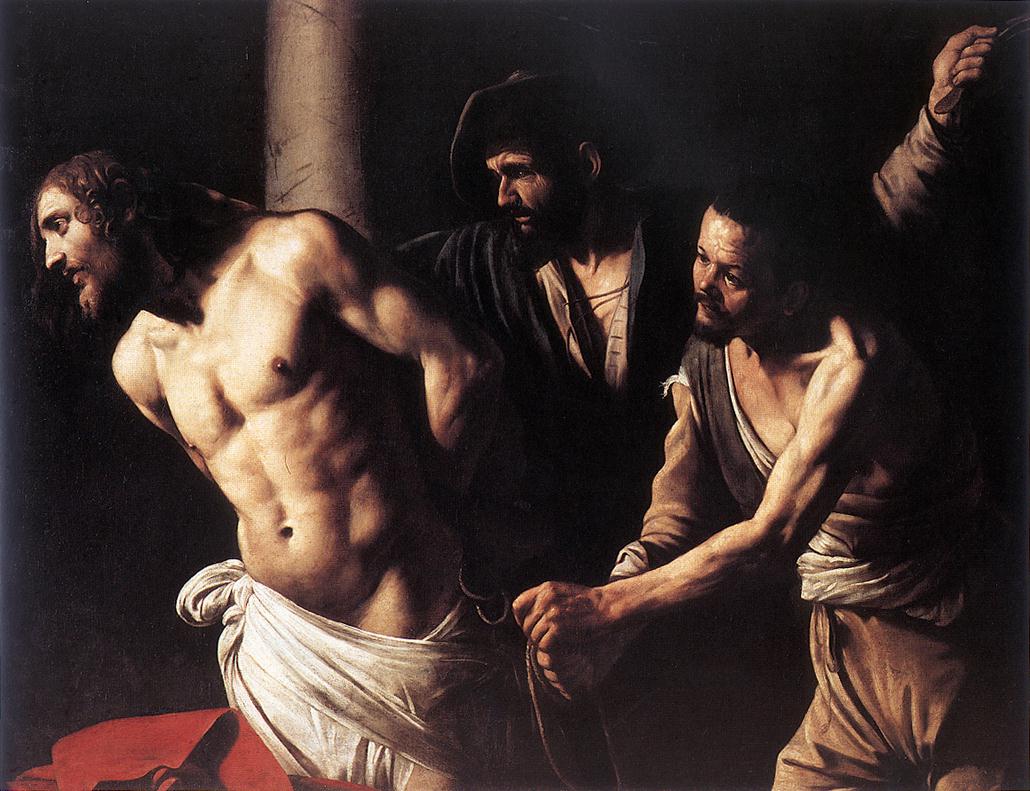
Caravaggio’s “Christ at the Column” (1607) compresses one of the most harrowing episodes of the Passion into a chamber of light and shadow where every tendon, rope, and glance becomes eloquent. Christ, stripped to the waist and bound behind his back, is pinned against a column as two executioners marshal the cords for the scourging. A third figure, half in darkness, supervises with a rough, pragmatic calm. There is no crowd, no architectural display, no ornamental flourish. Caravaggio distills the scene to its moral core: human force arranged against a body that refuses to resist and is therefore able to reveal.
Historical Moment And The Neapolitan Blade Of Caravaggio’s Style
The canvas belongs to Caravaggio’s first Neapolitan period after his flight from Rome. Exile sharpened his art. The theatrical ensembles of the Roman years condense here into tight half-length compositions, the chiaroscuro darkens to an almost mineral black, and storytelling shifts from anecdote to gesture. “Christ at the Column” is a quintessential product of this turn. It bears the hallmarks of Naples—devotion that prefers immediacy to ornament and a taste for images that confront rather than console—yet it also looks backward to the painter’s Roman breakthroughs, as if the artist were re-forging his earlier discoveries into a more lethal blade.
The Chosen Instant And Its Psychological Weight
Caravaggio chooses the suspended second before the first stroke falls. Christ’s wrists are tied, his torso twists away from the coming blow, and his head inclines not in collapse but in concentration. The executioner on the right clutches the rope with both hands to cinch the knot; behind him, a companion lifts the scourge just out of the light; in the center, a man in a cap inspects the binding. Because nothing yet has struck, the painting vibrates with expectation. Pain is not spectacle; it is a promise being prepared. That restraint is ethical as well as aesthetic. The viewer is made a witness, not a thrill-seeker.
Composition As A Triangular Engine
The composition is built on a firm triangular scheme. Christ’s luminous body forms the left side of the triangle; the two torturers on the right build the opposing side; the column is the stabilizing axis that closes the figure group and pins the drama in place. The diagonal swing of Christ’s torso—hip turned outward, shoulder twisting back—meets the counter-diagonal of the executioner’s drag, producing a visual torque that you can feel in your own spine. Caravaggio packs the figures tightly, the way a sculptor masses a relief, so the action seems to press forward into the viewer’s space.
Chiaroscuro As Judge And Narrator
Light falls across Christ from high left and travels down the ribcage, catching the serrated borders of the muscles with a cool, steady blaze. It skims the grim set of the central man’s mouth and lands in harsh highlights on the rope-burned forearms of the torturer at the right. The rest is swallowed in a brown-black that has more density than emptiness. Caravaggio’s darkness is an instrument that eliminates irrelevance; his light is a verdict. It identifies innocence and exposes agency. Without a single theological emblem, the painter gives the scene its creed.
The Column As Axis, Witness, And Altar
The column—neither beautifully carved nor monumental—rises behind Christ like a blunt fact. Against that stone, the Savior’s skin reads as living parchment. The column is a tool of restraint, but it is also the painting’s axis: a vertical that holds the composition and a liturgical sign that turns the bare chamber into a place of offering. It is a secular object pressed into sacred service, much like the cross will be. Caravaggio lets stone and flesh argue their meanings in silence.
Christ’s Body: Vulnerability That Refuses Theatricality
Caravaggio’s Christ is resolutely human. The abdomen tightens as the torso rotates; the intercostal muscles string under the skin; the deltoid rises where the bound arms strain behind. It is a body that knows the habits of breath and balance. The mouth is slightly open, as though feeling the edge of air before prayer forms. There is no halo, no crown of thorns visible in this instant, almost no blood. Sanctity here is not a set of attributes; it is a manner of being: attention, consent, and mercy embodied in posture.
The Workmen: The Banality And Skill Of Harm
The man in the cap at center is pure competence—eyes narrowed, torso leaned in just far enough to inspect. The right-hand figure is all leverage, rope gripped in a laborer’s hands, sleeves rolled, ribs sharply modelled. The third man lifts the whip with a cool economy of motion. None is demonized; all are disturbingly ordinary. The violence is procedural, and therefore more chilling. Caravaggio’s realism refuses the excuse of monsters. He shows that cruelty can be the work of men doing a job.
Gesture That Says Theology Without Words
The most telling shapes are those of the hands and neck. Christ’s wrists cross behind the column, denying him any gesture of defense; the throat opens as the head turns, exposing the place of breath and voice. That openness is a theology in flesh: the one who could command refuses to seize; the one whose word made the world offers the very site of speech. The torturer’s hands, by contrast, grip and bind. The painting becomes a diagram of two wills—one clenched, one surrendered—and the light aligns without sentimentality on the surrendered one.
The Route Of The Eye And The Rhythm Of Looking
Caravaggio engineers a path for the eye. The bright wedge of Christ’s torso pulls you in at left; your gaze slides along the taut line of the loincloth’s knot and the rope that vanishes behind his back; it jumps to the central handler’s shadowed face and then to the working forearms of the right-hand man; finally it arcs back over the raised arm of the flogger into darkness. That circular journey convinces you of causality. You do not just see figures; you understand what each does to the other and what all do to the one in light.
Color Palette And Emotional Climate
The palette is severe: the pallor of skin against near-black, fragments of tawny cloth, the ghost-white of the binding sash, and a smoldering red mantle pushed to the lower edge. By rationing color, Caravaggio keeps attention on value contrasts and tactile facts. The white sash is crucial—its chalky weight, knot, and twist operate like a metronome that keeps the image’s rhythm steady. The small ember of red functions as an ethical temperature: love is present, but it has been disciplined to endurance.
Space Reduced To Conscience
There is almost no background. The figures and column push forward against a wall of dark in which time and place disappear. This reduction is devotional. It deprives the viewer of escape routes—no horizon, no architecture, no anecdotal props—and insists that the only space left is interior. The painting becomes a room-sized examination of conscience: where would you stand, how would your hands move, what would your face show?
Relation To Other Flagellation Scenes
Caravaggio addressed the scourging more than once. Compared to the larger Neapolitan “Flagellation of Christ” executed the same year, this version is tighter, closer, and more surgical. There, the cross-like column stands in broad silhouette and the body reads as a near-classical statue lit by condemnation; here, the half-length intimacy puts tendon and breath within reach. Both reject spectacle in favor of decision, but this canvas is the more confessional image, placing the viewer almost between rope and skin.
Technique, Layers, And The Persuasion Of Paint
The surface reveals Caravaggio’s late economy. A warm, transparent ground establishes the overall tone. Broad masses in dark umber sketch the figures; semi-opaque flesh lights are floated onto chest and arm, then sweetened with thin glazes that yield the waxen life of skin. The edges oscillate between hard and lost: a crisp ridge on the left pectoral where light breaks; a dissolving contour where the abdomen rolls toward shadow; a knife-edge at the rope crossing the wrist. Highlights are sparing—a glint on a knuckle, a wet wink on the sash—each placed to steer perception rather than decorate.
Iconography Reduced To Presence
Traditional images of the Flagellation teem with heraldic soldiers, pilasters, and onlookers. Caravaggio removes all but the necessary participants and trusts their reality to carry dogma. The column stands in for the architecture of empire; the rope and scourge take the place of legal apparatus; Christ’s posture substitutes for the entire theology of atonement. By subtracting symbols, he discovers the most potent symbol of all: a human body telling the truth.
The Ethics Of Restraint
There is no melodrama, no theatrically flung limbs, no fountains of blood. The viewer is not bullied by pathos; the painting earns it. Restraint does not minimize suffering; it prevents its exploitation. The discipline of showing only what must be shown allows compassion to rise like a tide rather than crash like a wave. That ethical stance is one reason Caravaggio still moves modern viewers who may not share the faith of his patrons.
Theological Reading Encoded In Posture And Light
Read as theology, the picture is precise. The column becomes a proto-altar; the body presented upon it is both victim and priest; the light is the Father’s regard—severe, unwavering, truthful. The workers’ bodies, straining but finite, mark the reach of human power; they can bind flesh but cannot extinguish the light that names it. Christ’s turned head suggests prayer not to escape but to align his will with the one that sends him, making the chamber’s darkness feel less like absence than like the solemnity of a sanctuary.
The Viewer’s Station And The Demands Of Witness
Caravaggio drags the figures nearly to the picture plane. The right-hand executioner’s hands crop at the edge; Christ’s shoulder almost grazes our space. We cannot retreat to the role of spectator. We are either part of the mechanism that binds or part of the small, silent resistance constituted by attention. The painting trains a specific devotion: to watch without turning away, to accept the truth that light reveals, and to let one’s own posture be corrected by the posture of the one in the beam.
Naples, Piety, And The Culture Of Relics
The Neapolitan context matters. The city’s fervor for Passion imagery and relic cults found a formidable partner in Caravaggio’s realism. “Christ at the Column” operates almost like a reliquary of paint: an object that houses the memory of suffering with such convincing materiality that devotion becomes physical. The viewer’s eyes are asked to behave like fingers—tracing rope, knot, muscle—so that faith is learned not as abstraction but as touch remembered.
Why The Painting Endures
Beyond confessional boundaries, the image speaks to any age that knows institutional force and the fragility of the individual. The workers are not devils; they are proficient. Christ is not an otherworldly cipher; he is a person with pulse and breath. The painting therefore reads as a meditation on power and conscience. It teaches that the dignity of the bound can shame the efficiency of the binder, and that truth, once illuminated, makes us responsible for what we have seen.
Conclusion
“Christ at the Column” is one of Caravaggio’s starkest and most exact images of the Passion. By cutting the story to the bone—three men, one column, one body and a rope—he clears a space where the moral structure of the event can stand without scaffolding. Chiaroscuro becomes judgment, anatomy becomes scripture, restraint becomes compassion. The result is an encounter rather than an illustration. Stand before it long enough and you will notice that your breathing slows to the rhythm of the man in light, and that your hands, unconsciously, relax.