Image source: wikiart.org
Introduction to “Christ appointing Saint Roch as patron saint of plague victims”
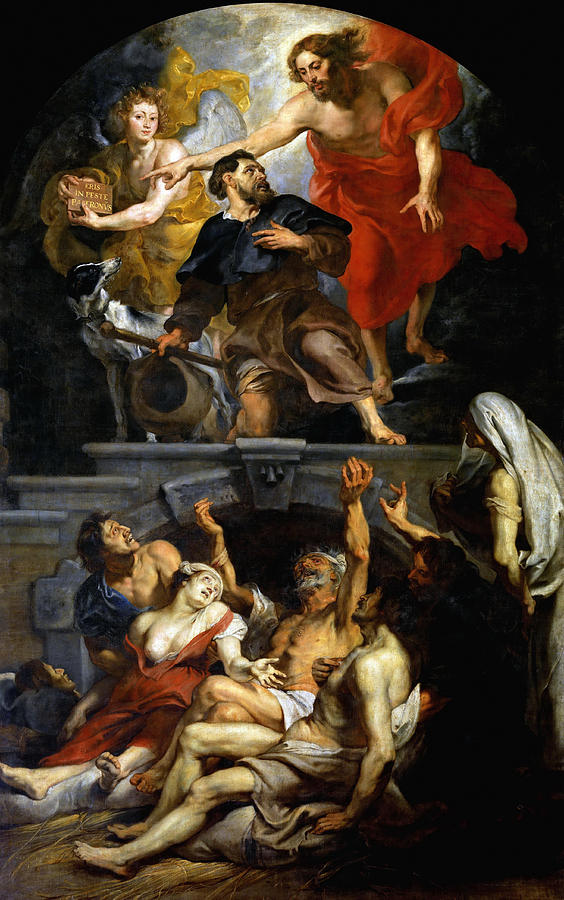
“Christ appointing Saint Roch as patron saint of plague victims” by Peter Paul Rubens is one of the most dramatic and emotionally charged religious images of the seventeenth century. The painting is split into two worlds. In the upper half, Christ appears in glory, draped in radiant red, accompanied by an angel who presents a tablet. Beside them stands Saint Roch, dressed as a pilgrim with staff and dog, startled yet receptive as Christ designates him as advocate for those afflicted by the plague. In the lower half, a pile of suffering bodies twists in agony. Men and women writhe on straw, their skin mottled and bruised by disease, arms reaching upward in desperate appeal.
This powerful contrast makes the painting more than a devotional image. It is a visual meditation on catastrophe and mercy, fear and hope. By bringing together the heavenly commission of a saint and the raw reality of epidemic suffering, Rubens transforms theology into an urgent plea for compassion. The work stands as a vivid reminder of how early modern communities understood and confronted recurring outbreaks of plague.
Historical Context and the Cult of Saint Roch
Plague periodically ravaged European towns during Rubens’s lifetime. Antwerp, where he spent much of his career, experienced repeated epidemics that wiped out large portions of the population. In such times, believers sought heavenly assistance through saints who were known as special protectors against disease. Saint Roch was one of the most popular of these intercessors.
According to legend, Roch was a fourteenth century pilgrim who devoted himself to caring for plague victims. He eventually contracted the disease himself and withdrew to a forest, where a loyal dog brought him bread and licked his wounds until he recovered. Images of Roch usually show him as a pilgrim with staff, cloak, and a bare thigh that reveals the plague sore. The faithful believed that he could intercede with God for the healing of those afflicted by epidemics.
Rubens’s painting likely functioned as an altarpiece in a church dedicated to Saint Roch or in a chapel commissioned by a confraternity of plague sufferers. It would have stood as a focal point for processions, prayers, and votive offerings during outbreaks. Viewers coming to the painting did not see it as a distant story. They recognized their own fears and grief in the contorted bodies at the bottom and found comfort in the assurance that Christ had appointed a compassionate protector for them.
Composition and the Drama of Two Realms
The composition of the painting is organized around a strong vertical axis that divides earth and heaven. At the top, framed by an arched opening, Christ strides forward, his body turning toward Saint Roch while his right hand stretches out in a commanding gesture. The red drapery that wraps around him billows outward, emphasizing his authority and divine energy. To his left, a golden angel hovers, holding a tablet that confirms Roch’s new role.
Below this elevated scene, separated by an architectural ledge, lies a heap of plague victims. The contrast between the calm yet powerful upper figures and the chaotic mass below gives the painting immense emotional impact. The lower group forms a tangle of limbs, cloth, and anguished faces. A woman in a red dress lies limp, her breasts exposed, her arm hanging down in exhaustion. An older man with a bandaged head raises one arm toward the heavens, while another figure clutches him in grief. At the right, a veiled woman leans in, perhaps a nurse or relative caring for the sick.
Rubens uses diagonals to connect the two realms. The outstretched arm of the suffering man leads the eye upwards toward Saint Roch, whose own arm echoes the movement as he turns toward Christ. From there, Christ’s gesture and the angel’s pointing hand complete the chain, creating a visual bridge between the desperate cries of the sick and the promise of divine assistance.
The Figure of Christ as Source of Authority
Christ stands at the compositional and theological center of the painting. Although physically placed slightly to the right in the upper register, his radiant red garment and luminous skin immediately draw the eye. Rubens portrays him in a vigorous pose, stepping forward as if emerging from the clouds. His hair and beard move gently, suggesting a breeze of heavenly energy. The expression on his face combines solemnity and compassion. He is not distant or remote. Instead, he appears deeply engaged in the act of commissioning.
The red drapery has multiple resonances. It recalls the blood of the Passion and the sacrificial love through which Christ redeemed humanity. It also evokes royal garments, affirming his role as king and judge. Against the darker background, the red glows like a living flame, symbolizing divine presence that can burn away the corruption of sin and disease.
Christ’s gesture is clear. With one hand he points toward the suffering below, acknowledging the reality of their pain. With the other he turns toward Saint Roch, indicating that this humble pilgrim is now entrusted with special responsibility for them. The direction of his gaze and movement communicates both authority and a willingness to involve human partners in the work of mercy.
Saint Roch as Intercessor and Model of Compassion
Saint Roch occupies a crucial intermediary position in the painting. Kneeling on the ledge between heaven and earth, he is physically closer to the plague victims than Christ yet elevated above them. Rubens presents him as a sturdy figure in pilgrim’s cloak, with a staff and a dog at his side. His body twists in surprise as he turns toward the radiant Christ. One hand rests on his chest, suggesting humility and reluctance. The other reaches backward as if seeking balance.
Roch’s facial expression conveys a mixture of awe, responsibility, and compassion. He seems overwhelmed by the honor of being chosen yet ready to accept the task for the sake of those in need. His dog, an important part of his legend, stands with one paw up, alert and attentive. The animal’s presence hints at the saint’s past suffering and miraculous healing, reminding viewers that he knows the experience of plague not just as a helper but as a patient.
By placing Roch in this mediating role, Rubens visualizes the theology of saintly intercession. The saint is not divine in himself but chosen by Christ to be a channel of grace for the afflicted. Believers praying before the painting would feel that they could turn to Roch, who in turn would plead with Christ on their behalf. The ledge on which he kneels thus becomes a symbolic place of encounter between human misery and divine mercy.
The Angel and the Tablet of Promise
To the left of Christ, an angel rendered in shimmering yellow and white moves forward with lightness and grace. Wings spread and hair streaming, the angel acts as a herald of good news. In his hands he holds a tablet inscribed with words that affirm Saint Roch’s patronage over plague victims. The angel’s finger points clearly toward the saint, making the divine decision unmistakable.
The tablet functions like a visual contract. It assures viewers that this appointment is not vague or symbolic but sealed and proclaimed in heaven. The bright golden color of the angel’s garment reinforces the sense of heavenly approval. Together with Christ’s gesture, the angel’s presence gives the scene an official, almost ceremonial character. This is the moment when responsibility is formally conferred, a turning point that believers can recall in their prayers.
The Plague Victims and the Reality of Suffering
The most emotionally affecting part of the painting is the group of plague victims in the lower half. Rubens does not idealize them. Their bodies are twisted, their skin discolored, their faces weary. Some are nearly naked, robes slipping aside to reveal emaciated limbs or swollen torsos. Their vulnerability is stark. They lie on straw at the entrance of what looks like a vault or cellar, perhaps a makeshift infirmary or charnel house.
Each figure embodies a different aspect of suffering. The woman in red slumps backward, her head turned to the side, eyes half closed, suggesting exhaustion or approaching death. An older man with a grey beard raises his arm, his bony hand reaching upward in a desperate plea. Another figure supports him, his face contorted with grief. A young man on the far left gazes upward in bewilderment, while a veiled woman on the right bends toward the group, her covered head a sign of mourning or poverty.
Rubens arranges these bodies in a dense cluster that contrasts with the more open space of the upper register. The sense of overcrowding echoes historical accounts of plague hospitals where the sick lay in tightly packed rows. Yet despite the chaos, the painter carefully structures the group with interlocking diagonals and curves, creating a visual rhythm that guides the eye upward to Roch and Christ.
The depiction of exposed flesh has a dual meaning. On one level it reveals the physical marks of disease and the indignities of death. On another level, it invites empathy by showing how fragile human bodies are. Viewers confronted with such raw vulnerability would be moved to compassion and prayer, not only for the figures represented but for their own neighbors and loved ones in times of epidemic.
Color, Light, and the Contrast of Despair and Hope
Rubens uses color and light to heighten the emotional tension between the two parts of the painting. The upper section is filled with warm, luminous tones. Reds, golds, and gentle flesh colors glow against the darker background. Light seems to emanate from Christ himself, bathing the angel and Roch in a soft radiance. This region of the painting feels airy and spacious, suggesting the clarity and harmony of the divine realm.
In contrast, the lower section is dominated by earth tones and shadows. Browns, dull reds, and ashy whites create an atmosphere of heaviness. Light falls unevenly across the plague victims, picking out pale faces and limbs while leaving other areas in darkness. This patchy illumination recalls the uncertain flicker of lamps in a crowded ward. It conveys a feeling of suffocation and confusion, appropriate to a scene of crisis.
The transition between these two zones occurs at the ledge where Saint Roch kneels. Here, the warm light from above begins to touch the darker tones below, hinting that hope is reaching into despair. The overall effect is a visual metaphor: heaven is not sealed off from the miseries of earth but shines down into them through the mediation of Christ and his saints.
Baroque Emotion and Movement
As a master of Baroque painting, Rubens excels at capturing intense emotion and dynamic movement. In this work, every figure is caught in a moment of action or feeling. Christ strides forward, robes swirling. Roch twists in surprise. The angel leans in with a tablet. Below, bodies writhe or slump, arms flung out, hands clasped, faces turned in anguish or pleading.
This sense of motion prevents the painting from becoming a static tableau. Instead, it feels like a living event that is unfolding in real time. Viewers are drawn into the narrative, almost hearing the cries of the sick and the firm voice of Christ. The dramatic gestures serve a devotional purpose. They make the spiritual reality of intercession and compassion emotionally credible. In the face of an invisible enemy like plague, such palpable images of help and concern were vital for sustaining hope.
At the same time, Rubens’s fluency with anatomy and drapery turns this emotional drama into a showcase of artistic skill. Muscles stretch, fabrics fold, and hair flies in ways that demonstrate his deep knowledge of the human body and movement. The painting thus satisfies both the religious and aesthetic desires of its audience.
Faith, Fear, and Communal Memory
For communities that experienced plague, images like this one were not abstract. They were entwined with collective memory of processions, vows, and miraculous deliverances. The painting would have reminded viewers of times when they or their ancestors begged Saint Roch for protection, perhaps promising offerings or the building of chapels in gratitude for survival.
The lower half can be read as a condensed memory of those dark days, while the upper half presents the promise that such suffering is not meaningless. Christ’s appointment of Roch suggests that, even in a world marked by disease and death, divine care is active. The painting acknowledges fear without letting fear have the final word. It offers a framework in which anguish can be transformed into trust and solidarity.
This interplay of faith and fear remains relevant for modern viewers who have lived through epidemics or global health crises. While our understanding of disease causes has changed, the emotional experience of uncertainty and vulnerability is similar. Rubens’s painting speaks across centuries by showing how art can hold together stark realism and deep hope.
Conclusion
“Christ appointing Saint Roch as patron saint of plague victims” is a powerful example of Peter Paul Rubens’s ability to merge theology, human experience, and artistic virtuosity. Through its dual structure of heaven above and plague stricken humanity below, the painting explores the tension between despair and redemption. Christ appears as the authoritative yet compassionate source of aid, Saint Roch kneels as a humble intercessor, and the angel proclaims the heavenly decree. Around and beneath them, suffering bodies testify to the harsh reality of epidemic disease.
Rubens’s mastery of composition, color, and movement turns this spiritual message into a visceral experience. The viewer feels the weight of illness and mortality but also the strong pull of hope as gestures and lines lead upward toward the glowing figures in the arch. The painting served its original viewers as an object of devotion and a reminder of communal resilience in the face of catastrophe. Today it continues to move audiences by revealing how art can confront suffering honestly while still affirming the possibility of mercy and healing.