Image source: wikiart.org
Introduction
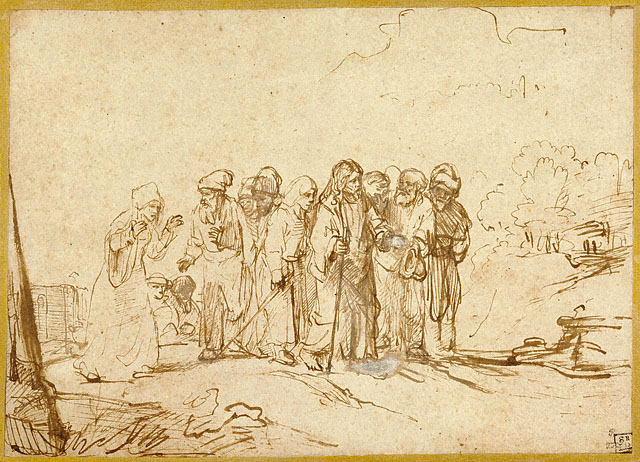
Rembrandt’s “Christ and the Canaanite Woman” (1650) is a small, crackling drawing that expands into a large drama of compassion. With swift brown ink lines and a breath of wash, the artist stages the Gospel encounter in which an unnamed gentile mother pleads with Christ to heal her daughter. A cluster of apostles forms a living wall; Christ stands at the hinge of the group; the woman leans forward from the left edge, her whole body pitched into speech. The landscape is barely more than a few strokes indicating a path, a bank, a few distant trees. The world is reduced to the essentials of encounter—need, hesitation, persistence, and mercy—rendered with the directness that marks Rembrandt’s late religious drawings.
The Biblical Moment and Its Stakes
The story appears in Matthew 15 and Mark 7. A woman from the region of Tyre and Sidon approaches Jesus, asking that her demon-tormented daughter be healed. The disciples urge Jesus to send her away; he answers with words that test her persistence—speaking of his mission to Israel and of bread meant for children. She replies, “Yes, Lord; yet the dogs eat of the crumbs that fall from their masters’ table.” Jesus commends her faith and grants the request. In a few lines, Scripture confronts prejudice, boundary, and grace.
Rembrandt chooses the instant when the exchange turns. The woman is still pleading; Christ is already shifting from refusal to regard; the disciples press in with various degrees of impatience or curiosity. The drawing forces viewers to stand inside an argument that will end in blessing and to feel how costly and courageous the woman’s insistence is.
Composition as Moral Architecture
The figures form two enclosures: a tight arc of apostles wrapped around Christ and an opposing thrust from the woman at the left margin. The apostles’ bodies close ranks, their heads aligned like a stony parapet. Christ is positioned just off center, slightly advanced, his right hand beginning to echo the angle of the woman’s appeal. The composition pivots on the distance between their hands and the narrow path that runs between them. Everything funnels attention to that corridor of decision. Nothing decorative distracts; the drawing’s architecture is ethical—who is inside, who outside, and how those places can change.
Line, Wash, and the Speed of Thought
Rembrandt’s pen is quick and confident. Coats are bundles of shorthand folds; beards are scrubs of ink; the woman’s headscarf is a few telling loops. Here and there, a diluted wash swells a figure, tipping Christ’s tunic and the ground plane into low relief. The paper’s untouched brightness serves as air and light. The drawing’s unfinishedness feels like thinking becoming speech: options weighed, a reply forming, empathy catching up to conviction. That agility is more than style; it mirrors the story’s movement from barrier to breakthrough.
The Canaanite Woman: Body of Persistence
The woman’s posture is the sheet’s most eloquent line. She leans forward from the waist, one arm lifted in entreaty, the other close to her body as if holding her plea like a child. Her feet are planted but turned inward, signaling humility rather than aggression. The head bows slightly, yet the angle of her neck keeps the voice alive. Rembrandt resists caricature. She is neither idealized saint nor theatrical beggar. She is a person who has spent days practicing this new grammar of courage, the shape the body takes when love of a child will not let it yield.
Christ Between Exclusion and Embrace
Christ’s stance records a mind in motion. He faces the woman directly, one foot subtly forward, the staff of his authority vertical but relaxed at his side. His right hand, gathered into a soft gesture, begins to turn outward as if to open the barricade of backs around him. Rembrandt’s Christ is neither aloof judge nor sentimental rescuer. He is a teacher who tests and then affirms, a man willing to let an outsider’s faith instruct his followers. The drawing’s theology is in this posture: authority that listens.
The Apostles as Chorus and Crowd
Behind Christ, the disciples form a chorus of human reactions. One leans in with a hand near his mouth, whispering counsel; another’s face compresses in skepticism; others press forward without resolution, their bodies telescoping into one another to become a single resistant mass. Rembrandt loved ensembles of heads—each with its own weather of doubt, irritation, or wonder. Here that variety carries a social truth: communities often respond to the stranger with a mixture of anxiety and curiosity before they learn to welcome.
The Ethics of Edges
By placing the woman at the extreme left, Rembrandt draws a sharp social edge: she is literally pushed to the margins of the page. Yet the strongest diagonals—the angle of her body and the slight forward hinge of Christ—run from that edge into the group. The most dynamic space is where center meets periphery. The drawing therefore enacts a civic parable: life flows into a community when it makes room for the voice that comes from beyond its customary borders.
Gesture as Language
Hands do the talking. The woman’s raised hand articulates request; Christ’s hand, halfway between refusal and blessing, articulates discernment; the nearest apostle’s hand, hovering near Christ’s sleeve, articulates caution. These lightly sketched hands compose a sentence that the viewer reads intuitively. Rembrandt understood that gestures have syntax. In this grammar, the verb is mercy and the conjunction is “yet”—as in, “yet even the dogs eat the crumbs.”
The Landscape as Breath
The landscape is spare: a few trees sketched to the right, a shallow bank, a sliver of stream and bridge, a trace of distant structures. These marks do not situate the story in a precise geography; they lend it breath. The open right half of the sheet offers a destination for the eye once the exchange resolves—space into which grace can move. It also keeps the scale human. The argument isn’t happening in the theater of a palace but on a path where travelers, fields, and water meet.
Light Without Modeling
No dramatic chiaroscuro carves the figures; the paper’s native light does most of the work. This restraint matters. Over-modeling would turn the drawing into spectacle. Rembrandt instead trusts outline, tiny flickers of shadow, and the shock of blankness around the figures to stage the scene. Light is ethical clarity rather than theatrical effect. We see just enough to take a side.
Comparing Rembrandt’s Late Religious Drawings
Around 1650, Rembrandt’s religious art simplifies. Oil paintings still carry thick paint and warm gloom, but the drawings speak a leaner language—ink that thinks quickly, compositions that compress story to the essentials. “Christ and the Canaanite Woman” belongs with sheets like “Christ Preaching (La Petite Tombe)” and “Supper at Emmaus” drawings in which a few people in ordinary clothes are caught at decisive instants. The shift signals a mature confidence: the nearer Rembrandt gets to the human center of a story, the less he needs ornament.
Theological Depth in Human Scale
The scene presents a theology that is not abstract. Faith here is not a doctrine but a posture: a woman’s body bowed yet unbroken, a teacher’s body turning to include. The “crumbs” she invokes are not rhetoric; they are the measure of daily hunger. By keeping everything small and close, Rembrandt makes the story impossible to keep at arm’s length. It becomes not a myth about antiquity but a question about how any community will see the foreigner who asks for help.
Psychology Without Caricature
Rembrandt refuses to make the disciples villains or the woman a sainted icon. Each figure holds mixed motives. The woman’s persistence contains fear; Christ’s authority contains testing; the disciples’ protectiveness contains real concern for order. This moral complexity gives the drawing its adult intelligence. Mercy triumphs, but not cheaply; it rises from argument, doubt, and a public change of mind.
The Drawing as Performance
You can sense the order of operations on the sheet. Rembrandt first arrays the group with long, lightly pressed strokes, then returns to accentuate Christ and the woman, then thickens a few shadows to weight the near ground. A faint blue-gray touch in some impressions (or later tinting) kisses the area between Christ and the woman, as if to confirm the charged space of their exchange. The drawing reads like a performance in one take: the artist’s hand keeping pace with his understanding of the scene.
The Viewer’s Position and Involvement
We stand just inside the woman’s space, slightly to her right, close enough to hear the whispering apostles. Our view is not neutral; proximity invites solidarity. We experience the crowding she feels and the relief when Christ’s posture softens. Rembrandt uses this viewpoint to prevent the viewer from defaulting to the comfort of the insiders. Our place is with the petitioner until the circle opens.
Language, Dogs, and the Reversal of Metaphor
The Gospel’s hardest word in this story is Christ’s metaphor of children and dogs. Rembrandt’s drawing faces that difficulty. The woman’s humility does not accept insult; it reworks the metaphor from exclusion to inclusion. Her brilliant reply—claiming “crumbs” as sufficient grace—becomes visible in the angle of her hand and the forward lean of her torso. Rembrandt’s economy of means lets that linguistic reversal live in bodies rather than in speech balloons. We watch words change shape in posture.
Costume, Time, and the Everyday
The figures wear a blend of imagined biblical dress and Rembrandt’s familiar studio garb: long robes, headcloths, caps. Nothing is courtly. Shoes are the kind you walk in; robes crease like well-used cloth. The timelessness helps the scene migrate across centuries. It could be happening on any path where insiders, outsiders, and a teacher meet. By avoiding archaeological fussiness, Rembrandt lets the story be a parable for present tense.
Mercy as Movement
Track the tiny motions across the figures: the woman’s step narrowing the gap, Christ’s shoulder rotating toward her, a disciple’s head inclining as if to hear better. Mercy arrives as movement, not as abstract decree. The drawing captures mercy mid-swing, the instant before the circle opens and the woman’s request becomes the group’s joy.
Resonances with Rembrandt’s Life
By 1650 Rembrandt had known loss and the cost of reputation. His sympathy for marginal lives—beggars, widows, foreigners—deepened. The Canaanite woman’s persistence and the disciples’ crowding would have been socially recognizable in Amsterdam’s mixed, contentious streets. The drawing thus carries not just piety but civic experience: the sense that compassion must be argued for in public and that art can model that argument without shrillness.
The Quiet Politics of Compassion
The sheet’s politics are gentle but firm. It proposes that communities become more truthful when they include voices from the edges, and that leaders earn authority by listening. The apostles do not disappear; they learn. The woman does not dominate; she is heard. Christ does not thunder; he turns and acknowledges faith wherever it is found. In a few inches of paper, Rembrandt outlines a polity of attention.
Why the Drawing Endures
The image endures because it condenses a hard social conversation into a legible human exchange. Its craft is transparent: a handful of lines, a bit of wash, and a white field doing the work of light. Its feeling is exact: dignity preserved, boundaries tested, mercy enacted. You do not have to know the theology to feel the justice of the outcome; you do not have to admire the technique to sense that the marks were made in sympathy with the scene.
Conclusion
“Christ and the Canaanite Woman” is a masterclass in how few lines it takes to tell the truth about people. A mother leans into speech; a teacher turns; a community learns to make space. Landscape and costume retreat so that hands and bodies can carry meaning. The drawing’s beauty is in its candor: it shows the world as it often is—tight circles, tested patience—and as it might be—circles that open, words that become bridges, crumbs that prove to be feasts. In Rembrandt’s small theater, the miracle is not spectacle but a mind and a body changing toward mercy.