Image source: wikiart.org
A Dawn of Recognition in a Garden of Stone
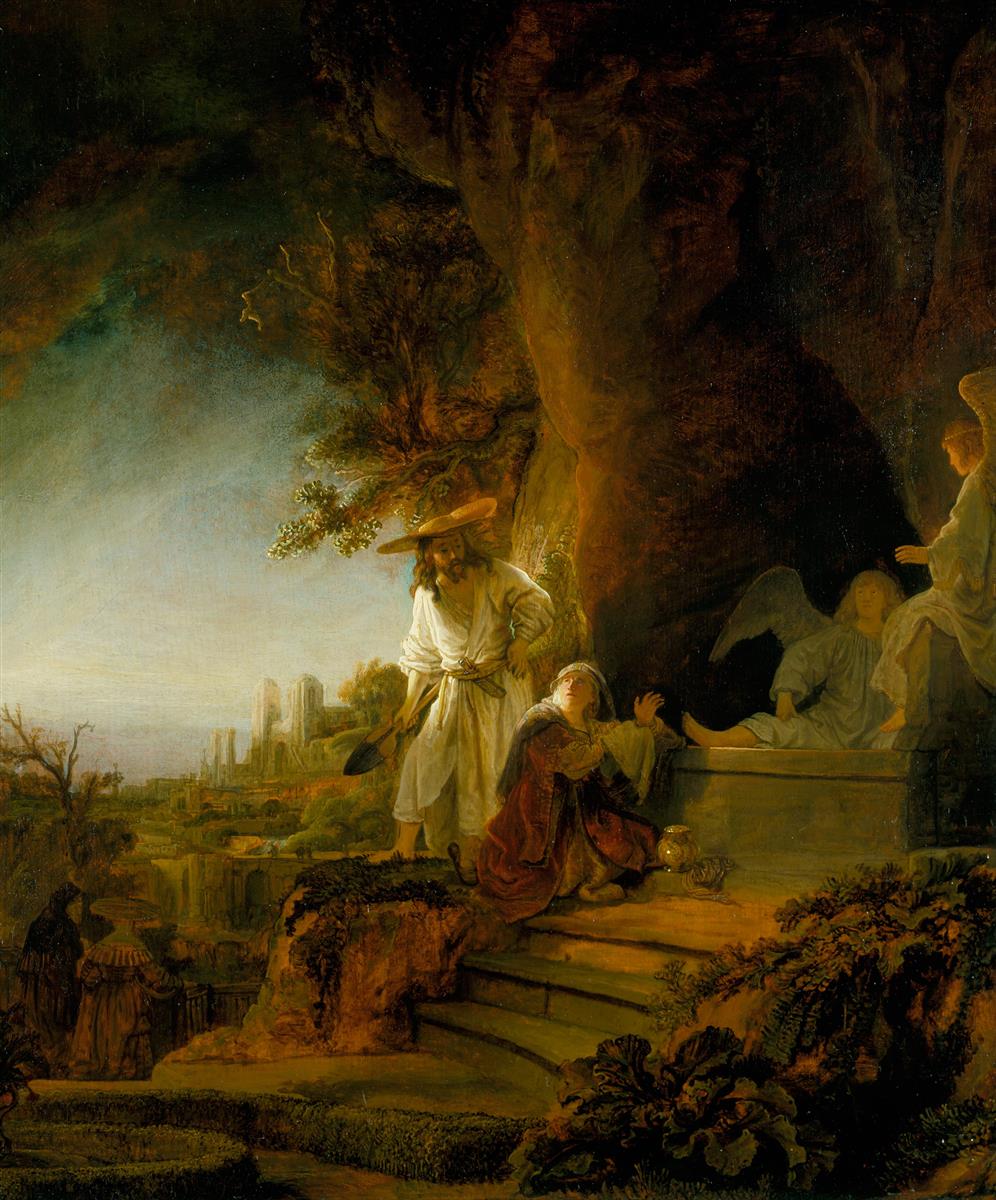
Rembrandt’s “Christ and St. Mary Magdalene at the Tomb” captures the charged instant after the Resurrection when Mary, weeping at the empty tomb, mistakes the risen Christ for a gardener and then realizes who stands before her. The scene unfolds on a terraced slope where stairs climb toward the sepulcher. A vast rock face pushes down from the right, its shadowed interior framing two angels who gesture toward the vacant slab. At the stair’s edge Mary kneels, one hand lifted in startled defense and the other reaching toward the man she thinks is a stranger. Christ stands above her in white, shovel in hand, hat brim catching the first cool light. Behind them, Jerusalem opens toward a pale horizon. The painting freezes the second when grief pivots into recognition, and the garden itself seems to hold its breath.
The Gospel Episode and Rembrandt’s Choice of Instant
The narrative comes from the Gospel of John: Mary Magdalene arrives to find the stone rolled away, sees angels, and, turning, encounters Jesus whom she does not yet recognize. When he speaks her name, she reaches for him; he responds, “Do not hold on to me,” often rendered as “Noli me tangere.” Rembrandt chooses the flash between misrecognition and revelation. Christ still appears as gardener—broad hat, spade, rolled sleeves—yet Mary’s body has already begun to withdraw from despair and lean toward joy. This temporal sliver allows the painting to hold two truths at once: the human habit of error and the divine clarity that arrives through a voice.
A Composition that Climbs Toward Meaning
The canvas organizes the viewer’s gaze with a series of ascending diagonals. Starting at the clipped hedges in the foreground, the eye takes the curving steps up to Mary’s kneeling figure, rises to Christ’s white garment and hat, and then lifts toward the angels who occupy the cool cavity of the tomb. Finally, the gaze moves out to the luminous city and the sky that dilates above the dark rock. The path is both literal and symbolic: from earth’s cultivation through human encounter to the mystery of empty stone and open heaven. The terraced garden doubles as a staircase of interpretation.
Light as a Theology of Morning
Rembrandt’s light is an active character. Dawn spreads from the left, a thin silver that fills the valley and brushes the city’s towers. It strikes Christ’s robe with a cool blaze that separates him from ground and stone. Mary receives reflected light that models her face and hands while leaving the folds of her mantle in warm shadow. Inside the tomb the light cools further; the angels seem made of air, their pallor consistent with the emptiness they proclaim. This careful temperature map—cool for the risen body and the messages of heaven, warm for earth and grief—turns illumination into theology. Morning itself reveals truth.
The Garden as Stage and Symbol
The space is unmistakably a garden: clipped hedges, terraced beds, a retaining wall veined with plants, and a tree that leans over the main figures like a witness. In Christian tradition, the garden of the Resurrection echoes Eden, a site where human history began and where, in Christ, it begins again. Rembrandt intensifies this echo by costuming Jesus as a gardener—spade, hat, practical belt—so that the vocation of tending becomes a metaphor for restoration. The garden is not merely backdrop; it is the argument that new creation has already started.
The Risen Christ in the Clothes of Work
Rembrandt’s Christ compels because he is both ordinary and luminous. The broad-brimmed hat shades his eyes; the shovel’s blade catches light; the robe is belted for movement; the sleeves are pushed to the elbow. Nothing about the attire is ceremonious. Yet the white garment gathers the dawn and gives it back, and the calm tilt of the head suggests command without display. By presenting the Savior in working clothes, the painter says plainly that redemption has entered daily life. The first task of the new world is gardening—cultivation and care.
Mary Magdalene’s Body Thinking Before Words
Kneeling at the step, Mary wears a robe of rich claret and umber, its hems and sleeves trimmed with pale borders. Her posture is pure Rembrandt: a body thinking before speech. One hand shields, the other reaches; the head twists toward the voice she recognizes; the knees hold ground even as the torso prepares to rise. The jar of spices lies abandoned beside her, a still-life relic of grief suddenly made obsolete. The expression is not exaggerated; we read astonishment from the geometry of limbs and the small tilt of the mouth. Rembrandt allows recognition to register through anatomy rather than theatrics.
Angels as Pointers to Absence
Inside the cool chamber two angels sit at either end of the slab, their bodies softly lit, their gestures modest—a hand indicating the vacated place, a turned head acknowledging the drama outside. They do not dominate; they certify. Their presence explains absence: what matters is not the stone but the one who stands in the garden. The compositional wedge of darkness that houses them functions as a resonance chamber; it holds the echo of death so that the brightness outside can be heard.
The Arc of the Shovel and the Grammar of “Do Not Hold”
Christ’s shovel is more than a prop. Its handle angles across his body like a staff, while the broad blade mirrors the curved step edge where Mary kneels. These arcs bind the figures. When he speaks “Do not hold on to me,” the gesture reads through the shovel’s position and the open hand that accompanies it: a gentle barrier that is also an invitation to a different kind of closeness. The tool becomes an emblem of the work ahead—cultivation rather than clinging.
A Dutch Landscape for a Sacred Morning
Though the subject is Jerusalem, the distant view looks Dutch: watercourses, clustered buildings, and a pale sky that feels North Sea in its coolness. Rembrandt purposefully localizes the miracle. He situates resurrection inside the world his viewers knew so that the story can be believed in present tense. The geography meshes with the garden’s tidy hedges and terraced beds, further domesticating the sacred. Transcendence proceeds through the familiar.
Color that Breathes Between Earth and Heaven
The palette flexes between earthen warmth and pearly cool. Ochres and siennas shape the retaining walls and rocks; viridian and olive map the foliage; claret, umber, and ivory enliven Mary’s robe; Christ’s whites are tuned with blue-gray glazes that keep them from chalk. The sky is a breath of pale blue shading rapidly toward violet-brown where the rock masses intrude. By restraining saturation, Rembrandt ensures that the slightest increase of light reads as revelation. When the eye moves from the rock’s gold-brown to Christ’s white, the change feels moral, not merely optical.
Brushwork and the Physics of Presence
Rembrandt’s surface shows multiple speeds. The rock face is worked with scumbled, leathery strokes that suggest age and erosion; the hedges are dragged with a dry brush that leaves crisp leaf clusters; the city beyond is thinly stated, almost evaporating into the morning; the figures receive the most deliberate handling—soft modeling in faces and hands, crisper edges where garments turn into shadow. This orchestration of touch is not showmanship; it is the means by which each element claims believable weight in the same air.
Gesture, Gaze, and the Circuit of Recognition
Sightlines make the painting pulse. Mary looks up toward Christ; Christ looks down toward Mary; the nearer angel glances at the empty slab and then out to the garden; the far angel inclines toward the distant figure at the tomb’s entrance; a pair of women at the far left—likely the other Myrrhbearers—move along the terrace and tilt inward as if drawn by rumor. These thin threads of gaze weave the composition into a circuit of recognition that travels from stranger to Savior to those who will carry the news.
The Silence After Grief
Though the picture suggests angelic speech and human exclamation, its mood is quiet. The rock muffles sound; the broad sky absorbs it. Rembrandt often paints the moment just after the loudest emotion—a hush in which understanding settles. The fragrant jar on the step is the only thing truly still; its task is finished. We are left in the suspended second when Mary’s name has been spoken and arms are half raised in a reflex she is told to resist. That silence—the delicate restraint Rembrandt captures—feels like the true climate of the Resurrection.
The Ethics of Touch and Distance
“Noli me tangere” has sometimes been read as rejection. Rembrandt renders it as redirection. Christ’s stance, slightly turned yet near, signals care for Mary’s heart while pointing her toward a mission beyond possession. The refusal of touch is the formation of vocation: go and tell. The painting honors that complexity by keeping the two figures close enough for breath to mingle while preventing the embrace. In the drama of distance, love becomes recognizable as responsibility.
Mary as First Witness and Messenger
The composition elevates Mary as the hinge of the story. Her red robe anchors the foreground; her jar marks the path from death-ritual to proclamation; her posture teaches the viewer how to respond—rise, listen, and turn. Rembrandt often dignifies women as capable bearers of sacred weight, and here he offers a portrait of discipleship founded on attention rather than rank. The angels wait quietly; Christ points the way; Mary will move the news into the city below.
The Tomb as Geological Cathedral
The rock that surrounds the tomb is massive, veined with plants, and cut by man into steps and a portal with a shallow arch. It feels ancient and yet recently handled. This geology becomes architecture without the help of columns or ornament; it is a natural cathedral in which Resurrection is enacted. By avoiding classical ruins or ornate masonry, Rembrandt keeps the miracle grounded in creation itself—the earth as witness and participant.
Small Figures, Large Consequences
In the lower left, two small women descend a path, one wrapped in a shawl, the other carrying a basket. Their presence widens the narrative frame: the news that begins on the steps will ripple through the city and the world. In the distance, workers move in gardens and terraces, oblivious. The scale of salvation always starts small, Rembrandt seems to say, then enlarges through ordinary movement across familiar ground.
How to Look, Slowly
Begin at the hedged garden and climb the steps with your eye until you reach the jar. Pause there. Move to Mary’s lifted hand and read the surprise in her fingers. Ascend to Christ’s white robe, note the shovel’s blade, and linger at the shadow cast by the hat’s brim across his brow. Slide into the cool interior where angels sit like pale punctuation. Then push outward over the rock’s ledge into the open city and sky. Return along the leaning tree to the exchange at center. Repeat. Each circuit braids earth, body, and message more tightly.
Why the Painting Still Feels New
Four centuries on, the picture speaks because it translates transcendence into a grammar of work and dawn. A woman with a jar, a man with a shovel, a garden tended, a city waking—these remain legible. The insight that recognition arrives not as spectacle but as a name spoken into grief also remains psychologically exact. By refusing melodrama and trusting light, Rembrandt gives the scene a modern clarity that outlives style.
Closing Reflection
“Christ and St. Mary Magdalene at the Tomb” is a hymn to the first morning of the world remade. It honors misrecognition, corrects it with a voice, and then directs love outward. The garden is not paradise regained as fantasy; it is a working plot, stairs edged with weeds, rock worn by weather—the kind of place where news can be believed. In the slow shift from shadow to cool light, Rembrandt lets viewers feel what Mary felt: the moment when sorrow turns and finds a gardener, and in that ordinary figure hears her name.