Image source: wikiart.org
Historical and Devotional Context of Childhood of Virgin
“Childhood of Virgin,” painted around 1665 by Bartolome Esteban Murillo, belongs to the deeply devotional world of seventeenth century Seville. In this period Spanish Catholicism emphasized the humanity of holy figures, inviting believers to imagine the intimate details of their lives. Murillo became one of the most beloved painters of this spiritual climate because he combined doctrinal clarity with tender, accessible scenes.
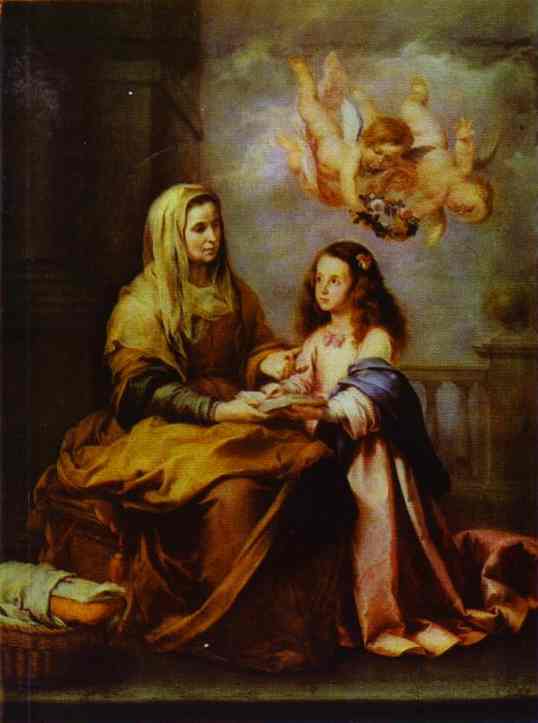
In this work he focuses on the young Virgin Mary with her mother, Saint Anne. Instead of showing spectacular miracles or dramatic visions, Murillo offers a quiet domestic encounter. The young Mary, still a child, sits beside her mother and receives instruction, most likely reading or reciting from a holy text. Above them a cluster of plump cherubs bursts through a glowing cloud, showering the pair with heavenly approval.
The painting thus serves two functions. It is a theological statement about Mary’s early preparation for her unique role as Mother of God, and it is a moral example for families who viewed it. Viewers were encouraged to see in Saint Anne a model of Christian motherhood and in the young Mary a model of purity, obedience and eager learning. Murillo translates these lofty ideas into gestures, colors and glances that are immediately understandable.
First Impressions and General Composition
At first glance the scene reads as a gentle family portrait. On the left, Saint Anne sits solidly on a low bench, wrapped in voluminous garments of brown ocher and warm green. On the right stands or kneels the young Mary, dressed in a pale, luminous gown with a deep pink inner layer and a soft blue mantle draped over her arm. Between them their hands meet over a book, creating the compositional and symbolic center of the painting.
The upper half of the canvas is dominated by a soft golden atmosphere. Out of this luminous cloud emerges a lively group of cherubs. Some hold flowers, others stretch their arms in playful movement. They hover above the two female figures like a blessing suspended in the air.
Murillo arranges the composition in a triangular structure. Saint Anne forms the base on the left, the Virgin the base on the right, and the angels provide the apex above. This creates a sense of stability and unity. At the same time, the poses of the figures generate gentle diagonals: Anne’s gaze and body lean toward Mary, whose head tilts slightly upward, while the angels’ limbs swirl around the vertical axis. The result is both calm and subtly dynamic.
In the lower left corner a small basket with sewing materials hints at household tasks. A balustrade and distant landscape on the right open the space and keep the scene from feeling cramped. Murillo’s composition balances intimacy with openness, showing a specific private moment that nonetheless touches the wider world.
Saint Anne as Teacher and Mother
Saint Anne is the anchor of the painting. Murillo portrays her as a mature woman with a lined, thoughtful face and modest clothing. Her head is covered with a simple veil, and her garments are heavy, practical and earth toned. She radiates steadiness and quiet authority rather than aristocratic glamour.
Her role is clearly that of teacher and guardian. She holds a book in her lap and directs the hands of the child toward it. Her left hand supports the book while her right hand gently guides Mary’s fingers, perhaps helping her trace the letters or turn the page. This physical connection sends a powerful message: spiritual knowledge is transmitted through patient, maternal care.
Anne’s gaze is calm and fixed on her daughter. There is no harshness in her expression. Instead we see seriousness mixed with affection and a hint of pride. Through this look Murillo suggests that raising a holy child requires both discipline and tenderness. Anne does not dominate Mary, but neither is she passive. She is fully engaged in her task, embodying the ideal of Christian education.
The solidity of Anne’s form reinforces her symbolic role. She occupies more space than any other figure, and her dark garments provide a stable base for the composition. She is the human foundation on which Mary’s extraordinary destiny is built. Murillo thereby honors the often overlooked contribution of parents and grandparents in shaping saints.
The Young Virgin Mary and Her Spiritual Awakening
In contrast to Anne’s earthiness, the young Virgin Mary appears delicate and luminous. Her face is youthful, with large expressive eyes and soft features. Her long hair falls in loose waves around her shoulders, giving her a natural, unadorned beauty.
Her clothing blends innocence with dignity. The pale rose dress and blue mantle recall the colors traditionally associated with Mary in Christian art. Even in childhood, Murillo signals her identity through this familiar color symbolism. Yet the fabrics are simple rather than luxurious. They drape softly over her form, suggesting purity and modesty rather than ostentation.
Mary’s posture reveals her inner disposition. She sits or kneels slightly turned toward Anne, hands resting on the book, yet her gaze lifts gently upward toward the cherubs. This dual orientation is significant. She is fully present in the act of learning from her mother, but she is also already attuned to the heavenly realm. Murillo thus visualizes the idea that Mary, even as a child, lived at the intersection of earthly obedience and divine vocation.
Her expression is one of quiet wonder. There is no fear in her eyes, only attentive curiosity and a dawning awareness of something greater than herself. Murillo avoids making her look precociously solemn. She remains a child, yet a child whose heart is opening to God. This subtlety is one of the painting’s most beautiful achievements.
The Book as Symbol of Formation and Scripture
The small book that Anne and Mary share is not merely a prop. It symbolizes the role of Scripture and teaching in spiritual growth. In seventeenth century Spain, emphasizing Mary’s education supported the Catholic ideal that holiness is nourished by meditation on holy texts, participation in liturgy and catechesis.
Murillo paints the book with just enough detail to make it legible as an object, without distracting from the figures. Its modest size suggests a prayer book or psalter. The way Anne holds it firmly while guiding Mary’s hand conveys the idea that older generations transmit faith, yet the younger must actively receive it.
The book also marks this scene as a moment of transition. The child Mary moves from simple innocence to informed devotion. She is not merely good because she is naïve, but because she learns, reflects and chooses. Murillo’s emphasis on learning speaks to viewers who were themselves encouraged to deepen their knowledge of the faith, not just rely on external rituals.
The Cherubs and Heavenly Confirmation
Above the two central figures, Murillo paints a swirling cluster of cherubs. Their presence transforms the domestic lesson into a sacred event. These plump, playful children with wings are typical of Murillo’s style. He excelled at rendering cherubic faces full of life and charm, making them appealing to viewers of all ages.
Here the cherubs appear bursting through a soft cloud of light. Some look down at Anne and Mary, others hold flowers and garlands. Their gestures seem to echo the joy and approval of heaven. The message is clear: the humble acts of teaching and learning below are of great importance in the divine plan.
The cherubs also mirror Mary’s own age. Their rounded faces and tiny bodies emphasize that heaven has a special love for children. In a sense, they are her celestial companions. Their presence suggests that Mary’s childhood, though outwardly ordinary, was surrounded and supported by invisible grace.
The golden light that surrounds them spills downward, subtly illuminating the heads and shoulders of Anne and Mary. This visual link between heaven and earth underscores the idea that spiritual formation in the family is itself a work of grace, not merely human effort.
Light, Color and Baroque Atmosphere
Murillo’s use of light is one of the strengths of “Childhood of Virgin.” The background is suffused with a warm golden glow that gradually darkens toward the edges, creating a soft vignette effect. This light seems to emanate both from the cherubs and from an unseen source above, enveloping the scene in a gentle radiance.
The main figures are modeled with a delicate chiaroscuro. Highlights rest on Anne’s veil, Mary’s face and hands, and the folds of their garments, while shadows gather in the corners and recesses. This contrast brings the figures forward and gives them a sculptural presence without harsh drama. Murillo’s light is tender rather than theatrical.
Color harmonies reinforce the emotional tone. Anne’s clothing in warm browns and muted greens provides a solid, earthy base. Mary’s combination of rose and blue introduces cooler, more luminous hues that suggest grace and purity. The cherubs above are painted in soft pinks and creams, blending with the golden background to create a sense of overflowing warmth.
The overall atmosphere is serene and contemplative. While Baroque art often emphasizes movement and intensity, Murillo chooses a quieter mode here. His brushwork is fluid but controlled, especially in the drapery and clouds. The painting invites prolonged, peaceful contemplation rather than quick excitement.
Domestic Details and Everyday Holiness
One of the most appealing aspects of this work is its attention to small domestic details. At Anne’s feet we glimpse a basket with folded linens, perhaps part of the household’s daily chores. The stone bench, the modest balustrade and the suggestion of a building behind them situate the scene in a recognizable living space.
These elements encourage viewers to see sanctity within ordinary routines. The Virgin Mary does not grow up in a palace but in a simple home where sewing, washing and reading are part of daily life. The lesson is that holiness can flourish in any environment when it is nurtured by love and faithfulness.
Murillo’s sensitivity to everyday realities also reflects his broader artistic interests. Throughout his career he depicted beggar children, street scenes and genre subjects that revealed his compassion for common people. Even when painting exalted religious figures, he grounds them in human experience. “Childhood of Virgin” embodies this approach by transforming an everyday lesson into a scene of quiet transcendence.
Murillo’s Vision of Femininity and Childhood
The painting offers a distinct vision of femininity rooted in seventeenth century Catholic ideals yet still resonant today. Saint Anne represents mature womanhood, combining strength, wisdom and modesty. The young Mary embodies innocent beauty, receptivity and spiritual aspiration. Together they present a continuum of female life dedicated to God.
Murillo avoids sentimental stereotypes. Anne is not harsh or severe; Mary is not fragile or passive. Both are active participants in the exchange taking place. The painting therefore subtly honors the intellectual and spiritual capacities of women. The book, the attentive expressions and the shared focus indicate that learning and reflection are central to their identity.
As a depiction of childhood, the work is equally nuanced. Mary is clearly a child, shorter than Anne, with youthful features and a slightly awkward posture, yet she is endowed with a seriousness beyond her years. Murillo acknowledges that children can grasp profound truths and participate in meaningful spiritual lives. This would have appealed to parents and educators in his audience, encouraging them to take the religious formation of children seriously.
Emotional and Spiritual Impact on the Viewer
For a modern viewer, “Childhood of Virgin” may first attract attention through its sweetness and softness, but lingering before the canvas reveals deeper layers. The steady presence of Saint Anne, the open and searching face of Mary, and the joyful cherubs overhead invite reflection on the ways faith and character are formed.
The painting stirs gratitude for those who have acted as teachers and mentors in our own lives. It also challenges viewers to consider how they might pass on wisdom to younger generations. The image shows that this passing on happens not only in churches and schools but also in living rooms, kitchens and quiet corners where a book is opened and a conversation begins.
Spiritually, the work reminds believers that God’s grace often works slowly and silently in the background of childhood experiences. The young Mary does not yet know the full extent of her future mission, but she is being prepared for it through simple fidelity to daily lessons. This encourages patience and trust for those who are still in the process of discovering their vocation.
Conclusion
“Childhood of Virgin” by Bartolome Esteban Murillo is a tender yet profound exploration of early holiness, maternal guidance and the interplay between everyday life and heavenly grace. Through a carefully structured composition, gentle light and expressive figures, Murillo transforms an intimate domestic lesson into a scene of theological depth.
Saint Anne’s solid, earth toned presence anchors the composition and symbolizes steadfast parental care. The young Virgin Mary, luminous in rose and blue, embodies purity, intelligence and openness to God. The shared book becomes a visual metaphor for the transmission of faith, while the hovering cherubs attest that such humble acts of teaching and learning are precious in the eyes of heaven.
More than three centuries after its creation, the painting continues to speak to viewers about the value of education, the dignity of family life and the quiet ways in which grace shapes human hearts. It invites contemplation not only of Mary’s unique childhood but also of our own beginnings and the people who helped form us. Murillo’s gentle brushwork and warm palette wrap these reflections in a visual embrace, making “Childhood of Virgin” a cherished masterpiece of Spanish Baroque devotion.