Image source: wikiart.org
Introduction
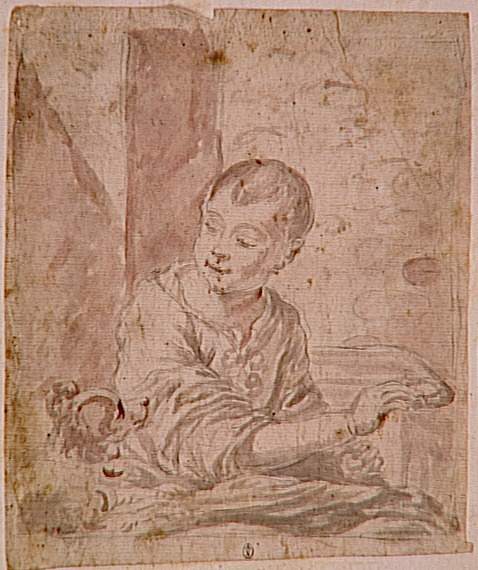
“Child Watching a Dog” by Bartolomé Esteban Murillo is a small, intimate drawing that captures one of the themes closest to the artist’s heart: the world of children. Although the date of the work is unknown, the sheet reveals many features associated with Murillo’s mature style. The boy leans forward slightly, his gaze directed toward a small dog at the lower left edge of the composition. The scene is rendered in a limited palette of ink and wash, yet the emotional content is rich.
Murillo is renowned for his tender depictions of street children, beggars, and humble families in seventeenth century Seville. In this drawing he uses the simplest means to evoke curiosity, play, and the quiet bond between a child and an animal. There is no elaborate setting, no narrative event of great historical importance. Instead, Murillo focuses on a fleeting everyday moment and transforms it into an image of enduring charm.
Historical Context And Murillo’s Children
In seventeenth century Spain, children were often portrayed either as miniature adults in aristocratic portraits or as anonymous figures in religious scenes. Murillo broke new ground by dedicating entire compositions to the lives of poor and ordinary children. His paintings such as “The Young Beggar” or “Children Eating Grapes and Melon” explore the resilience, mischief, and vulnerability of youth in a city marked by economic hardship.
“Child Watching a Dog” belongs to this broader interest in childhood. Whether it is a preparatory study for a larger painting or a self-contained work on paper, it shows Murillo experimenting with poses and expressions that would allow viewers to empathize with a child’s perspective. The drawing also reflects a growing European fascination with childhood as a distinct phase of life, worthy of artistic attention in its own right.
The use of ink and wash instead of oil paint suggests that Murillo was exploring compositional ideas quickly, perhaps in his studio sketchbook. Yet even in this seemingly informal format, he achieves a remarkable delicacy of feeling. The drawing reveals how carefully he observed the gestures and moods of children around him.
Composition And Spatial Arrangement
The composition of “Child Watching a Dog” is simple but carefully balanced. The boy occupies the central and upper portions of the sheet. His body is turned slightly to the right, but his head twists toward the left where the dog appears. This gentle twist in the torso creates a sense of movement, as if the boy has just turned his attention toward the animal.
The dog is much smaller, placed near the lower left corner. Only part of its body is visible, but the raised head and alert posture are enough to convey its presence. By situating the dog at the edge, Murillo suggests that it has just entered the scene or is about to leave it. The diagonal line of the boy’s arm leads directly to the animal, visually linking them and emphasizing the direction of the child’s gaze.
Behind the boy, a vertical band of darker wash may represent a wall, doorway, or hanging cloth. This vertical element stabilizes the composition, framing the boy’s head and preventing the eye from drifting off the page. The rest of the background is left vague. Smudges of wash hint at a shallow interior space but never resolve into firm architecture. The focus remains resolutely on the interaction between child and dog.
The Child’s Gesture And Expression
Murillo’s sensitivity to gesture is particularly evident in the figure of the boy. He sits with his body angled toward the viewer yet his attention directed sideways. One hand extends toward the dog, perhaps offering food or simply reaching out in curiosity. The other arm bends close to his torso, reinforcing the sense of partial rotation.
The boy’s face is rendered with only a few strokes, yet it is expressive. His eyes are slightly narrowed as he looks toward the dog, and his mouth seems gently parted, suggesting a mix of amusement and interest. There is no fear or tension in his features. Instead, he appears relaxed and engaged, absorbed in observing the animal’s behavior.
Murillo often portrayed children with a combination of naturalism and idealization. The boy in this drawing appears healthy and plump, his hair roughly indicated with loose strokes. His clothing, a simple loose shirt with a few buttons at the collar, situates him in a modest social class. Yet his posture and expression give him individual personality rather than reducing him to a generic type.
The tilt of his head and the subtle lift of his eyebrows invite viewers to share in his curiosity. We do not know exactly what the dog is doing, but we sense that the boy finds it entertaining. The drawing thus encourages us to look at the world temporarily through a child’s wondering eyes.
The Dog And The Dynamics Of Play
Although small, the dog plays an essential role in the emotional structure of the drawing. Murillo outlines it with a few energetic lines, emphasizing movement rather than anatomical detail. The animal’s head seems lifted, perhaps looking back at the boy or reacting to something in his hand.
The dog’s presence introduces an element of play and companionship. In many of Murillo’s paintings, animals function as companions to children, mirroring their energy and vulnerability. Here the dog may also symbolize loyalty or the simple joys of daily life. The fact that the child watches rather than commands the animal hints at an observational relationship rather than one of dominance.
The invisible space between the boy’s outstretched hand and the dog becomes a zone of anticipation. Is the child about to feed the dog, pet it, or tease it? Murillo leaves the narrative open ended, encouraging viewers to imagine the rest of the story. This open quality adds liveliness to the composition and reflects the unpredictable nature of interactions between children and animals.
Medium, Technique, And The Language Of Wash
“Child Watching a Dog” is executed in pen and ink with wash, possibly over faint preparatory lines. This medium allows for rapid, fluid drawing and subtle gradations of tone. Murillo uses thin lines to define the contours of the boy’s face, arms, and clothing, while broader sweeps of wash suggest shadows and volume.
The wash is particularly effective in modeling the folds of the child’s shirt and the soft drapery around his lap. Light areas of the paper remain visible on the boy’s forehead, nose, and hands, creating highlights that give these parts a sense of roundness. The darker vertical strip behind him pushes his figure forward, enhancing the illusion of depth.
The surface of the paper shows stains and spots, signs of age and handling that only increase the sense of immediacy. It is as if we are looking over the artist’s shoulder at a moment of concentrated sketching. The quick, searching lines reveal Murillo’s thought process as he worked out proportions and relationships.
Despite the apparent spontaneity, the drawing is controlled. Murillo knows exactly where to concentrate detail and where to let forms dissolve. The dog and some parts of the background remain barely suggested, yet the viewer’s imagination easily completes them. This ability to say much with few strokes testifies to Murillo’s technical mastery.
Light, Atmosphere, And Mood
Even without color, Murillo creates a convincing sense of light. Illumination seems to fall from the upper left, highlighting the child’s face, chest, and forearm. The shadows on the underside of the arm, along the collar, and behind the head establish a gentle chiaroscuro that gives the figure three dimensionality.
The general tone of the drawing is warm and subdued. The washes produce a soft, hazy atmosphere rather than a sharp contrast of light and dark. This atmosphere contributes to the quiet mood of the scene. Nothing dramatic occurs; instead, we are invited into a moment of contemplation.
The absence of strong shadows in the lower half of the drawing allows the boy’s gesture toward the dog to feel relaxed and unforced. Murillo avoids dramatic diagonals or extreme foreshortening. Instead, he embraces calm, rounded forms that reflect the peaceful nature of the child’s focus.
Overall, the mood is one of gentle observation. The child watches the dog, and we in turn watch the child. The drawing becomes a meditation on the simple act of looking, on the way children notice and enjoy small movements in their environment.
Genre, Social Context, And Humanism
Murillo’s genre scenes often depict poor children in the streets of Seville, yet he portrays them with warmth and dignity. “Child Watching a Dog” fits within this humane tradition. The boy’s clothes are plain, and his surroundings are sparse, suggesting a modest or lower class context. However, there is no emphasis on misery or deprivation. Instead, Murillo focuses on the child’s capacity for play and curiosity.
This approach reflects a humanistic outlook that values every person, regardless of social status. By dedicating artistic attention to a simple child and his dog, Murillo elevates their daily experience. The drawing implies that the inner life of a poor child is just as worthy of contemplation as the lives of noble patrons or saints.
At the same time, the modest setting and minimal props may invite viewers of Murillo’s time to feel compassion or charitable concern. Many of his paintings were purchased by wealthy collectors who might have been encouraged to respond to the plight of the less fortunate. In this way, even a small drawing like “Child Watching a Dog” participates in a broader social and spiritual discourse about poverty, innocence, and responsibility.
Relationship To Murillo’s Other Works
Looking at Murillo’s larger oeuvre, one can see connections between this drawing and more elaborate paintings. The pose of the child, the loose shirt, and the relaxed interaction with an animal recall several well known canvases of street boys. It is possible that this drawing served as a study for one of those works or for a now lost painting.
Murillo frequently used drawings to explore figure types and gestures that could later be adapted for different compositions. The boy here might reappear in modified form as a shepherd, an angel, or a young apostle in a religious scene. The dog could provide a model for animals in Nativity or pastoral settings.
Even if the drawing stands alone, it illuminates how Murillo built his larger compositions from careful observation of individual figures. It also confirms his consistent interest in portraying children with vivid sense of character. Whether begging, playing, or simply daydreaming, Murillo’s young subjects embody a tender realism that has fascinated viewers for centuries.
Emotional Resonance And Viewer Engagement
“Child Watching a Dog” resonates with viewers because it captures a universal experience. Nearly everyone has watched a child interact with an animal or remember doing so themselves. The drawing taps into memories of curiosity, amusement, and wordless companionship.
Murillo does not moralize explicitly here. Unlike some of his religious works, this drawing does not instruct the viewer about doctrine or virtue. Instead, it invites quiet empathy. We are free to recall our own experiences, to imagine what the child might be thinking, or to speculate about the relationship between boy and dog.
At the same time, the simplicity of the scene carries a gentle lesson about attention. The child is fully present to the small drama of the dog’s behavior. In a world that often rushes past such minor details, Murillo reminds us that there is beauty and meaning in slowing down to watch. The drawing encourages contemplative looking, both at art and at life.
Conclusion
“Child Watching a Dog” by Bartolomé Esteban Murillo may be a modest work on paper, but it offers a rich field for reflection. Through delicate lines and subtle washes, the artist presents a young boy whose curiosity and quiet engagement with a small dog illuminate the value of everyday moments. The composition is simple yet carefully arranged, the gestures expressive yet understated.
The drawing exemplifies Murillo’s deep interest in children and his humanistic approach to art. It situates the child in a humble environment without reducing him to a stereotype, allowing viewers to experience his inner world through posture and expression. The presence of the dog adds playfulness and warmth, while the minimal background keeps the focus on their interaction.
In a few square inches of paper, Murillo captures the essence of his larger achievement: the ability to find dignity and grace in ordinary lives. “Child Watching a Dog” stands as a gentle reminder that art can reveal the beauty of simple acts of looking, of paying attention, and of sharing the world with other creatures.