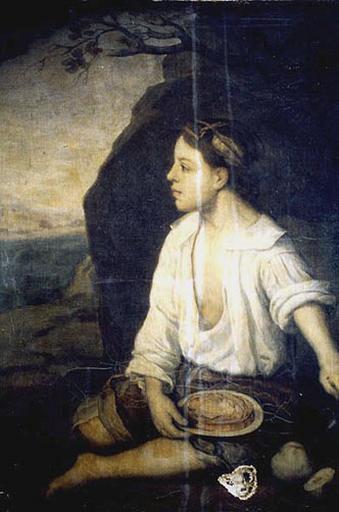
Image source: wikiart.org
Introduction to Murillo’s “Child Sitting”
“Child Sitting” by Bartolomé Esteban Murillo is an intimate and quietly moving scene that reveals another side of the great Sevillian master. Unlike his large religious altarpieces filled with angels and saints, this painting focuses on a single child seated on the bare ground, absorbed in thought. The loose white shirt, rolled-up trousers, and simple food at his side place him far from the world of aristocratic portraits.
Murillo became famous for his sympathetic depictions of children in seventeenth century Seville, many of whom were poor street boys or young workers. “Child Sitting” fits within that tradition. The boy appears to be pausing during a humble meal, his body turned slightly toward the light, his gaze wandering toward the distant landscape. The result is both a genre scene and a subtle meditation on childhood, poverty, and interior life.
Although the exact date of the painting is not known, its style suggests Murillo’s mature period, when his brushwork had become softer and his interest in the lives of ordinary people especially strong. The canvas may be small, but it carries a surprising emotional weight.
Historical Context: Seville and Murillo’s Street Children
To understand the significance of “Child Sitting,” it helps to recall the world in which Murillo worked. Seville in the seventeenth century was a city marked by sharp contrasts. Once a thriving port connected to Spain’s American colonies, it had fallen on hard times due to plagues, economic decline, and shifts in trade routes. Large numbers of orphans, beggars, and working children filled the streets.
Murillo, deeply rooted in this environment, did not ignore the social reality around him. While he earned important commissions for churches and religious institutions, he also produced a remarkable series of paintings depicting poor children eating, playing, or resting. Works like “The Young Beggar,” “Children Eating Grapes and Melon,” and “Boys Playing Dice” present these youngsters with warmth and humanity rather than moralistic condemnation.
“Child Sitting” likely belongs to this broader group of genre scenes. Instead of focusing on action or mischief, however, Murillo offers a moment of stillness. The boy is neither laughing nor begging; he is simply present, alone with his thoughts. This quieter approach allows viewers to see beyond stereotypes of street children and to recognize the child’s inner life.
Composition and Spatial Arrangement
The composition of “Child Sitting” is simple yet carefully arranged. The boy occupies the lower right portion of the canvas, seated on the ground with one leg bent and the other extended. His torso turns slightly toward the left, leading the eye toward the open space of the landscape. Behind him rises a dark rock or cave entrance, creating a strong vertical shape that frames his profile and makes his illuminated face stand out.
The left side of the painting opens onto a view of distant water and land. A strip of sky, though muted, hints at open air and freedom beyond the rocky shelter. Near the top, a few branches or sparse foliage stretch across the sky, suggesting a tree growing from the rock above. This juxtaposition between the enclosed darkness of the rock and the open landscape creates a subtle tension: the boy is both sheltered and confined.
Objects on the ground help balance the composition. A plate of food rests near his lap, along with a piece of bread or fruit and a shell-like object that hints at the nearby sea. These items form a small still life that grounds the figure in everyday reality.
The overall arrangement leads the viewer’s gaze in a gentle curve: from the dark corner at the lower left, along the boy’s extended leg, up his torso to his turned face, and then outward toward the horizon. This movement mirrors the child’s own contemplative gaze as it travels from his immediate surroundings to the world beyond.
The Child: Gesture, Expression, and Clothing
Murillo paints the child with great sensitivity. His body language is relaxed but alert. He sits on the earth with bare feet, one hand resting near his lap while the other reaches outward, perhaps toward an unseen companion or simply in a momentary gesture. The slightly open fingers suggest an interrupted action, as if he has paused mid-movement because something has caught his attention.
His face, seen in profile, is the emotional center of the painting. Murillo gives him soft features, a straight nose, and full lips parted just enough to hint at a breath or unspoken thought. His eyes are directed toward the distant landscape, not toward us. This outward gaze underscores his inner absorption. He seems to be listening, remembering, or dreaming rather than merely watching something specific.
The boy’s clothing speaks volumes about his social position. He wears a loose white shirt that falls open at the chest, exposing more skin than would be considered proper in elite circles. The sleeves are rolled up, and the fabric is slightly rumpled, indicating frequent use rather than luxury. His brown shorts are patched and worn. There is no trace of shoes.
Yet Murillo does not paint him in a degrading manner. The open shirt also lends the figure a certain natural grace, reminiscent of classical youths. The boy sits with an unselfconscious dignity, suggesting that the artist sees beauty and nobility even in poverty.
Setting and Objects: Food, Shell, and Landscape
The simple objects around the child add layers of meaning. The plate in his lap contains what appears to be a modest meal, perhaps bread or some small fish. Nearby lies a round fruit or loaf, and in the foreground, a shell gleams with pale tones against the earth. These items may simply indicate that the boy is eating a meager lunch near the shore, but they can also be read symbolically.
Bread often symbolizes basic sustenance, the minimal nourishment needed to survive. In Christian tradition, it also carries Eucharistic connotations, pointing toward spiritual food. The shell, associated with the sea, pilgrimage, and baptism, can suggest travel, vulnerability, or the fragile beauty of life. Together, these objects hint at a life of hardship that still carries traces of grace and meaning.
The landscape in the background reinforces this impression. The stretch of water, probably a river or coastal inlet, opens onto an indistinct horizon. The sky is not stormy, but neither is it bright. Its subdued tones echo the muted palette of the child’s clothing and the rocky surroundings. This environment is not idyllic; it is rugged and sparse, yet it remains open and expansive.
The rock behind the child functions almost like a backdrop in a stage set, pushing him forward and giving the composition depth. It could also be interpreted as a place of temporary refuge, a natural shelter where he can rest and think before returning to the demands of daily survival.
Light, Color, and Murillo’s Painterly Technique
Light plays a crucial role in directing attention and shaping mood. Murillo allows a soft, natural light to fall from the left, illuminating the child’s face, neck, and chest while leaving the rock behind him and parts of the ground in shadow. This contrast highlights his humanity, making him the brightest and most visually compelling element in the scene.
The color palette is dominated by earth tones: browns, muted greens, grays, and the off-white of the shirt. These subdued hues evoke a sense of simplicity and poverty. There are no rich reds or blues associated with Murillo’s religious paintings here. Instead, the limited color range underscores the modesty of the subject and the harshness of his environment.
Murillo’s brushwork appears loose and somewhat sketchy, particularly in the landscape and rock. Forms are suggested rather than sharply defined. This gives the painting a certain immediacy, as if we are glimpsing a fleeting moment. By contrast, the child’s face and hands receive more careful modeling, with smoother transitions of light and shadow. This focus on the figure’s flesh conveys warmth and life, making him stand out from the rougher surroundings.
The overall effect is atmospheric and slightly melancholic. The painting does not glitter; it glows quietly, inviting slow, thoughtful looking rather than instant impact.
Emotional Tone and Implied Narrative
Although “Child Sitting” is not a narrative painting in the usual sense, it suggests a story through its details and mood. We sense that the boy lives a difficult life, perhaps as a street child, fisher’s helper, or young laborer. The bare feet, worn clothes, simple food, and outdoor setting all point to a world of work and survival rather than comfort.
Yet the child is not shown in action. Murillo chooses a moment of pause, when he is free to turn inward. The distant gaze and relaxed posture convey contemplation and perhaps longing. He might be thinking of family members, dreaming of a different life, or simply watching the play of light on the water.
The painting’s emotional tone is gentle and reflective. There is sadness in the boy’s situation, but Murillo avoids exaggerating it. Instead, he emphasizes the child’s quiet resilience and capacity for thought. Viewers may feel a mix of compassion and admiration. The child’s vulnerability is evident, yet so is his dignity.
In this way, the painting subtly challenges viewers to see poor children not as faceless masses but as individuals with their own inner worlds. Murillo brings us close enough to recognize the boy’s humanity without turning the scene into mere sentimentalism.
Social Commentary and Murillo’s Humanism
Murillo’s images of children often carry an undercurrent of social commentary. Seventeenth century Spain, and Seville in particular, grappled with issues of poverty, orphanhood, and social inequality. Many children worked from a young age or lived on the streets, vulnerable to hunger and exploitation.
By depicting these children with empathy, Murillo participated in a broader Catholic impulse to care for the poor and marginalized. His paintings may have been purchased by wealthy patrons, yet they frequently reminded those patrons of the human beings in need outside their doors. Works like “Child Sitting” could inspire charity, reflection, and a more compassionate view of society’s least privileged members.
At the same time, Murillo does not reduce the child to a mere symbol. He retains a strong sense of individuality. The boy’s features, pose, and gaze feel specific, as if the artist had observed a real person and captured his personality on canvas. This humanistic approach elevates the work beyond simple moralizing.
Place within Murillo’s Oeuvre and Artistic Legacy
“Child Sitting” forms part of a broader group of Murillo’s genre scenes that helped shape European attitudes toward childhood in art. Before the seventeenth century, children often appeared as miniature adults in paintings or in strictly religious contexts. Murillo and some of his contemporaries began to depict them as distinct beings with their own moods, pleasures, and sorrows.
These images influenced later artists in Spain and beyond. The combination of realism, tenderness, and social awareness can be seen as a precursor to nineteenth century interest in everyday life and to modern artistic investigations of childhood.
Within Murillo’s own oeuvre, “Child Sitting” offers a quieter counterpart to more bustling scenes of boys playing, begging, or eating. It reveals his ability to capture introspection as well as action. The painting deepens our appreciation of his range, showing that his concern for children went beyond charming street anecdotes to include genuine psychological insight.
Contemporary Appreciation
Today, “Child Sitting” continues to resonate with viewers. Its themes of poverty, resilience, and inner life are as relevant as ever. Many people see in this solitary child a reflection of contemporary issues: displaced youth, child labor, or young people navigating challenging circumstances.
At the same time, the painting offers a space for contemplation. The simplicity of the scene, the muted colors, and the child’s thoughtful gaze encourage viewers to slow down and consider the lives of those who are often overlooked. Murillo’s gentle realism invites empathy rather than voyeurism.
For art enthusiasts and scholars, the work provides valuable insight into Spanish Baroque genre painting and the evolution of childhood imagery. For a general audience, it offers a moving reminder of the dignity and complexity present even in the most modest lives.
Conclusion
“Child Sitting” by Bartolomé Esteban Murillo may not have the grand scale of his altarpieces or the sparkling color of his Marian images, but it possesses a quiet power all its own. Through a simple scene of a boy resting with his meager meal near a rocky shore, Murillo explores themes of poverty, contemplation, and human dignity.
The carefully balanced composition, nuanced use of light and color, and sensitive portrayal of the child’s expression all work together to create a painting that feels intimate and timeless. It reflects the social realities of seventeenth century Seville while speaking to universal concerns about childhood and compassion.
In this modest canvas, Murillo demonstrates that great art does not always require spectacular subjects. Sometimes, a single child sitting on the ground, lost in thought, can open a window onto the deeper questions of life, survival, and hope.