Image source: wikiart.org
A Castle Framed by Weather and Leaves
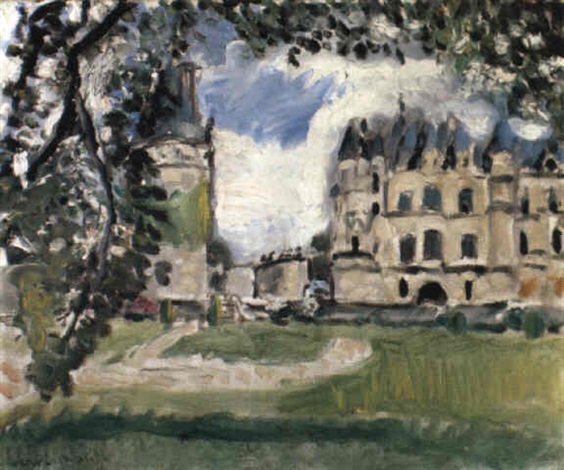
Henri Matisse’s “Château de Chenonceaux” (1917) captures one of France’s most recognizable Renaissance sites, but he refuses the grand, postcard view. Instead of the long gallery that famously strides across the Cher, he chooses the château’s parkland and its clustered volumes seen from a low vantage on the lawn. A bower of leaves presses down from the top edge like a natural proscenium; the great façade and a freestanding turret rise from a broad, pale-green sward; a belt of cloud breaks to show blue sky. The subject is architecture, yet the picture breathes like landscape. Matisse reduces the scene to a few negotiated forces—stone and foliage, light and weather, mass and opening—so the painting reads instantly and then unfolds slowly, with the surface’s frank brushwork recording the tempo of his looking.
The Chosen View and Its Intent
The vantage point is set well inside the grounds, close to the grass and beneath a canopy of tree branches. This choice matters. It organizes the composition around three registers: a dark leafy top that behaves like a curtain, a middle stage where the buildings sit in light, and a wide, quiet base of lawn. The framing leaves do more than decorate. They press the space downward, creating a sheltered feeling and keeping the eye inside the park. The château does not loom; it occupies. This is a lived place rather than a monument studied from afar. By choosing an oblique, cropped angle and letting the lawn dominate the foreground, Matisse gives weight to the air around architecture—the weather and trees share the scene’s authority.
Architecture as Rhythm, Not Inventory
Matisse interprets the building as a sequence of volumes and accents rather than a ledger of windows and moldings. The main block at right is simplified into pale planes punctuated by dark window voids and a shadowed arcade. To the left stands a turreted pavilion, wrapped in a green swath of climbing vine that softens its profile and voices nature’s slow reclamation of stone. Between the two, lower outbuildings step toward the horizon in a shallow procession. Where an academic view would elaborate every dormer and carving, Matisse insists on rhythm: big rectangle, smaller cylinder, narrow connector, reiterated windows as beats. The result is a music of masses against a ground of weather, architectural character rendered without pedantry.
The Framing Canopy and the Logic of Edges
The boughs at the top edge are drawn with the artist’s characteristic black, their leaves rubbed and scumbled so light pops through as negative fragments. These dark shapes narrow toward the center, functioning like a vignette that funnels attention to the pale façade and its surrounding sky. The canopy’s scalloped edge repeats at smaller scales throughout the picture—in the break of the cloud bank, in the irregular outline of the hedge line, in the vine’s lacy border on the turret—tying nature’s ornament to the man-made rhythm of arches and roofs. Edge is the glue here. Soft, broken edges render distance and air; firm, dark ones deliver structure and nearness. The switching between them is the painting’s pulse.
Color as Atmosphere and Measure
The palette is constrained and confident: cool greens of lawn and trees from mint to olive; buff and pearl grays of the château walls; dense blacks for window recesses and architectural seams; a limited range of sky notes—milky whites, slate grays, and a handful of saturated blue shards. Because Matisse withholds extraneous hues, each color carries clear responsibility. The green field establishes a calm base note; the stone’s warm gray introduces human order without chill; the deep voids of windows provide the consonant that keeps the chord from floating away; the blue of sky, parceled out in small amounts, brightens the entire scale, making the weights of stone and foliage believable.
Light as a Broad Envelope
Light in this painting is not theatrical; it is a generous envelope that exposes planes and keeps the scene habitable. Cloud cover dominates, filtering the sun such that shadows are understated and edges remain readable. The façade brightens along its upper stories where cloud opens, while the lawn holds a paler path of trodden grass that bends toward the center. The clouds themselves are painted as bodies of paint—thick, rolling forms that sweep horizontally—so sky is not a flat backdrop but a moving partner. By avoiding hard contrasts, Matisse makes stone, leaf, and air share one atmosphere, the very definition of plein-air credibility.
The Lawn as Stage and Interval
The large green forefield might seem empty at first glance, but it is essential to the picture’s breath. It is a pause that sets off the busier middle register and allows the château to sit rather than strain. Matisse activates this field with modest variations: cooler patches where shadows or worn paths interrupt the grass, warmer zones nearer the foreground, and a curving pale track that functions as a visual invitation toward the buildings. The lawn is not a void; it is the painting’s space-maker, a quiet declaration that emptiness—handled with tact—is as meaningful as ornament.
Drawing With Paint and the Authority of Black
Matisse’s black is the scaffold. It outlines tree limbs and the heavier architectural seams; it girds the cloud’s underside; it separates hedge from lawn and building from sky. But black is never a dead line. It thickens and thins with pressure, breaks and recovers, and in places blends into the adjacent color so transitions feel lived. Within those drawn contours, he lays paint broadly: walls are brushed in smooth, opaque passes; trees are dabbed and scumbled; clouds are dragged and feathered. Everywhere the hand is visible, yet never fussy. The mark-making gives the painting the sincerity of work done on site, with decisions left on the surface rather than sanded away.
Space Built by Bands and Overlap
The recession into distance is handled by simple, effective means. A dark hedge and the tops of outbuildings create a horizontal bar that stabilizes the center and pushes the façade behind it; paler tones occur farther back; small incidents—tiny rectangles of roof, a dot of arbor—diminish in scale along the horizon. The tree canopy frames space at the top while leaving gaps that carry the eye into depth. The result is a shallow, believable world that honors the painting’s surface while offering a place one could walk. Perspective exists but whispers; there is no insistence on vanishing points, only a civilized arrangement of nearer and farther.
Nature and Architecture in Productive Tension
One of the painting’s feats is its balanced dialogue between the constructed and the grown. The château’s rectilinear masses face the irregularities of trees and cloud, and each clarifies the other. Ivy climbs the turret as a vertical counter-melody to the straight seam of stone. The canopy’s organic scallop is echoed in the row of dormers, but the comparison flatters both rather than collapsing them. Matisse is not pitting civilization against nature; he’s showing how their patterns rhyme when looked at with the right attention. It is a visual ethic that runs through his interiors and landscapes of this period: order without sterility, ornament without frivolity.
The 1917 Temperament and What It Means
Dated 1917, the canvas belongs to a moment when Matisse had tempered the blazing primaries of his Fauvist youth into a quieter, more structural vocabulary. Black returns as a constructive tone; color saturations reduce to a disciplined scale; drawing takes on a declarative clarity. Yet there is nothing bleak here. The painting’s openness, the buoyant cloud, the fresh greens and lucid stone communicate steadiness rather than austerity. In a year overshadowed by war, that matters. “Château de Chenonceaux” refuses spectacle and offers instead a measure of composure: a place where the mind can organize what it sees and breathe.
Dialogues With Predecessors Without Quotation
The subject tempts comparison to the Impressionists who loved the Loire’s châteaux. But Matisse resists the shimmer of countless tiny touches. He prefers robust planes and clean intervals that let the architecture hold its dignity. From Corot he borrows the idea of a framing tree; from Cézanne the sense that buildings are volumes first and textures second. He folds those lessons into his own grammar of black contour and edited color, producing an image that feels both rooted in French tradition and unsentimentally modern.
The Eye’s Route Through the Painting
The viewer’s path is carefully choreographed. Most eyes enter at the bright patch of lawn near the center bottom, follow the pale track that bends toward the buildings, and then climb the façade’s stack of windows to the roofline. From there the gaze moves into the high cloud, glides left under the canopy, and descends the dark turret to the hedge line and back to the lawn. Along this loop Matisse places his strongest value contrasts—black windows against pale stone, blue sky streaked through white cloud, deep foliage framing open ground—so the circuit remains satisfying and inexhaustible. Each pass reveals a new brushstroke in the leaves, a softened correction along a roof edge, a gentler tint in the stone.
Memory, Place, and a Refusal of Postcard Grandeur
Chenonceau is famous for the elegant gallery that leaps the river, but Matisse declines the tourist angle. He chooses instead a view in which the building is embedded—literally framed—by its park and weather. This choice turns memory into feeling rather than spectacle. The painting evokes the experience of arriving at such a site on a clear windy day, stepping under trees to look across the lawn, and watching cloud shadow move across the façade. It is a record not of triumphal architecture but of architecture belonging to the world, subject to light and season like any other inhabitant.
Material Facts That Reward Close Looking
Close inspection offers small, durable pleasures. The sky’s blue is brushed around the leaves with just enough precision to make the canopy’s edge vibrate; the ivy on the turret is a mixture of dragging greens and stippled darks that let stone peep through; the façade’s windows are blocks of dusky paint with softened bottoms where light gathers; the lawn’s lighter track is an underlayer permitted to live, not a later highlight. Matisse allows pentimenti—ghosts of earlier decisions—to remain at cornices and hedge edges, a candid record of the painting thinking.
Why This Picture Endures
The endurance of “Château de Chenonceaux” lies in its calm intelligence. With a restricted palette and a handful of strong shapes Matisse constructs a view that holds together at any distance. From across a room it reads as a clear arrangement—dark canopy, pale château, broad lawn, moving sky. Up close it resolves into generous paint, varied edges, and small negotiations of color temperature that keep the surface alive. It grants equal dignity to building and weather and shows how looking, when disciplined and generous, can make the world feel ordered without being reduced.
A Closing Reflection on Order and Air
Matisse’s château is not a relic; it is a participant in the day’s conditions. Leaves crowd the top edge as if you’ve stepped under them. Clouds roll and break, offering the stone both shade and illumination. The grass holds the weight of decades of footsteps, yet today it is simply a stage for light. In this balance between order and air sits the painting’s gift. It teaches that architecture, however noble, is most itself when seen in the world’s breath, and that painting, however modern, is most convincing when it can stage that meeting with nothing more than a few true relationships and a hand that trusts them.