Image source: wikiart.org
Introduction to “Chasuble of St. Ildefonso”
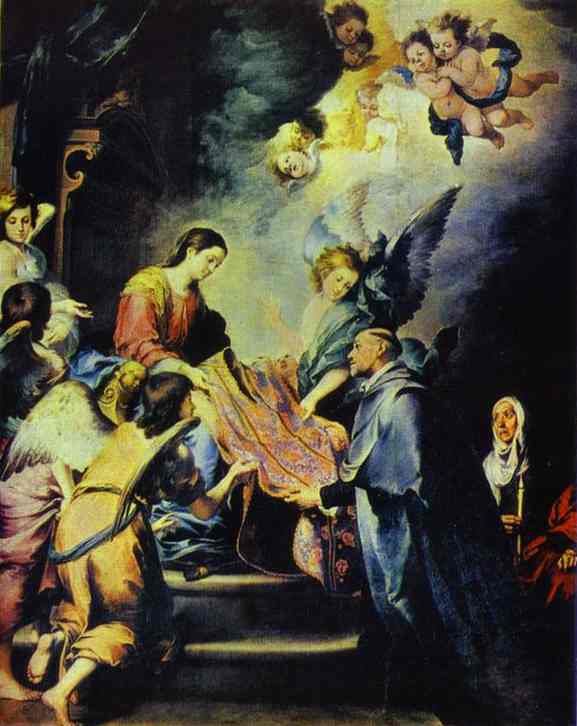
“Chasuble of St. Ildefonso,” painted by Bartolomé Esteban Murillo around 1660, is one of the great Baroque celebrations of Marian devotion in seventeenth century Spain. The painting shows a visionary moment in which the Virgin Mary, surrounded by a radiant host of angels, presents a magnificent chasuble to Saint Ildefonso of Toledo as a reward for his fervent defense of her privileges.
Murillo orchestrates this miracle with theatrical light, cascading draperies, and a dense gathering of celestial figures. Yet beneath the spectacle lies a carefully structured image of humility, liturgy, and theological affirmation. The saint receives the vestment as a servant of the Church, while Mary, enthroned in light, appears as Queen and Intercessor.
This work allows us to see how Murillo combined his gifts for tender human observation with grand religious narrative. The faces, gestures, and fabrics are made tangible and intimate, while the whole scene simultaneously opens toward the infinite, filled with clouds and cherubs that dissolve into heavenly brightness.
The Legend of St. Ildefonso and its Meaning
To understand the painting, it is helpful to recall the story that inspired it. Ildefonso was a seventh century bishop of Toledo renowned for his passionate writings in defense of the Virgin Mary, particularly her perpetual virginity. According to legend, Mary appeared to him in a vision as he prayed before her altar. In gratitude for his devotion, she presented him with a chasuble, a priestly vestment, to be worn when serving at the altar.
By the time Murillo painted this subject, Ildefonso had become a powerful symbol of Spanish loyalty to Marian doctrines. In seventeenth century Spain, where arguments about the Immaculate Conception were intense, he was venerated as an early champion of Mary’s unique holiness. Depicting Mary clothing the saint in a heavenly vestment visually affirms that heaven itself approves his teaching and service.
Murillo uses the legend to align the Spanish Church with the divine will. The painting declares that those who defend Mary’s honor are rewarded by her personally. At the same time, the chasuble is a liturgical garment, so the vision also dignifies the priestly role and the sacramental life of the Church.
Overall Composition and Baroque Theatricality
The composition is built on a sweeping diagonal that cuts from the lower left of the canvas, where kneeling angels and attendants gather, up to the bright cluster of cherubs in the upper right. At the center of this current sits the Virgin Mary, slightly elevated on a throne or platform, leaning forward as she extends the glowing vestment to the saint.
St. Ildefonso kneels to the right of Mary, his body turned toward her, his face lifted in gratitude. Other angels assist, holding the chasuble and guiding it toward the bishop’s hands. The human and angelic figures crowd the lower half of the canvas, creating a sense of fervent activity around the miracle.
Above them, a burst of light opens in the dark clouds. Several cherubs float in this radiant zone, their bodies bathed in gold and pale blue. They act almost like a heavenly chorus, witnessing the event and reinforcing the vertical connection between earth and heaven.
Murillo uses these diagonals and verticals to direct the viewer’s gaze. The eye travels from the kneeling figures up along the curve of the chasuble to Mary’s hands, then further upward into the glowing sky. The scene mimics the motion of a stage drama, with Mary occupying the role of central protagonist. Yet the saint and the assisting angels are given enough presence and detail that the event feels genuinely communal, not simply a static apparition.
Light, Color, and Atmosphere
One of the most striking features of the painting is Murillo’s handling of light. The scene is set against deep, stormy shadows that envelop the background architecture. Out of this darkness, a supernatural radiance spills from the heavenly opening above and from Mary herself. The light is not uniform; it glows most intensely around her face and hands and on the gleaming surface of the chasuble, then softens as it touches the surrounding angels and the kneeling saint.
This luminous gradient creates a spiritual hierarchy. Mary and her gift are clearly the source and focus of divine illumination. The figures closest to her share more of this light, suggesting their intimacy with the mystery, while those further away recede into the penumbra. Such nuanced lighting not only heightens drama but also conveys theological meaning, indicating grace flowing outward from Mary as Mediatrix.
Color plays an equally important role. Mary’s garments, typically red and blue, are here tempered with softer, warm hues that harmonize with the golden light. The chasuble itself is a tour de force of color: rich pinks, golds, and intricate patterns shimmer against the deeper blues and browns around it. Murillo delights in the tactile brilliance of the fabric, making it at once an earthly luxury and a symbol of heavenly favor.
The angels’ clothing contributes to a kaleidoscope of tones: pale blues, creamy whites, yellows, and soft greens. These colors, combined with the rosy skin tones of the cherubs, form a radiant symphony against the cool, dark backdrop. The effect is that of a spiritual sunrise within the gloom, echoing the transformative power of grace.
The Figures Around the Virgin
Murillo peoples the painting with a variety of figures, each adding nuance to the story. Closest to Mary are the angels who physically handle the chasuble. One kneels at her feet, hands raised to receive the garment. Another hovers behind her, wings spread, helping guide the cloth toward the saint.
These angels are not anonymous decorations. Their faces reveal different emotions: reverent concentration, joyful attention, gentle admiration. Murillo gives them individual features, making them look almost like idealized children or youths. This personalization reinforces the sense that heaven is a community of loving beings actively involved in human salvation.
To the far right stands a nun or devout woman holding a candle, gazing toward the miracle in awe. She serves as a stand in for the viewer, a witness from the earthly Church who beholds the vision with wonder. Her presence subtly anchors the scene in the present, suggesting that such graces continue to radiate into the lives of the faithful.
Several cherubs populate the upper region of the painting, some looking directly down, others conversing among themselves. Their playful yet reverent presence provides a bridge between the solemn actions below and the infinite light above.
The Central Relationship Between Mary and St. Ildefonso
At the heart of the painting is the interaction between Mary and the kneeling bishop. Murillo captures a delicate balance between majesty and intimacy. Mary sits elevated, her posture calm and assured. She leans slightly forward, meeting the saint’s gaze with a serene kindness. Her gesture of presenting the chasuble is both formal and affectionate, like that of a queen bestowing an honor and a mother dressing her beloved son for a sacred service.
St. Ildefonso, on the other hand, kneels with humility. His hands are extended to receive, yet he does not grasp greedily. His expression appears deeply moved, a mixture of gratitude, awe, and perhaps disbelief at such favor. The folds of his blue cloak fall heavily around him, emphasizing his grounded humanity compared to Mary’s airy lightness.
Murillo has given Ildefonso a strong, recognizable profile, suggesting that he may have drawn on portraits of contemporary clerics or benefactors to create a believable likeness. This realism underscores that sainthood arises from real, historical persons, not abstractions.
The meeting of their hands at the chasuble’s edge becomes the physical center of the painting. Here earthly obedience touches heavenly generosity. The richly decorated cloth acts as a tangible sign of the bond between them, an emblem of both reward and responsibility.
Symbolism of the Chasuble
The chasuble itself carries multiple layers of meaning. As the outermost vestment worn by a priest during the celebration of the Eucharist, it symbolizes charity and the yoke of Christ. By placing it directly into Ildefonso’s hands, Mary confirms his role as a servant of the altar and protector of orthodox teaching.
Its sumptuous material and radiant color suggest a garment woven in heaven, not merely a product of earthly workshops. Yet Murillo also delights in the realistic details of embroidery and pattern, allowing the viewer to feel its weight and texture. This dual aspect mirrors the sacramental nature of the Church itself, where tangible objects become bearers of divine grace.
The chasuble also visually connects Mary and the saint. Draped across her lap and extending toward him, it becomes a kind of bridge. The saint does not climb to Mary’s level, nor does she descend entirely; instead, the garment forms an intermediate zone where heaven and earth meet. In a broader spiritual sense, it symbolizes Mary’s role as the one through whom Christ took on flesh and entered the world, the living garment of the Incarnate Word.
Murillo’s Personal Style and the Sevillian Context
“Chasuble of St. Ildefonso” is unmistakably a work of Murillo’s mature style. The softness of faces, the delicate transitions of light, and the warm, inviting color palette all reflect the painter who was beloved in Seville for his depictions of the Virgin, Christ, and everyday people.
Seville in the mid seventeenth century was a city of intense religious life, with confraternities, monasteries, and churches commissioning artworks to inspire devotion and express doctrinal commitments. Murillo, deeply embedded in this environment, responded with paintings that combined Counter Reformation clarity of message with emotional warmth.
In this work he avoids the harsher, more muscular drama found in some contemporaries. Although the composition is dynamic, the overall mood is one of gentle reverence rather than violent ecstasy. The figures are beautiful, but they are not idealized to the point of coldness. Their emotions are legible, inviting viewers into a shared experience rather than keeping them at a distance.
Murillo’s sensitivity to children and humble people, evident in his genre scenes of street urchins, subtly colors even this exalted subject. Many of the angels have the soft faces of Sevillian children, transformed into celestial beings. This choice makes heaven feel near and familiar to the faithful who encounter the painting.
Narrative Flow and Viewer Participation
The painting is not a static tableau but a narrative frozen at a climactic instant. A viewer entering the scene visually may begin at the lower left among the busy angels, move up to Mary presenting the chasuble, then follow the swirling drapery and line of sight to the saint. From there, the eye is drawn upward again into the bright cloud of cherubs.
This circular movement means that the viewer’s gaze never settles for long. Instead, one experiences a kind of visual liturgy, moving from earthly service to heavenly approval and back again. Murillo thus encourages ongoing contemplation rather than a single glance.
The presence of the watching nun on the right, standing a bit apart from the central action, offers viewers a role model. She embodies devout attention. Her small size and modest placement suggest humility, but her bright face and candle remind us that each believer is invited to stand as a witness to God’s gifts in the Church.
Emotional and Spiritual Impact
“Chasuble of St. Ildefonso” is ultimately a painting about grace received in humility. The saint does not earn the chasuble as a trophy of personal achievement. Rather, he is gifted with it because he devoted himself to defending Mary’s honor and serving the Church with fidelity.
Murillo communicates this reality through the gentle tenderness of Mary’s expression, the saint’s kneeling posture, and the radiant yet peaceful atmosphere. Even the bustling angels appear to handle the vestment with care, as if aware that they are participating in a sacred exchange.
For viewers, the painting offers a vision of how faithfulness in teaching and worship can be honored by heaven. It invites contemplation of vocation, ministry, and the role of Mary as supporter of those who serve her Son. The rich colors and luminous cloudscape speak to the senses, while the theology embedded in gesture and symbol speaks to the mind and heart.
Conclusion
In “Chasuble of St. Ildefonso,” Bartolomé Esteban Murillo masterfully unites narrative legend, theological symbolism, and Baroque visual splendor. Through a carefully choreographed scene of Mary bestowing a heavenly vestment on a devoted bishop, he presents a powerful image of the bond between the Virgin, the clergy, and the faithful Church in seventeenth century Spain.
The swirling draperies, radiant chasuble, and bright chorus of angels create a painting that is both intensely dramatic and deeply tender. Murillo’s subtle light, warm palette, and humanized figures make the supernatural event feel close and inviting, turning a complex doctrine into an accessible scene of grace.
Even today, the work continues to captivate. It offers not only a window into Spanish Baroque spirituality but also a timeless meditation on humility, reward, and the beauty of service offered in love.