Image source: wikiart.org
A Sovereign Forged in Steel
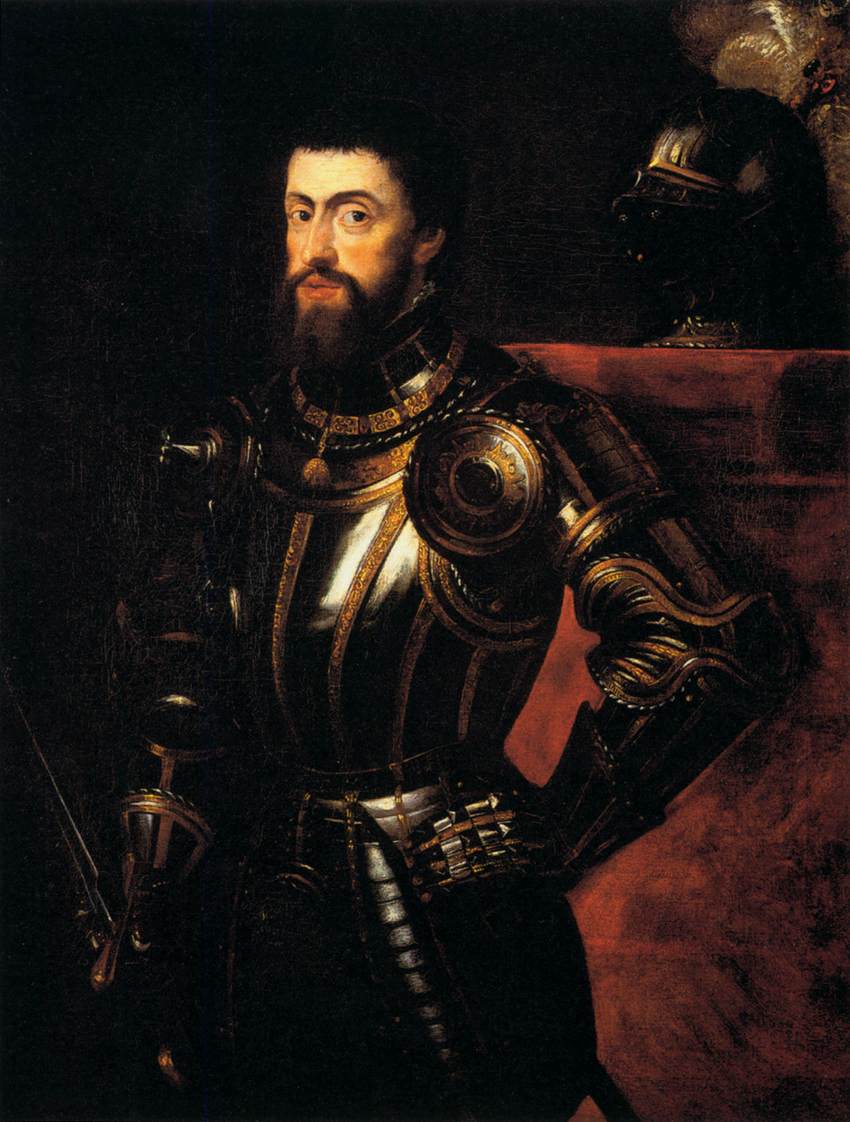
Peter Paul Rubens’s “Charles V in Armour” (1603) condenses imperial legend into a single, polished presence. The Habsburg emperor stands half-length against a dark ground, his body locked in black-and-gold plate, his gaze steady, his left hand planted at the hip as if bracing the weight of empire. A plumed tournament helm sits behind him on a crimson hanging, a quiet herald of ceremony and conquest. Painted during Rubens’s Italian years, the portrait synthesizes Northern clarity and Venetian splendor to fashion an image where the man and the state share one glimmering skin of metal. It is an early declaration of the artist’s gift for transforming political power into living theater.
Historical Moment and Lineage
In 1603 Rubens was working for the Gonzaga court in Mantua, absorbing Italian art and serving patrons connected to Habsburg power. The subject, Charles V, had abdicated and died decades earlier, but his image still served as the master-brand of Habsburg authority from Spain to the Low Countries. Rubens knew the classic prototypes—most famously Titian’s equestrian “Charles V at Mühlberg”—and he threads that heritage through his own language. Instead of a battlefield panorama, Rubens presents the emperor in studio intimacy, translating the rhetoric of conquest into the controlled glamour of ceremonial armor. The portrait functions not only as likeness, but as a dynastic reliquary: the steel is a relic, the face a legend renewed.
Composition and the Architecture of Presence
The design is austere and exact. Charles occupies the left two-thirds of the canvas, turned three-quarters toward the viewer, his torso angled so the breastplate gleams along one powerful diagonal. The right third is a shallow stage bearing the red hanging and helmet. This balancing still life steadies the composition the way a column steadies a façade. Rubens trims distractions to a minimum. No balustrades, no columns, no panorama intrudes. The architecture here is the armor itself—curved plates, swelling pauldrons, bead-edged gorget, and the precise flange of a fauld—all arranged to read as coherent volumes in space. The figure locks into the rectangle as a structural solution: authority solved through geometry.
The Armor as Political Rhetoric
Rubens paints the suit as if it were a constitutional document. The blackened steel, inlaid with delicate gold bands and cartouches, reads as Milanese or Augsburg work of the highest rank, the kind of damascened parade armor crafted for pageants and state entrances. Every element performs a virtue. The polished planes declare prudence and self-control; the gold fillets announce magnificence; the flawless fit implies discipline; the sword hilt and gauntlet couched at the hip stand for readiness without belligerence. Armor in portraits of this kind does not mean constant war; it means legitimate capacity for war—a sovereign’s right and responsibility. Rubens articulates that distinction by giving the metal ceremony over bloodshed, beauty over brutality.
Light, Reflection, and the Drama of Surface
Illumination falls from the upper left, skating across ridges and turning on rounded plates like a fugue of highlights. Rubens manages these reflections as a composer manages crescendos—bright at the breastplate, then softened as they cascade down the torso, flashing again on the cuisse and pauldron. The black field of the steel is never simply black; it is a deep, glazed mixture that catches a warm light along edges, cold light on planes, and pools shadow that seems to absorb the room. The gold details are painted not as flat yellow bands but as small territories of light with red and brown undertones that feign engraved depth. In armor, light is the content. The painter uses it to show that rule is a polished practice, burnished continuously against history’s frictions.
The Face and Its Temperament
Despite the sumptuous shell, the portrait’s force ultimately rests in the eyes. Charles’s gaze is steady, intelligent, and slightly remote, the look of a man accustomed to deliberation. The beard and close-cropped hair frame a face modeled with cool restraint—no florid blush, little sweat, a quiet confidence. Rubens avoids flattery. He neither enlarges the eyes into theatrical mirrors of soul nor tightens them into severity. The expression sits at the noble median where duty and fatigue meet. That poise is the psychological key. We sense a ruler practiced in bearing contradictory burdens: victory and administration, grandeur and piety, span and strain.
Crimson and Black: The Palette of Empire
The chromatic strategy is simple and regal. Black armor and deep ground set the stage; gold enlivening inlay and chain supply the imperial accent; the red hanging at right blooms as a counter-color. Red is the ancient tone of power—blood, law, senate—and here it acts as a warm echo that prevents the portrait from sinking into gloom. The small zones of flesh—the face and hands—are painted in tempered hues that keep company with the metals rather than competing with them. Rubens makes the colors behave the way a court behaves: deference to the sovereign element, each hue playing its protocol-bound role.
Gesture and the Language of Stance
The left hand rests at the hip with the thumb cocked and fingers relaxed, a gesture between command and repose. The right, partially shadowed, carries the sword hilt, more reminder than threat. This choreography of hands and weight distributes authority through the body. The stance reads as stable rather than aggressive; the emperor is ready, not raging. Rubens writes character into posture. The diagonal from gauntlet through breastplate to the dark helmet behind completes a triangle of preparedness: body, weapon, symbol.
The Helmet as Silent Herald
That helmet on the red cloth is a still-life with a voice. Its closed visor and plume imply the public pageantry of tournaments and military reviews, the theater in which kings perform martial identity to their subjects. Placed beside the sitter rather than on his head, it suggests prudence: fighting gear acknowledged but not currently in use. The curve of the crest catches a small, separate highlight that reads like a distant trumpet note, an elegant reminder that this portrait speaks in the key of ceremony.
Rubens Between Venice and Antwerp
The picture reveals how thoroughly Rubens digested Italian lessons. The limited palette and orchestration of black and red recall Venetian portraiture, especially Titian’s gravely luminous men in armor. Yet the painting’s finish and descriptive precision betray Northern craft: the beadwork on the gorget, the crisp rim of the pauldron, the convincing weight of the fauld over the hips. What looks effortless is a calculated fusion—Venetian atmosphere wrapped around Flemish scrutiny. Out of that synthesis Rubens makes a new kind of state portrait, neither icy nor florid, a living compromise between clarity and splendor.
Texture and Touch: From Steel to Skin
Rubens’s brush changes dialect as surfaces change. On steel he uses firm, elastic strokes that trace curvature; on gold he scumbles thin lights over warm grounds to simulate metallic depth; on flesh he softens into wet transitions and minute breaks of light along the lower eyelid and bearded lip. Even the black ground carries subtle variation—scratches of drying brush, dullness against the gleam—a darkness with history. These registers of touch make the figure breathe in its armor, skin and steel sharing a single system of light.
Iconography and the Economy of Symbols
A portrait this restrained relies on concentrated signs. Armor performs valor; gold fillets speak magnificence and divine favor; the red drapery frames the emperor as if before a throne; the helmet whispers pageant; the sword signals justice. Rubens withholds the overabundant emblems—laurels, globes, thunderbolts—that could cheapen the dignity. He trusts a few well-played notes. The economy of symbols communicates confidence: an emperor who needs little to be understood.
Dialogue with Titian and the Invention of Distance
Rubens surely had Titian’s equestrian image in mind, yet he deliberately reduces the space between viewer and monarch. Titian’s Charles rides within a world; Rubens’s Charles stands within a darkness that belongs to portraiture’s intimate chamber. The shift trades battlefield narrative for psychological proximity. We are close enough to read the emperor’s eyes, far enough to keep our place as subjects. That calibrated distance—neither familiar nor aloof—is the true achievement of the painting.
Probable Function and Audience
Such a portrait would serve dynastic display: a gift picture for allied courts, a gallery anchor in a princely palace, a visual primer for the virtues expected of Habsburg heirs. Its scale and finish make it transportable and re-displayable, a political instrument as mobile as a letter. When viewers encountered it, they met not only the memory of Charles V but also the present claims of those who bore his name. Rubens supplied a face for ideology, but he did so with enough human gravity to keep the image from dissolving into propaganda.
Conservation, Condition, and the Poetics of Gloom
The painting’s heavy darks and lacquered passages are vulnerable to the creep of varnish and the hunger of time. When well preserved, the armor’s black reads not as flatness but as depth; when dulled, the subtleties collapse. Rubens’s intent depends on the precise play of micro-highlights along chamfers and beadings. Those tiny calls of light are the syntax of the picture. They articulate sentence after sentence of authority across the surface. The portrait rewards careful lighting in display; it is a theater whose stagehand is illumination.
Legacy and the Later Baroque Court Image
Rubens’s solutions here ripple outward through the century. Velázquez, Van Dyck, and court painters across Europe learned how to project sovereign poise by controlling light on polished surfaces, by simplifying the stage, and by letting character carry ornament. The language of black armor, red backdrop, and quiet gaze becomes a courtly dialect spoken from Madrid to Vienna. Even when armor ceased to be militarily relevant, it persisted in portraits as a costume of legitimacy; Rubens helped codify that grammar.
Humanity Inside the Harness
Perhaps the portrait’s most modern quality is its allowance for human inwardness inside a political costume. Through careful modeling of eyes and mouth, Rubens locates the man within the emblem. The steel does not erase vulnerability; it contains it. The gaze is neither triumphal nor theatrical; it is mindful. In that quietude lies the painting’s power to survive changing regimes of taste. Beyond the Habsburg myth—beyond the gilded shell—we meet a face thinking about the price of rule.
Why the Image Still Compels
Contemporary viewers feel the pull of this picture because it solves an evergreen problem: how to represent power without bombast. Rubens achieves it by restraint, by the noble economy of means, by trusting that the weight of a pauldron, the flash along a gorget, and the gravity of a human gaze are eloquent enough. The portrait speaks softly yet authoritatively across centuries. It reminds us that leadership, at its best, shines through craft and composure, not noise.
Conclusion: Steel, Light, and the Measure of a Reign
“Charles V in Armour” is an early masterclass in Rubens’s ability to translate political mythology into convincing presence. Composition, color, and light collaborate to make a single argument: a ruler is as solid as the surfaces that reflect his principles. The painting’s beauty is neither ornamental nor incidental; it is ethical, a polished testimony to prudence, justice, and measured strength. In the reflective skin of armor, Rubens casts the emperor’s enduring portrait—and with it, a template for the Baroque age’s vision of sovereign poise.