Image source: wikiart.org
Claude Monet and an Early Winter Vision
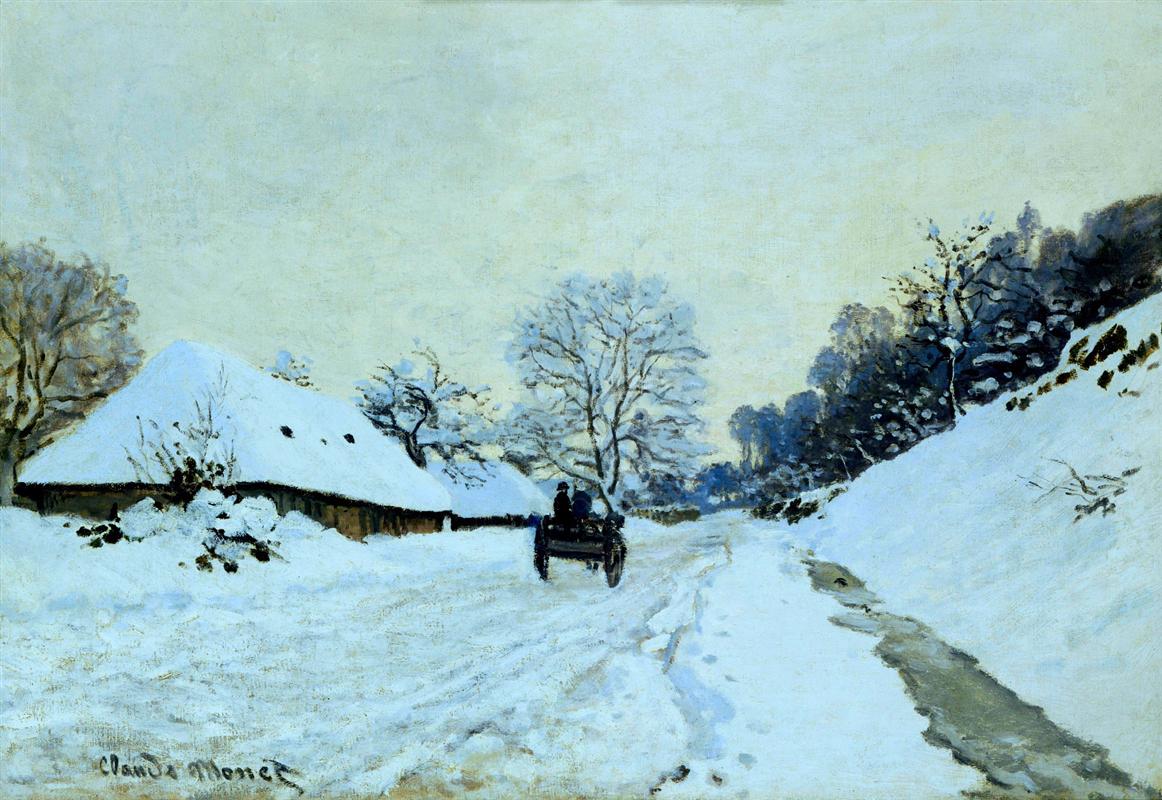
Claude Monet’s Cart on the Snow Covered Road with Saint-Simeon Farm from 1865 is a quiet and deeply atmospheric painting that reveals how early he had already begun to transform ordinary landscape into something emotionally resonant. At first glance, the scene seems simple. A snow-covered road stretches through a rural setting. A cart moves through the center of the composition. A farmhouse sits low on the left, while a rising bank of snow and dark trees frames the right side. Bare branches break the pale sky. Nothing dramatic appears to happen. Yet the painting lingers in the mind because Monet turns this modest winter road into an image of stillness, movement, cold, and human endurance.
This work belongs to a crucial moment in Monet’s development. In the mid 1860s, he was still a young artist, not yet the universally celebrated figure he would later become. He was already committed, however, to looking at nature directly and treating landscape as a living, changing subject rather than as a backdrop for history or mythology. In this painting, that commitment is already visible. The subject is not idealized countryside. It is a specific weather condition, a particular road, a certain quality of winter light, and a fleeting impression of space altered by snow.
The title itself directs attention to place. Saint-Simeon Farm was a real location associated with the Normandy region and with painters drawn to the changing coastal and rural atmosphere there. Instead of presenting the site as picturesque in an easy or sentimental way, Monet shows it under snow, subdued and nearly silent. The farm is not made into a romantic monument. It is part of the lived environment. The road is still in use, the cart still travels, and the scene feels inhabited even though very few figures appear. This balance between observation and feeling is one of the painting’s greatest strengths.
What makes the work especially compelling is that Monet does not rely on bright spectacle. Snow scenes can easily become decorative or overly dramatic, but this one is restrained. The beauty of the painting lies in its pale tonal range, its sense of muffled sound, and its ability to make winter feel both harsh and luminous. The scene is cold, but not lifeless. The whiteness of the snow does not flatten the world. Instead, it reveals subtle distinctions in light, shadow, and texture. This is where Monet’s sensitivity becomes clear. He understands that white is never just white, and that a winter road can contain as much visual richness as a summer garden or a sunlit riverbank.
The Composition and the Experience of Looking
The composition of Cart on the Snow Covered Road with Saint-Simeon Farm is carefully organized, but it never feels rigid. Monet creates structure through the road, the farmhouse, the embankment, and the trees, yet the overall impression remains natural and unforced. The viewer’s eye is led gradually inward rather than directed with theatrical emphasis.
The road is the painting’s central organizing element. It begins in the foreground and curves gently toward the middle distance, pulling the viewer into the scene. Because the road has been covered in snow but still shows tracks and disturbed surfaces, it becomes both a visual path and a record of recent passage. It tells us that this landscape is not untouched wilderness. People still move through it, though winter has made that movement slower and more difficult. The cart placed near the center reinforces this sense of travel and persistence. It gives the painting a human rhythm without overwhelming the landscape.
On the left, the large roof of Saint-Simeon Farm anchors the composition. Its broad snow-covered surface forms a strong triangular mass that contrasts with the open sky above and the road beside it. The building is low and quiet, almost merging with the ground under the weight of snow. It feels sheltered and solid. This mass gives the painting stability. Without it, the open whiteness might drift into vagueness. The farm acts as a visual counterweight to the rising snowy bank on the right.
That bank on the right side of the composition creates a different kind of force. It slopes upward and is topped by dark trees and brush, producing a denser, more shadowed area. This prevents the painting from becoming too symmetrical. The left side feels inhabited and grounded, while the right side feels slightly more isolated and natural. Between them lies the road, the zone of passage and transition.
The cart itself is small in scale, yet essential. Monet does not treat it as a genre anecdote or narrative focal point in the conventional sense. Instead, it is integrated into the landscape. The figures seem almost absorbed by the cold environment, appearing as dark accents against the pale snow. Their smallness makes the land feel larger and the winter atmosphere more enveloping. At the same time, their presence keeps the scene from becoming empty. The painting is about weather, space, and perception, but also about human life continuing within those conditions.
The bare trees are another important compositional element. Their branches rise delicately against the pale sky and break the broad areas of white with intricate linear forms. These trees keep the upper part of the painting active. They create a subtle vertical rhythm that balances the horizontal spread of snow and road. Monet uses them not only to define winter, but also to give the composition breath and movement.
Snow as Color, Texture, and Light
One of the most remarkable features of this painting is Monet’s treatment of snow. Rather than depicting it as a blank surface, he explores the many ways snow catches light, holds shadow, and changes the appearance of the land. This sensitivity would become one of the defining features of his later art, but even here it is already impressive.
The dominant impression is whiteness, yet the painting is filled with variations. Cool blues, soft grays, creamy off-whites, and muted earth tones all appear within the snow. This is crucial, because real snow is never uniformly white. It reflects the sky, absorbs nearby colors, and shifts in appearance depending on depth, moisture, and disturbance. Monet observes these changes with unusual care. The result is a surface that feels alive.
The sky plays an important role in this effect. It is pale and expansive, and its cool tone seems to filter down into the snow below. The snowy fields and road reflect that same cold light, creating unity across the painting. At the same time, darker accents from the trees, the cart, and the farmhouse walls help define the snow’s brightness. Monet understands that light is most convincing when set against contrast. The dark shapes do not merely describe objects. They allow the whiteness around them to intensify.
Texture is equally important. The snow on the road is not smooth. It has been marked by wheels, compacted by passage, and partially melted in places. In the foreground, the varied handling suggests slush, packed snow, and wet surfaces. This prevents the scene from becoming too polished. Winter here is not decorative powder laid gently over the world. It is a physical condition that alters the land’s surface and affects how people move through it.
The snow on the roof of the farm has a different texture from the snow on the road. It appears heavier and more settled, creating a thick blanket over the structure. Snow on the embankment to the right looks more irregular, broken by plants and earth beneath. These differences are subtle but important. Monet makes us feel the varied weight and behavior of snow depending on where it lies.
There is also a poetic dimension to this handling of snow. Because the scene is so subdued, viewers are invited to slow down and notice small tonal shifts. The painting does not announce itself through color brilliance in the usual sense. Instead, it offers a quieter brilliance, one built from restraint. This kind of beauty is more intimate. It asks for close attention and rewards it.
Atmosphere, Silence, and the Winter Mood
The emotional power of Cart on the Snow Covered Road with Saint-Simeon Farm comes largely from its atmosphere. This is not just a picture of a place. It is a picture of what winter feels like in that place. Monet captures the hush that often follows snowfall, when sound seems dampened and the world appears temporarily slowed.
The painting’s mood is contemplative rather than dramatic. There is no storm in progress, no theatrical sunset, no crowd of figures. Instead, Monet presents a moment of subdued passage through a cold rural road. The cart moves, but slowly. The farmhouse stands still. The trees are bare and quiet. Even the sky seems muted, as though holding its breath. This restraint is what gives the painting depth.
The road contributes strongly to the sense of silence. Roads usually imply traffic, exchange, and activity, but here the snow has softened all that. The path is still passable, yet difficult. Its surface is muffled. Its edges are less defined than they would be in another season. This transformed road becomes a symbol of winter’s power to alter daily life. Familiar routes remain, but they are changed by weather.
The mood is not bleak in a purely negative sense. There is solitude here, but also serenity. The soft light and broad snowfields create an almost meditative calm. The painting recognizes winter hardship without turning the season into misery. This balance is one reason it feels so human. Monet does not sentimentalize nature, but neither does he strip it of quiet beauty.
The tiny human presence is essential to this emotional balance. The cart reminds us that this is lived space. Someone is traveling, perhaps working, perhaps returning home. We do not know their story, and Monet does not insist that we do. Their smallness within the landscape suggests humility and endurance. Human life continues, but in winter it must adapt to the season’s pace and weight.
This atmosphere also reveals Monet’s ability to find emotional richness in ordinary conditions. He does not need grand mountains or violent weather to create mood. A country road, a farmhouse, and a cart are enough. The mood comes from how these elements are seen and felt. In that sense, the painting is already very modern. It trusts perception itself as a worthy subject.
Saint-Simeon Farm and the Rural World
The inclusion of Saint-Simeon Farm gives the painting a strong sense of locality and lived reality. This is not a generalized winter landscape invented in the studio. It feels tied to a specific environment, and that specificity matters. Monet’s rural world is not a fantasy of timeless peasant life. It is a place shaped by weather, labor, and routine.
The farm is important not just as an architectural feature, but as a sign of habitation. It suggests shelter, work, food, and continuity. Covered in snow, it becomes even more evocative because it seems to endure the season rather than resist it. The low roofline, nearly consumed by white, expresses the heavy stillness of winter. Yet the structure remains firm. This creates a quiet sense of resilience.
Monet avoids detailed anecdotal description. He does not fill the scene with farm animals, workers, or domestic incident. This restraint keeps the painting from slipping into illustration. The farm’s presence is enough. It grounds the landscape in human use without distracting from the larger study of atmosphere and light.
The relationship between the farm and the cart is especially interesting. Together they imply movement between shelter and exposure. The farm stands for permanence and rest, while the cart stands for passage and effort. The road connects these states. In this way, the painting subtly reflects the rhythms of rural life. Winter does not stop the world, but it changes the tempo of work and travel.
There is also something deeply honest in Monet’s choice of subject. He does not seek out a polished estate or a grand architectural landmark. He paints an ordinary farm and the road near it. This choice aligns with the broader shift in nineteenth century art toward modern experience and direct observation. What matters is not whether the subject is traditionally noble, but whether it offers truth of vision.
Brushwork and the Young Monet’s Developing Style
Although this painting predates the fully developed Impressionist style most viewers associate with Monet, it already reveals important aspects of his artistic direction. His brushwork is observant, economical, and sensitive to changing surfaces. He is not yet dissolving forms into flickering touches in the way he would later do, but he is already more interested in optical effect than academic finish.
The handling of the snow is a key example. Monet does not labor over every detail in a highly polished manner. Instead, he uses paint to suggest the surface conditions of the road, roof, and banks through varied strokes and tonal relationships. This gives the painting freshness. It feels seen rather than manufactured.
The trees show a similar balance of description and freedom. Their branches are sufficiently defined to read clearly, but they are not rigidly outlined. Monet allows them to remain somewhat airy and responsive to the surrounding light. This is especially effective against the pale sky, where the branches seem to emerge and recede with natural delicacy.
The cart and figures are handled with notable economy. They are small and dark, built from a few decisive marks. Yet they are entirely convincing in their role. Monet demonstrates that detail is not always necessary for presence. A few well-placed strokes can make the viewer feel movement, weight, and human scale.
This willingness to let paint remain paint, while still serving direct observation, is a major part of Monet’s importance. In works like this one, we can see him moving away from the expectation that a painting should smooth over its own making. The visible touch of the artist becomes part of the image’s vitality. It helps convey changing weather and unstable surfaces more effectively than a rigidly finished style might have done.
The Painting’s Place in Monet’s Career
As an early work, Cart on the Snow Covered Road with Saint-Simeon Farm offers a valuable glimpse into Monet before the height of Impressionism. It shows that many of the qualities later celebrated in his mature work were already taking shape. He was already fascinated by temporary effects of light and season. He was already drawn to ordinary landscape as a worthy and rich subject. He was already looking for truth in atmosphere rather than in idealized design.
Snow scenes would remain important to Monet and to several of his contemporaries because they offered a challenge. Snow transforms color, flattens some forms while sharpening others, and tests an artist’s ability to observe subtle differences. It is a perfect subject for a painter interested in perception. In this 1865 work, Monet meets that challenge with remarkable sensitivity.
The painting also shows that his art did not emerge suddenly from nowhere in the 1870s. The seeds are visible earlier. His future achievements in rendering fleeting conditions of light have roots in works like this one, where weather itself becomes the central theme. The scene may appear modest, but it is artistically ambitious. Monet is not simply recording a road in winter. He is exploring how paint can evoke cold air, muffled sound, and diffuse light.
For viewers familiar with the dazzling color of his later haystacks, water lilies, or London scenes, this painting can be especially revealing. It reminds us that Monet’s greatness did not depend only on radiant color. It also depended on patience, restraint, and the ability to find visual poetry in quiet conditions.
Why the Painting Still Feels Fresh
One reason this painting continues to resonate is that it does not feel trapped in its century. Its appeal is immediate because the experience it captures is universal. Anyone who has seen a road after snowfall, noticed how sound changes in winter, or felt the strange brightness of a pale sky over white ground can recognize something here.
The painting also feels fresh because it avoids obvious sentimentality. It does not tell us what to feel in an exaggerated way. Instead, it leaves room for reflection. Some viewers may see loneliness in the small cart on the road. Others may see peace, endurance, or simple everyday beauty. The painting remains open enough to support these different responses.
Its freshness also comes from Monet’s honesty. He does not over-explain the scene. He trusts the visual experience. That trust is one of the hallmarks of enduring art. The work continues to speak because it is grounded in close looking. Weather changes, art movements rise and fade, but the direct encounter between eye, landscape, and light remains compelling.
Conclusion
Cart on the Snow Covered Road with Saint-Simeon Farm is a powerful example of Claude Monet’s early ability to transform an ordinary rural scene into a richly atmospheric work of art. Through a restrained palette, subtle tonal variation, and thoughtful composition, he creates a winter landscape that feels both specific and universal. The road draws us inward, the farm anchors the scene, the cart introduces human presence, and the snow itself becomes the true protagonist, changing every surface it touches.
What makes the painting memorable is not dramatic action, but quiet perception. Monet captures the stillness of winter without making the scene lifeless. He reveals hardship without losing beauty. He paints snow not as empty whiteness, but as a complex field of reflected light, shifting texture, and emotional suggestion. The result is a work that speaks softly yet deeply.
Seen today, the painting offers more than an early chapter in Monet’s career. It stands as a reminder of how much can be discovered in modest subjects when they are observed with patience and intelligence. A cart on a country road, a farm under snow, a pale sky over bare trees: these elements could have remained merely descriptive. In Monet’s hands, they become something more enduring. They become a meditation on season, place, and the fragile persistence of everyday life.
