Image source: wikiart.org
Introduction to “Carrying the Cross”
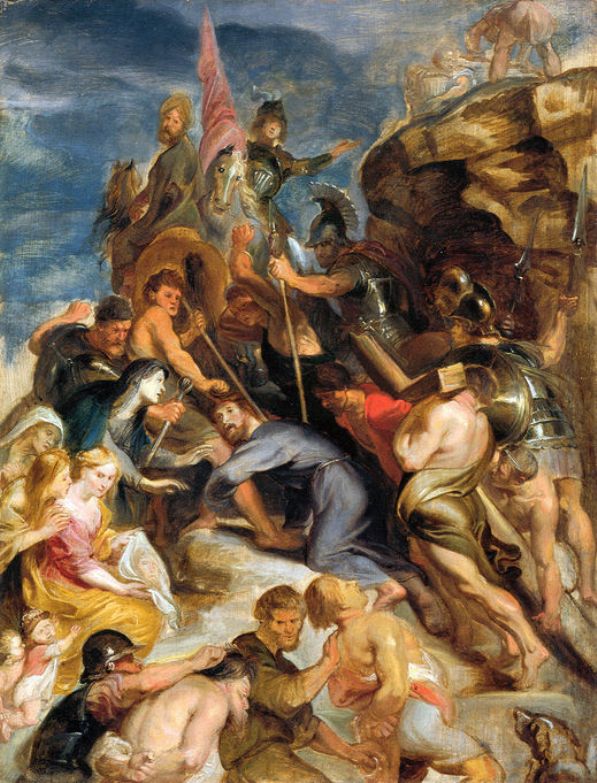
Peter Paul Rubens’ “Carrying the Cross,” painted in 1637, is a compact yet intensely dramatic vision of Christ’s journey to Golgotha. Unlike some of his grand vertical altarpieces, this painting compresses the event into a crowded, almost claustrophobic scene in which soldiers, women, children, and executioners swirl around the stumbling figure of Jesus. The cross dominates the center, angled sharply across the picture plane as Christ strains beneath its weight.
Rubens turns a familiar Gospel episode into a moving study of human emotion: cruelty, indifference, grief, compassion, and resignation all appear within a single, densely populated composition. Painted late in his career, “Carrying the Cross” showcases his mature Baroque style—energetic brushwork, dynamic diagonals, and a powerful interplay between light and shadow.
Narrative Context and Rubens’ Devotional Aim
The subject derives from the Passion narrative in the New Testament, specifically the moment when Christ is forced to carry his own cross through the streets of Jerusalem on the way to his crucifixion. Christian devotion in Rubens’ Catholic Flanders encouraged the faithful to meditate on each step of Christ’s suffering as part of the Stations of the Cross.
Rubens had already addressed this subject in larger works, such as his monumental “Road to Calvary.” In “Carrying the Cross” he condenses the story, focusing on one intense moment when Jesus, pressed by soldiers and surrounded by a turbulent crowd, struggles to advance. The painting is meant not only to tell the biblical story but also to draw the viewer into active contemplation—emotionally identifying with Christ and the other participants.
Composition: Diagonals and Compression
The composition is built on powerful diagonals that suggest movement uphill and forward. The cross itself runs diagonally from lower left toward upper right, its horizontal beam almost colliding with the rocky cliff. Christ’s body follows this line: he bends low, knees buckling, one arm extended to the ground for support.
Opposing diagonals intersect this main line. Soldiers’ spears angle in different directions; bodies twist and turn; the rocky outcrop on the right slants sharply upward. The result is a network of crisscrossing lines that create a sense of instability and pressure. The crowd appears to push and jostle, compressing Christ in the center.
Despite the chaos, Rubens orchestrates the scene carefully. The central area where Christ falls forms a visual anchor. Around it, groups of figures cluster in arcs: women on the lower left, soldiers and riders above, executioners and bystanders to the right and bottom. This circular arrangement creates a vortex, drawing the viewer’s eye toward Jesus and emphasizing that all attention—hostile or compassionate—is focused on him.
The Figure of Christ: Exhaustion and Resolve
Christ is shown mid-fall, his body twisted as he tries to keep the cross from crushing him completely. Unlike some depictions where he lies prone, Rubens catches him in a transitional pose: one knee on the ground, the other bent, arms strained. His head turns slightly toward the left, eyes meeting those of a woman who leans down with a cloth—Veronica.
His face is marked by suffering but not theatrical despair. The expression combines exhaustion, physical pain, and gentle acceptance. A crown of thorns encircles his head; his blue robe and red undergarment echo the traditional colors associated with divinity and sacrifice. Light falls on his face and shoulders, distinguishing him even as he is jostled and nearly hidden within the mass of bodies.
The modeling of Christ’s body underscores both vulnerability and endurance. Muscles are visible beneath the robe, but the weight of the cross overwhelms his strength. Rubens thus emphasizes the paradox of the Passion: the one believed to be omnipotent chooses to submit to human weakness.
Veronica and the Women of Jerusalem
On the lower left, a cluster of women surrounds Christ, adding emotional depth to the scene. Most prominent is Veronica, who stretches forward holding a cloth toward Jesus’ face. Her garments—white veil, dark cloak, and a touch of blue—echo Marian colors, associating her with purity and compassion. Her gesture is urgent yet gentle, hands reaching into the tumult to offer comfort.
Nearby, a woman in a golden dress bends toward the ground with another cloth, perhaps symbolizing additional acts of service or echoing the idea of the veil that will later bear Christ’s image. Behind them stand other women whose faces register grief, fear, or stunned silence. One mother clutches a child, while another young figure leans in with wide-eyed curiosity and distress.
This group represents the “daughters of Jerusalem” mentioned in the Gospel of Luke, whom Christ addresses during his journey. Rubens gives them a tangible presence, showing that Christ’s suffering is not isolated; it is witnessed and felt by those who love him. Their flowing garments and soft flesh provide a visual contrast to the hard armor and rigid weapons of the soldiers.
Soldiers, Executioners, and the Mechanics of Violence
The right side and upper portions of the composition are dominated by armed men and executioners. Rubens paints them with muscular bodies and gleaming armor, emphasizing their physical power. One soldier near Christ pushes the cross with a pole, forcing it forward regardless of Jesus’ collapse. Another grasps a rope, pulling on Christ or the cross to drag the procession onward.
Above, mounted soldiers on horseback oversee the operation. One raises his arm, perhaps shouting orders, while another holds a banner that flutters in the wind. Their faces show determination, boredom, or harsh satisfaction, but rarely pity. These figures embody the machinery of state violence—agents carrying out a sentence with little regard for the victim’s humanity.
Yet Rubens does not caricature them as simple monsters. Some soldiers appear almost hesitant, glancing sideways at the women or at Christ’s suffering. Their polished armor reflects light; they, too, are bathed in the same atmosphere of divine history, whether they recognize it or not. This nuance prevents the painting from becoming a simplistic moral tale and instead underscores the complexity of human participation in injustice.
The Rocky Cliff and the Path to Golgotha
On the upper right, a rocky cliff rises steeply, its jagged forms rendered with vigorous brushstrokes. At the top, small figures prepare the site of crucifixion, hoisting ropes or arranging tools. Their diminutive scale makes the hill seem tall and foreboding. The cliff functions as both a literal obstacle and a symbolic barrier between earthly life and impending death.
The diagonal of the path leads up this cliff, suggesting the route that Christ and the soldiers must still climb. The viewer senses that the current collapse is only one of several; the destination—Golgotha—looms ahead. By including preparations at the summit, Rubens reminds us that the violence is systematic and planned. The journey is not aimless suffering but directed toward a grim endpoint.
The rocky forms also add to the emotional tone. Their harsh, angular shapes contrast with the softness of human flesh, reinforcing the idea that the environment itself becomes hostile in this moment of cosmic drama.
Children and Bystanders: Witnesses to the Passion
In the lower foreground, Rubens introduces a group of children and bystanders. Some cling to their mothers; others are pulled along roughly by soldiers. One child, nearly naked, stretches backward while an adult drags him forward, his small body twisted in distress. Another turns his head to look at Christ with wide eyes.
These children represent innocence confronted with brutality. Their presence underscores the generational impact of violence. They also serve to personalize the biblical story for viewers: the events of the Passion are not remote but unfold in a world where families and children are present.
The bystanders, too, offer a range of reactions. Some appear indifferent, others curious or disturbed. A man in the center foreground looks out toward the viewer with a troubled expression, as if inviting us to consider our own place in the crowd. Rubens uses these figures to open a bridge between the seventeenth-century viewer and the first-century scene.
Light, Color, and Emotional Atmosphere
Light plays a crucial role in structuring the scene. A diffuse, cool illumination brings out the volumes of bodies and the gleam of metal, but there is no strong single source; instead, light seems to pervade the air. The sky is a turbulent mix of clouded blues and grays, suggesting unstable weather and mirroring the spiritual storm.
Christ and the compassionate women receive the brightest highlights. Their garments—Christ’s blue, Veronica’s white and dark blue, the golden dress of the kneeling woman—stand out against the earthy tones. This chromatic emphasis helps the viewer navigate the crowded composition and locate the moral center.
The soldiers’ armor reflects dull silvers and bronzes. Flesh tones across the painting range from rosy pinks to warmer browns, all rendered with Rubens’ characteristic vigor. The interplay of warm and cool tones creates depth and enhances the sense of physical presence, while also conveying the emotional heat of the scene.
Brushwork and the Energy of a Late Rubens
“Carrying the Cross” displays Rubens’ late, more painterly technique. His brushwork is broad and confident, especially in the background sky, the rocky cliff, and the swirling garments. Individual strokes remain visible, giving the painting a sense of immediacy and motion. Figures meld slightly into their surroundings, as if vibrating with energy.
Yet he exercises control where it matters most. The faces of Christ, Veronica, and a few key onlookers are rendered with greater clarity, ensuring that their emotions read distinctly. The complex choreography of bodies is handled with extraordinary skill—every limb, shoulder, and head fits into the crowded space without confusion.
This lively execution reflects the artist’s seasoned mastery. Rubens no longer strives for the polished smoothness of his earlier years; he trusts the viewer’s eye to unify the rapid strokes into forms, much as the tumult of the procession resolves into a coherent narrative upon contemplation.
Theological and Moral Meaning
Beyond its visual brilliance, “Carrying the Cross” carries profound theological meaning. It dramatizes the Christian belief that Christ willingly shoulders the burden of humanity’s sin, even as people around him contribute to his suffering through cruelty, indifference, or cowardice. His fall under the cross symbolizes the crushing weight of this burden.
At the same time, the presence of Veronica and the weeping women affirms that compassion and faith persist even amid violence. Their gestures show that small acts of mercy—offering a cloth, expressing grief—participate in the sacred drama and are not forgotten. The contrast between those who help and those who harm invites viewers to examine their own choices in the face of suffering.
The painting also touches on the theme of following Christ. Many devotional texts of the time urged believers to “take up their cross” in imitation of Jesus. By depicting the crowd physically following behind him up the hill, Rubens offers a visual metaphor for this spiritual path—though with the warning that mere proximity is not enough; true discipleship requires compassion, not mere attendance.
Relationship to “The Road to Calvary”
Comparing “Carrying the Cross” with Rubens’ larger “Road to Calvary” sheds light on his artistic intentions. Both works depict the same episode, with similar motifs: the central fall, Veronica’s gesture, mounted soldiers, and a tumultuous crowd. However, “Carrying the Cross” is more compressed and immediate. The verticality of the larger altarpiece is replaced by a more compact format that almost overwhelms the frame with bodies.
Where “The Road to Calvary” spreads the procession out and emphasizes its monumental, almost pageant-like character, “Carrying the Cross” feels closer, more chaotic, and more bodily. This intimacy may have suited a smaller devotional setting, encouraging viewers to engage with the Passion on a personal level. Together, the two paintings demonstrate Rubens’ versatility in adapting the same subject to different scales and spiritual emphases.
Contemporary Resonance and Lasting Impact
For modern viewers, “Carrying the Cross” remains deeply resonant. Its crowded composition and depiction of a persecuted figure surrounded by military force evoke contemporary scenes of oppression, forced marches, and public humiliation. The painting challenges us to ask where we stand in similar situations: with the indifferent, the cruel, or the compassionate.
Its portrayal of diverse reactions—soldiers, mothers, children, bystanders—also speaks to the complexity of human behavior in times of crisis. Rubens shows that even within a single event, people respond in many ways, from active participation in injustice to courageous empathy.
Art historically, the work exemplifies the heights of Baroque religious painting. Its dynamic composition, emotional range, and painterly energy influenced generations of artists and continue to be studied as models of narrative power in visual art.
Conclusion
“Carrying the Cross” is a powerful synthesis of Peter Paul Rubens’ mature artistry and his deep engagement with the Passion narrative. In a relatively small format, he orchestrates a dense crowd of figures around the falling Christ, using sweeping diagonals, vivid color, and expressive gestures to convey the physical and spiritual weight of the moment.
The painting invites viewers to enter the scene emotionally—to feel the crush of the crowd, the strain of the cross, the sting of soldiers’ blows, and the compassion of Veronica and the women of Jerusalem. It is both a historical visualization of a biblical event and a timeless reflection on suffering, responsibility, and the possibility of mercy. Through this intense Baroque drama, Rubens continues to speak across centuries, urging each viewer to consider how they respond when confronted with another’s burden.