Image source: wikiart.org
Historical Moment And Why “Carmelina” Matters
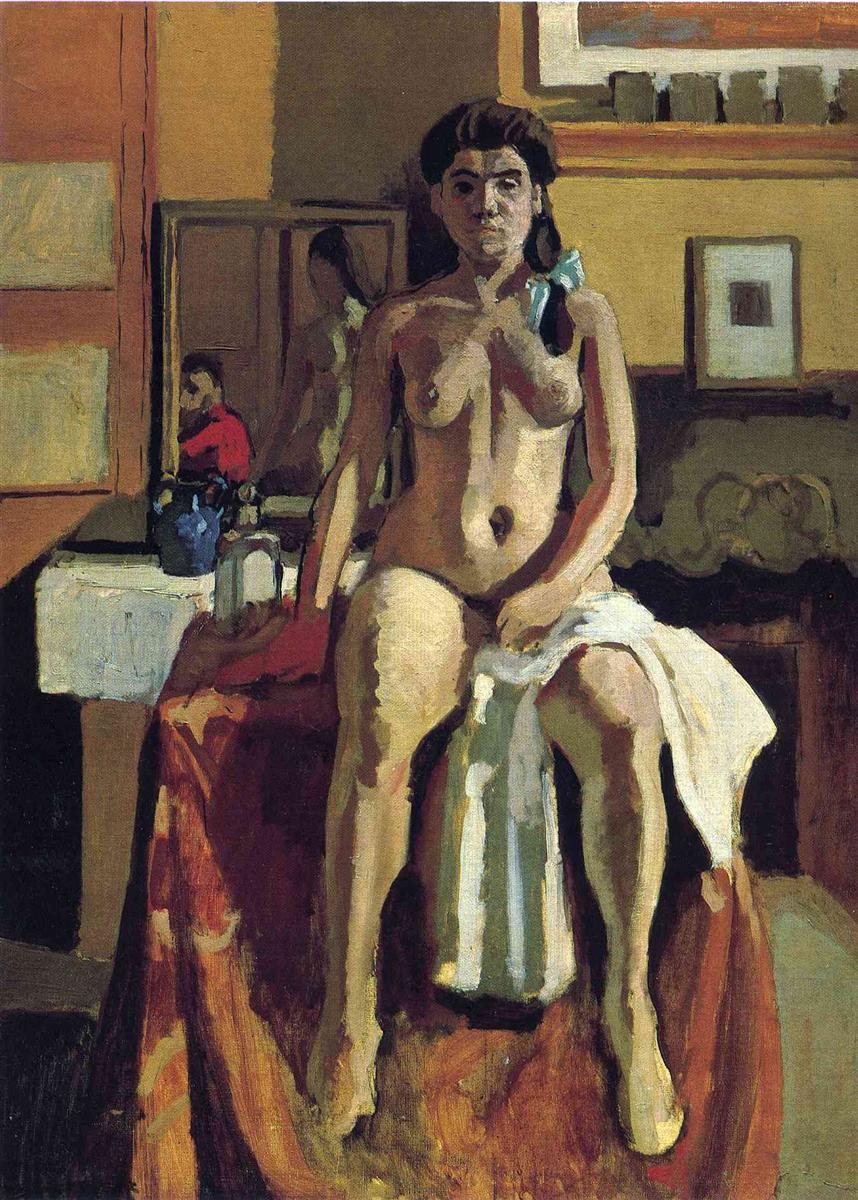
Henri Matisse painted “Carmelina” in 1903, a transitional year when he was moving from tonal, studio-based naturalism toward the simplified planes and bold color harmonies that would soon define Fauvism. The subject is a studio nude—the most traditional of academic exercises—yet Matisse turns it into a meditation on looking, representation, and the modern painter’s working space. With a mirror that folds the room back on itself, a deliberate network of rectangles and frames, and a model who meets the viewer’s gaze with poised self-possession, “Carmelina” is both an homage to classical precedent and a quiet manifesto for the new century.
First Impressions: A Self-Contained Theater Of Seeing
At first glance, the painting reads like a compact stage. A nude model sits frontally on a cloth-draped pedestal, one hand supporting the body, the other gathering a white towel that spills down between her knees. Behind her, a mirror reflects the studio: bottles, a blue vessel, a second view of the model in profile, and the small, surprising presence of the artist himself in a red shirt. The room is warm—ochres, raw siennas, olive grays—and the figure is shaped by broad, unblended planes. Nothing feels fussy. Even with its detail, the scene is built of large, clear relationships you can grasp at once.
Composition: A Pyramid In A Grid
Matisse stabilizes the picture with a classical pyramidal arrangement. The pedestal and drapery form the base; the knees flare outward; the torso rises to the head at the apex. Around that stable triangle he builds a grid of rectangles—the cupboard doors, the mirror, framed artworks, wall panels, the squared basin at left. Those rectilinear elements do not compete with the figure; they activate the negative space and hold the composition like a scaffolding. The frontal pose engages the viewer directly, but the mirror’s oblique view and the slight twist of the shoulders keep the pyramid from freezing into stasis.
The Mirror And The Triangular Gaze
The most radical device in “Carmelina” is the mirror. It introduces a second and third viewpoint at once: the profile of the model and the painter watching the scene he paints. This triangular gaze—model, artist, viewer—creates a subtle drama about who is looking at whom. The model’s direct frontality invites us in; the mirror reminds us we are also being watched, not just by the painter in red but by painting itself as an apparatus. The set-up nods to old-master reflexivity (think Velázquez’s “Las Meninas” or Manet’s mirrors), yet Matisse uses it to modern ends: it makes the painted surface honest about its own making.
Light And Atmosphere: Studio Glow Instead Of Spotlight
Light in “Carmelina” is steady, suffused, and interior. Rather than a single beam, the figure is modeled by a climate—a soft, warm illumination that allows color to carry volume. Shadows are warm olive or violet-gray rather than black; highlights are creamy, never chalk white. The towel and the blue vessel near the sink are the brightest notes, and they function like musical accents, clarifying the rhythm of the picture without breaking its calm.
Color Architecture: Earths, Creams, And Measured Blues
The chromatic structure is deliberately restrained. Earth colors—ochre, burnt sienna, umber—dominate the room and supply the complexion’s middle notes. Cool relief comes from blue-gray in the mirror glass, the cool white of the towel, and the cobalt-leaning blue of the jar at left. By restricting the palette, Matisse intensifies temperature contrasts. Warm flesh against cooler room, creamy towel against browned drapery, red shirt in the mirror against olive surroundings—each relation reads with authority. The result is a harmony that feels classical and modern at once.
Drawing By Planes And Selective Contour
Matisse’s drawing is not an outline filled in; it is a construction of planes. Large, simplified shapes—breast, ribcage, thigh, calf—are established with broad strokes, their edges negotiated where one color meets another. At key junctures he reinforces the form with a darker seam: the contour of the left thigh, the shadow running under the right breast, the jawline, the knuckles of the supporting hand. These firm accents resemble the cloisonné edges he admired in Gauguin and the Nabis, but they are never decorative flourishes; they are structural stitches that hold the masses together.
Flesh As Architecture, Not Ornament
The body is frank and un-idealized. The stomach softens; the knees bear weight; the clavicles present themselves as clear planes. Matisse is not chasing the glossy polish of academic marble nor the dematerialized shimmer of Impressionism. He builds the figure like architecture, with load-bearing planes of warm and cool. The few pinker notes—in the face and nipples—are never sugary. This measured approach grants the model gravity and presence. She is not a fantasy odalisque; she is a person in a working room.
Drapery, Pedestal, And The Role Of Objects
The drape under the model is not mere backdrop. Painted in rich, rusty reds with ochre lights, it forms a visual counterweight to the skin. Its folds echo the arc of thighs and the vertical drop of the towel, creating a woven pattern that ties figure to base. Studio objects—the blue jar, the bottles, the glimpsed sink—supply a humble still life that anchors the left perimeter and, via reflection, opens the space backward. Their small, saturated blues and whites act as cool punctuation in a warm paragraph.
Space: Shallow Depth, Real Presence
Depth in “Carmelina” is shallow but convincing. Overlaps produce a series of planes: pedestal before figure, figure before mirror, mirror before the back wall. The mirror complicates depth without multiplying perspectives into confusion. The floor is scarcely described; the upper wall is a stack of rectangles. This economy maintains the modern emphasis on surface while giving the body undeniable occupation of space. You feel the model’s weight on the platform and the air around her shoulders.
Brushwork And Materiality: A Studio Language
Matisse’s brush speaks different dialects across the canvas. On skin, paint is laid in supple, long strokes that turn with form; on drapery it becomes broader and more calligraphic; on walls and frames it is flatter, more declarative. The mirror is handled with thin, quick scumbles so it reads as reflective yet remains part of the same painted world. Nowhere does he hide the act of painting. The evident weave of the canvas and the decisiveness of the strokes acknowledge the material fact of the picture, reinforcing its modernity.
Influences: Old Masters Filtered Through Modern Eyes
“Carmelina” listens to a number of predecessors without echoing any one of them. Manet’s frank nudes and studio reflections are present in the painting’s directness and self-awareness. Courbet’s robust flesh enters in the weighty modeling of thighs and abdomen. A Cézannesque simplification of volumes surfaces in the way chest and limbs are built from interlocking planes. Even Degas’s rehearsal rooms whisper in the measured, workaday atmosphere. Yet Matisse’s temperament—the calming architecture of color, the equality of figure and decorative field—makes the work unmistakably his.
The Politics Of Looking: Agency In The Studio
Carmelina’s steady gaze is crucial. Neither coy nor confrontational, it reads as a negotiation between artist and model—collegial, professional, alert. The towel grasped between her legs registers modesty and agency at once, and the upright spine refuses languor. Meanwhile, the tiny painter in red inside the mirror quietly complicates the transaction: he acknowledges his presence and implicates himself in the act of looking. The painting thus becomes not only a depiction of a nude but also a reflection on the ethics and theatre of the studio.
From “Carmelina” To The Odalisques
This canvas anticipates later developments in Matisse’s career. The frontal nude in a richly patterned room foreshadows the odalisques of the 1920s, where color and decoration engulf the figure in a harmonic whole. But the seed is already here: the model embedded within a constructed environment of rectangles and fabrics; the enigma of a mirror that opens the space and repositions the viewer; the insistence that color relationships can be as expressive as anatomy.
A Painter’s Palette: Likely Pigments, Purposefully Limited
While only technical analysis can be definitive, the harmony suggests a pragmatic kit of earths and a few strong cools. Lead white carries the lights; yellow ochre and raw sienna supply wall warmth and flesh undertones; burnt umber and umber-violet mix into shadows; cobalt or ultramarine cools the mirror glass and corrections; touches of viridian or terre verte temper the warmer notes. The red seen in the reflection would plausibly be vermilion or cadmium red, a small but potent accent. The restraint of this palette is not a limitation; it is how the atmosphere stays coherent.
How To Look Slowly: A Brief Viewing Method
Begin with the big forms: triangle of the figure on a red pedestal nested within a grid of wall rectangles. Let your eye then find the three whites—the towel, the sink, and the collar of the painter in the mirror—which triangulate the room’s light. Move closer to watch edges resolve by contact: warm thigh against cooler drapery, hair mass against wall, elbow against mirror frame. Step further back to feel the calm air of the whole. The longer you toggle between near and far, the more the painting’s balance—between intimacy and structure, disclosure and reserve—declares itself.
Why “Carmelina” Endures
“Carmelina” endures because it is many paintings at once without dilution. It is a serious study of the nude, a still life of studio implements, a self-portrait by way of reflection, and a measured experiment in modern composition. It respects the long tradition of the figure in the studio while opening that tradition to new spatial and chromatic thinking. Most of all, it gives the viewer a rare combination of frankness and quiet: a human presence rendered with dignity inside a room that seems to think about itself.